

Artificial intelligence appears to have many ingredients that could produce powerful monopolies.
Training frontier models requires enormous amounts of capital, computing infrastructure, specialized chips, electricity, data, and engineering talent. Big technology companies also enter the AI race with huge existing user bases, established cloud platforms, and powerful distribution networks.
At first glance, the conclusion seems obvious: AI should favor the largest companies.
But investors need to separate four very different ideas:
Market share → competitive moat → pricing power → excess returns
A company can lead an AI market without possessing all four.
For investors, the more useful question is not whether one company can monopolize all of AI, but which layers of the AI stack can sustain market power, pricing power, and excess returns.
That distinction changes the analysis. Instead of trying to predict which company will “win AI,” investors can examine where durable competitive advantages actually exist—and how easily competitors can attack them.
An AI monopoly may be difficult to sustain at one layer even while monopoly-like economics emerge elsewhere in the AI value chain.
Market Leadership Is Not the Same as an AI Monopoly
Imagine that Company A develops the world’s best AI model.
Customers flock to it. Revenue grows rapidly. Competitors fall behind.
That looks like a strong moat.
Now imagine that 12 months later, several competing models deliver similar performance. Developers can switch between them through APIs, inference prices decline, and businesses increasingly route different workloads to different models.
Company A may still have an excellent product.
But its original technological advantage has become less valuable economically.
For investors, this is the difference between innovation advantage and durable market power.
A durable moat should make it difficult or uneconomic for competitors or customers to neutralize the advantage.
A useful distinction is:
Technological lead + weak switching costs = potentially temporary advantage
while
Structural advantage + high switching costs + pricing power = potentially durable moat
Different layers of AI can therefore produce very different competitive outcomes.
1. Model Moat: Can the Best AI Model Stay the Best?
The most visible AI monopoly debate centers on foundation models.
It may not be where the strongest long-term moat exists.
Stanford’s 2026 AI Index shows how quickly frontier competition can change. U.S. and Chinese models traded places at the top of performance rankings multiple times beginning in early 2025, and the gap between their leading models remained in the single digits as of March 2026.
That does not mean leading models are economically identical. Reliability, reasoning, latency, multimodal capabilities, enterprise integration, safety, and cost can all differ.
But rapid competitive movement creates a challenge for an AI monopoly based primarily on model quality.
If competitors can repeatedly approach or overtake frontier performance, being number one today may not guarantee a durable advantage.
The economics reinforce this challenge.
AI inference has also become dramatically cheaper over time. Stanford’s 2025 AI Index estimated that the cost of querying a model performing around the GPT-3.5 level on MMLU fell from $20 per million tokens in November 2022 to $0.07 by October 2024.
Lower costs can accelerate AI adoption. But rapidly falling prices can also make it harder for model providers to defend unusually high margins unless they maintain meaningful differentiation.
This creates an important contradiction:
Training frontier AI can require enormous resources, while the economic value of a specific model advantage can depreciate quickly.
A company can spend billions building a technological lead only to see competitors narrow the performance gap while inference becomes cheaper.
What to watch: Do customers continue paying a meaningful premium for one model, or does model selection increasingly depend on price, latency, reliability, and workload?
If customers can easily substitute one capable model for another, model leadership may be a weaker moat than benchmark rankings suggest.
2. Compute Moat: Scarcity May Matter More Than Intelligence
If models become more competitive, a stronger moat may exist one layer down.
AI cannot run without compute.
Frontier models depend on specialized chips, high-performance networking, data centers, electricity, cooling systems, and cloud infrastructure. These assets require substantial capital and can take years to expand.
OECD analysis of AI infrastructure identifies structurally concentrated parts of this supply chain, particularly specialized chips and cloud computing.
A model can potentially be replicated or surpassed through innovation. A large-scale computing ecosystem cannot necessarily be replicated quickly.
Consider what a new competitor would need to reproduce a hyperscale AI infrastructure platform:
- access to advanced accelerators,
- large-scale data-center capacity,
- reliable electricity,
- high-speed networking,
- specialized engineering expertise,
- enormous amounts of capital,
- and enough customer demand to utilize the infrastructure efficiently.
The final condition is crucial.
Building infrastructure is not enough. A company needs sufficient demand to spread those costs across paying workloads.
That is where economies of scale can become economically meaningful.
Microsoft’s fiscal 2026 fourth-quarter commentary provides an example. The company said Azure demand continued to exceed available capacity and that additional capacity brought online during the quarter was quickly monetized. Microsoft also reported substantial throughput improvements for Copilot workloads through infrastructure optimization.
This suggests that infrastructure advantage is not simply about owning more GPUs.
A more useful relationship is:
Compute moat = access to capacity + infrastructure efficiency + utilization + customer demand
A company with enormous capacity but weak utilization can destroy capital.
A company that combines scarce infrastructure with high utilization and strong monetization can potentially create a much stronger economic moat.
What to watch: Does infrastructure scale produce lower unit costs, greater throughput, and high utilization, or merely larger capital expenditures?
3. Data Moat: More Data Is Not Automatically Better
Data is frequently described as one of AI’s strongest competitive advantages.
That statement is too broad to be useful for investors.
The relevant question is not whether a company possesses large amounts of data.
It is whether competitors cannot economically reproduce that data and whether the data measurably improves the product.
Publicly available internet data may be valuable for model training, but access to broadly available information does not necessarily create a durable company-specific moat.
Proprietary data can be different.
Consider a hypothetical enterprise AI system that becomes more useful as it processes:
- company-specific workflows,
- customer interactions,
- specialized industrial data,
- internal documents,
- and repeated user feedback.
If that information improves the product and cannot easily be transferred to a competitor, the system may create a reinforcing loop:
More customers → more proprietary usage data → better product → more customers
But investors should be careful with the phrase “data network effect.”
More data creates a stronger moat only when additional data produces meaningful incremental improvement.
If another million similar interactions add little to product performance, the economic value of that additional data may be much smaller than expected.
Privacy rules, data ownership, interoperability, and customer restrictions can further limit how information is used.
What to watch: Is the data proprietary, difficult to reproduce, legally usable, and demonstrably valuable for improving the product?
If one of those conditions fails, the data moat may be weaker than it appears.
4. Distribution Moat: The Strongest AI Company May Not Build the Best Model
Distribution may be one of the most underestimated parts of the AI monopoly debate.
A company does not necessarily need the best model if it already controls where customers encounter AI.
Large technology platforms can distribute AI through existing:
- operating systems,
- productivity software,
- cloud platforms,
- search engines,
- advertising systems,
- developer ecosystems,
- browsers,
- smartphones,
- and enterprise relationships.
That matters because customer acquisition is not free.
A standalone AI company may need to attract users one at a time. An incumbent platform can potentially introduce an AI feature directly into software customers already use.
This produces an important investment insight:
The economic winner from AI does not necessarily have to be the company with the highest benchmark score.
It may instead be a company capable of distributing sufficiently good AI at a structurally lower incremental customer-acquisition cost.
However, not every distribution advantage is equally durable.
Distribution based on genuine ecosystem value and customer preference is economically different from an advantage that depends heavily on defaults, exclusivity, or restrictive bundling. The latter can be more exposed to competitive and regulatory challenges.
The U.S. Google search monopolization case illustrates this risk. In 2025, court-ordered remedies restricted certain exclusive distribution agreements involving Google Search, Chrome, Google Assistant, and the Gemini app, including arrangements that could prevent partners from simultaneously distributing competing GenAI products.
What to watch: Can the company distribute AI more efficiently because customers genuinely value its ecosystem, or does the advantage depend heavily on mechanisms that competitors or regulators can disrupt?
5. Switching-Cost Moat: The Most Important Test May Come After Adoption
Winning customers is only half of a moat.
The harder question is whether customers can leave.
Imagine two enterprise AI platforms.
Platform A offers an excellent model, but customers can export their data, replace the API, and migrate to another provider relatively easily.
Platform B becomes embedded in internal workflows, security systems, proprietary data pipelines, developer tools, employee processes, and compliance infrastructure.
Even if Platform A has the technically superior model, Platform B may have the stronger economic moat.
Switching is no longer a simple model comparison.
Customers must consider migration costs, employee retraining, rewritten integrations, data transfers, security reviews, downtime, and operational risk.
This distinction becomes increasingly important if frontier model performance converges.
When several models become “good enough,” competitive advantage can migrate away from the intelligence layer and toward the surrounding system.
The FTC has examined similar concerns in major cloud and AI partnerships, including whether contractual or technical arrangements could raise switching costs or make multi-provider strategies more difficult.
For investors, the distinction is important.
Healthy switching costs can emerge because a product becomes deeply useful and integrated into customer workflows.
Artificial switching costs can depend more heavily on restrictive arrangements or limited interoperability.
They may initially produce similar customer retention, but their durability can be very different.
What to watch: If a competitor offered comparable AI capabilities at a substantially lower price tomorrow, how expensive, disruptive, and time-consuming would it be for customers to switch?
That question can reveal more about an economic moat than another benchmark leaderboard.
The AI Stack May Produce Several Moats Instead of One Monopoly
The biggest mistake in analyzing an AI monopoly may be treating AI as a single market.
It is better understood as a stack.

| AI Layer | Potential Source of Moat | What Could Weaken It |
|---|---|---|
| Chips & Compute | Scale, scarcity, specialized technology, capital intensity | Alternative architectures, supply expansion, custom chips |
| Cloud Infrastructure | Scale efficiency, utilization, ecosystem, customer integration | Multi-cloud adoption, interoperability, regulatory scrutiny |
| Foundation Models | Performance, brand, research capability | Rapid imitation, falling inference prices, performance convergence |
| Proprietary Data | Unique information, feedback loops, domain-specific usage | Diminishing returns, portability, privacy and usage restrictions |
| Applications | Workflow integration, specialization, user experience | Easy substitution, weak differentiation, low switching costs |
| Distribution | Installed base, customer relationships, ecosystem reach | Open standards, multi-homing, competitive or regulatory intervention |
This framework leads to a different conclusion from the conventional “winner takes all” AI narrative:
AI may create monopoly-like infrastructure economics without creating a monopoly in AI models.
Here, “monopoly-like” refers to economic characteristics such as high fixed costs, scale advantages, scarcity, and barriers to entry—not a legal finding that these markets are monopolies.
Foundation models can remain highly competitive while cloud infrastructure, chips, distribution, or specialized applications develop stronger structural barriers.
The next question is therefore not simply where a moat exists, but where the bottleneck moves.
The Bottleneck Migration Test
A useful way to analyze AI monopoly potential is to follow the scarce resource through the value chain.
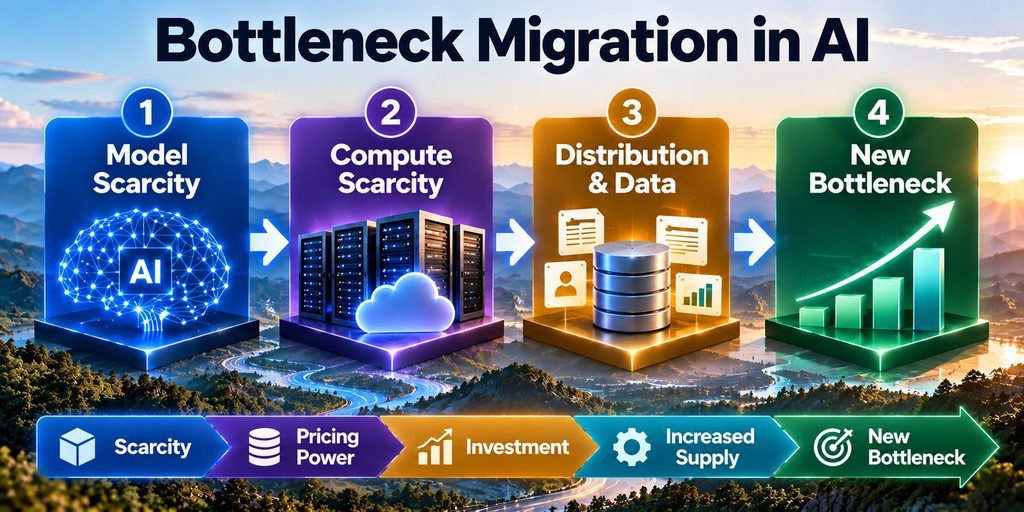
Suppose advanced models are initially scarce. Leading model developers may capture substantial value.
Then competing models improve. Model capability becomes less scarce, but compute remains constrained. Economic value may migrate toward infrastructure.
Later, additional chips and data centers expand compute supply. Distribution, proprietary data, or customer workflows may then become harder to replicate.
The process can be summarized as:
Scarcity → pricing power → investment → increased supply → new bottleneck
This is why today’s most profitable layer does not automatically remain tomorrow’s most profitable layer.
For investors, the better question is not simply:
Who controls the bottleneck today?
It is:
How expensive and how long will it take competitors to remove that bottleneck?
This distinction also matters for valuation.
A temporary shortage that competitors can eliminate through aggressive capital spending should not necessarily receive the same valuation premium as a proprietary workflow, network, or data advantage that becomes harder to reproduce as the business grows.
A 5-Test Framework for Evaluating an AI Moat
Investors do not need to predict which AI model will rank first several years from now.
Instead, they can test whether a company’s advantage is becoming economically harder to attack.
| Layer Test | Core Question for Investors | Warning Sign |
|---|---|---|
| 1. Model Differentiation | Will customers continue paying a meaningful premium for this model? | Performance converges while prices fall |
| 2. Compute Advantage | Does infrastructure investment produce lower unit costs, higher throughput, and strong utilization? | CAPEX rises much faster than monetization |
| 3. Data Advantage | Does proprietary data measurably improve the product or customer outcome? | Data is reproducible or produces diminishing incremental value |
| 4. Distribution Advantage | Can the company reach and monetize AI users at a structurally lower acquisition cost? | The advantage depends heavily on vulnerable defaults or exclusivity |
| 5. Switching Costs | How expensive, disruptive, and time-consuming is it for customers to leave? | Workloads and data can move to competing providers with little friction |
No single test proves the existence of a moat.
The strongest businesses may combine several. Infrastructure scale can reduce costs, distribution can bring customers onto the platform, customer usage can generate proprietary data, and workflow integration can increase switching costs.
Together, those advantages can create a reinforcing system.
Scale alone does not prove defensibility.
When a Strong AI Moat Can Weaken
Strong economic returns often create the forces that eventually weaken them.
High margins attract competitors, expensive products encourage cheaper alternatives, and closed ecosystems create demand for interoperability.
This creates an important distinction between two types of advantage.
A self-reinforcing advantage becomes harder to attack as the business grows. Proprietary workflows or valuable network effects can sometimes behave this way.
A self-correcting advantage encourages competition and investment that gradually reduce the original scarcity.
Both can produce strong profits today.
They should not necessarily receive the same long-term valuation.
The Bottom Line
An AI monopoly may emerge in individual parts of the value chain, but investors should be careful about assuming that technological leadership automatically creates durable economic dominance.
The key distinctions are:
technological leadership ≠ economic defensibility
scarcity ≠ permanent competitive advantage
market share ≠ pricing power and excess returns
For long-term investors, the central question is therefore not simply which company has the best AI.
It is:
Which company controls an advantage that competitors cannot cheaply reproduce and customers cannot easily bypass—and how long can that advantage survive?
That is the difference between leading an AI market today and owning a durable economic moat.
FAQ
Q1. Could open-source AI weaken the economics of proprietary AI models?
Yes. Capable open-source or open-weight models can give customers more alternatives and make an AI monopoly at the model layer harder to sustain. However, businesses must still consider infrastructure, reliability, security, support, and operating costs—not just the price of the model.
Q2. Could smaller AI companies still compete against hyperscalers?
Yes, especially in specialized markets. Smaller companies can build defensibility around proprietary data, industry-specific workflows, or products that solve narrow customer problems better than general-purpose platforms. The key test is how easily larger competitors can reproduce that advantage.
Q3. What financial metrics can show whether an AI moat is creating real value?
Look for evidence that competitive advantages are translating into pricing power, customer retention, improving unit economics, operating leverage, and eventually free cash flow. For infrastructure-heavy AI businesses, investors should also compare revenue growth with the capital spending required to sustain it.
This article is for educational purposes only and does not constitute personalized investment advice. Competitive conditions, technology, regulation, and company economics can change rapidly. Investors should review current company filings and primary sources before making investment decisions.
📚 Related Articles
AI Power Bottleneck: Will Electricity Matter More Than GPUs?
How Long Can AI Data Center Investment Keep Growing? 5 Signals Beyond CAPEX
Can Big Tech Maintain Its Profit Margins in the AI Era?

High Interest Rates and the Economy: Why Can Growth Stay Strong?
If high interest rates are supposed to slow the economy, why can consumers keep spending,…

Can Big Tech Maintain Its Profit Margins in the AI Era?
Artificial intelligence is creating new revenue opportunities for Big Tech, but it is also changing…

Free Cash Flow vs Earnings: Why Profits Can Rise While Cash Flow Falls
A company reports higher earnings. Revenue is growing, margins look healthy, and net income reaches…