

How much cash in your investment portfolio should you keep?
It sounds like a question that should have a percentage answer: 5%, 10%, maybe 20%. But starting with a percentage can lead you in the wrong direction.
A better question is: What is this cash supposed to do?
Cash for an emergency is different from cash for a home purchase next year. Cash reserved for portfolio rebalancing is different from money sitting on the sidelines because the stock market feels expensive.
The percentage matters less than the purpose behind it.
Once you define that purpose, deciding how much cash to hold becomes much easier.
What Counts as Cash in an Investment Portfolio?
Portfolio cash can include more than money sitting in a checking account.
Depending on how you manage your finances, it may include:
- uninvested brokerage cash;
- savings or money market deposit accounts;
- money market funds;
- certificates of deposit;
- short-term Treasury bills.
These options are not interchangeable. Liquidity, yield, insurance protection, maturity, and access can differ.
Investor.gov, the SEC’s investor education website, explains asset allocation as dividing investments among categories such as stocks, bonds, and cash.
That is a more useful starting point than copying another investor’s preferred cash percentage.
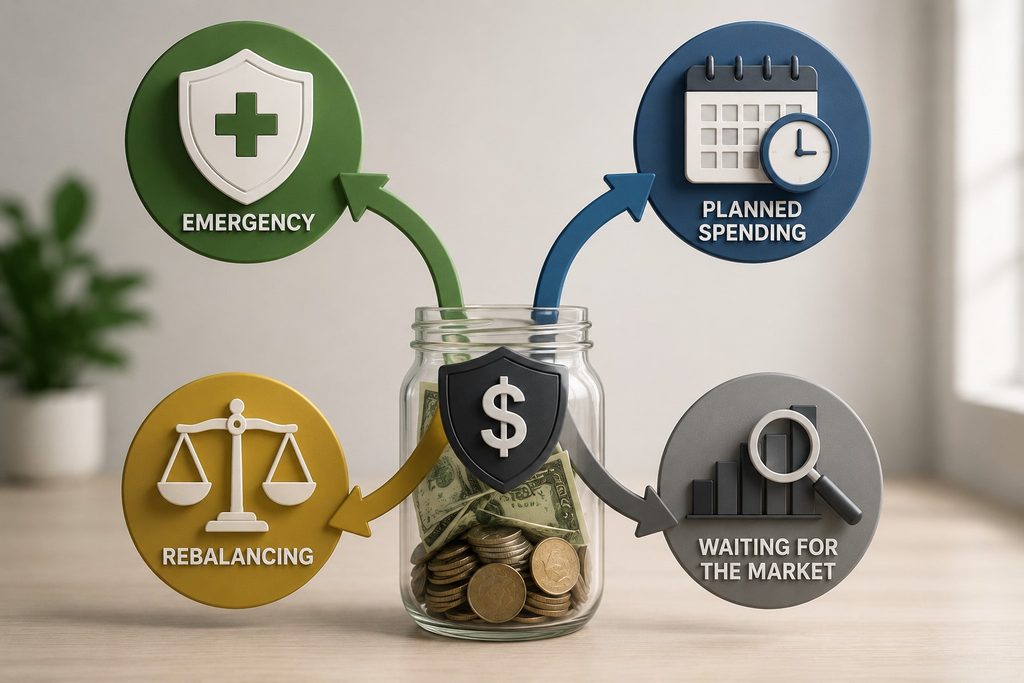
Four Jobs for Cash in an Investment Portfolio
A practical way to think about cash in your investment portfolio is to divide it according to its job.
| Type of Cash | What It Is For | Question to Ask |
|---|---|---|
| Emergency cash | Unexpected expenses or income disruption | Could I handle an emergency without selling investments? |
| Planned-spending cash | Money you expect to need relatively soon | When will I actually need this money? |
| Portfolio cash | Liquidity and rebalancing | What role does this cash play in my asset allocation? |
| Market-timing cash | Money waiting for a “better” market | Do I have a plan, or am I simply waiting because I feel uncertain? |
The first three can have clear financial purposes.
The fourth deserves more scrutiny.
Two investors might both hold 20% cash. One plans to buy a home next year. The other has no upcoming expense but is waiting for the stock market to crash.
The percentage is identical. The reasoning is completely different.
1. Separate Emergency Cash First
Before judging whether you have too much or too little cash in your investment portfolio, identify the money that cannot realistically be treated as long-term investment capital.
FINRA notes that emergency savings can help cover unexpected expenses or income disruption without requiring an investor to take on substantial debt or liquidate investments. A commonly discussed starting framework is roughly three to six months of living expenses, although individual circumstances vary.
The important point is not finding one perfect emergency-fund number. It is separating two different jobs.
Suppose someone says:
“I have 15% of my portfolio in cash.”
That number alone tells us very little.
If the 15% is also the person’s entire emergency reserve, it serves a different purpose from a 15% cash position held by someone who already has emergency savings outside the investment portfolio.
2. Match Cash to When You Will Need the Money
Time horizon can change the answer dramatically.
Consider a hypothetical investor with a $100,000 portfolio who expects to need $20,000 for a major expense within the next year.
Leaving the entire $100,000 exposed to volatile stocks creates timing risk.
The market might be higher when the $20,000 is needed. It could also be substantially lower. If the expense cannot be postponed, the investor may have to sell regardless of market conditions.
That is not primarily a stock-picking problem. It is a mismatch between investment risk and spending timing.
Investor.gov similarly explains that investors with longer time horizons may be able to tolerate greater volatility, while shorter horizons can call for less risk.
When evaluating cash in your investment portfolio, ask:
When does this money need to become spendable?
Money needed next year should not automatically be managed like money intended for retirement decades from now.
3. Cash Can Make Rebalancing Easier
Cash can provide flexibility when markets move sharply.
Consider this hypothetical portfolio:
| Asset | Amount | Portfolio Weight |
|---|---|---|
| Stocks | $70,000 | 70% |
| Bonds | $20,000 | 20% |
| Cash | $10,000 | 10% |
| Total | $100,000 | 100% |
Suppose stocks fall substantially while bonds and cash remain relatively stable.
The original 70/20/10 allocation changes. An investor following a predetermined asset-allocation plan may then use some cash to rebalance toward the target.
There is an important distinction here.
“Stocks have fallen enough, so they must recover now” is a market prediction.
“My portfolio has moved outside its target allocation, so I am rebalancing according to my plan” is a process.
The second approach does not require identifying the exact market bottom.
For someone building an allocation for the first time, understanding how to build a stock portfolio can therefore be more useful than concentrating on individual stock picks.
This is one reason cash in your investment portfolio can be useful even when it is not expected to produce the highest long-term return.
4. Cash Can Help Emotionally—Until It Becomes Market Timing
Cash can provide more than liquidity. It can also reduce psychological pressure.
When nearly every available investment dollar is already in the market, a sharp decline can create a feeling that there is no flexibility left. That pressure can encourage investors to sell, change strategies, or make large portfolio adjustments simply to regain a sense of control.
A reasonable cash buffer can make it easier to stick with a plan.
But cash can create the opposite behavioral problem as well.
Imagine an investor reduces stock exposure because the market looks risky. Stocks fall further, so the investor waits. Then the market starts recovering, but buying feels uncomfortable because prices have already risen.
The investor continues waiting for another decline.
Eventually, “I’ll buy when prices are lower” becomes “I’ll buy when I feel certain.”
Markets rarely provide that certainty.
This is why the reason for holding cash matters so much.
Cash with a defined job is portfolio planning. Cash with no defined job can easily become market timing.
If the goal is simply to invest new money gradually rather than predict the perfect entry point, a predetermined strategy such as dollar cost averaging can provide more structure.
The Hidden Cost of Holding Too Much Cash
Holding too much cash in your investment portfolio can reduce volatility, but that stability is not free.
One potential cost is inflation. Another is opportunity cost—the return you may give up by not investing the money elsewhere.
Consider two hypothetical investors with $100,000 intended for a long-term goal.
Investor A: $90,000 invested and $10,000 in cash.
Investor B: $50,000 invested and $50,000 in cash.
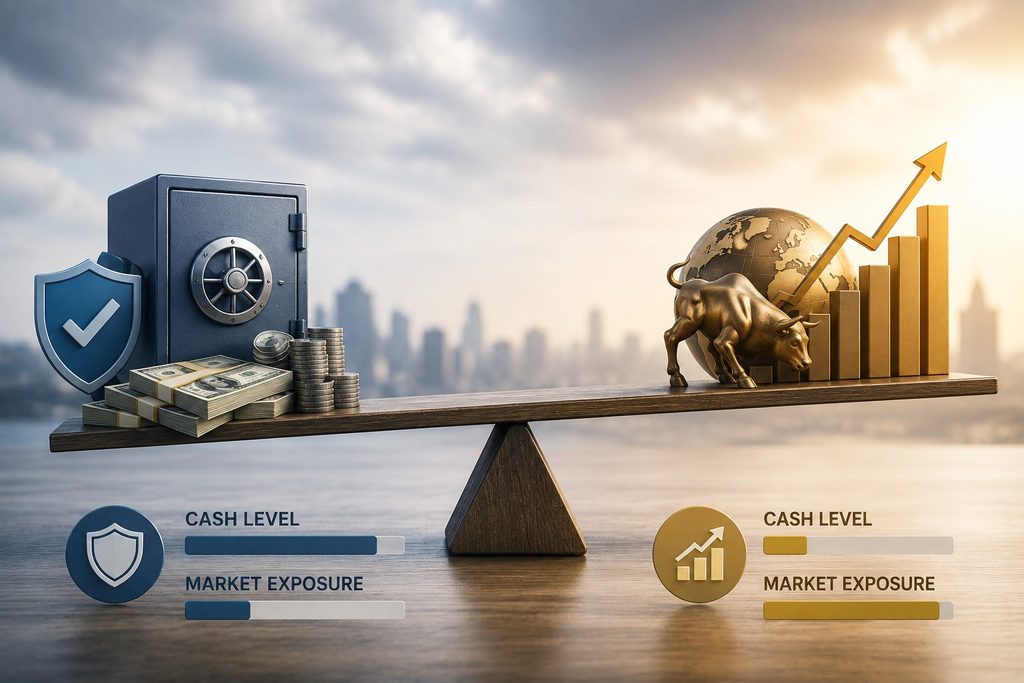
Investor B may experience less short-term volatility.
But suppose the reason for holding $50,000 is simply that stocks seem expensive and the investor is waiting for a major correction.
What happens if stocks continue rising before that correction arrives?
Even if the market eventually declines, prices could still remain above the level where the investor originally decided to wait.
That does not make a 50% cash allocation automatically wrong. Someone expecting a large near-term withdrawal could have a perfectly reasonable reason for holding that amount.
The distinction is straightforward:
“I need this money within 18 months” is a planning decision.
“The market must crash soon” is a forecast.
How Much Cash in Your Investment Portfolio Is Reasonable?
There is no universal percentage.
A better approach is to answer four questions.
Do You Already Have Emergency Savings?
If your investment account is also your only source of emergency liquidity, account for that before deciding how much cash is genuinely available for investing.
When Will You Need the Money?
Money for a known near-term expense has a different capacity for risk than money with a 20-year investment horizon.
How Much Volatility Can You Actually Tolerate?
Risk tolerance is not just a number on a questionnaire.
Consider what you would realistically do if the stock portion of your portfolio fell 30%. Would you stay with the plan, rebalance, continue contributing, or feel compelled to sell?
An aggressive allocation is not useful if its volatility repeatedly causes you to abandon your strategy.
Why Is the Cash There?
This may be the most revealing question.
Is it an emergency reserve? A planned purchase? Rebalancing cash? Recently deposited money? A scheduled future investment?
Or are you waiting for the market to feel safe?
If you cannot identify the job, the cash balance deserves another look.
Check Where Your Brokerage Cash Is Actually Going
Even when the amount of cash in your investment portfolio is intentional, the place where that cash sits may be completely accidental.
Uninvested cash can accumulate without much attention.
Dividends arrive. Securities are sold. New contributions enter the account. The balance may then remain in whatever default cash option the brokerage uses.
The SEC has advised investors to examine brokerage cash sweep programs because uninvested cash may be placed in bank sweep programs, money market fund sweeps, or other arrangements with different yields, protections, and conditions.
Check your brokerage account and answer four questions:
- Where is the uninvested cash held?
- What is it currently earning?
- Is it a bank deposit or a money market fund?
- What protections and conditions apply?
A cash allocation can be intentional even when the place where that cash sits is accidental.
Where Can You Keep Portfolio Cash?
The appropriate place depends on liquidity needs, yield, protection, taxes, and when the money will be needed.
Bank Accounts
Savings and money market deposit accounts can be useful when easy access is a priority.
The FDIC states that the standard deposit insurance amount is $250,000 per depositor, per insured bank, for each account ownership category.
FDIC insurance applies to eligible bank deposits. It does not mean stocks, bonds, mutual funds, or other investment products are FDIC-insured.
Money Market Funds
Money market funds are investment products rather than bank deposit accounts.
That distinction matters because a money market fund does not receive FDIC insurance simply because its name resembles a bank money market deposit account.
Treasury Bills
Treasury bills are short-term U.S. government securities that can also serve a cash-management role.
TreasuryDirect currently lists regular T-bill maturities of 4, 6, 8, 13, 17, 26, and 52 weeks.
Treasury bills are not identical to cash in a bank account. Maturity, liquidity, purchasing mechanics, and tax treatment should be considered before using them for a specific cash need.
The highest quoted yield is therefore not the only consideration. The cash vehicle should match the job the money needs to perform.
A 3-Step Portfolio Cash Check You Can Do Today
To review cash in your investment portfolio, take your current cash balance and divide it into four buckets.
Emergency cash: $__________
Money needed for known near-term expenses (for example, within 1–3 years): $__________
Portfolio/rebalancing cash: $__________
Cash with no defined purpose: $__________
Then review those numbers in three steps.
Step 1: Protect Money With a Near-Term Job
Identify emergency savings and known spending needs first.
Do not automatically treat those dollars as long-term investment capital.
Step 2: Identify Deliberate Portfolio Cash
Look at money intentionally reserved for liquidity, rebalancing, or a predetermined investment schedule.
You should be able to explain why the cash exists and roughly how it will be used.
Step 3: Examine the Last Number
Now look at cash with no defined purpose.
If that number is large, ask yourself:
Why am I holding this cash?
There may be a perfectly reasonable answer.
But if the answer is mainly “I’m waiting until the market feels safer,” what looks like asset allocation may have gradually turned into market timing.
Cash Is a Tool, Not a Market Forecast
There is no magic percentage for cash in your investment portfolio.
Too little can create liquidity problems and increase the chance that you need to sell investments at an inconvenient time. Too much can reduce long-term market participation and create opportunity cost.
A more useful sequence is:
Separate emergency savings. Identify near-term spending. Define the job of the remaining portfolio cash.
Instead of asking what percentage another investor holds, start with your own cash and ask what each dollar is there to do.
FAQ
Q1. Is 10% Cash Too Much for an Investment Portfolio?
Not necessarily. A 10% cash allocation could be appropriate for one investor and unnecessary for another. Emergency savings, upcoming expenses, time horizon, risk tolerance, and overall asset allocation all affect the decision.
Q2. Should I Keep Cash Ready for a Stock Market Crash?
Keeping some cash as part of a predetermined rebalancing strategy is different from holding a large cash position indefinitely because you expect a crash. Waiting for a better entry point requires deciding both when not to invest and when to return to the market.
Q3. Are Treasury Bills the Same as Cash?
No. Treasury bills are short-term U.S. government securities rather than bank cash. They can serve a cash-management role, but their maturity, liquidity, purchasing process, and tax characteristics differ from a savings account.
📚 Related Articles
How to Build Your First Stock Portfolio: A Smart and Simple Beginner’s Guide
Dollar Cost Averaging: A Powerful Beginner’s Guide to Smarter Investing

Stock Valuation Checklist: 7 Critical Checks Before Calling a Stock Cheap
A stock can look cheap because its price has fallen 40%, its P/E ratio is…
RSI Divergence vs MACD Crossover: Which Is More Reliable for Trading?
RSI divergence can warn that price momentum is weakening before a reversal becomes obvious. A…

Before You Buy the Dip: 5 Critical Balance Sheet Checks Every Investor Should Make
A stock that falls 20%, 30%, or even 50% can suddenly look cheap. But a…
Disclaimer: This article is for educational and informational purposes only and is not personalized financial or investment advice. Investment decisions should be based on your own circumstances, research, risk tolerance, and, when appropriate, professional guidance.