

Market capitalization is one of the first numbers investors see when researching a stock.
It looks simple: multiply the share price by the number of shares outstanding. But the number becomes useful only when you understand what it does—and does not—tell you.
Market cap helps you compare company size, avoid judging a stock by its share price alone, and understand why a small company may behave differently from an established global business.
It does not tell you whether a stock is cheap, whether the business is profitable, or whether its share price will rise.
A useful way to remember it is:
Use market capitalization to understand the size of a business, then use financial fundamentals to evaluate its quality.
What Is Market Capitalization?
According to the U.S. Securities and Exchange Commission’s definition of market capitalization, market cap is calculated by multiplying a company’s current share price by its total number of outstanding shares.
The formula is:
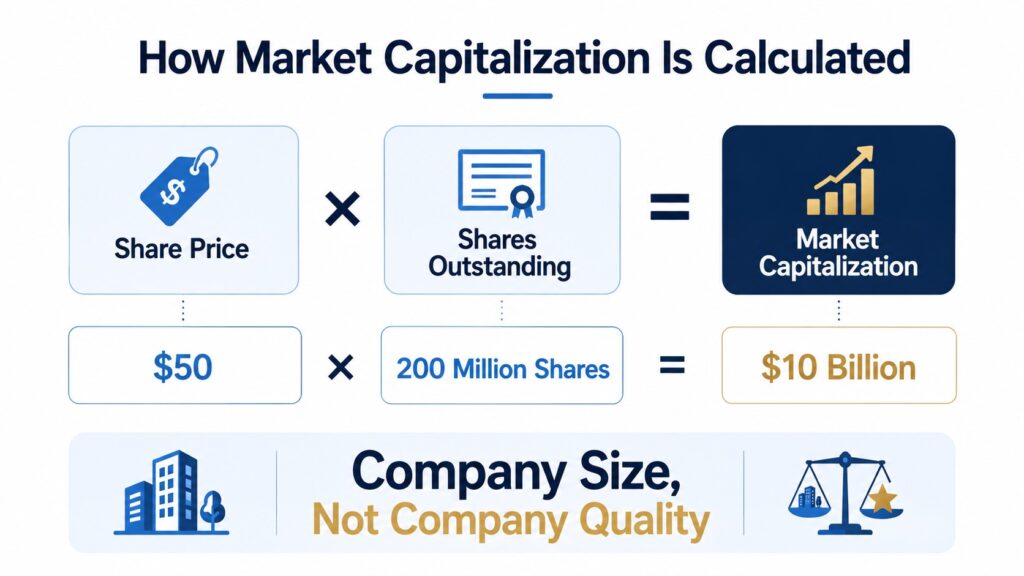
Market Capitalization = Current Share Price × Shares Outstanding
Imagine a company with:
- A share price of $50
- 200 million shares outstanding
Its market capitalization would be:
$50 × 200 million = $10 billion
This does not mean the company has $10 billion in cash or produces $10 billion in annual revenue.
It means the stock market currently values all of its outstanding equity at approximately $10 billion.
Why Share Price Alone Can Be Misleading
One of the most common beginner mistakes is assuming that a high-priced stock represents a larger or more expensive company.
The price of one share does not tell you the value of the whole business.
Consider two simplified companies:
| Company | Share Price | Shares Outstanding | Market Cap |
|---|---|---|---|
| Company A | $500 | 50 million | $25 billion |
| Company B | $50 | 2 billion | $100 billion |
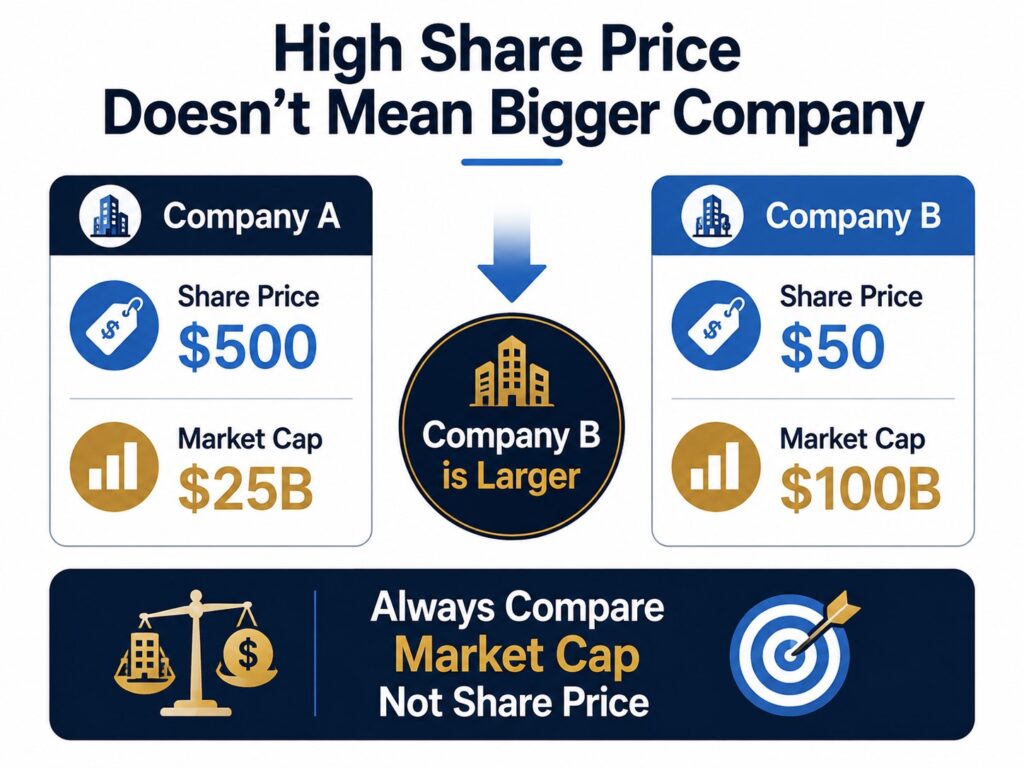
Company A has the higher share price, but Company B has the larger market capitalization because it has far more shares outstanding.
Berkshire Hathaway Class A is a useful real-world example of why this distinction matters. Its unusually high price per share does not, by itself, tell an investor whether Berkshire is larger than Apple, Microsoft, or another major company.
You still need to compare the total value of all outstanding shares.
Early in my stock research, I sometimes treated a lower-priced share as if it had more room to rise than a stock trading at several hundred dollars. That comparison was misleading because I was looking at the price of one unit rather than the market value of the entire company.
Since then, I have treated market cap mainly as a classification tool—not as a signal that a stock is cheap.
Large-Cap, Mid-Cap, Small-Cap, and Micro-Cap Stocks
Market capitalization is commonly used to group companies by size.
The following ranges are broad guidelines:
| Category | Approximate Market Capitalization | General Characteristics |
| Large-cap | More than $10 billion | Established operations, greater liquidity, often more mature |
| Mid-cap | $2 billion to $10 billion | Proven businesses with potential room to expand |
| Small-cap | $250 million to $2 billion | Higher growth potential, but often greater business and price risk |
| Micro-cap | Below $250 million | Limited liquidity, smaller operations, and potentially higher risk |
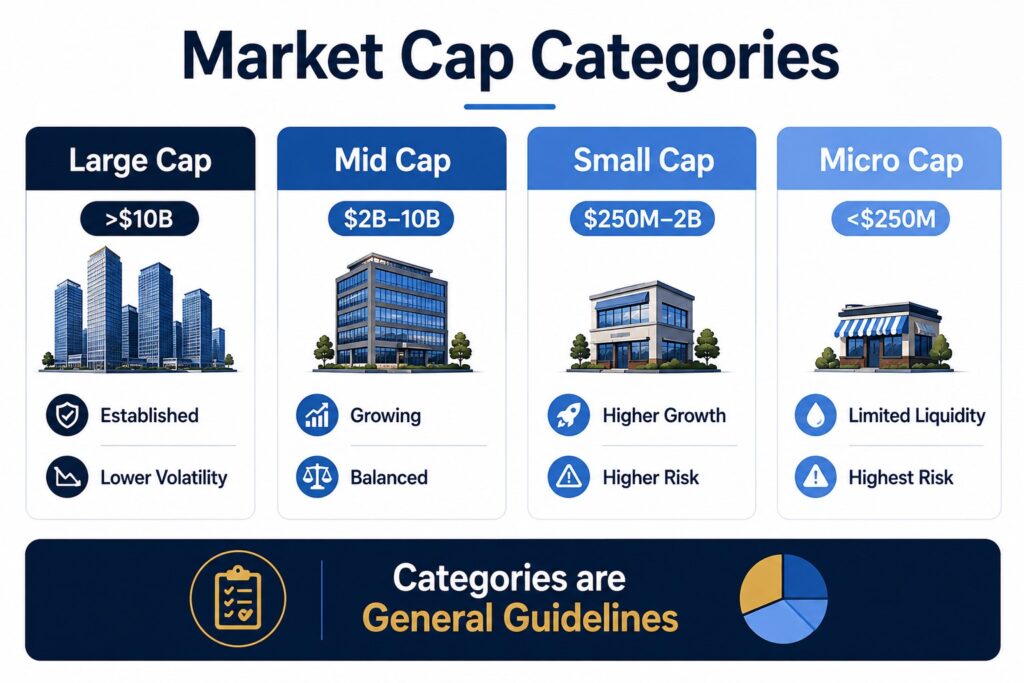
These thresholds are general guidelines rather than fixed rules. Index providers and financial institutions may use different classifications. For example, the SEC notes that companies with market capitalizations below approximately $250 million or $300 million are often described as micro-cap stocks.
Index providers, fund companies, and financial institutions may use different definitions. A business near one boundary may therefore be classified differently depending on the source.
Market cap categories also change over time. A company may move from small-cap to mid-cap as its share price and total market value rise, or move in the opposite direction during a prolonged decline.
What Market Cap Can Tell Investors
Market capitalization gives investors a useful starting point for understanding a company.
It may provide clues about:
- The company’s relative size
- Typical trading liquidity
- Its maturity as a business
- The level of institutional investor participation
- Its possible sensitivity to economic conditions
- The type of stock index or ETF that may hold it
Market cap also affects many indexes. In a market-cap-weighted index, companies with higher market values receive greater weight than smaller constituents. The SEC’s investor education materials explain that larger-cap securities account for a greater share of this type of index.
This helps explain why a small group of very large companies can have a noticeable influence on the performance of a broad index.
Still, market cap should not be used as a complete risk score. A large company can face serious financial or competitive problems, while a smaller company may have a strong balance sheet and a durable business model.
Market Cap Does Not Tell You Whether a Stock Is Cheap
Company size and stock valuation are different concepts.
A company with a $500 billion market cap is not automatically expensive. Its valuation may be supported by substantial revenue, profits, cash flow, and durable growth.
A company worth $1 billion is not automatically cheap. Investors may already be paying a high price relative to its earnings or financial position.
For example, two software companies could each have a market capitalization of $20 billion.
One might be profitable and generate consistent free cash flow. The other might be growing more quickly but losing money and relying on external financing.
Their market caps are equal, but their financial quality and valuation risks are not.
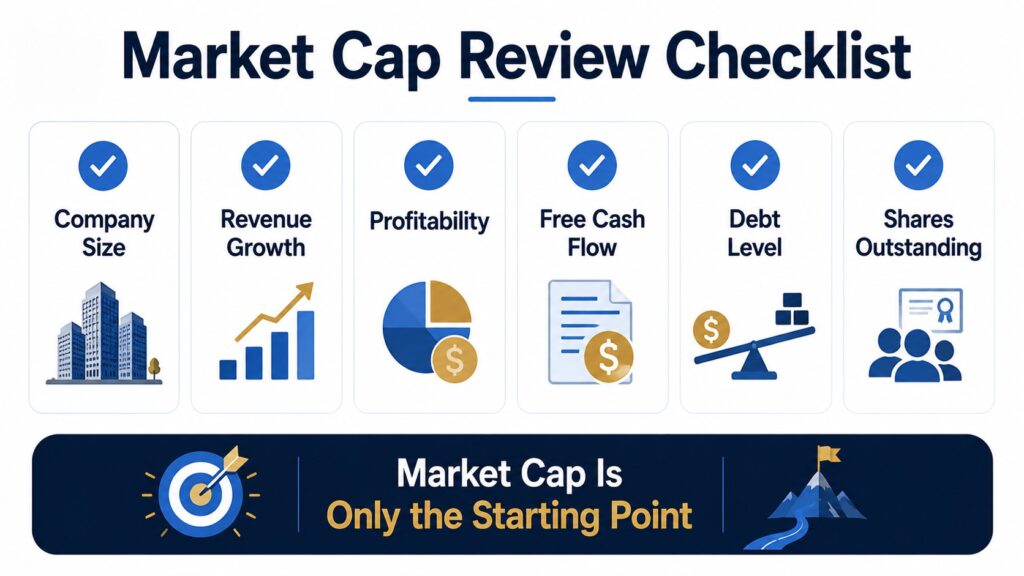
After checking market capitalization, I usually move through five questions:
- Is revenue growing?
- Is the company profitable?
- Does it generate free cash flow?
- How much debt does it carry?
- Has the number of shares increased?
Market cap tells me how the market currently sizes the company. These additional questions help me understand what supports that size.
Market Cap Can Rise Even When the Business Does Not Improve
A company’s market capitalization can increase because investors are willing to pay a higher price for its shares.
The company’s revenue, profit, or cash flow does not necessarily improve at the same rate.
Excitement about artificial intelligence, a new product, a possible regulatory change, or an industry trend may push a stock higher before the expected business results appear.
That does not automatically mean the price increase is unjustified. It means the market may be pricing in future results rather than current performance.
I find it useful to separate two questions:
Has the company’s market value increased?
Have its business results improved enough to support that increase?
The gap between these questions can help investors distinguish proven operating progress from rising market expectations.
How Stock Splits Affect Market Capitalization
A stock split changes the number of shares and the price of each share proportionally.
Suppose a company completes a two-for-one split. An investor who owned 100 shares may then own 200 shares, while the price per share is adjusted to approximately half its previous level.
The split itself does not change the shareholder’s proportional ownership or the company’s underlying market value. As Investor.gov explains in its stock split guide, a standard stock split increases the number of shares without diluting the ownership interests of existing shareholders. Investor.gov also notes that, unlike issuing new shares, a stock split does not dilute existing ownership interests.
However, the market price may still move after a split announcement or once the adjusted shares begin trading. That movement comes from normal supply, demand, expectations, and market sentiment—not from the mathematical split itself.
This is another reason a lower share price should not automatically be interpreted as a cheaper company.
Why Shares Outstanding and Dilution Matter
The market-cap formula has two moving parts:
- Share price
- Shares outstanding
Many beginners monitor the first and ignore the second.
A company can issue additional shares to raise money, compensate employees, fund an acquisition, or convert certain securities into common stock.
When more shares are issued, existing investors may own a smaller percentage of the company. Investor.gov describes this as dilution and notes that issuing more shares can reduce each investor’s proportional ownership.
Suppose a company’s share price remains unchanged while its outstanding share count rises substantially. Its market capitalization may increase even though the price received by existing shareholders has not risen.
This is why a rising market cap does not always mean existing shareholders are better off.
Investors should check whether the increase came from:
- A higher share price
- Additional share issuance
- Or a combination of both
Share repurchases can work in the opposite direction by reducing the number of outstanding shares, although investors should still examine the price paid and whether the repurchase was a productive use of company cash.
Market Capitalization vs. Enterprise Value
Market capitalization measures the market value of a company’s equity.
It does not directly account for the company’s debt or subtract cash held on the balance sheet.
Enterprise value offers a broader view. A simplified version is:
Enterprise Value = Market Cap + Debt − Cash
Imagine two companies with the same $10 billion market cap.
One has very little debt and substantial cash. The other carries several billion dollars of debt.
Their equity values are similar, but their broader financial positions are not.
Market cap is useful when comparing stock-market size. Enterprise value may be more useful when comparing the overall value of operating businesses, especially when debt levels differ significantly.
A Practical Market Cap Review Routine
When comparing companies, use market cap in a simple order.
1. Identify the size category
Determine whether the company is broadly considered large-cap, mid-cap, small-cap, or micro-cap.
This provides initial context about its scale and possible liquidity.
2. Compare companies in the same industry
A small biotechnology company and a mature utility may have very different economics.
Market-cap comparisons are usually more meaningful between companies with similar business models.
3. Check the fundamentals supporting the market value
Review revenue, profit margins, earnings, free cash flow, debt, and expected growth.
A large market cap needs either strong current results or credible expectations about the future.
4. Review the share count
Look at whether shares outstanding have increased or decreased over several reporting periods.
The number can usually be found in the company’s latest Form 10-K or Form 10-Q. Investors can search these reports by company name or ticker through the SEC’s EDGAR filing database.
5. Compare market value with business progress
Ask whether the market cap has risen because the company improved, investor expectations changed, new shares were issued, or several of these happened together.
6. Consider the broader environment
Smaller or unprofitable companies may be more sensitive to interest rates, financing costs, and weak economic conditions.
This is not a prediction. It is a framework for avoiding conclusions based on one number.
Common Beginner Mistakes
The most frequent market-cap mistakes include:
- Assuming a high share price means a larger company
- Calling a low-priced stock cheap without checking its share count
- Treating every company below $2 billion as a typical small-cap stock
- Assuming smaller companies always have greater upside
- Ignoring dilution and stock-based compensation
- Confusing market capitalization with enterprise value
- Comparing market caps without checking revenue, profit, debt, or cash flow
Market cap becomes more useful when it leads to better questions rather than an immediate investment conclusion.
Final Thoughts
Market capitalization is a useful starting point because it shows the total value the market assigns to a company’s equity.
It helps investors compare company size, understand broad risk characteristics, and avoid judging a stock by the price of one share.
However, market cap does not measure profitability, financial strength, competitive advantage, or whether a stock is reasonably valued.
A practical rule is simple:
Use market capitalization to understand the size of a business, then use revenue, earnings, cash flow, debt, share count, and valuation to evaluate its quality.
The next time you compare two stocks, do not ask only which one has the lower share price.
Ask how much the entire company is worth, why the market assigns it that value, and whether the business fundamentals support those expectations.
FAQ
Q1. Is market capitalization the same as a company’s total value?
Not exactly. Market cap measures the market value of the company’s equity. It does not directly include debt or subtract cash, which is why investors may also examine enterprise value.
Q2. Can a low-priced stock have a large market cap?
Yes. A company with a low share price can still have a large market cap if it has many shares outstanding.
Q3. Does a higher market cap mean a better investment?
No. It indicates company size, not business quality or valuation attractiveness.
Q4. Does a stock split reduce market capitalization?
The stock split itself does not reduce the company’s underlying market value. The share price and number of shares are adjusted proportionally, although normal market trading can move the price afterward.
Q5. Can issuing new shares increase market capitalization?
Yes. If the share price remains stable while shares outstanding increase, the market cap can rise. Existing shareholders may still experience dilution.
📚 Related Articles
How to Read Financial Statements: A Simple and Powerful Beginner’s Guide
Fundamental Analysis for Beginner Investors: A Smart Guide to Better Stock Decisions
Is a Low P/E Ratio Always Better? 5 Costly Mistakes to Avoid
How to Build Your First Stock Portfolio: A Smart and Simple Beginner’s Guide

Why Stocks Rise on Bad News: What Beginner Investors Should Know
Many beginner investors wonder why stocks rise on bad news, especially when the headlines seem…
Is a Low P/E Ratio Always Better? 5 Costly Mistakes to Avoid
When I first began studying stock valuation, the P/E ratio seemed like the easiest number…

How to Build Your First Stock Portfolio: A Smart and Simple Beginner’s Guide
Learning how to build your first stock portfolio can feel more complicated than it needs…
Disclaimer: This article is for educational purposes only. It is not financial advice or a recommendation to buy or sell any specific stock, ETF, cryptocurrency, or other asset. All investment decisions are your own responsibility.