
The S&P 500 is one of the most widely followed measures of the U.S. stock market. It appears constantly in financial headlines, serves as a benchmark for professional investors, and is tracked by many index funds used by long-term investors.
But knowing that it contains 500 large U.S. companies is only the starting point.
To understand what the S&P 500 is actually telling you, you need to know how companies are weighted, why a few mega-cap stocks can have an outsized impact, and why a rising index does not always mean the entire market is equally strong.
What Is the S&P 500?
The S&P 500 is a stock market index designed to measure the large-cap segment of the U.S. equity market.
According to the official S&P U.S. Indices Methodology, the index contains 500 constituent companies and is considered a proxy for the U.S. equity market.
An index itself is not an investment product.
It is better understood as a measurement system: a defined group of securities combined according to a set of rules to show how that part of the market is performing.
Investors who want exposure to the index typically use an index mutual fund or exchange-traded fund, or ETF. These funds seek to track a market index rather than allowing investors to purchase the index itself.
A useful way to remember the distinction is:
The S&P 500 is the benchmark. An S&P 500 index fund is an investment vehicle designed to track it.
How Does the S&P 500 Work?
One of the most important details for beginners is that all 500 companies do not receive equal weight.
The index uses float-adjusted market capitalization weighting. This means larger companies generally have more influence on index performance, while shares that are not readily available for public trading are excluded from the float adjustment.
A simplified market-cap calculation is:
Share Price × Shares Outstanding = Market Capitalization
Consider a hypothetical example.
Company A has a market capitalization of $3 trillion, while Company B has a market capitalization of $100 billion.
Company A would have substantially more influence on a market-cap-weighted index.
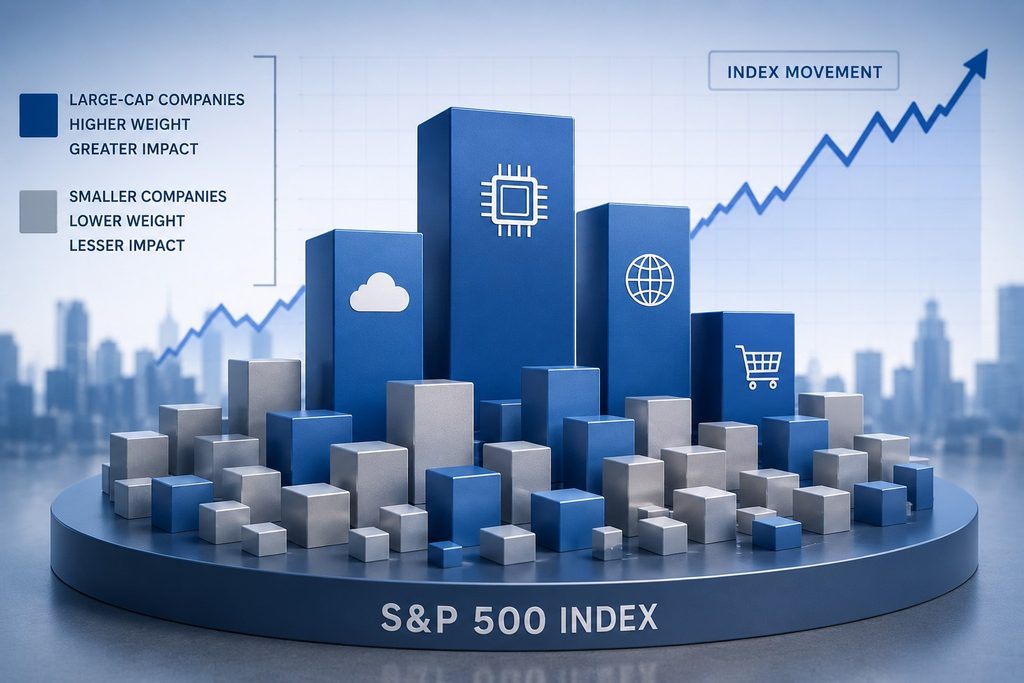
So buying a fund that tracks the index does not mean allocating exactly 0.2% of your money to each company. Larger companies receive larger weights.
This is more than a technical detail. It directly affects which companies can drive the index on a particular day.
The S&P 500 Is Not Simply the 500 Biggest Stocks
Another common shortcut is to think of the index as an automatic list of America’s 500 largest stocks.
Its construction is more deliberate than that.
S&P Dow Jones Indices applies eligibility and selection criteria that include factors such as U.S. company status, market capitalization, liquidity, public float, financial viability, and sector representation.
The result is a benchmark for the U.S. large-cap market, not the entire U.S. stock market.
The official S&P 500 index overview describes the index as including 500 leading companies and covering approximately 80% of available U.S. market capitalization.
Smaller companies still exist outside the index.
That distinction becomes useful whenever a headline says “the stock market rose,” because stocks outside the large-cap universe may be behaving quite differently.
What Does a 1% S&P 500 Gain Actually Tell You?
Suppose the index begins a trading day at 6,000 and closes at 6,060.
The percentage gain is:
(6,060 − 6,000) ÷ 6,000 × 100 = 1%
The headline would say the index gained 1%.
But that statement leaves out an important question:
Who actually produced the gain?
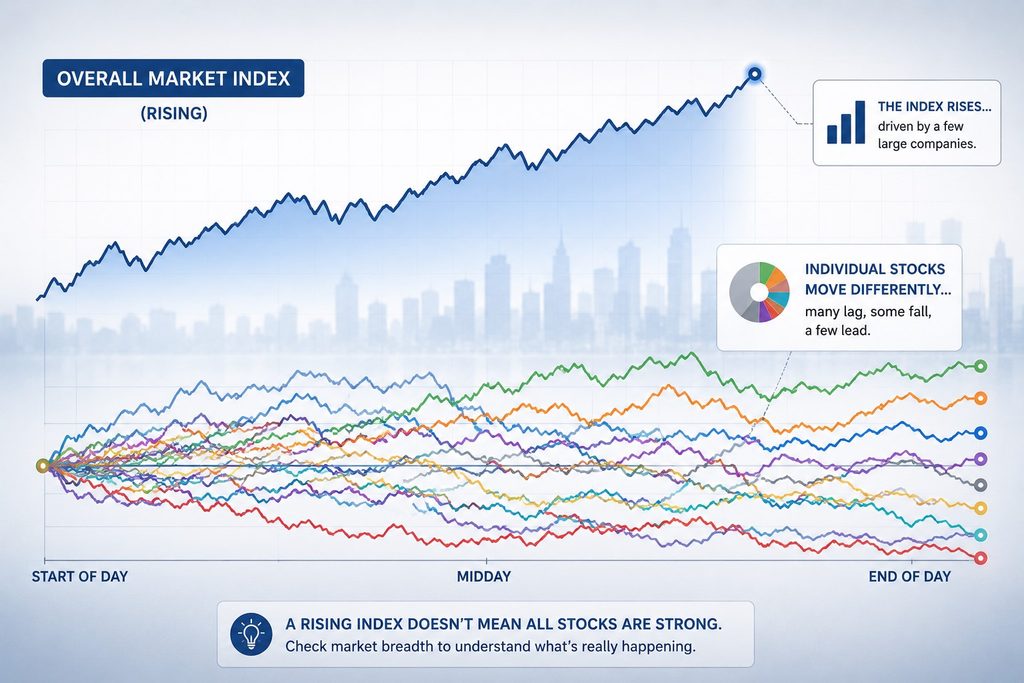
The index can rise even when many individual stocks fall. Because larger companies carry larger weights, a strong rally in several mega-cap stocks can offset weakness elsewhere.
This is where I would move beyond the headline number.
I would not automatically interpret a 1% index gain as meaning that “the whole market is strong.” The first thing worth checking is participation, often described as market breadth.
If a wide range of stocks are advancing, the move is broad.
If a small number of heavily weighted companies account for most of the gain, the headline index may look stronger than underlying participation suggests.
That does not automatically make a narrow rally bearish or unsustainable. It simply changes what the headline number is telling you.
What Is S&P 500 Index Investing?
S&P 500 index investing generally means buying a fund whose objective is to track the index instead of selecting hundreds of individual companies yourself.
The SEC’s Investor.gov guide to index funds explains that these funds seek to track a market index. Investors cannot invest directly in the index itself, and some index funds may hold all securities in the target index while others use a representative sample.
This approach is commonly associated with passive investing.
The investor is generally not trying to identify which individual company will outperform next year. Instead, the objective is to gain exposure to the market segment represented by the index.
That changes the beginner’s question from:
“Which stock should I pick?”
to:
“Does broad exposure to large U.S. companies fit the role I need in my portfolio?”
Why Index Investing Appeals to Beginners
The strongest practical benefit is diversification at the company level.
If you invest heavily in one company and that business runs into serious trouble, the impact on your portfolio can be substantial.
A broad index fund spreads company-specific exposure across hundreds of businesses.
But diversification should not be confused with protection from stock-market losses.
If the broad large-cap market falls sharply, a fund tracking the index can also suffer a substantial decline.
The more accurate way to describe the benefit is:
An index fund reduces dependence on the outcome of one or a few individual companies. It does not remove market risk.
Index investing can also reduce the amount of individual-company research required.
Cost is another consideration. Many index funds have relatively low expenses, but “index fund” does not automatically mean “cheap.”
The SEC notes that even relatively small recurring fees can have a significant effect on a portfolio over long periods because fees reduce the amount of money left invested to earn returns.
That makes the actual expense ratio worth checking rather than assuming two similar-looking funds are economically identical.
Is the S&P 500 Really Diversified?
Yes—but the more interesting question is how it is diversified.
Owning hundreds of companies provides substantial diversification at the individual-company level.
At the same time, market-cap weighting can create concentration at the top.
Imagine an index with hundreds of holdings in which a relatively small group of mega-cap companies represents a large share of total market value.
The investor still owns many companies, but those largest holdings can exert disproportionate influence over performance.
So I would not stop with:
“Does the fund own 500 companies?”
A more useful second question is:
“How dependent is current index performance on the largest holdings?”
There is also another layer of diversification.
Owning hundreds of large U.S. stocks is not the same as owning every part of the market or every asset class.
A portfolio invested entirely in this large-cap index may still have limited direct exposure to smaller U.S. companies, international equities, bonds, or other asset categories.
S&P 500 Index Fund vs. Individual Stocks
| Factor | S&P 500 Index Fund | Individual Stocks |
|---|---|---|
| Number of companies | Hundreds | Depends on portfolio |
| Company-specific risk | Reduced through diversification | Can be high |
| Research required | Generally lower | Generally higher |
| Control over holdings | Limited | High |
| Primary objective | Track an index | Depends on stock selection |
| Market risk | Still present | Still present |
The biggest difference is not that one approach has risk and the other does not.
It is where the risk comes from.
With a diversified index fund, broad market conditions usually matter more than the results of a single company.
With individual stocks, investors also need to evaluate company-specific factors such as earnings, valuation, balance-sheet strength, competitive position, and portfolio concentration.
How I Would Read the S&P 500 Beyond the Headline
This is where the S&P 500 becomes more useful than a number scrolling across a financial-news screen.
When the index rises or falls sharply, I would separate two questions:
1. What does today’s move tell me about the market?
2. Does today’s move change the role of an index fund in a long-term portfolio?
Those are not the same question.
For the first question, four checks are especially useful.
1. Market Breadth
Are many stocks participating in the move, or is a small group doing most of the work?
A broad advance and a narrow mega-cap-led advance can produce the same headline return while describing very different market participation.
This is why an S&P 500 gain should not automatically be translated into “most stocks are doing well.”
2. Concentration
How much influence are the largest companies having?
Because the index is float-adjusted market-cap weighted, the largest constituents naturally have greater influence on index performance.
That influence deserves more attention when market leadership becomes unusually narrow.
A concentrated rally is not automatically unhealthy. But it carries different information from an advance supported by a much larger share of the market.
3. Earnings Expectations
Stock prices reflect expectations about future company performance, including earnings and cash flows.
If the index rises while expected corporate profits are improving, that is a different setup from an index rising mainly because investors are willing to pay higher valuation multiples for unchanged earnings expectations.
That distinction helps separate fundamental improvement from valuation expansion.
It also prevents a common mistake: assuming price itself explains why the investment became more attractive.
4. The Macro Environment
Interest rates, Treasury yields, inflation expectations, and Federal Reserve policy can influence how investors value future corporate earnings.
But no single macro indicator should be treated as a standalone trading signal.
The more useful question is:
Why are financial conditions changing, and which parts of the index are most sensitive to that change?
For example, rising Treasury yields associated with stronger growth expectations can represent a different market environment from rising yields driven by renewed inflation concerns.
The direction of the yield is only the first piece of information. The reason behind the move is often more useful.
These four checks can be summarized as:
Breadth → Concentration → Earnings → Macro
Their purpose is to help diagnose the market, not to mechanically generate a buy-or-sell signal.
A narrow rally, higher Treasury yields, or weaker market breadth may be useful information without requiring a long-term investor to change strategy immediately.
That separation between market diagnosis and portfolio action is one of the most useful habits a beginner can develop.
What to Check Before Choosing an S&P 500 Fund
Once an investor decides that this kind of exposure fits the portfolio, the fund itself still needs to be evaluated.
Four checks are particularly useful.
1. What Index Does the Fund Track?
Do not assume every product described as an index fund owns the same portfolio.
Different indexes can follow different eligibility rules, weighting methodologies, and market segments.
2. What Does the Fund Cost?
Review the expense ratio and any other relevant fees.
The SEC explains that even relatively small investment fees and expenses can have a meaningful impact on portfolio value over long periods because fees reduce the amount of money left invested to earn returns.
3. How Closely Does It Track the Benchmark?
An index fund’s actual return may differ slightly from the index because of expenses and differences in portfolio implementation.
Investor.gov notes that index funds may use different approaches to tracking their benchmarks, including full replication or sampling.
4. What Role Does It Play in the Overall Portfolio?
A diversified stock fund can still be inappropriate for money that may be needed soon or for an investor who cannot tolerate substantial equity-market declines.
Recent performance would not be my first selection criterion.
Two funds can show similar returns while differing in fees, structure, liquidity, tracking quality, and how well they fit a broader portfolio.
Three Beginner Mistakes Worth Avoiding
The first mistake is treating the S&P 500 as protection against every type of risk.
It provides broad company-level diversification, but market risk remains.
The second is assuming every index move reflects the experience of every stock.
Market-cap weighting means a headline gain can sometimes conceal weaker participation underneath the surface. This is why breadth and concentration deserve attention when interpreting daily moves.
The third is changing a long-term strategy simply because the index has become volatile.
Volatility may reflect changes in earnings expectations, valuations, Treasury yields, inflation, monetary policy, investor sentiment, or several factors at once.
Understanding the cause is more useful than treating the price move itself as an instruction.
The Practical Way to Think About the S&P 500
The index is useful in two distinct ways.
As an investment benchmark, it represents a broad cross-section of large U.S. companies and can be tracked through index funds.
As a market-reading tool, it becomes much more informative when you look beneath the headline return.
For market interpretation, the framework I would use is:
Breadth → Concentration → Earnings → Macro
For long-term index investing, the questions are different:
Diversification → Cost → Time Horizon → Portfolio Role
Keeping those two frameworks separate helps prevent one of the easiest mistakes for a beginner to make: treating every market observation as a portfolio instruction.
Understanding today’s market and deciding what belongs in a long-term portfolio are related tasks, but they are not the same task.
That distinction is ultimately more useful than trying to predict the S&P 500’s next move.
FAQ
Q1. Can I invest directly in the S&P 500?
No. It is a market index, not a security investors can purchase directly. Investors generally gain exposure through mutual funds or ETFs designed to track the index.
Q2. Is the S&P 500 the entire U.S. stock market?
No. It measures the large-cap segment of the U.S. market. Smaller companies and other eligible U.S. equities exist outside the index.
Q3. Does the S&P 500 always go up over the long term?
No future market return is guaranteed. Historical performance can provide useful context, but it cannot establish what the index must earn over any future period.
📚 Related Articles
ETF Investing for Beginners: A Smart and Practical First Guide
Market Capitalization Explained: The Costly Mistake Beginner Investors Make
How to Build Your First Stock Portfolio: A Smart and Simple Beginner’s Guide
Stock Valuation Checklist: 7 Critical Checks Before Calling a Stock Cheap
A stock can look cheap because its price has fallen 40%, its P/E ratio is…
RSI Divergence vs MACD Crossover: Which Is More Reliable for Trading?
RSI divergence can warn that price momentum is weakening before a reversal becomes obvious. A…
Before You Buy the Dip: 5 Critical Balance Sheet Checks Every Investor Should Make
A stock that falls 20%, 30%, or even 50% can suddenly look cheap. But a…
Disclaimer: This article is for educational and informational purposes only and is not personalized financial or investment advice. Investment decisions should be based on your own circumstances, research, risk tolerance, and, when appropriate, professional guidance.