
ETF investing for beginners can look simple at first.
You open a brokerage app, search for a popular fund, and buy a share. The difficult part is not placing the order. It is understanding what you are actually buying.
Many new investors assume that every ETF is diversified, low-risk, and suitable for long-term investing. That is not always true.
One ETF may hold hundreds of companies across several countries. Another may concentrate heavily on a single industry or investment theme. Both products are called ETFs, but their risks and price movements can be very different.
When I compare ETFs, I do not begin with the one-year return chart. I first check the index, top holdings, expense ratio, and concentration level. This order makes it easier to understand the fund before recent performance influences the decision.
This guide explains how ETFs work, what beginners should check before investing, and how to avoid choosing a fund based only on popularity or recent returns.
What Is an ETF?
Understanding how an exchange-traded fund works is the first step in ETF investing for beginners. According to the U.S. Securities and Exchange Commission’s Investor.gov ETF guide, an ETF pools money from multiple investors and invests it in stocks, bonds, or other assets. Unlike a traditional mutual fund, an ETF trades on a stock exchange throughout the trading day.
Instead of buying many securities separately, you can buy one ETF that holds a collection of assets. Depending on the fund, those assets may include stocks, bonds, commodities, or securities from several countries.
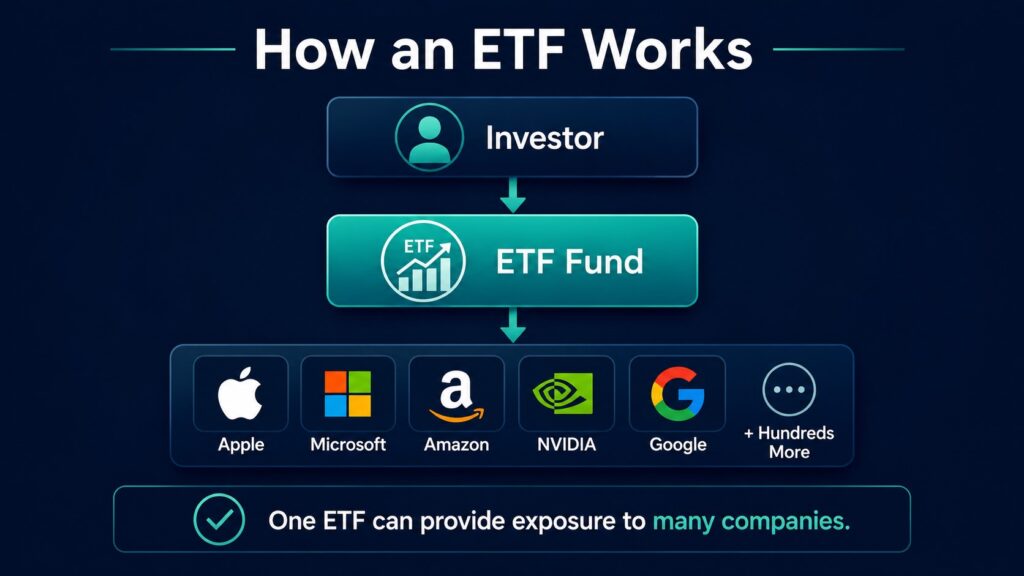
For example, an ETF tracking the S&P 500 provides exposure to hundreds of large U.S. companies. A global-market ETF may hold companies from the United States, Europe, Japan, and other developed or emerging markets.
A simple way to understand the difference is:
- A stock gives you ownership in one company.
- A broad-market ETF gives you small ownership positions in many companies.
Diversification does not remove market risk. An ETF can still lose value during a market decline. However, diversification may reduce the impact that one company has on the entire portfolio.
ETF vs. Individual Stocks
Both ETFs and individual stocks can play a role in a portfolio, but they require different levels of research and risk tolerance.
| Feature | Broad-Market ETF | Individual Stock |
|---|---|---|
| Diversification | Holds many companies | Represents one company |
| Company-specific risk | Usually lower | Usually higher |
| Research required | Low to moderate | Moderate to high |
| Price volatility | Often more balanced | Can be much sharper |
| Typical use | Long-term diversified exposure | Targeted company investment |
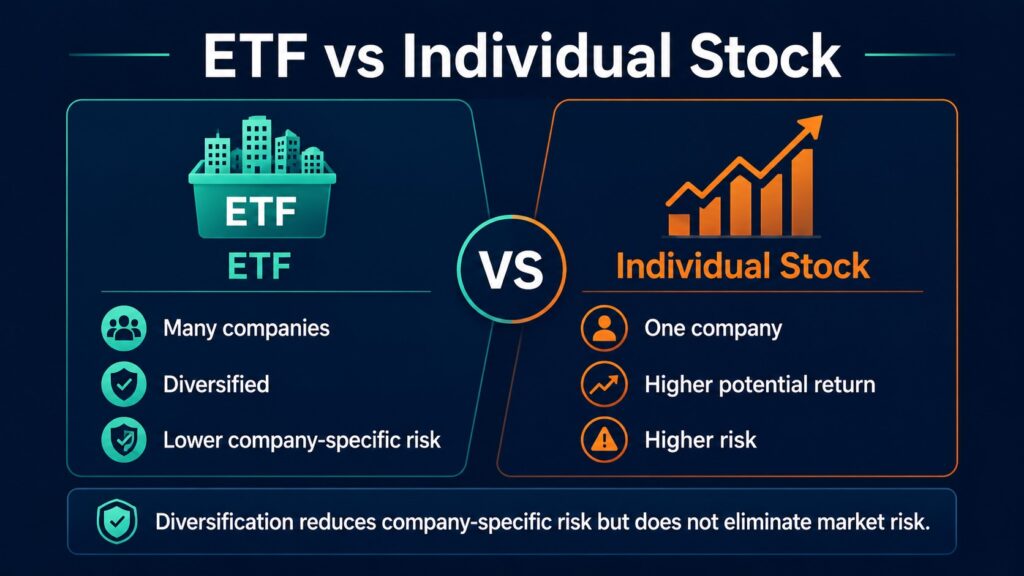
An individual stock may outperform the wider market, but it can also fall sharply if the company reports weak earnings, loses market share, or faces regulatory problems.
A broad-market ETF spreads company-specific risk across many holdings.
For a beginner, the main advantage is not that an ETF guarantees better returns. It is that the portfolio becomes less dependent on the success or failure of one company.
Not Every ETF Is Broadly Diversified
The word “ETF” describes the fund structure, not the level of safety.
This is one of the most important lessons in ETF investing for beginners.
A broad-market ETF may track an index such as the S&P 500, MSCI World, or FTSE All-World. These funds generally hold companies across several industries.
A sector ETF focuses on one part of the economy, such as technology, healthcare, energy, or financial services.
A thematic ETF may concentrate on trends such as artificial intelligence, clean energy, robotics, cybersecurity, or electric vehicles.
These narrower ETFs can rise quickly when their theme becomes popular. They can also experience deeper losses when expectations change or investor interest moves elsewhere.
The mistake beginners often make is seeing the word “ETF” and assuming the product is automatically conservative.
The better question is:
What does this fund actually own?
How to Choose an ETF for the First Time
One of the biggest challenges in ETF investing for beginners is deciding what to compare first. Recent performance is usually the easiest number to notice.
However, a strong one-year return does not tell you whether the fund is diversified, expensive, concentrated, or suitable for your investment goal.
I usually check the following five items before looking closely at the performance chart.
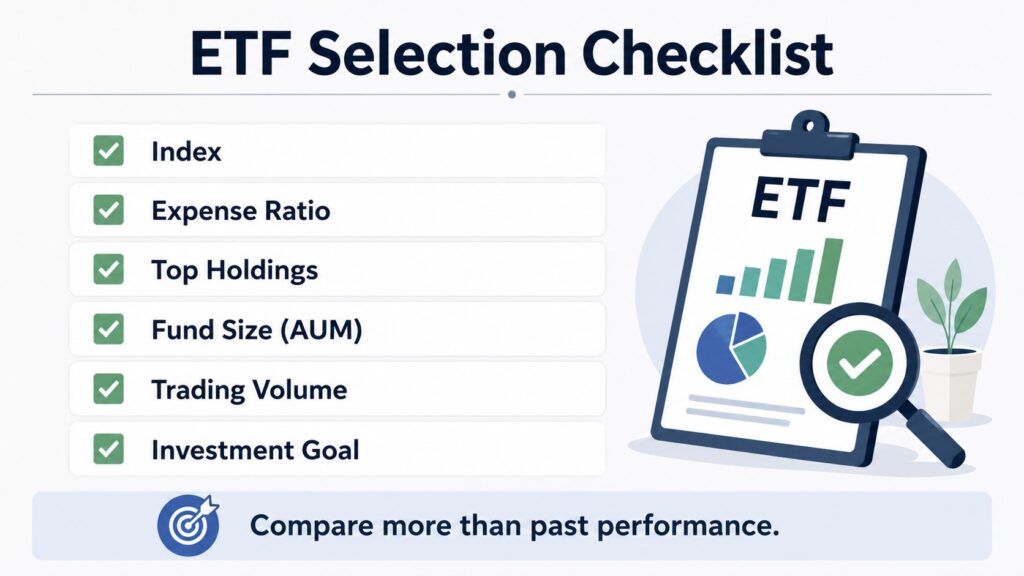
1. The Index or Investment Strategy
Start with the ETF’s investment objective.
Does the fund track:
- a broad stock-market index?
- a specific industry?
- one country?
- high-dividend companies?
- growth stocks?
- a rules-based investment strategy?
Two ETFs can have similar names while following very different indexes.
Read the fund description and identify the tracked index before looking at returns. The index usually tells you more about the investment than the ticker symbol or marketing name.
2. The Expense Ratio
The expense ratio is the annual management cost charged by the fund. Vanguard’s expense ratio guide explains that this cost covers expenses such as portfolio management, administration, marketing, and distribution.
Lower costs are generally helpful because fees reduce returns over time. However, the cheapest ETF is not automatically the best choice.
Expense ratios should be compared only between ETFs with similar objectives.
For example, a broad-market index ETF and a specialized thematic ETF are not direct substitutes simply because one has a lower fee.
Always check the latest expense ratio on the ETF issuer’s official website because fees can change.
3. The Top Holdings
Review the ETF’s largest positions.
This helps you understand whether the fund is broadly diversified or heavily dependent on a small number of companies.
For example, imagine that two ETFs both include “technology” in their names.
The first ETF may hold a large percentage of its assets in three mega-cap companies. The second may spread its assets more evenly across software, semiconductors, hardware, and smaller technology businesses.
The names may look similar, but the concentration risk is different.
When I compare similar ETFs, I open the issuer pages side by side and check:
- the top 10 holdings
- the weight of the largest holding
- the combined weight of the top five or top 10 positions
- sector allocation
This simple comparison often reveals differences that are not obvious from the ETF name.
4. Fund Size and Trading Activity
Assets under management, commonly called AUM, show how much money is invested in the ETF.
Larger, established ETFs often have active trading markets, but AUM alone does not determine liquidity.
Beginners should also check:
- average trading volume
- bid-ask spread
- how frequently the ETF trades
- whether the market price stays close to its net asset value
The bid-ask spread is the difference between the highest price a buyer is offering and the lowest price a seller is willing to accept.
A narrow spread generally makes it easier to buy or sell near the quoted market price. A wider spread may result in a less favorable trade, especially in a lightly traded ETF.
5. Fit With Your Goal
An ETF can be well designed and still be wrong for your portfolio.
Ask yourself:
- Am I investing for several years or several decades?
- Do I want broad diversification or targeted exposure?
- Can I tolerate a large temporary decline?
- Will I continue holding this ETF during a weak market?
- Does this fund overlap with ETFs I already own?
These questions are usually more useful than asking which ETF performed best last year.
Common ETF Mistakes Beginners Make
ETF investing for beginners becomes more difficult when investors focus on fund popularity instead of holdings, costs, and concentration risk.
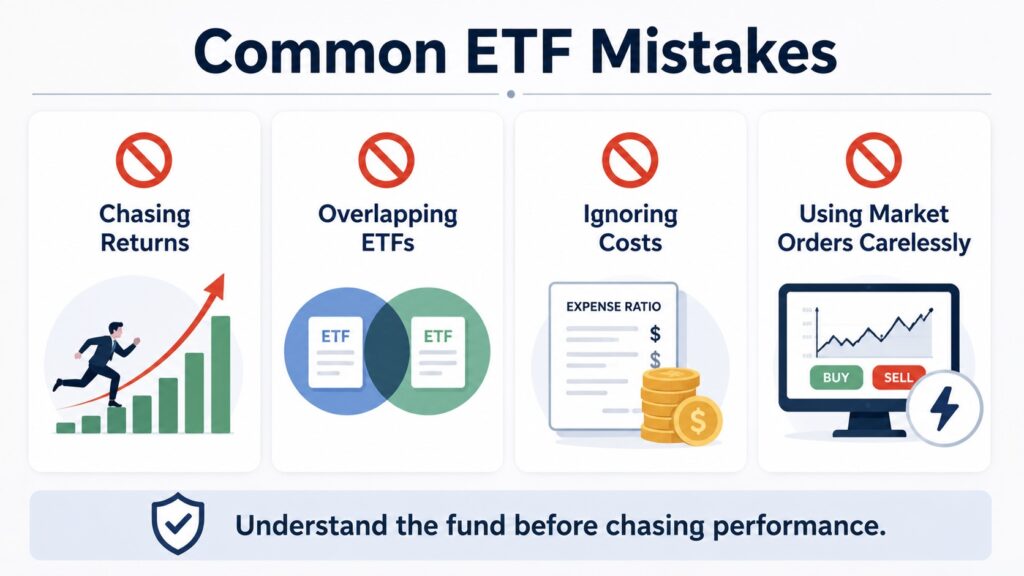
Chasing Recent Winners
One of the most common mistakes is buying an ETF after a strong rally.
When a sector performs well, related ETFs receive more media coverage and investor attention. Beginners may buy near the end of the rally without considering whether prices already reflect optimistic expectations.
A high recent return tells you what has already happened. It does not guarantee what will happen next.
Owning Several Overlapping ETFs
Another mistake is buying several ETFs that hold many of the same companies.
For example, an investor may own:
- a total U.S. stock-market ETF
- an S&P 500 ETF
- a Nasdaq-focused ETF
- a technology-sector ETF
The portfolio contains four funds, but many of the largest holdings may be identical.
More ETFs do not always mean more diversification.
Before adding another ETF, compare the top 10 holdings of both funds. If the same companies appear near the top with similar weights, the new ETF may increase concentration rather than provide meaningful diversification.
Ignoring Currency, Taxes, and Account Rules
ETF returns can also be affected by factors outside the fund itself.
Depending on your country and brokerage account, you may need to consider:
- currency conversion costs
- dividend taxes
- capital-gains taxes
- brokerage commissions
- account maintenance fees
- withholding taxes
- local retirement or tax-advantaged account rules
These details vary by country and account type. Check them with your brokerage and official tax sources before investing.
Using a Market Order Without Checking the Spread
A market order tells the broker to execute the trade at the best available price.
This may be reasonable for a highly liquid ETF with a narrow bid-ask spread. However, a market order can result in an unexpected price when the ETF trades infrequently or the market is volatile.
Before placing an order, check the spread.
For a less actively traded ETF, a limit order may provide more control over the purchase price. A limit order does not guarantee execution, but it prevents you from paying more than the price you set.
A Simple ETF Research Routine
A practical research routine is an important part of ETF investing for beginners, and it does not require expensive software or advanced market analysis.
Start with the issuer’s official fund page and follow this order:
- Read the investment objective.
- Identify the tracked index.
- Check the expense ratio.
- Review the top 10 holdings.
- Check sector and geographic allocation.
- Review fund size and average trading volume.
- Look at the bid-ask spread.
- Compare the ETF with similar funds.
- Check whether it overlaps with your current holdings.
- Decide whether it fits your time horizon and risk tolerance.
For a more detailed explanation of ETF pricing, costs, risks, and trading considerations, beginners can also review the SEC’s Investor Bulletin on Exchange-Traded Funds.
This process usually gives you more useful information than comparing dozens of return charts.
I also find it helpful to explain an ETF in one sentence before considering it.
For example:
“This fund tracks large U.S. companies across multiple sectors.”
Or:
“This fund concentrates on semiconductor companies and may be more volatile than the broader market.”
If the strategy cannot be explained clearly in one or two sentences, more research may be necessary.
A Simple ETF Comparison Example
Suppose a beginner is comparing two ETFs.
ETF A
- Tracks a broad U.S. stock-market index
- Holds thousands of companies
- Has a low expense ratio
- Includes large-, mid-, and small-cap stocks
- Has high trading volume
ETF B
- Focuses on artificial intelligence companies
- Holds fewer stocks
- Has a higher expense ratio
- Concentrates heavily in technology
- Has experienced strong recent returns
ETF B is not necessarily a bad investment.
However, it carries a different type of risk.
ETF A may be more suitable for someone seeking broad long-term market exposure. ETF B may be more appropriate as a smaller, targeted position for an investor who understands the concentration and volatility.
The important point is not to decide which ETF is universally better.
The goal is to understand why the two funds may behave differently.
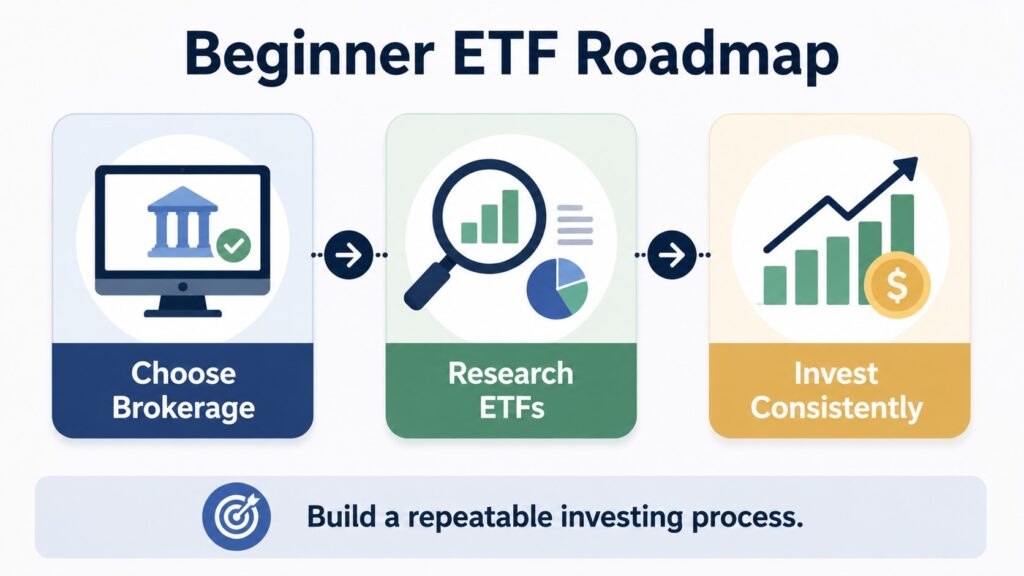
A Three-Step Beginner Action Plan
The following ETF investing for beginners action plan focuses on choosing a brokerage, researching broad-market funds, and building a consistent investment process.
Step 1: Choose a Reputable Brokerage
Use a regulated brokerage available in your country.
Compare:
- trading fees
- account costs
- available ETFs
- currency conversion charges
- tax reporting support
- educational resources
- order types
Do not choose a brokerage only because its app looks simple.
Step 2: Research Broad-Market Options First
Begin by learning about ETFs that track broad indexes rather than immediately searching for a narrow theme.
Compare the:
- index
- expense ratio
- holdings
- geographic exposure
- trading volume
- bid-ask spread
The goal is not to find the perfect ETF. It is to understand the trade-offs between a few reasonable options.
Step 3: Build a Consistent Process
Some investors use regular monthly contributions, often called dollar-cost averaging.
This approach does not guarantee a profit or prevent losses. It can, however, reduce the pressure to predict the perfect entry point.
A consistent process may include:
- investing on a regular schedule
- reviewing the portfolio periodically
- avoiding unnecessary trading
- checking whether the original investment reason still applies
- rebalancing when one position becomes too large
Consistency, costs, diversification, and emotional discipline often matter more than choosing between two very similar broad-market ETFs.
Practical Investor Takeaway
Before buying an ETF, ask these questions:
- What index or strategy does it follow?
- What are its largest holdings?
- How concentrated are the top positions?
- What is the expense ratio?
- How actively does the ETF trade?
- Is the bid-ask spread narrow or wide?
- Does it overlap with ETFs I already own?
- Does it fit my investment goal and risk tolerance?
An ETF should not be judged only by its recent return.
The more useful test is whether you understand what it owns, how it behaves, and why it belongs in your portfolio.
Final Thoughts
ETF investing for beginners can make diversification easier, but the ETF label alone does not make an investment safe.
Before buying, understand the index, review the holdings, check the costs, and confirm that the fund fits your long-term plan.
A simple investment process is often more useful than constantly searching for the ETF with the highest recent return.
This article is for educational purposes only and does not provide personalized investment advice.
FAQ
Q1. Are ETFs good for beginners?
Many broad-market ETFs are beginner-friendly because they provide diversification and may be easier to research than a large group of individual stocks.
However, risk depends on the assets held by the ETF. A leveraged, inverse, sector, or thematic ETF may be much more volatile than a broad-market fund.
Q2. Can an ETF lose money?
Yes. ETF prices can decline when the underlying assets lose value. Diversification may reduce company-specific risk, but it does not eliminate market losses.
Q3. How many ETFs does a beginner need?
There is no fixed number.
One broadly diversified ETF may provide more meaningful diversification than several overlapping funds. The number of ETFs matters less than what the funds actually hold.
Q4. What is the most important thing to check before buying an ETF?
Start with the tracked index or investment strategy.
After that, review the top holdings, expense ratio, concentration level, trading activity, and fit with your investment goal.
Q5. Should beginners use market orders or limit orders?
A market order may be convenient for highly liquid ETFs with narrow spreads.
A limit order may provide more price control, especially when an ETF trades less frequently or the market is volatile. However, a limit order may not be filled if the market price does not reach your limit.
Q6. Where should I check ETF information?
Start with the ETF issuer’s official website.
Review the investment objective, tracked index, expense ratio, holdings, allocation, AUM, trading information, and latest fund documents.
📚 Related Articles
What Is a Stock? A Simple Guide for Beginner Investors
Fundamental Analysis for Beginner Investors: A Smart Guide to Better Stock Decisions
How to Read Financial Statements: A Simple Beginner’s Guide
Interest Rates and the Stock Market: A Beginner’s Practical Guide
Stock Valuation Checklist: 7 Critical Checks Before Calling a Stock Cheap
A stock can look cheap because its price has fallen 40%, its P/E ratio is…
RSI Divergence vs MACD Crossover: Which Is More Reliable for Trading?
RSI divergence can warn that price momentum is weakening before a reversal becomes obvious. A…
Before You Buy the Dip: 5 Critical Balance Sheet Checks Every Investor Should Make
A stock that falls 20%, 30%, or even 50% can suddenly look cheap. But a…
Disclaimer: This article is for educational purposes only. It is not financial advice or a recommendation to buy or sell any specific stock, ETF, cryptocurrency, or other asset. All investment decisions are your own responsibility.