
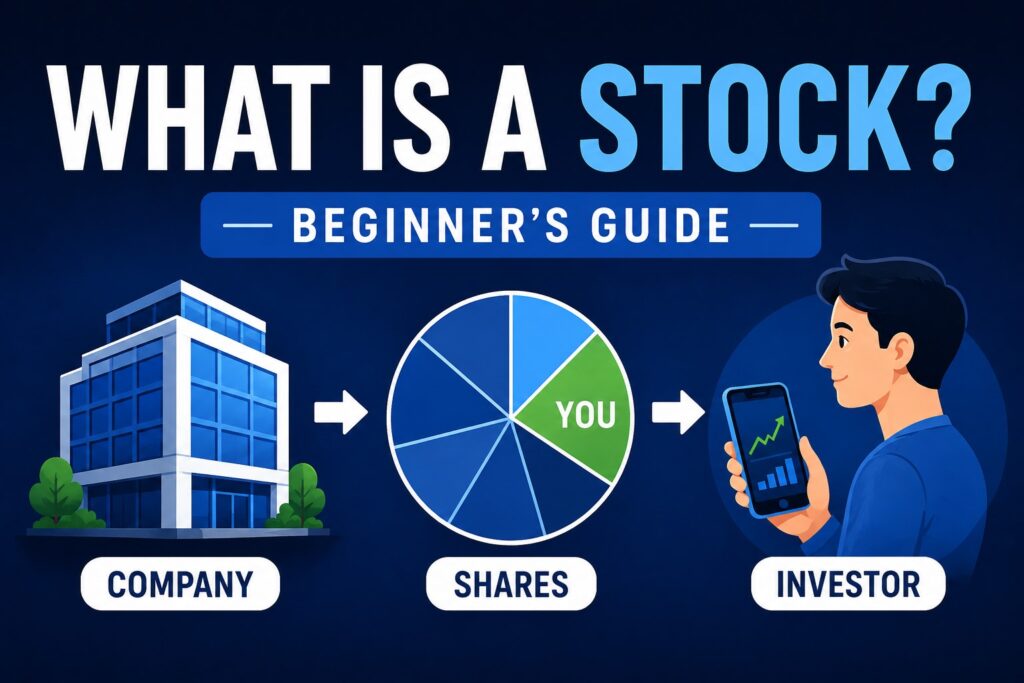
What Is a Stock? A stock is a small piece of ownership in a company, and buying one means you become a partial owner of that business.
This idea may sound simple, but it is one of the most important concepts in investing. When people talk about buying Apple, Microsoft, Coca-Cola, or any other public company, they are usually talking about buying shares of stock.
For beginners, the stock market can feel confusing because prices move every day. Some stocks rise quickly, while others fall sharply. News headlines, earnings reports, interest rates, and investor emotions can all affect prices.
When I first learned about stocks, I thought stock investing was mostly about finding prices that would go up. Later, I realized that understanding the business behind the stock matters much more than guessing short-term price moves.
But before thinking about price movements, it helps to understand the basic idea: a stock is not just a number on a screen. It represents ownership in a real business.
This guide explains stocks in simple language, how shareholders make money, why stock prices move, and what beginners should look at before buying a stock.
Key Takeaways
- A stock represents partial ownership of a company.
- A shareholder is someone who owns shares of a business.
- Stock prices can move because of earnings, interest rates, economic conditions, news, and investor sentiment.
- Investors may make money through capital gains or dividends.
- Stocks are not guaranteed like bank deposits.
- A low stock price does not automatically mean a stock is cheap.
- Understanding how a company makes money is often more important than watching daily price movements.
What Is a Stock?
A stock is a financial asset that represents ownership in a company. When a company sells stock, it is selling small pieces of ownership to investors.
Companies often issue stock to raise money. They may use that money to expand operations, hire employees, develop products, open new locations, or invest in future growth. These ownership pieces are called shares.
Imagine a company is divided into one million pieces. If you own one share, you own one small piece of that business. While you may not influence company decisions directly, you still participate in the company’s financial journey as a shareholder.
A simple way to think about it is this:
Buying a stock means buying a small ownership claim on a real business, not simply betting on a price moving up or down.
That distinction matters because successful investing usually starts with understanding the business itself rather than trying to predict short-term market movements.
What Is a Stock Owner? Understanding Shareholders
Owning a stock means you are a shareholder.
As a shareholder, your ownership is proportional to the number of shares you own. If you own a few shares of a large company, your ownership stake is very small, but you are still a part-owner of that business.
For example, if you own one share of Apple, you do not get to decide what products the company launches next. However, you do own a tiny portion of the business and participate in its financial success as a shareholder.
Some stocks also provide voting rights. These rights allow shareholders to vote on certain corporate matters, although most individual investors buy stocks primarily because they want to participate in a company’s long-term growth.
The key idea is that your investment outcome is connected to the company’s business performance. If the business becomes more valuable over time, the stock may become more valuable as well.
Common Stock vs Preferred Stock
There are two main types of stock: common stock and preferred stock.
Most beginner investors buy common stock. It typically includes voting rights and offers the potential for long-term price appreciation.
Preferred stock works differently. It usually pays dividends before common stock and may provide more predictable income. However, it often has less growth potential than common stock.
| Type of Stock | Main Feature | Common Use |
|---|---|---|
| Common Stock | Ownership with voting rights and growth potential | Long-term investing |
| Preferred Stock | Priority dividend payments and income focus | Income-oriented investing |
For most beginners, common stock is the starting point and the type most frequently discussed in investing conversations.
For an official beginner explanation of stocks, you can also review Investor.gov’s stock basics.
Why Do Stock Prices Go Up and Down?
Stock prices change because investors continuously reassess what a company may be worth in the future.
One major factor is company earnings. If a company reports stronger profits than expected, investors may become more optimistic about future growth.
Interest rates also play an important role. Higher rates can increase borrowing costs for businesses and make lower-risk investments more attractive, which may put pressure on stock prices.
For a deeper beginner-friendly explanation, you can read my guide on Interest Rates and the Stock Market.
Economic conditions matter as well. Consumer spending, employment trends, inflation, and economic growth can all influence corporate performance.
Investor sentiment can move markets even when fundamentals have not changed significantly. Fear and optimism often drive short-term price fluctuations.
News is another important factor. Earnings announcements, product launches, management changes, regulatory developments, and global events can all affect investor expectations.
In practice, stock prices are influenced by:
- Company earnings
- Interest rates
- Economic conditions
- Investor sentiment
- News and market expectations
The mistake beginners often make is assuming every price move has a single cause. Markets are usually influenced by several factors at once.
Two Ways Investors Make Money From Stocks
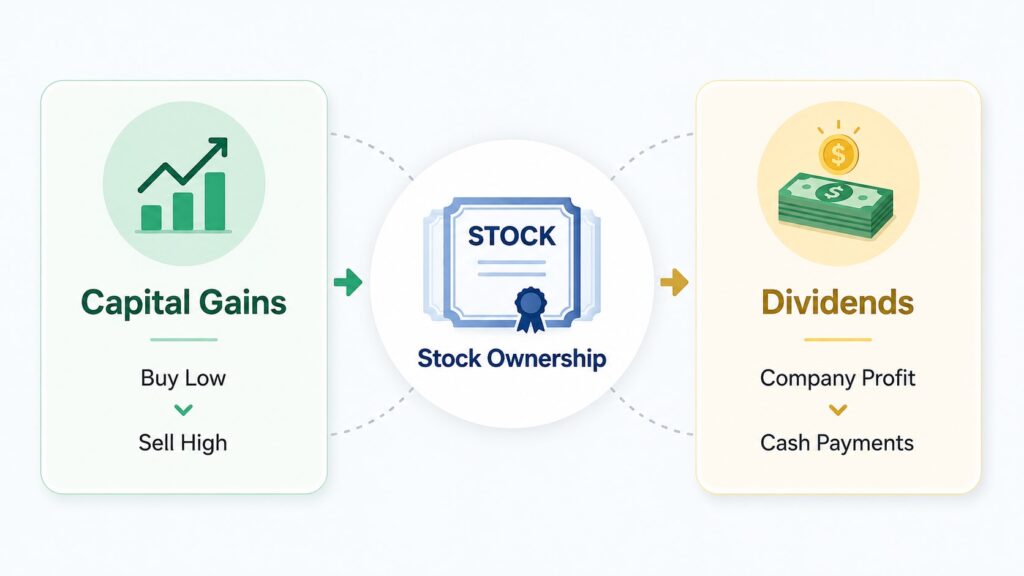
Investors generally earn returns from stocks through capital gains and dividends.
Capital Gains
A capital gain occurs when an investor sells a stock for more than the original purchase price.
For example, if someone buys a stock at one price and later sells it at a higher price, the difference is a capital gain.
Many investors focus on capital appreciation because successful businesses can grow significantly over long periods.
However, capital gains are never guaranteed. Stocks can also decline in value, leading to losses.
Dividends
A dividend is a payment that some companies distribute to shareholders.
Companies with consistent profits may choose to share a portion of those profits with investors through dividends.
Not all companies pay dividends. Some businesses prefer to reinvest profits into future growth opportunities instead.
The difference is simple:
- Capital gains come from rising stock prices.
- Dividends come from profit distributions paid to shareholders.
Some investors earn returns from both sources over time.
Basic Stock Market Terms Every Beginner Should Know
Many investing concepts become easier once you understand the language used by investors and financial media.
The table below explains several important stock investing terms in simple language.
| Term | Meaning | Common Beginner Misunderstanding | Real-World Example |
| Stock | Ownership in a company | Thinking a stock is only a ticker symbol | Owning Microsoft stock means owning a small piece of Microsoft’s business |
| Shareholder | A person who owns shares | Thinking ownership has no connection to business performance | Shareholders may benefit if the company grows profits |
| Stock Price | Current market value of one share | Assuming a higher price means a better company | A $300 stock is not automatically better than a $30 stock |
| Dividend | Payment distributed to shareholders | Thinking all stocks pay dividends | Some mature companies pay dividends while many growth companies do not |
| Capital Gain | Profit from selling at a higher price | Assuming gains are guaranteed | Selling above your purchase price creates a capital gain |
| Investment Risk | Possibility of losing money | Believing stocks always rise over time | A company can lose value if business conditions worsen |
Instead of memorizing these definitions, try connecting each term to a real business. That approach often makes investing concepts easier to understand.
Advantages and Risks of Investing in Stocks
Stocks can be powerful long-term investment tools, but they are not guaranteed investments.
Unlike certain bank deposits that may be protected by government insurance programs, stocks can lose value and fluctuate significantly over time.
Advantages
- Potential for long-term growth
- Easy access through brokerage accounts
- Opportunity to participate in business growth
- Potential dividend income
- Exposure to economic expansion
Risks
- Prices can decline significantly
- Companies can experience financial difficulties
- Market volatility can influence emotions and decision-making
- Economic downturns can hurt stock performance
- Positive returns are never guaranteed
Stocks can help investors build wealth over time, but risk is a normal part of stock ownership.
My Beginner Mistake: Focusing Only on Stock Prices
When I first started learning about stocks, I spent most of my time staring at price charts.
If a stock dropped sharply, I assumed it had become a bargain. If a stock reached a new high, I assumed I had already missed the opportunity. That mindset made investing feel emotional rather than rational.
One mistake I remember making early was focusing on a company’s share price without understanding the business behind it. I saw a stock trading at a much lower price than well-known companies and assumed it must be cheap.
What I did not understand at the time was that a stock price alone tells you very little about a company’s quality, profitability, competitive position, or future prospects.
Over time, I realized that understanding how a company earns money is far more important than guessing where the stock price might move next week.
Today, when I research a company, I usually start with three simple questions:
- How does the company make money?
- Is demand for its products or services growing?
- What risks could hurt the business in the future?
A stock chart can show what happened.
A business helps explain why it happened.
That shift in perspective made stock investing much easier to understand.
Today, I try not to judge a stock only by whether it looks cheap on the chart. I first look for a business model I can explain in simple words, signs of steady demand, and risks that could weaken future earnings. This simple routine does not make investing risk-free, but it helps me avoid decisions based only on price movements.
What Beginners Should Look At Before Buying a Stock
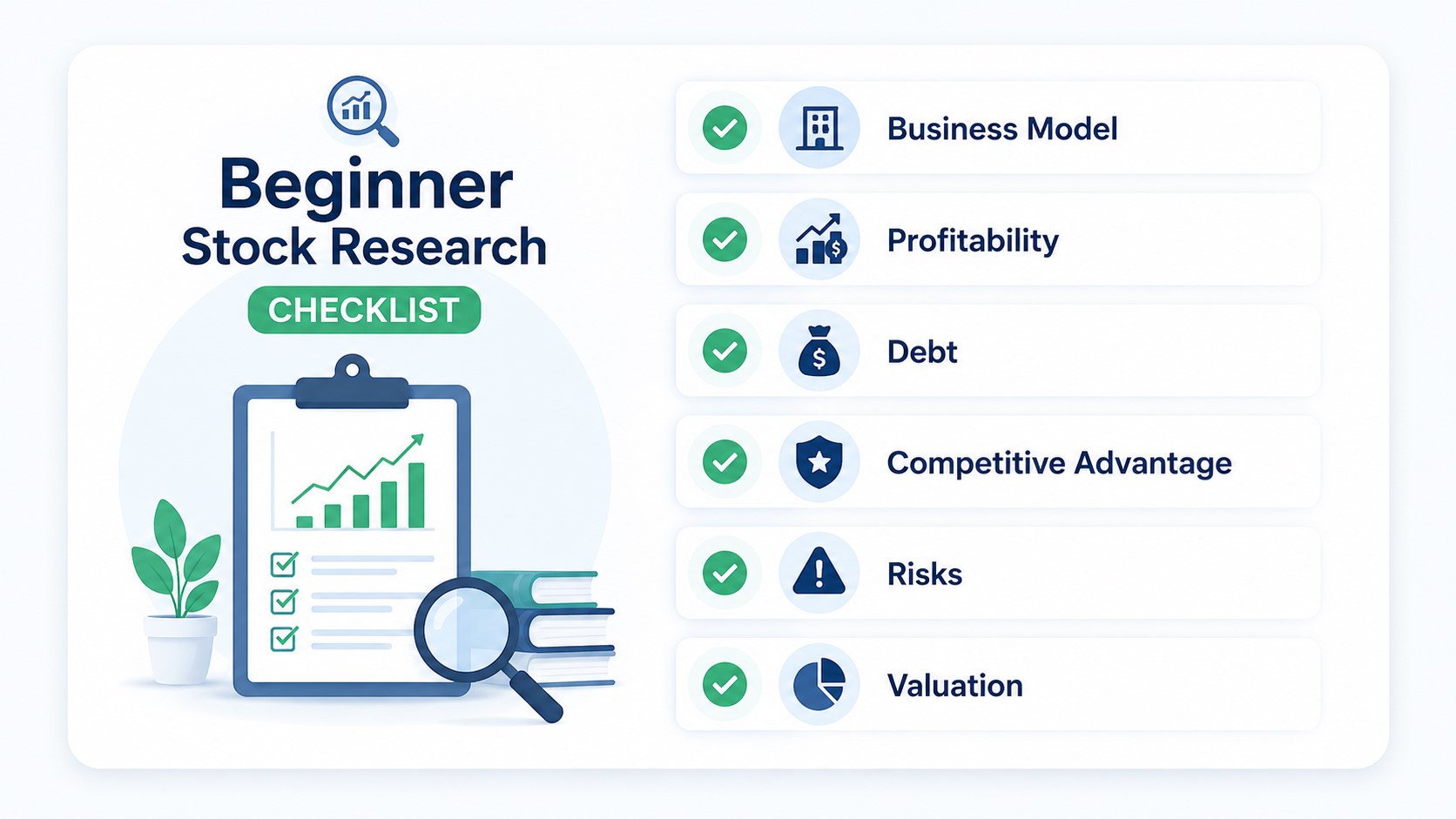
Before buying a stock, beginners should spend less time asking whether the price will rise tomorrow and more time understanding the business itself.
The first question is simple: How does the company make money?
If you cannot explain the business model in plain language, you may need more research before investing.
Next, look at profitability. Is the company generating profits, or is it still trying to reach profitability?
If you want to evaluate profitability, debt, and business quality more clearly, start with my guide on How to Read Financial Statements.
Debt levels are also important. Companies with excessive debt may face additional challenges during economic slowdowns or periods of higher interest rates.
Another useful question is whether the company has a competitive advantage. This could include a strong brand, loyal customers, unique technology, or an efficient business model.
Finally, consider risk. Every company faces challenges, including competition, regulation, changing consumer preferences, and economic uncertainty.
A simple beginner checklist might include:
- Can I explain how the company makes money?
- Is the company profitable?
- Does it have manageable debt?
- What makes it different from competitors?
- What risks could affect future performance?
- Am I buying because I understand the business or because the stock price is moving?
This checklist does not guarantee success, but it encourages better decision-making.
Using Reliable Sources for Stock Education
Because investing involves real money, beginners should learn from trustworthy sources.
Beginners can also review basic investor education materials from Investor.gov and financial term explanations from Investopedia.
These resources focus on education rather than speculation and can help build a stronger investing foundation.
Social media can be useful for discovering ideas, but it should not replace independent research. A short post may tell you what someone thinks, but it rarely explains the complete picture.
Final Thoughts
Before buying any stock, remember that investing is not about predicting tomorrow’s price movement. It is about understanding a business well enough to make informed decisions over time. The more you focus on the business itself, the less intimidating stock investing becomes.
Investors can make money through capital gains, dividends, or both. At the same time, stocks involve risk, and prices can move for many different reasons.
The most important lesson for beginners is simple: understand the business before focusing on the stock price.
A good next step is to learn how to review a company’s revenue, profits, debt, and cash flow. That is where stock investing starts to become less about guessing and more about making informed decisions.
This article is for educational purposes only and should not be considered personal investment advice.
❓ FAQ
Q1. What is a stock in simple terms?
A stock is a small piece of ownership in a company. When you buy a stock, you become a shareholder and own part of that business.
Q2. Are stocks guaranteed like bank deposits?
No. Stocks are not guaranteed like certain bank deposits. Stock prices can rise or fall, and investors can lose money.
Q3. What should beginners check before buying a stock?
Beginners should first understand how the company makes money. Then they should evaluate profitability, debt, competition, risks, and overall business quality.
Q4. Is buying one share of stock worth it?
Yes. Even one share can help beginners learn how stock ownership works and gain experience following a real company.
📚 Related Articles
How to Read Financial Statements: A Simple and Powerful Beginner’s Guide
Fundamental Analysis for Beginner Investors: A Smart Guide to Better Stock Decisions
Interest Rates and the Stock Market: A Beginner’s Practical Guide
Inflation and Stock Investing: A Smart and Essential Beginner’s Guide

Stock Valuation Checklist: 7 Critical Checks Before Calling a Stock Cheap
A stock can look cheap because its price has fallen 40%, its P/E ratio is…
RSI Divergence vs MACD Crossover: Which Is More Reliable for Trading?
RSI divergence can warn that price momentum is weakening before a reversal becomes obvious. A…

Before You Buy the Dip: 5 Critical Balance Sheet Checks Every Investor Should Make
A stock that falls 20%, 30%, or even 50% can suddenly look cheap. But a…
Disclaimer: This article is for educational purposes only. It is not financial advice or a recommendation to buy or sell any specific stock, ETF, cryptocurrency, or other asset. All investment decisions are your own responsibility.
Pingback: How to Read Financial Statements: A Simple and Powerful Beginner's Guide
Pingback: Fundamental Analysis for Beginner Investors: A Smart Guide to Better Stock Decisions