
Inflation and stock investing are closely connected because inflation changes how investors think about earnings, interest rates, and risk. When inflation rises, companies may face higher costs, consumers may spend more carefully, and central banks may raise interest rates to slow demand.
For beginner investors, the key is not to panic every time inflation appears in the news. The better goal is to understand how inflation flows through the market and how investors usually react to changing expectations.
What Is Inflation?
Inflation means prices are rising across the economy over time. If food, rent, energy, wages, and services become more expensive, the purchasing power of money declines. The same dollar buys less than before.
For investors, inflation matters because it can affect business profits, consumer demand, interest rates, and stock market valuations. A company may still grow revenue during inflation, but if wages, shipping, energy, and borrowing costs rise faster than sales, profit margins can weaken.
To understand official inflation data, readers can check the U.S. Bureau of Labor Statistics Consumer Price Index page.
Why Stock Markets Care About Inflation
Stock markets care about inflation because inflation can influence interest rates. When inflation stays too high, the Federal Reserve may raise interest rates or keep rates higher for longer. Higher rates can make borrowing more expensive for businesses and consumers.
They can also pressure stock valuations. If you are new to this topic, you may also want to read our guide on interest rates and the stock market.
A simple way to think about it is this: when interest rates are low, investors may be willing to pay more for future earnings. When interest rates rise, those future earnings are discounted more heavily.
This is especially important for companies whose profits are expected far in the future. That is why inflation is not only an economic topic. It is also a stock market topic.
A useful external source here is the Federal Reserve’s Monetary Policy page.
How Inflation Affects Different Stocks
Inflation does not affect every stock in the same way. Growth stocks are often more sensitive to interest rate expectations. Many growth companies are valued based on earnings expected far in the future. When rates rise, those future earnings may be worth less in today’s valuation model.
For example, a technology-heavy ETF such as QQQ may become more volatile when inflation pushes bond yields higher. This connects closely with how Treasury yields affect growth stocks. Investors may still like the companies inside the ETF, but they may become less willing to pay high valuation multiples.
This is why high-growth technology stocks can fall sharply even when the businesses are still strong.
Value stocks may react differently. Some companies in energy, consumer staples, utilities, or financials may handle inflation better, depending on pricing power and business conditions. Energy companies, for example, may benefit when oil and gas prices rise. Banks may sometimes benefit from higher interest rates, although the full picture depends on credit conditions and the yield curve.
This does not mean value stocks always win during inflation. It simply means investors often rotate between sectors as the macro environment changes.
A Real Market Example: The 2021–2022 Inflation Cycle
A clear example was the 2021–2022 inflation cycle. As U.S. inflation stayed high, the Federal Reserve began raising interest rates aggressively. During that period, many high-growth technology stocks came under pressure, while energy-related sectors performed relatively better.
The lesson is not that technology stocks are bad or energy stocks are always safe. The better lesson is that inflation can change how investors price risk.
When rates rise quickly, markets often become less forgiving toward expensive valuations and distant future earnings. Companies that looked attractive when money was cheap may suddenly look risky when bond yields rise.
This is why beginner investors should not look at stock prices alone. They should also ask what is happening in the macro background.
Readers can review historical rate data using FRED’s Federal Funds Effective Rate chart.
The Beginner Mistake: Reading Inflation Too Simply
One mistake I made early as an investor was focusing on a single economic indicator. During high-inflation periods, I used to check only the CPI headline number and assume the market would react in a simple way. If CPI came in hot, I expected stocks to fall. If CPI cooled, I expected stocks to rise.
But markets are rarely that simple. There were times when stocks rose even after a “bad” inflation report because investors had already expected worse. There were also times when stocks fell after a seemingly decent report because bond yields moved higher or the Fed sounded more hawkish.
That changed how I read macro data. Now I try to ask better questions:
- Was the inflation number higher or lower than expected?
- Was the surprise large or small?
- Were markets already positioned for bad news?
- Did Treasury yields rise or fall after the report?
- Did growth stocks or defensive sectors lead the market?
To answer these questions without getting overwhelmed, I highly recommend opening FRED Economic Data or a market tracking tool like TradingView right after a CPI release.
My practical tip for beginners is to look at the U.S. 10-Year Treasury Yield chart on FRED before checking individual stock tickers. Over time, I found that bond yields often reveal how the market is interpreting inflation data much faster than stock prices do. If the 10-year yield jumps sharply after a hotter-than-expected CPI report, it usually suggests that investors expect tighter Federal Reserve policy ahead. Seeing that reaction first helps me stay patient and avoid making emotional decisions based on a single market headline.
The market usually reacts to the full context, not one headline.
Why Expectations Matter More Than the Number Alone
Beginners often think markets react only to good news or bad news. In reality, markets react to the gap between expectations and reality.
For example, if inflation is high but slightly lower than expected, stocks may rise because investors feel relief. If inflation is lower than last month but still higher than expected, stocks may fall because the market was hoping for faster improvement.
This is why two inflation reports can look similar on the surface but create very different market reactions. A useful habit is to compare the actual CPI number with the consensus estimate. Then watch how Treasury yields, the U.S. dollar, and major indexes react after the data.
The first reaction is not always the final reaction, but it often gives clues about what investors are focused on.
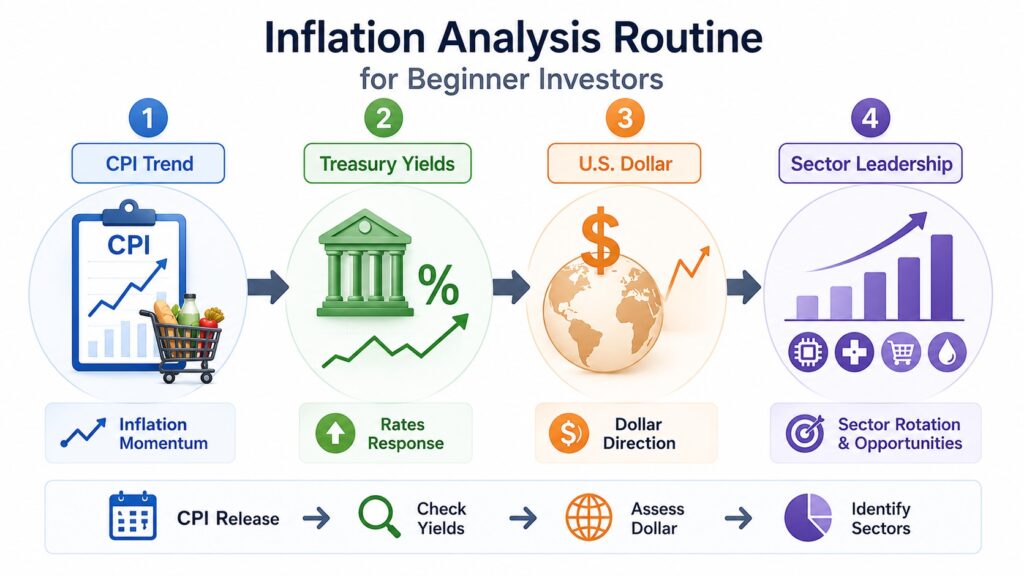
A Simple Inflation Analysis Routine
When inflation news comes out, I like to use a simple routine.
1. Check the Inflation Trend
Start with the trend. Is inflation cooling, accelerating, or staying sticky?
One monthly report matters, but the trend matters more. A single soft report may not change the Fed’s view if the longer trend is still uncomfortable.
2. Watch Treasury Yields
Next, I check U.S. Treasury yields, especially the 10-year Treasury yield. If yields rise after inflation data, growth stocks may face pressure because higher yields can reduce the appeal of long-duration assets.
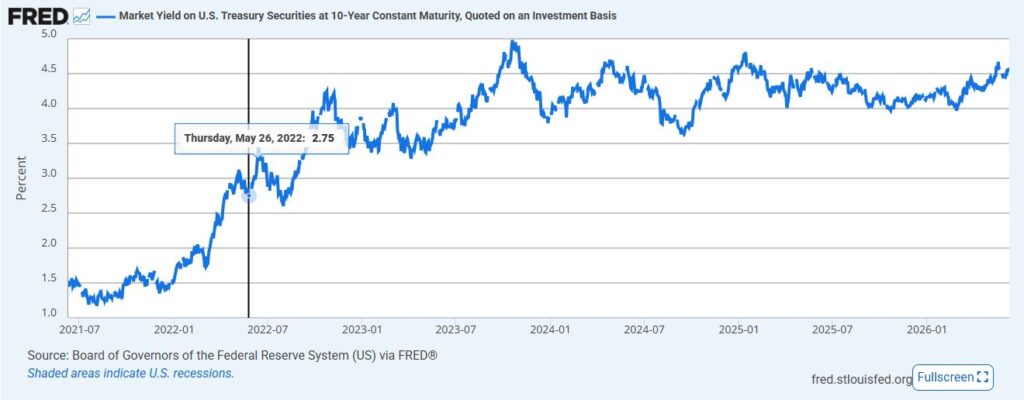
If yields fall, the market may be pricing in lower future rate pressure.
3. Look at the U.S. Dollar
The U.S. dollar index can also give useful clues. A stronger dollar can pressure multinational companies, commodities, and risk assets. A weaker dollar may ease some pressure on global liquidity and investor sentiment.
This does not mean the dollar explains everything. But it is worth checking.
4. Compare Sector Leadership
Finally, I look at which sectors are leading. If technology and consumer discretionary stocks lead, investors may be feeling more comfortable with growth and risk. If energy, staples, utilities, or defensive sectors lead, the market may be more cautious.
This routine does not predict the market perfectly. It simply helps investors avoid emotional decisions based on one headline.
Inflation and Stock Investing: What Beginners Should Remember
Inflation affects stock investing through several channels:
- Higher business costs
- Lower consumer purchasing power
- Higher interest rates
- Lower valuation multiples
- Sector rotation
- Changes in investor sentiment
For beginners, the most useful question is not simply: “Is inflation high?”
A better question is: “What does inflation mean for interest rates, earnings, and market expectations right now?”
That question leads to better analysis.
Final Thoughts
Inflation can pressure stocks, but the relationship is not automatic. Sometimes stocks fall when inflation rises. Sometimes stocks rise even after a hot inflation report because investors expected worse. Sometimes certain sectors benefit while others struggle.
This is why inflation should be treated as part of a broader macro framework, not a single buy-or-sell signal.
For beginner investors, the goal is to build a calm process: check inflation trends, watch interest rate expectations, compare sector leadership, and avoid reacting to one data release alone.
This article is for educational purposes only and is not investment advice.
❓ FAQ
Q1. Does inflation always hurt stocks?
No. Moderate inflation can happen during economic growth. Stocks usually react more strongly to unexpected or persistent inflation.
Q2. Why do growth stocks struggle when inflation rises?
Growth stocks often depend on future earnings. Higher interest rates can reduce the present value investors assign to those future earnings.
Q3. Can any stocks benefit from inflation?
Some sectors, such as energy or certain financial companies, may perform better in specific inflationary environments. It depends on the cycle.
Q4. What should beginners watch when inflation data comes out?
Beginners can watch CPI expectations, Treasury yields, the U.S. dollar, sector leadership, and the Federal Reserve’s policy signals.
Q5. Should beginners sell stocks when inflation rises?
Not automatically. Inflation is only one factor. Investors should also consider earnings, valuations, interest rates, and market expectations.
📚 Related Articles
Interest Rates and the Stock Market: A Beginner’s Practical Guide
How to Read US CPI Data: What Every Investor Should Know
What Is the Dollar Index? A Smart Beginner’s Guide to DXY and Global Markets
How U.S. Treasury Yields Affect Tech Stocks: A Smart and Powerful Beginner’s Guide

Stock Valuation Checklist: 7 Critical Checks Before Calling a Stock Cheap
A stock can look cheap because its price has fallen 40%, its P/E ratio is…
RSI Divergence vs MACD Crossover: Which Is More Reliable for Trading?
RSI divergence can warn that price momentum is weakening before a reversal becomes obvious. A…

Before You Buy the Dip: 5 Critical Balance Sheet Checks Every Investor Should Make
A stock that falls 20%, 30%, or even 50% can suddenly look cheap. But a…
Disclaimer: This article is for educational purposes only. It is not financial advice or a recommendation to buy or sell any specific stock, ETF, cryptocurrency, or other asset. All investment decisions are your own responsibility.
Pingback: Interest Rates and the Stock Market: A Beginner’s Practical Guide
Pingback: What Is a Stock? A Simple and Effective Beginner’s Guide
Pingback: Recession Signals: An Essential Beginner’s Guide to Reading the Economy and Stock Market
Pingback: How to Read US CPI Data: What Every Investor Should Know
Pingback: What Is the Dollar Index? A Smart Beginner’s Guide to DXY and Global Markets
Pingback: How U.S. Treasury Yields Affect Tech Stocks: A Smart and Powerful Beginner's Guide