
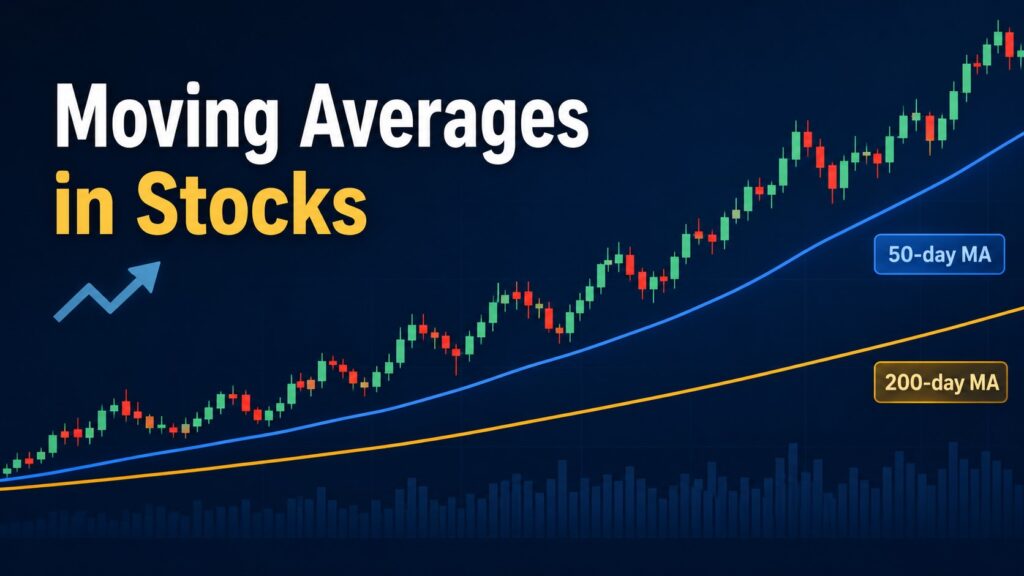
If you have ever opened a stock chart and noticed smooth lines moving across the price, you were probably looking at moving averages.
Moving averages in stocks are popular because they help investors see the bigger picture without getting distracted by every daily price swing. They do not predict the future, but they can help answer one important question: Is this stock generally trending higher, trending lower, or moving sideways?
For beginner investors, that question is often more valuable than trying to predict the next candle.
What Is a Moving Average?
Before using moving averages in stocks, it helps to understand what a moving average actually measures.
A moving average is simply the average closing price of a stock over a specific period.
For example:
- 20-day moving average = average closing price over the last 20 trading days
- 50-day moving average = average closing price over the last 50 trading days
- 200-day moving average = average closing price over the last 200 trading days
As new trading days are added, older data drops out of the calculation. This causes the moving average line to continuously update over time.
A simple way to think about it is this:
A stock’s current price reflects the latest balance between buyers and sellers, while a moving average smooths past prices to make the broader trend easier to see.
Why Moving Averages Matter for Investors
Markets are noisy.
A stock can rise sharply one day and fall the next. If you focus only on daily price movements, it becomes difficult to identify the larger trend.
Moving averages help smooth that noise.
When price remains above a rising moving average, it is consistent with an established upward trend. When price remains below a declining moving average, it is consistent with a downward trend.
The important point is that a moving average summarizes past price data. It confirms trend direction with a delay rather than predicting where price will move next.
This does not automatically create a buy or sell signal. Instead, it provides context.
For example, many investors monitor broad market ETFs such as SPY and QQQ relative to their 50-day and 200-day moving averages. If the overall market falls below key moving averages, even strong individual stocks can become more volatile.
The Most Important Moving Averages for Beginners
| Moving Average | Primary Use |
|---|---|
| 20-Day MA | Short-term trend |
| 50-Day MA | Medium-term trend |
| 200-Day MA | Long-term trend |
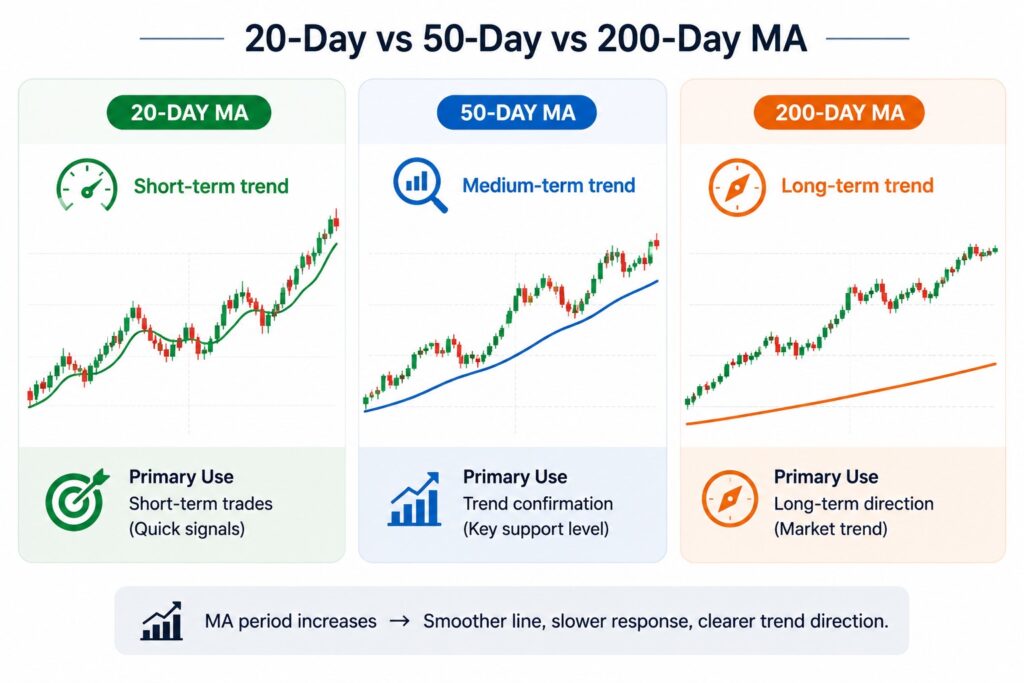
For most beginners, the 50-day and 200-day moving averages provide a practical starting point.
The 50-day moving average helps identify the medium-term trend, while the 200-day moving average provides a broader view of long-term market direction.
When price trades above both the 50-day and 200-day moving averages while both averages are rising, the pattern is generally consistent with an established upward trend.
When price remains below both averages while they are falling, the pattern is generally consistent with a downward trend.
Neither condition guarantees that the trend will continue.
A Practical Framework for Reading Moving Averages
The most practical way to use moving averages in stocks is to treat them as one part of the chart’s broader structure rather than as automatic trading signals.
A practical process is:
- Identify the broader trend. Start by determining whether the chart is generally rising, falling, or moving sideways.
- Check price position. See whether price is above, below, or repeatedly crossing the 50-day and 200-day moving averages.
- Check the slope. A rising, falling, or flat moving average provides different information even when price is on the same side of the line.
- Examine support and resistance. Determine whether important price levels reinforce or conflict with the moving-average signal.
- Check volume. Strong participation can provide additional context for a breakout, breakdown, or reversal.
- Compare the broader market. An individual stock’s trend can behave differently when the overall market environment is weakening or strengthening.
The goal is not to make six indicators agree perfectly. It is to determine whether the evidence tells a consistent story or whether the chart is sending mixed signals.
How to Read Price Around a Moving Average
Many beginners focus only on whether price is above or below a moving average.
However, the direction of the moving average is just as important.
A rising moving average often suggests trend strength.
A falling moving average may indicate trend weakness.
A flat moving average can suggest a market that is moving sideways.
This distinction becomes especially important in sideways markets. When price repeatedly moves above and below a relatively flat moving average, crossover signals can produce whipsaws—moves that appear to confirm a new trend but quickly reverse.
In that environment, the moving average may provide less useful directional information than it does during a persistent trend. Support and resistance, volume, and the broader price structure become especially important.
A stock touching a moving average does not automatically mean it will reverse.
Investors should also evaluate:
- Trend direction
- Volume
- Support and resistance
- Market conditions
- Sector performance
The moving average becomes much more useful when viewed alongside these factors.
Volume is especially important here. If you are new to this concept, our guide on How to Read Stock Volume can help you understand whether a move has real participation behind it.
Golden Cross and Death Cross Explained
A Golden Cross occurs when the 50-day moving average rises above the 200-day moving average.
A Death Cross occurs when the 50-day moving average falls below the 200-day moving average.
These signals receive a lot of attention in financial media because they are easy to understand.
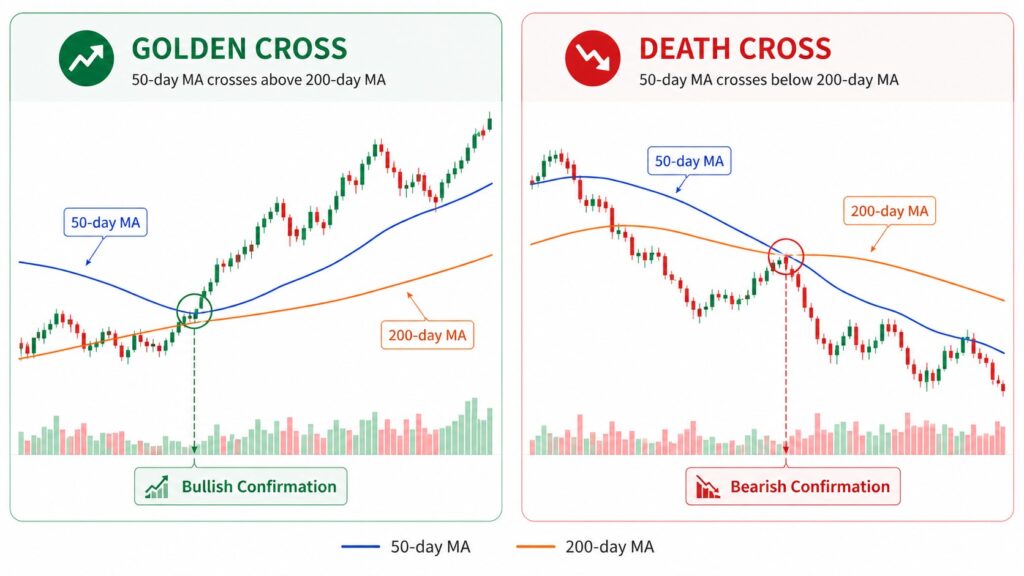
However, beginners often misunderstand them.
A Golden Cross does not guarantee future gains.
A Death Cross does not guarantee future losses.
A common beginner mistake is chasing a stock immediately after a Golden Cross appears in the news.
A Golden Cross is better understood as confirmation of a developing trend than as a standalone reason to buy.
The reason is simple: both moving averages are calculated from past prices. By the time the 50-day average crosses above the 200-day average, the stock may already have been rising for some time. The crossover therefore confirms a change that has already developed rather than identifying the exact beginning of a new trend.
Common Beginner Mistakes
When using moving averages in stocks, beginners often make several interpretation mistakes:
- Buying solely because price touches a moving average
- Chasing Golden Cross headlines
- Ignoring volume
- Focusing only on short-term charts
- Ignoring broader market trends
- Treating moving averages as exact support levels
The biggest lesson is simple.
Moving averages help identify trends, but they do not eliminate risk.
Highly volatile stocks can move sharply even while price remains above a moving average. A weakening sector or broader market can also change the significance of what initially appears to be a strong chart.
To read these short-term reactions better, it also helps to understand candle shapes and wicks. You can start with Candlestick Charts for Beginners.
A Simple Moving Average Checklist
Before using moving averages in stocks, ask yourself:
- Is price above or below the 50-day moving average?
- Is price above or below the 200-day moving average?
- Are the moving averages rising or falling?
- Is volume confirming the move?
- Is the broader market strong or weak?
- Am I looking at the full chart or just one indicator?
This checklist cannot predict the next price move, but it can help investors evaluate moving averages in a more consistent way.
If you want to practice reading moving averages visually, TradingView’s charting tools can help you compare different timeframes and moving average settings.
Final Thoughts
The most useful way to interpret moving averages in stocks is as evidence about trend direction, not as a prediction of what price will do next.
Price position matters, but so does the slope of the moving average and the market environment in which a crossover occurs. A rising moving average during a persistent trend can provide useful context, while repeated crossovers around a flat moving average may simply reflect a sideways market.
For beginners, the 50-day and 200-day moving averages provide a practical starting point. From there, moving averages become more useful when combined with price structure, support and resistance, volume, and broader market conditions.
The goal is not to find a moving average that always works. It is to understand when the indicator is providing useful trend information—and when market conditions make its signals less reliable.
❓ FAQ
Q1. What is the best moving average for beginners?
The 50-day and 200-day moving averages are common starting points because they provide useful views of intermediate- and longer-term trends. The appropriate period depends on the investor’s timeframe and purpose.
Q2. Is the 200-day moving average a buy signal?
No. It is a useful reference level, but it should be combined with volume, support and resistance, and broader market conditions.
Q3. Should I use moving averages alone?
No. Moving averages work best when combined with price action, volume, support and resistance, and broader market analysis.
📚 Related Articles
How to Read Stock Chart Trends: A Smart Beginner’s Guide
Support and Resistance in Stock Charts: A Beginner’s Guide to Better Buy and Sell Timing
Trading Volume for Beginners: How to Read It With Price Action
MACD Indicator Explained: A Smart Beginner’s Guide to Better Chart Reading

High Interest Rates and the Economy: Why Can Growth Stay Strong?
If high interest rates are supposed to slow the economy, why can consumers keep spending,…

Can AI Become a Monopoly? Where the Real Economic Moats Are
Artificial intelligence appears to have many ingredients that could produce powerful monopolies. Training frontier models…

Can Big Tech Maintain Its Profit Margins in the AI Era?
Artificial intelligence is creating new revenue opportunities for Big Tech, but it is also changing…
Disclaimer: This article is for educational and informational purposes only and does not constitute personalized investment advice or a recommendation to buy or sell any security. Investing involves risk, including the possible loss of principal.
Pingback: How to Read Bollinger Bands: 5 Beginner Mistakes to Avoid
Pingback: RSI Indicator Explained for Beginners: How to Read Momentum Without Overreacting
Pingback: Trading Volume for Beginners: How to Read It With Price Action
Pingback: Support and Resistance in Stock Charts: A Beginner's Guide to Better Buy and Sell Timing
Pingback: Stop Loss and Take Profit Strategy for Beginners
Pingback: MACD Indicator Explained: A Smart Beginner’s Guide to Better Chart Reading