
Treasury yields affect tech stocks mainly through discount rates, valuations, and investor expectations about future earnings. When the 10-year Treasury yield rises quickly, technology stocks can face valuation pressure even when there is no negative company-specific news.
Many beginners focus on earnings reports, product launches, and company news when evaluating technology stocks. Those factors matter, but they are only part of the story.
I first paid closer attention to this relationship during periods when the Nasdaq moved sharply as bond yields were rising, even though major technology companies had not suddenly reported bad news. That experience changed how I interpreted tech stock volatility.
Now, when growth stocks fall together, I do not immediately assume something is wrong with Apple, NVIDIA, Microsoft, or the broader technology sector. One of the first things I check is whether the 10-year Treasury yield is moving significantly.
The basic idea is simple: higher Treasury yields can raise the discount rate investors use to value future earnings. Because much of the value investors assign to growth-oriented technology companies depends on future earnings expectations, changes in yields can have an outsized impact on tech stock valuations.
But rising yields do not always mean tech stocks will fall. Why yields are rising—and whether earnings expectations remain strong—can matter just as much as the direction of yields themselves.
In this guide, you’ll learn what Treasury yields are, why investors watch the 10-year yield so closely, how Treasury yields affect tech stock valuations, and why rising yields can pressure the Nasdaq more during some periods than others.
If you are new to interest-rate investing, you may also want to read my beginner guide on how interest rates affect the stock market.
What Are U.S. Treasury Yields?
U.S. Treasury securities are debt instruments issued by the U.S. government. When investors purchase Treasury securities, they are lending money to the government in exchange for interest payments.
You can also learn more from the U.S. Treasury’s official marketable securities page.
The yield represents the return investors receive from holding those securities.
Common Treasury maturities include:
- 3-Month Treasury Bill
- 2-Year Treasury Note
- 10-Year Treasury Note
- 30-Year Treasury Bond
Treasury yields move throughout the day because bond prices fluctuate. When bond prices rise, yields typically fall. When bond prices fall, yields typically rise.
Because U.S. Treasuries are considered among the safest financial assets globally, their yields often serve as benchmark interest rates for the broader market.
Why the 10-Year Treasury Yield Matters
The 10-year Treasury yield is often viewed as the market’s reference rate.
Investors watch it because it reflects expectations about economic growth, inflation, Federal Reserve policy, and future interest rates. Many valuation models and financial products use the 10-year Treasury yield as a foundation.
When financial news reports mention “rising yields,” they are frequently referring to the 10-year Treasury.
Investors can track this data through FRED’s 10-Year Treasury Constant Maturity Rate chart.
💡 Quick Tip for Beginners: When searching on FRED, use the ticker code DGS10 to find the 10-Year Treasury Constant Maturity Rate instantly. Bookmarking this chart allows you to check the market environment in less than five seconds each morning.
How U.S. Treasury Yields Affect Tech Stocks
Technology stocks often depend heavily on future growth expectations. This creates a direct connection between Treasury yields and stock valuations.
When Treasury yields rise, investors can earn higher returns from relatively safe government bonds. As a result, future earnings generated by companies become slightly less attractive compared with those safer alternatives.
The market often adjusts by reducing the value assigned to future cash flows. This adjustment can pressure growth-oriented sectors such as technology.
For beginner investors, understanding how Treasury yields affect tech stocks can make it easier to separate company-specific news from broader macroeconomic pressure.
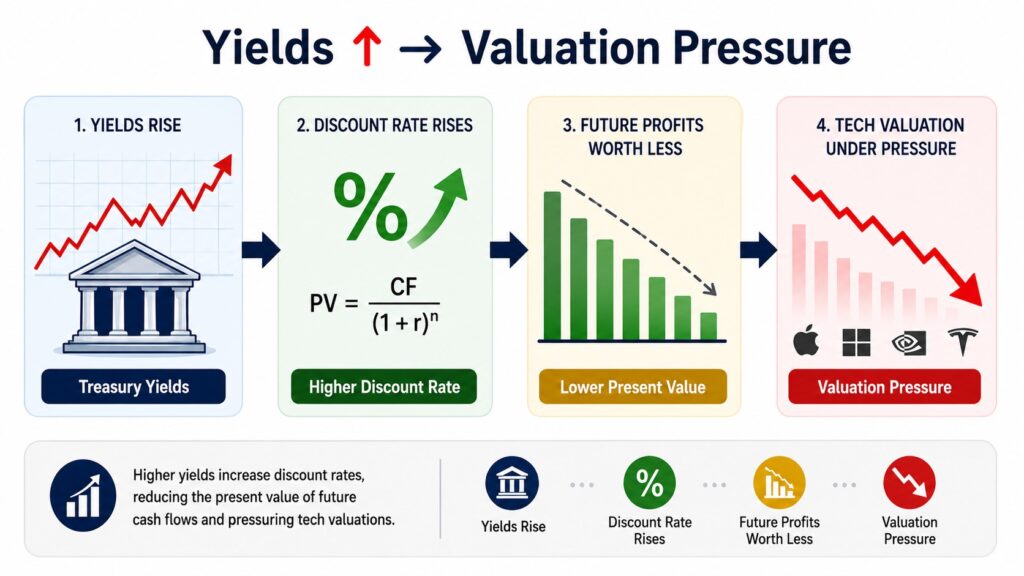
Comparison: Lower vs. Higher Treasury Yield Environment
| Factor | Lower Treasury Yields | Higher Treasury Yields |
|---|---|---|
| Borrowing Costs | Lower | Higher |
| Growth Stock Valuations | Often Higher | Often Lower |
| Investor Risk Appetite | Generally Stronger | More Selective |
| Future Earnings Value | More Valuable | Less Valuable |
| Technology Sector Impact | Supportive | Potential Headwind |
The Relationship Between Interest Rates and Valuation
One of the most misunderstood concepts among beginner investors is the discount rate.
Imagine a company expected to generate significant profits ten years from now. Those future profits are not worth the same as cash received today.
Investors use a discount rate to estimate what those future earnings are worth in today’s dollars. Treasury yields play an important role in that calculation.
When Treasury yields rise:
- Discount rates tend to increase.
- Future earnings become less valuable.
- Growth stock valuations may face pressure.
When Treasury yields fall:
- Discount rates tend to decrease.
- Future earnings become more valuable.
- Growth-oriented stocks may benefit.
This is one reason technology stocks often react strongly to bond market movements.
Why Growth Stocks Are More Sensitive to Yield Changes
Not all companies react equally to changes in Treasury yields.
A mature company generating stable cash flows today may be less affected. Growth companies are different because investors often buy them for significantly larger earnings in the future.
Examples include NVIDIA, Microsoft, Amazon, Tesla, and other technology leaders.
Because a large portion of their valuation is based on future expectations, changes in discount rates can have a larger impact on investor sentiment. This helps explain why technology-heavy indexes such as the Nasdaq often experience larger swings during periods of rapid yield movement.
Why Rising Yields Do Not Always Cause Tech Stocks to Fall
One common beginner mistake is assuming that rising yields automatically lead to falling technology stocks.
Markets rarely work that way.
The key question is why yields are rising.
Rising Yields Due to Economic Growth
If yields rise because economic growth is improving, corporate earnings may also strengthen. Strong earnings growth can offset some valuation pressure.
Rising Yields Due to Inflation Concerns
If yields rise because inflation remains elevated, investors may become more cautious toward risk assets.
Rising Yields Due to Federal Reserve Expectations
Markets often react to anticipated policy changes before they occur. Investor expectations frequently matter as much as actual rate decisions.
The context behind the move is often more important than the move itself.
Real-World Example: Nasdaq and Treasury Yield Movements
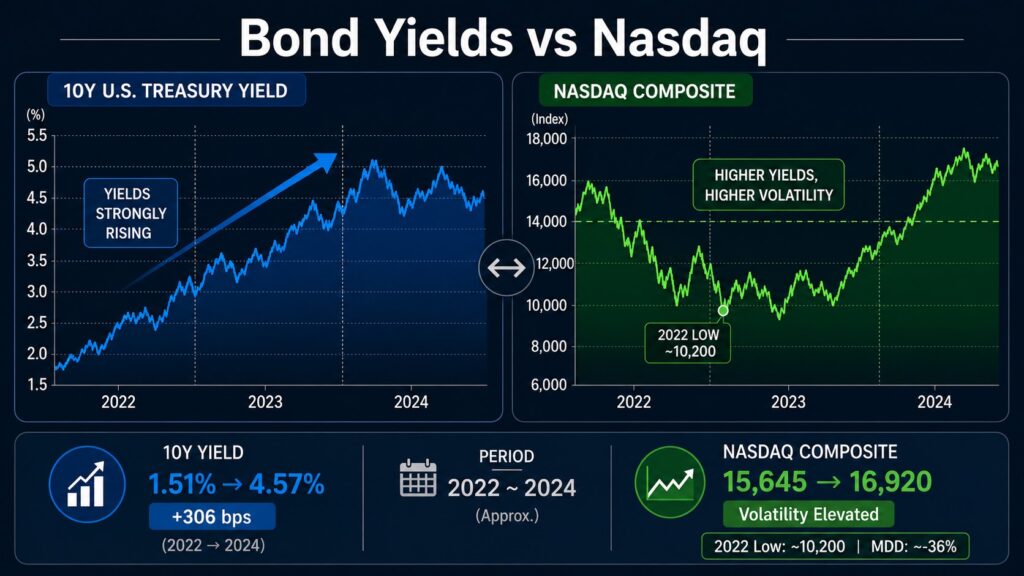
A useful example occurred during 2022, when the Federal Reserve aggressively raised interest rates to combat inflation. As Treasury yields moved higher throughout the year, many growth-oriented technology stocks faced valuation pressure.
Investors became less willing to pay premium prices for future earnings, and the Nasdaq experienced significant volatility.
Another example occurred during parts of 2023 and 2024 when the 10-year Treasury yield surged as markets reassessed inflation and interest-rate expectations. Even when many large technology companies continued reporting strong business results, rising yields often became a major topic among investors because they influenced valuation assumptions.
These periods highlighted an important lesson.
Technology stocks are influenced not only by company fundamentals but also by the broader interest-rate environment. That is why experienced investors often monitor bond markets alongside earnings reports.
My Personal Observation as a Retail Investor
One mistake I made early was focusing only on stock charts while ignoring Treasury yields.
Whenever the Nasdaq experienced a sudden pullback—especially during periods of bond market volatility when the 10-year Treasury yield spiked—I used to panic-search for company-specific bad news. I would assume that perhaps NVIDIA, Apple, or another major technology company had reported disappointing developments.
Over time, I realized that was not always the case. Sometimes the pressure was coming from the bond market rather than the companies themselves.
Rising Treasury yields were changing how investors valued future earnings. Understanding that relationship improved the way I interpreted market movements.
After that, I started checking the 10-year Treasury yield before reading individual stock news. This simple habit helped me avoid overreacting to every Nasdaq pullback.
One practical change I made was creating a simple routine. Before opening individual stock charts, I now spend a minute checking the 10-year Treasury yield, the latest inflation data, and the Nasdaq futures market. This does not tell me where stocks will go next, but it helps me understand whether the market is reacting to company news or broader macroeconomic forces.
Today, when technology stocks become volatile, I typically check three things before reacting emotionally:
- Is the 10-year Treasury yield moving sharply?
- Are inflation expectations changing?
- Are earnings trends still supporting long-term growth?
This approach does not predict market direction. However, it helps avoid a common beginner mistake: treating every Nasdaq decline as a company-specific problem.
Key Indicators I Watch Alongside Treasury Yields
Treasury yields provide useful information, but they should never be viewed alone.
10-Year Treasury Yield
Provides insight into long-term interest rate expectations.
Inflation Data
Consumer Price Index (CPI) reports often influence bond market behavior.
For a broader beginner-friendly explanation, you can also read my guide on how inflation affects stock investing.
Federal Reserve Policy
Market expectations about future rate decisions can significantly affect yields.
Investors can also review official policy statements and economic projections published by the Federal Reserve to better understand interest-rate expectations.
Nasdaq Performance
Helps gauge investor appetite for growth stocks.
Corporate Earnings
Long-term stock performance ultimately depends on earnings growth.
Quick Market Checklist
When technology stocks become volatile, ask:
- Are Treasury yields rising or falling?
- Why are yields moving?
- What is inflation doing?
- What is the Federal Reserve signaling?
- Are earnings expectations improving or weakening?
This framework can help investors focus on the bigger picture instead of reacting to headlines.
Final Thoughts
Understanding how Treasury yields affect tech stocks can make it easier to interpret periods of Nasdaq volatility.
Treasury yields influence discount rates, investor expectations, and stock valuations. Because growth-oriented technology companies depend heavily on expectations about future earnings, they can be particularly sensitive to rapid changes in yields.
But Treasury yields are only one part of the picture. Economic growth, inflation, Federal Reserve policy, and corporate earnings all matter.
That is why I view Treasury yields as a context indicator rather than a prediction tool. They may not tell us where technology stocks are headed next, but they can help explain why the market is moving.
For beginner investors, understanding that relationship is often more useful than trying to predict every short-term Nasdaq move.
❓ FAQ
Q1. Why do tech stocks react to Treasury yields?
Technology stocks often rely on future earnings growth. Rising Treasury yields increase discount rates, reducing the present value of those future earnings.
Q2. What Treasury yield matters most for investors?
The 10-year Treasury yield is generally the most widely followed because it reflects long-term economic and interest rate expectations.
Q3. Where can I track Treasury yield data?
Many investors use FRED’s DGS10 chart and official U.S. Treasury resources to monitor Treasury yields and broader interest-rate trends.
📚 Related Articles
Interest Rates and the Stock Market: A Beginner’s Practical Guide
Why US Treasury Yields and Nasdaq Can Rise Together: A Powerful Beginner’s Guide
Inflation and Stock Investing: A Smart and Essential Beginner’s Guide
Why Stocks Fall After Good Earnings: 5 Reasons Most Investors Miss

High Interest Rates and the Economy: Why Can Growth Stay Strong?
If high interest rates are supposed to slow the economy, why can consumers keep spending,…

Can AI Become a Monopoly? Where the Real Economic Moats Are
Artificial intelligence appears to have many ingredients that could produce powerful monopolies. Training frontier models…

Can Big Tech Maintain Its Profit Margins in the AI Era?
Artificial intelligence is creating new revenue opportunities for Big Tech, but it is also changing…
Disclaimer: This article is for educational purposes only. It is not financial advice or a recommendation to buy or sell any specific stock, ETF, cryptocurrency, or other asset. All investment decisions are your own responsibility.
Pingback: Interest Rates and the Stock Market: A Beginner’s Practical Guide
Pingback: What Is the Dollar Index? A Smart Beginner’s Guide to DXY and Global Markets
Pingback: Why US Treasury Yields and Nasdaq Can Rise Together: A Powerful Beginner’s Guide
Pingback: How to Read US CPI Data: What Every Investor Should Know
Pingback: Recession Signals: An Essential Beginner’s Guide to Reading the Economy and Stock Market
Pingback: Fundamental Analysis for Beginner Investors: A Smart Guide to Better Stock Decisions
Pingback: Russell 2000 Rally: Is the Big Tech Trade Finally Over?