
I used to feel nervous whenever the US 10-year Treasury yield started rising sharply. When I first started following the US stock market, I thought the relationship was simple: if yields rise, growth stocks fall.
So whenever the 10-year Treasury yield moved higher, I became cautious about Nasdaq-related stocks and sometimes reduced positions too early. But there were times when the Nasdaq continued to rise even as yields moved higher.
That experience taught me an important lesson. The market does not only care about whether yields are rising. It cares more about why they are rising.
This is the key to understanding US Treasury yields and Nasdaq, because the relationship depends more on market interpretation than on a simple rule. A higher yield can mean tighter financial conditions, but it can also reflect stronger growth expectations, better earnings, or improving business confidence. Those situations can lead to very different market reactions.
This article is for educational purposes only. It is not investment advice or a recommendation to buy or sell any security.
Key Takeaway
The Nasdaq can rise even when the US 10-year Treasury yield increases if investors believe the move reflects stronger economic growth, improving corporate earnings, or rising business confidence.
However, if yields rise because inflation remains sticky or investors expect the Federal Reserve to keep interest rates higher for longer, the market may react much more cautiously.
Instead of asking, “Are yields rising?” ask, “Why are yields rising?” That question usually leads to a better interpretation of the market.
For beginner investors, understanding US Treasury yields and Nasdaq together can make market reactions much easier to interpret.
The Basic Relationship Between Treasury Yields and Nasdaq
The US 10-year Treasury yield is often viewed as one of the most important benchmark interest rates in global financial markets. When this yield rises, borrowing costs can become more expensive. It can also reduce the present value of future corporate profits because investors use higher discount rates when valuing companies.
For official yield data, you can check the 10-Year Treasury Constant Maturity Rate on FRED.
This matters especially for growth stocks because much of their value is based on expected future earnings. That is why rising Treasury yields can pressure the Nasdaq, where many technology and growth companies are listed.
But this relationship is not automatic. If earnings expectations are strong enough, investors may still be willing to buy Nasdaq stocks even while yields are rising. For example, if major technology companies are reporting strong revenue growth, improving margins, or positive guidance, the market may focus more on future profits than on the negative effect of higher yields.
A simple way to think about it is this: higher yields can hurt valuations, but stronger earnings can support stock prices. The market is always balancing both sides.
Why US Treasury Yields and Nasdaq Can Rise Together
To understand why US Treasury yields and Nasdaq can rise together, start with the reason behind the yield move. Sometimes Treasury yields rise because investors expect the economy to remain strong. If companies are hiring, consumers are spending, and corporate profits are improving, bond investors may demand higher yields because growth expectations are rising.
At the same time, stock investors may become more confident about corporate earnings. This is one reason the Nasdaq can rise with Treasury yields.
Big Tech earnings are especially important. Companies involved in cloud computing, semiconductors, software, digital advertising, and artificial intelligence can have a large influence on Nasdaq performance.
When these companies report strong earnings or provide positive guidance, investors may believe that future profit growth can offset some of the pressure from higher interest rates. In that environment, rising yields do not always mean fear. They may signal that the market expects better growth.
For example, if semiconductor or cloud companies report better-than-expected earnings while demand for AI-related services remains strong, investors may focus more on future profit growth than on higher interest rates.
This was the part I missed when I first started watching Treasury yields. I focused too much on the number itself and not enough on the reason behind the move.
Good Yield Increase vs. Bad Yield Increase
Not all yield increases send the same message.
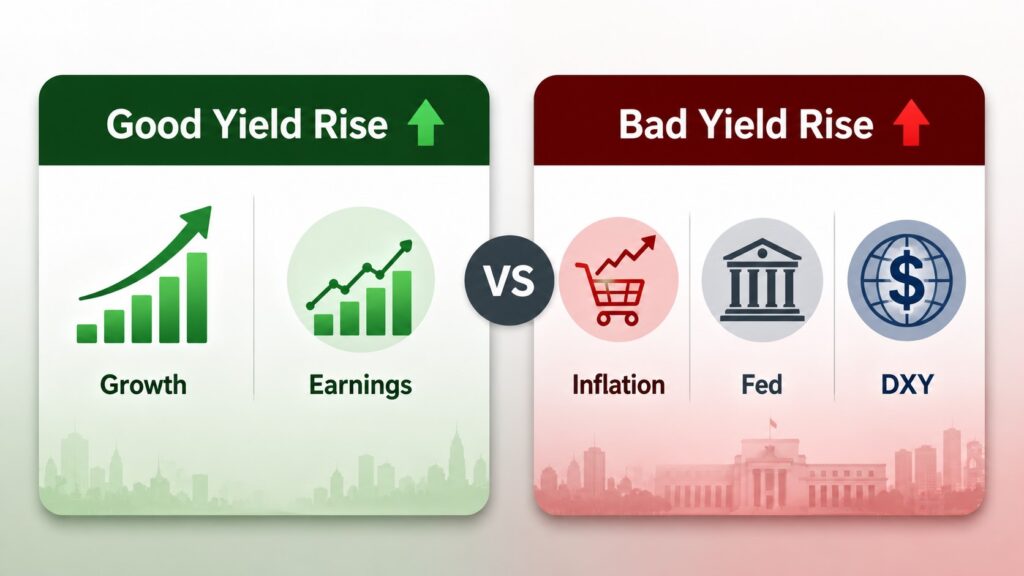
| Yield Increase Type | What It Usually Means | Why It Matters for Nasdaq |
|---|---|---|
| Growth-driven yield increase | Investors expect stronger economic activity | Nasdaq can rise if earnings expectations improve |
| Earnings-supported yield increase | Big Tech profits remain strong despite higher rates | Stock prices may stay resilient |
| Inflation-driven yield increase | Investors worry about higher prices and lower purchasing power | Nasdaq may face pressure from tighter Fed expectations |
| Fed-driven yield increase | Markets expect higher-for-longer interest rates | Growth stock valuations may weaken |
| Risk-premium yield increase | Investors demand more compensation to hold bonds | Market sentiment can become more fragile |
This table is important because beginner investors often treat every yield increase as the same signal. It is not. A yield increase caused by stronger growth is very different from a yield increase caused by sticky inflation.
Why Inflation-Driven Yield Increases Are More Dangerous
Inflation is where the story changes. If Treasury yields rise because inflation remains high, investors may worry that the Federal Reserve will keep interest rates elevated for longer. That can pressure growth stocks because higher rates reduce the present value of future earnings.
For official inflation data, the Bureau of Labor Statistics CPI page is a useful source to check.
This is where real yields matter. Real yield means the Treasury yield after adjusting for inflation expectations. In simple terms, it shows how tight financial conditions feel after inflation is considered.
For example, if nominal yields rise but inflation expectations rise even faster, the real pressure may not be as strong. But if real yields rise sharply, it can mean money is becoming more expensive in a deeper way.
The Dollar Index, also known as DXY, is another useful indicator to watch. DXY tracks the US dollar against a basket of major currencies. A stronger dollar can tighten global financial conditions because many companies, countries, and investors rely on dollar-based funding.
If Treasury yields, real yields, and DXY all rise together, the market may become more cautious. That combination can be very different from a healthy yield increase driven by growth and earnings.
A Common Mistake Beginner Investors Make
The biggest mistake is reacting to one indicator alone. Many beginners see the US 10-year Treasury yield rising and immediately assume the Nasdaq must fall.
I made a similar mistake early on. I looked at the yield chart, but I did not check whether Big Tech earnings were improving, whether inflation expectations were changing, or whether the market was pricing in a different Federal Reserve path.
That is why the Nasdaq’s strength confused me. The lesson is simple. One indicator rarely explains the whole market. A better approach is to connect several signals before forming a view.
Instead of asking, “Is the 10-year yield up or down?” I now try to ask, “What is the market reacting to?” That question usually leads to a better interpretation.
Since then, I no longer react to Treasury yields alone. Before forming a market view, I try to check earnings, inflation, real yields, and the Dollar Index together.
Practical Order to Check After Yields Rise
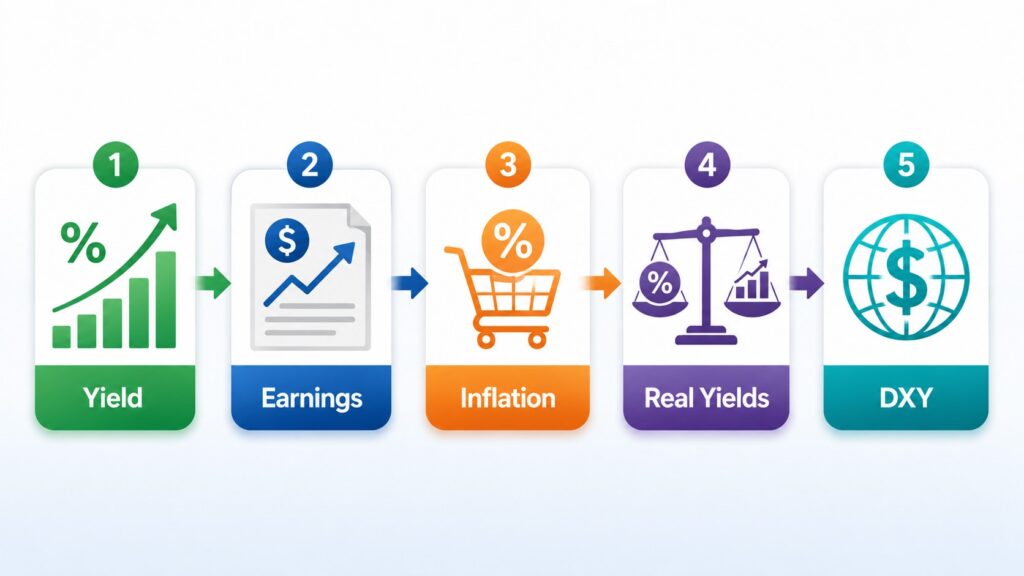
When the Nasdaq rises while Treasury yields also increase, I usually check the market in this order.
1. US 10-Year Treasury Yield
First, check whether the yield is rising slowly or sharply. A gradual move higher can sometimes reflect stronger growth expectations. A sudden spike may create more pressure because it can quickly change market expectations.
2. Nasdaq and Big Tech Earnings
Next, check whether major technology companies are supporting the move. Are earnings strong? Are margins improving? Are companies giving positive guidance?
If the answer is yes, the Nasdaq may remain resilient even with higher yields.
3. Inflation Expectations
Then check whether inflation fears are rising again. If investors think inflation is becoming sticky, they may expect the Federal Reserve to stay tighter for longer. That can create pressure on growth stocks.
You can also review the Federal Reserve’s monetary policy page to understand how policy expectations affect market reactions.
4. Real Yields
After that, check real yields. If real yields are rising sharply, financial conditions may be tightening more seriously. This can make high-valuation growth stocks more vulnerable.
5. Dollar Index DXY
Next, check the Dollar Index. If DXY is rising along with Treasury yields, it may signal tighter global liquidity. This can be a warning sign for risk assets.
6. Trading Volume and Market Breadth
Finally, check whether the Nasdaq rally is broad or narrow. If only a few large stocks are carrying the index, the rally may be weaker than it looks. But if many sectors and companies are participating, the move may be healthier.
This routine does not predict the market perfectly. It simply helps investors avoid reacting emotionally to one headline.
Beginner Checklist
Use this checklist before assuming rising yields are bad for the Nasdaq.
- Are yields rising because of stronger growth expectations?
- Are Big Tech earnings still strong?
- Is inflation cooling or heating up?
- Are real yields rising sharply?
- Is the Dollar Index moving higher?
- Are Federal Reserve expectations becoming more hawkish?
- Is Nasdaq trading volume supporting the move?
- Is the rally broad, or is it led by only a few large stocks?
If the answer is mostly growth and earnings, the Nasdaq may stay resilient. If the answer is inflation, rising real yields, a stronger dollar, and tighter Fed expectations, the market setup may become more fragile.
Practical Investor Takeaway
The relationship between US Treasury yields and Nasdaq is not a fixed rule. It is a market interpretation problem.
When I first watched yields rise, I focused too much on the number itself. Now I try to understand the reason behind the move.
Is the market pricing in better growth? Is inflation becoming a problem again? Are Big Tech earnings strong enough to support valuations? Are real yields and DXY sending a warning signal?
This kind of thinking is more useful than simply saying, “Yields are up, so stocks must go down.”
For beginner investors, this distinction matters because the same market signal can have different meanings depending on the background. A rising 10-year Treasury yield can be a warning sign, but it can also be a sign that investors expect stronger growth. The difference depends on the context.
❓ FAQ
Q1. Why can the Nasdaq rise when Treasury yields rise?
The Nasdaq can rise when Treasury yields rise if investors believe the increase is connected to stronger economic growth and better earnings expectations. If Big Tech profits remain strong, investors may still support Nasdaq stocks.
Q2. Are rising Treasury yields always bad for growth stocks?
No. Rising Treasury yields can pressure growth stock valuations, but the impact depends on why yields are rising. Growth-driven yield increases are different from inflation-driven yield increases.
Q3. Why should beginners watch real yields and DXY?
Real yields show whether financial conditions are tightening after inflation is considered. DXY shows the strength of the US dollar, which can affect global liquidity, investor sentiment, and risk assets.
Q4. What should investors check first when yields and Nasdaq rise together?
Start with the US 10-year Treasury yield, then check Big Tech earnings, inflation expectations, real yields, DXY, trading volume, and market breadth. This gives a more complete picture than looking at yields alone.
Conclusion
Understanding US Treasury yields and Nasdaq requires more than memorizing a simple rule, because the same yield move can mean different things in different market environments. Higher Treasury yields do not automatically mean the Nasdaq must fall. The market cares about the reason behind the yield move.
If yields rise because growth expectations and Big Tech earnings are improving, the Nasdaq can continue rising. But if yields rise because inflation is sticky, real yields are climbing, DXY is strengthening, and Federal Reserve expectations are becoming tighter, the market may become more vulnerable.
For beginner investors, the goal is not to predict every market move. The goal is to build a better interpretation routine.
Watch the yield, but also check earnings, inflation, real yields, the US dollar, trading volume, and Federal Reserve expectations. Markets rarely move because of one indicator alone.
The next time Treasury yields rise, do not ask only whether the Nasdaq will fall. Ask why yields are rising in the first place. That simple question can completely change how you interpret the market.
📚 Related Articles
How U.S. Treasury Yields Affect Tech Stocks: A Smart and Powerful Beginner’s Guide
Interest Rates and the Stock Market: A Beginner’s Practical Guide
Inflation and Stock Investing: A Smart and Essential Beginner’s Guide
Why Stocks Fall After Good Earnings: 5 Reasons Most Investors Miss

Stock Valuation Checklist: 7 Critical Checks Before Calling a Stock Cheap
A stock can look cheap because its price has fallen 40%, its P/E ratio is…
RSI Divergence vs MACD Crossover: Which Is More Reliable for Trading?
RSI divergence can warn that price momentum is weakening before a reversal becomes obvious. A…

Before You Buy the Dip: 5 Critical Balance Sheet Checks Every Investor Should Make
A stock that falls 20%, 30%, or even 50% can suddenly look cheap. But a…
Disclaimer: This article is for educational purposes only. It is not financial advice or a recommendation to buy or sell any specific stock, ETF, cryptocurrency, or other asset. All investment decisions are your own responsibility.
Pingback: How U.S. Treasury Yields Affect Tech Stocks: A Smart and Powerful Beginner's Guide