
When I first started learning how to read US CPI data, CPI releases were one of the most confusing macro events to follow. I thought lower inflation should always be good for stocks, and higher inflation should always be bad. But the market did not move that simply.
There were days when CPI looked high, but the Nasdaq went up. There were also days when CPI came in lower than the previous month, yet Treasury yields rose and stocks fell. At first, I thought the market was being irrational. Later, I realized I was looking at the wrong thing.
The key is not just whether CPI is high or low. The real question is whether CPI is higher or lower than market expectations. That is why learning how to read US CPI data is important for beginner investors. CPI can affect Federal Reserve expectations, US Treasury yields, the US dollar, Nasdaq futures, global stocks, and exchange rates.
This article is for educational purposes only. It is not investment advice. The goal is to help you build a calm routine when CPI data is released.
Key Takeaway
US CPI matters because it can change expectations about Federal Reserve policy. If inflation is stronger than expected, investors may expect interest rates to stay higher for longer. That can push Treasury yields and the US dollar higher, while putting pressure on growth stocks and the Nasdaq.
If inflation is weaker than expected, markets may expect a softer Fed stance. That can lower yields, weaken the dollar, and support risk assets. But the most important word is expected.
Markets usually react more to the gap between actual CPI and market expectations than to the CPI number alone.
What Is US CPI?
US CPI, or the Consumer Price Index, measures changes in the prices consumers pay for goods and services. It includes categories such as food, energy, housing, transportation, medical care, and recreation.
For investors, CPI is important because it gives a broad picture of inflation pressure in the US economy. Since the Federal Reserve watches inflation when making interest rate decisions, CPI can quickly affect stocks, bonds, currencies, and global markets.
However, CPI should not be read like a simple scorecard. A CPI report may look good at first glance but still worry investors if the details show sticky inflation. The opposite can also happen. A CPI report may look high, but markets may rally if the numbers are better than feared.
For readers who want to review the official methodology behind the CPI, the US Bureau of Labor Statistics (BLS) provides detailed information on how the index is calculated.
Understanding how to read US CPI data becomes much easier once you know how the report is structured and why investors focus on specific inflation measures.
Why Core CPI Matters More Than Headline CPI
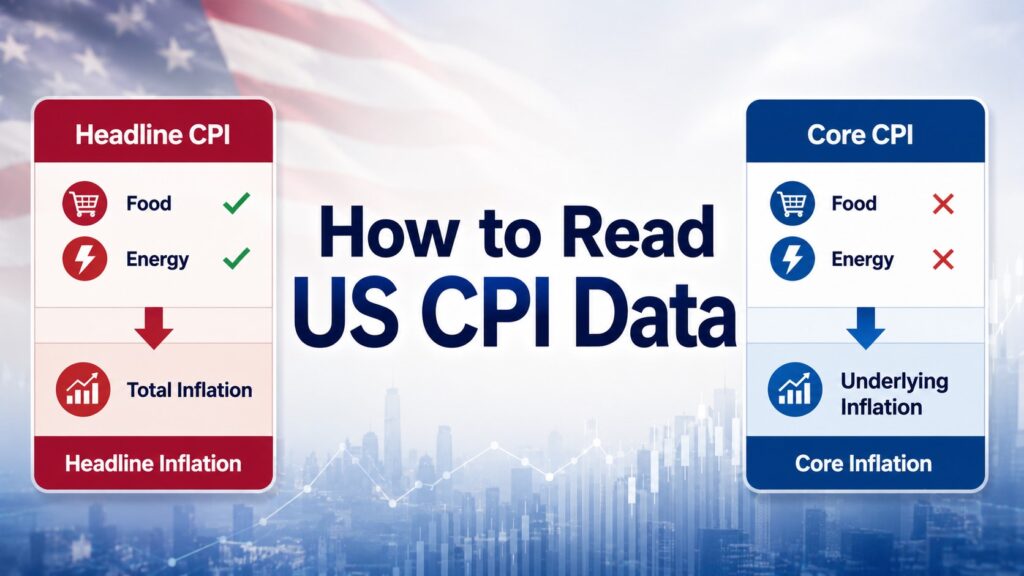
Headline CPI includes all consumer prices, including food and energy. Core CPI excludes food and energy because those prices can move sharply due to short-term factors such as oil prices, weather, or supply shocks.
That is why investors often pay close attention to Core CPI. It can give a cleaner view of whether underlying inflation is cooling or staying persistent.
| CPI Measure | What It Includes | Why Investors Watch It |
|---|---|---|
| Headline CPI | All consumer prices | Shows total inflation pressure |
| Core CPI | Excludes food and energy | Shows underlying inflation trend |
| Energy CPI | Gasoline, fuel, energy services | Can move sharply month to month |
| Shelter CPI | Rent and housing-related costs | Important because it can be sticky |
A common beginner mistake is assuming that lower headline CPI always means inflation is solved. For example, headline CPI may fall because gasoline prices declined. But if Core CPI remains firm, investors may still worry that inflation pressure is not cooling enough.
Why Month-Over-Month CPI Matters More Than Year-Over-Year CPI
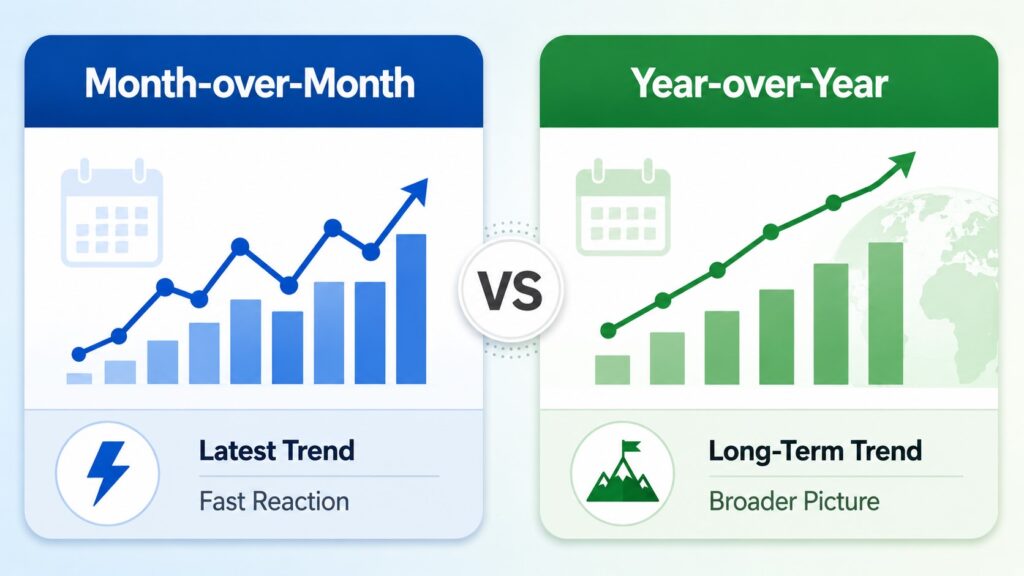
CPI is usually reported in two ways: month-over-month and year-over-year. Year-over-year CPI compares prices with the same month one year earlier. It is useful for seeing the bigger inflation trend.
Month-over-month CPI compares prices with the previous month. It is more important for short-term market reactions because it shows the latest inflation momentum.
For example, year-over-year inflation can look lower because last year’s comparison base was high. But if month-over-month CPI is rising again, investors may worry that inflation pressure is returning.
A simple way to think about it is this:
Year-over-year CPI shows the longer trend.
Month-over-month CPI shows the current speed.
Markets often care more about the current speed right after the release.
Why CPI Must Be Compared With Market Expectations
The market does not react to CPI in isolation. It reacts to whether CPI is above, below, or in line with market expectations.
If investors expected Core CPI to cool, but the report comes in hotter, Treasury yields may rise and Nasdaq futures may fall. If investors expected a hot report, but CPI comes in softer, stocks may rally even if inflation is still above the Federal Reserve’s long-term target.
This is where many beginner investors get confused. They ask, “Why did stocks fall when inflation was lower than last month?” The answer is often simple: inflation was lower than last month, but not as low as the market expected.
How to Read US CPI Data After the Release
After a CPI report is released, I try not to react to one headline number. Instead, I check the market reaction in a specific order. This routine helps me avoid emotional decisions.
1. Headline CPI and Core CPI
First, I check both headline CPI and Core CPI. Headline CPI tells me the broad inflation picture. Core CPI tells me whether underlying inflation is cooling or staying sticky.
If headline CPI is soft but Core CPI is firm, I do not immediately assume the report is bullish. For markets, Core CPI often carries more weight because it gives a better signal about persistent inflation pressure.
2. Month-Over-Month CPI
Next, I check the month-over-month numbers. This is where the market often focuses first.
A small monthly increase can support the idea that inflation is cooling. A stronger monthly increase can make investors worry that inflation is becoming sticky again.
For beginner investors, this is one of the most important points. Do not look only at year-over-year CPI. Always check month-over-month CPI as well.
3. Market Expectations
After checking the actual CPI numbers, I compare them with expectations. This is the step many beginners skip.
A CPI number can look high in absolute terms but still be positive for markets if it is lower than expected. A CPI number can look lower than last month but still hurt markets if it is higher than expected.
The market is always comparing reality with what was already priced in.
4. US 10-Year Treasury Yield
The US 10-year Treasury yield is one of the most important signals after a CPI release. If CPI is hotter than expected, the 10-year yield may rise because investors expect interest rates to stay high.
Higher yields can pressure stock valuations, especially growth stocks. If CPI is softer than expected, yields may fall because investors expect inflation pressure to ease.
When I check CPI, I always watch whether the 10-year yield is rising or falling after the release.
5. Dollar Index
The Dollar Index, or DXY, measures the US dollar against a basket of major currencies. Hotter CPI can support the dollar because higher interest rate expectations make dollar assets more attractive.
Softer CPI can weaken the dollar if investors expect the Federal Reserve to become less restrictive. For international investors, DXY is important because it affects global liquidity, commodities, emerging markets, and exchange rates.
6. Nasdaq Futures
Nasdaq futures often react strongly to CPI because growth stocks are sensitive to interest rates. Many Nasdaq companies are valued based on future earnings expectations. When yields rise, those future earnings may be discounted more heavily.
That is why hotter CPI can pressure Nasdaq futures quickly. However, the first reaction is not always the final reaction. Sometimes yields spike first, then reverse lower. In that case, Nasdaq can recover after the initial drop.
This is why I try to wait for the first reaction to settle before drawing a conclusion.
7. Exchange Rates
For international investors, exchange rates are another key signal after a US CPI release. If US CPI is hotter than expected and the dollar strengthens, many local currencies may weaken against the US dollar.
This can affect investors who hold US stocks, ETFs, or dollar-denominated assets. A stronger dollar may increase the value of US assets in local currency terms, but it can also signal tighter global financial conditions.
Exchange rates such as EUR/USD, USD/JPY, GBP/USD, and other local currency pairs can all move when CPI changes expectations for US interest rates.
For global investors, CPI is not only a US inflation report. It can become a currency and liquidity event.
How International Investors Can Interpret CPI
International investors should not look only at the Nasdaq reaction. They should also watch the US dollar and exchange rates.
A hotter-than-expected CPI report may lead to:
- Higher US Treasury yields
- Stronger US Dollar Index
- Weaker local currencies against the dollar
- Pressure on Nasdaq and growth stocks
- More volatility in emerging markets
A softer-than-expected CPI report may lead to:
- Lower US Treasury yields
- Weaker US Dollar Index
- Stronger local currencies against the dollar
- Relief rally in Nasdaq
- Better sentiment for risk assets
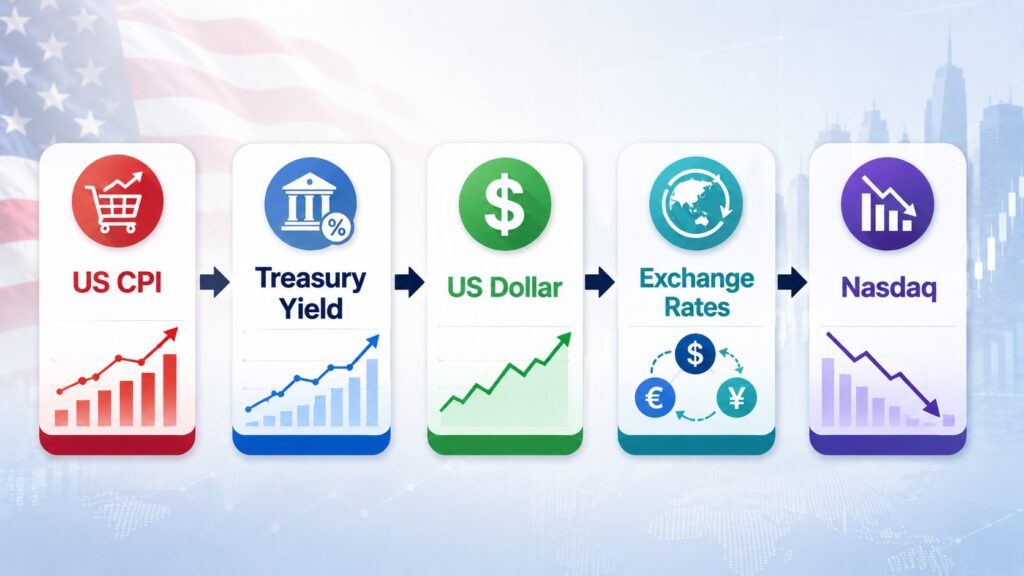
The key is to connect the dots. CPI affects Federal Reserve expectations. Fed expectations affect Treasury yields. Yields affect the US dollar. The dollar affects exchange rates and global risk sentiment. Nasdaq and other risk assets then react to this changing macro environment.
Practical CPI Release Checklist
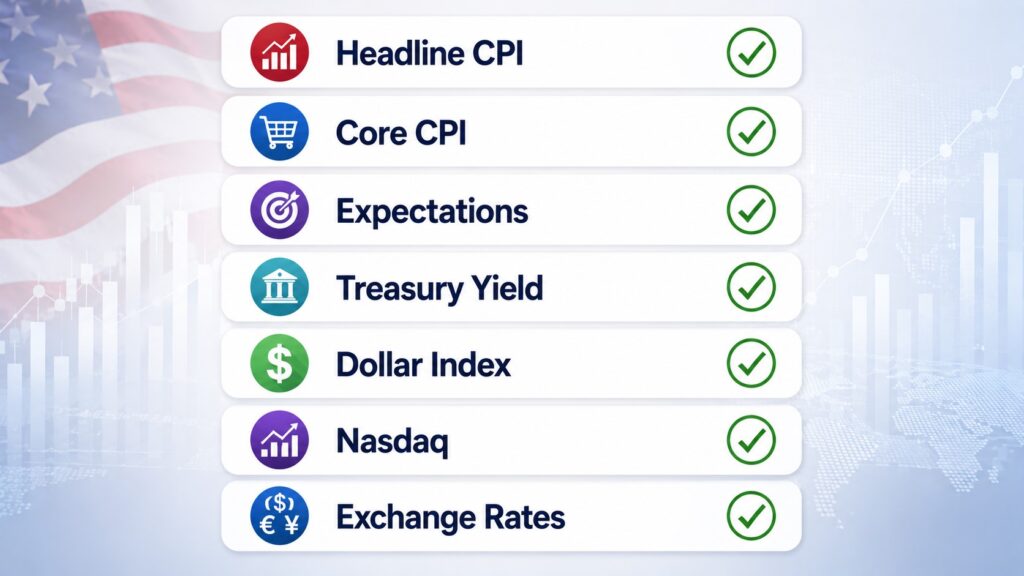
Use this checklist when learning how to read US CPI data after every release.
- Check headline CPI month-over-month.
- Check Core CPI month-over-month.
- Compare both numbers with market expectations.
- Check headline CPI year-over-year.
- Check Core CPI year-over-year.
- Watch the US 10-year Treasury yield.
- Check whether the US Dollar Index is rising or falling.
- Watch Nasdaq futures reaction.
- Check major exchange rates.
- Wait for the first reaction to settle before drawing conclusions.
- Ask whether the report changes Federal Reserve expectations.
- Avoid making investment decisions from one data point alone.
This checklist does not predict the market. It simply helps you interpret the reaction more calmly.
Common Beginner Mistakes When Reading CPI
One mistake is looking only at the headline CPI number. Another mistake is ignoring market expectations. A third mistake is reacting too quickly in the first few minutes after the release.
CPI days can be volatile because many markets move at the same time. Treasury yields, the dollar, Nasdaq futures, and exchange rates can all react within minutes.
That does not mean you need to trade immediately. For beginner investors, the better goal is to understand what the market is pricing in.
❓ FAQ
Q1. Is Core CPI more important than headline CPI?
Often, yes. Core CPI removes food and energy, which can be volatile. Investors watch it because it may show the underlying inflation trend more clearly.
Q2. Why does Nasdaq react strongly to CPI?
Nasdaq includes many growth stocks, which are sensitive to interest rates. If CPI raises expectations for higher rates, Nasdaq can come under pressure because future earnings are discounted more heavily.
Q3. Why do exchange rates move after US CPI?
CPI affects expectations for US interest rates. If markets expect higher rates, the US dollar may strengthen, which can move exchange rates around the world.
Q4. Is learning how to read US CPI data enough for investing?
No. Learning how to read US CPI data is important, but CPI is only one piece of the bigger market picture. Investors should also consider Federal Reserve communication, employment data, Treasury yields, earnings, and overall market sentiment.
Conclusion
Learning how to read US CPI data is not about memorizing one inflation number. It is about understanding the chain reaction.
For long-term investors, understanding CPI reports is a practical skill that makes it easier to interpret market reactions instead of simply following headlines.
CPI influences Federal Reserve expectations. Those expectations move Treasury yields. Yields influence the US dollar. The dollar affects exchange rates. Nasdaq and other risk assets then react to this changing macro environment.
For beginner investors, the goal is not to predict every CPI day perfectly. The goal is to build a calm routine.
For readers who want to understand how the Federal Reserve thinks about inflation and interest rates, the Federal Reserve’s official website provides useful policy information.
Check the data, compare it with expectations, watch yields, follow the dollar, and then interpret how stocks and exchange rates respond. That process is far more useful than reacting emotionally to a headline.
📚 Related Articles
Inflation and Stock Investing: A Smart and Essential Beginner’s Guide
Interest Rates and the Stock Market: A Beginner’s Practical Guide
What Is the Dollar Index? A Smart Beginner’s Guide to DXY and Global Markets
How U.S. Treasury Yields Affect Tech Stocks: A Smart and Powerful Beginner’s Guide

Stock Valuation Checklist: 7 Critical Checks Before Calling a Stock Cheap
A stock can look cheap because its price has fallen 40%, its P/E ratio is…
RSI Divergence vs MACD Crossover: Which Is More Reliable for Trading?
RSI divergence can warn that price momentum is weakening before a reversal becomes obvious. A…

Before You Buy the Dip: 5 Critical Balance Sheet Checks Every Investor Should Make
A stock that falls 20%, 30%, or even 50% can suddenly look cheap. But a…
Disclaimer: This article is for educational purposes only. It is not financial advice or a recommendation to buy or sell any specific stock, ETF, cryptocurrency, or other asset. All investment decisions are your own responsibility.
Pingback: What Is the Dollar Index? A Smart Beginner’s Guide to DXY and Global Markets
Pingback: Interest Rates and the Stock Market: A Beginner’s Practical Guide
Pingback: PCE vs CPI: Why Smart Investors Must Care About Core PCE