
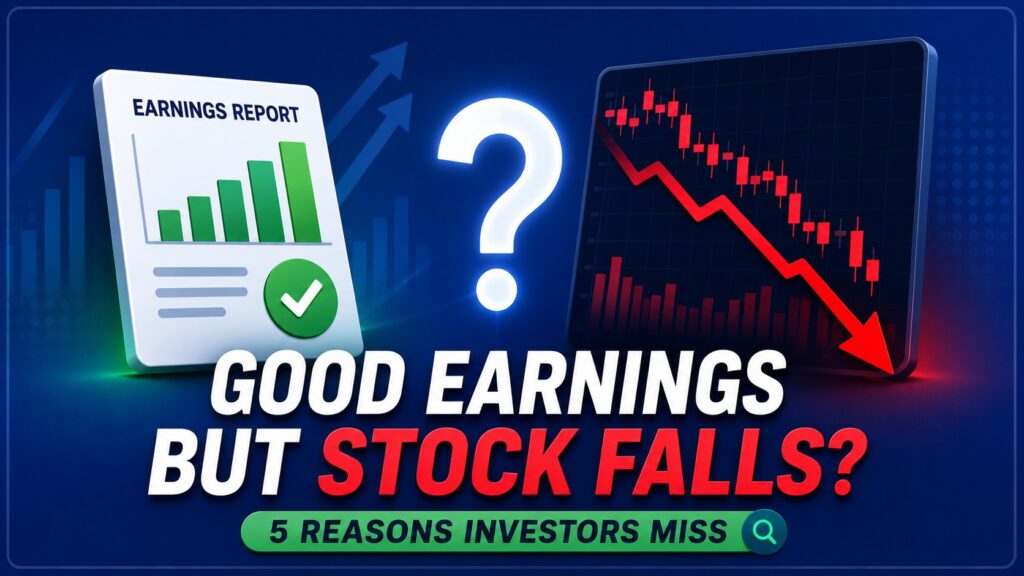
I still remember one earnings season that completely changed the way I looked at the stock market. A company I owned reported excellent quarterly results. Revenue beat estimates. Earnings per share came in higher than analysts expected. Every financial headline described it as an “earnings beat.”
I checked my brokerage account expecting to see a strong gain. Instead, the stock was already down sharply before the market had even been open for an hour. My first instinct was to think the market was overreacting and consider buying more.
But instead of rushing in, I decided to wait until I finished reading the earnings call transcript. Looking back, that decision taught me more about earnings season than any investing book ever had.
Later that evening, I listened to the earnings call instead of reading only the headlines. That was when I realized the numbers themselves had never been the whole story. Management sounded cautious about future demand, analysts had expected even stronger guidance, and Treasury yields had also risen sharply that week.
The company had delivered a good quarter, but the market was simply looking beyond it. That experience completely changed how I read earnings reports. Today, before making any investment decision after earnings, I spend far more time looking at expectations, valuation, guidance, and the overall market environment than I do looking at the earnings beat itself.
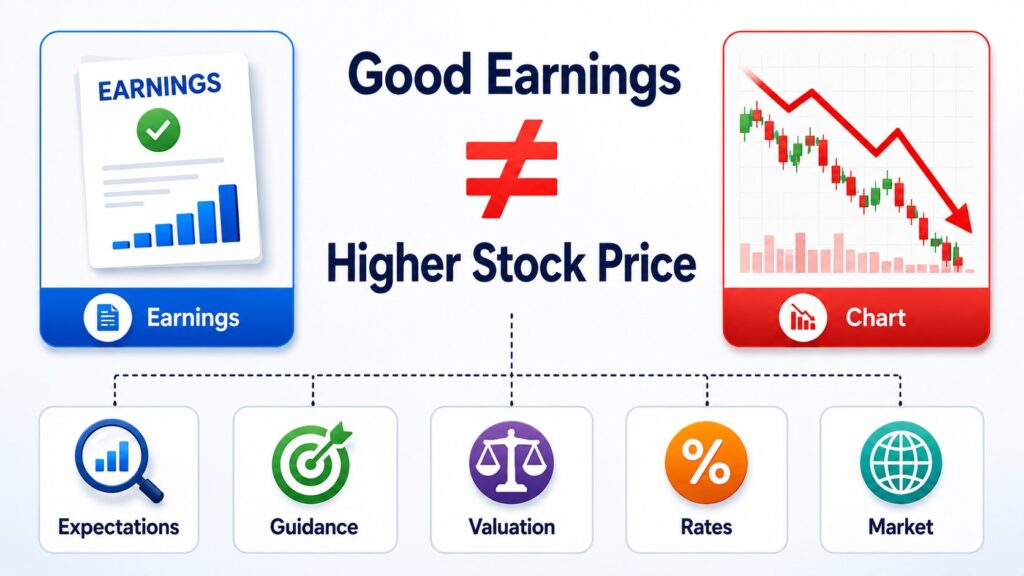
If you have ever wondered why stocks fall after good earnings, the answer is usually much more complicated than the headline suggests. In many cases, why stocks fall after good earnings comes down to one simple idea: the market reacts to what investors expected, not just what the company reported.
The Stock Market Prices the Future, Not the Past
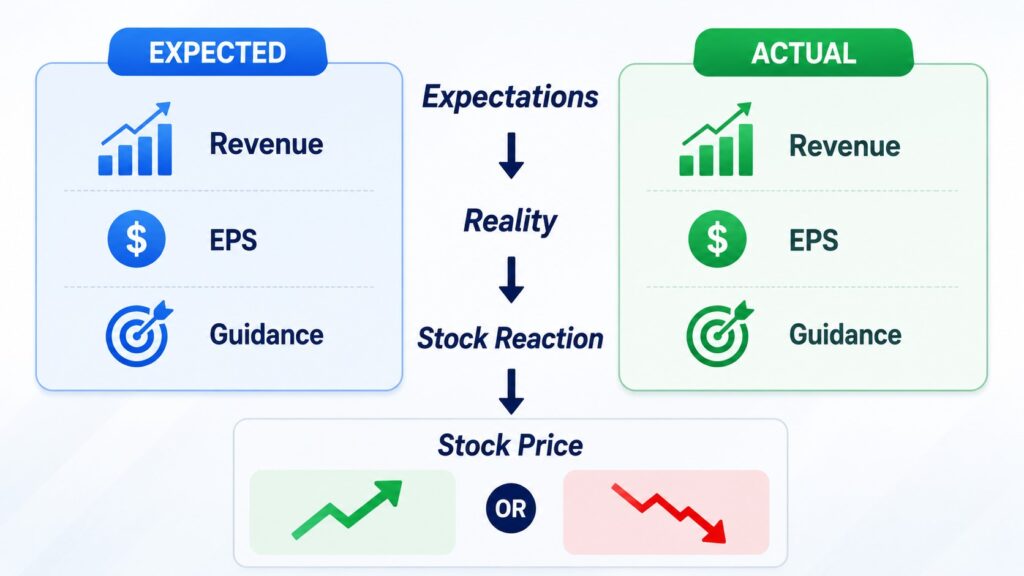
To understand why stocks fall after good earnings, you first need to understand that the stock market prices future expectations more than past results.
One of the biggest mistakes beginner investors make is assuming that a company’s stock price should immediately reflect how well the business performed during the previous quarter. That sounds logical, but the stock market rarely works that way.
Share prices represent what investors believe a company will earn in the future rather than what it earned yesterday. By the time earnings are officially announced, professional investors have already spent weeks analyzing sales trends, industry data, supply chains, management comments, and analyst revisions.
Much of the good news may already be reflected in the stock price before the earnings report is released. This is why two companies can report almost identical earnings results but experience completely different stock reactions.
One company surprises investors with better-than-expected future prospects. The other simply confirms what everyone already expected. Only one creates new information, and that difference matters much more than whether earnings beat consensus estimates by a few cents.
Expectations Move Markets More Than Headlines
Imagine two companies that both report earnings 10% above Wall Street estimates. Company A had already climbed 35% during the previous three months because investors expected outstanding results. Company B had barely moved because expectations were relatively low.
Even though both companies report the same earnings surprise, Company A may fall while Company B rallies. The reason is simple: expectations were completely different.
The market constantly compares reality with expectations. It does not reward good news by itself. It rewards news that is better than expected.
This is one of the clearest reasons why stocks fall after good earnings even when the earnings report looks strong on the surface.
That simple distinction explains many of the confusing price movements beginners see during earnings season. Whenever I review an earnings report today, I no longer ask, “Did the company beat earnings?” Instead, I ask, “Was the report strong enough to exceed what investors had already priced into the stock?”
That one question has saved me from making several emotional investment decisions.
The market does not reward good news by itself. It rewards news that is better than expected.
Buy the Rumor, Sell the News Happens More Often Than You Think
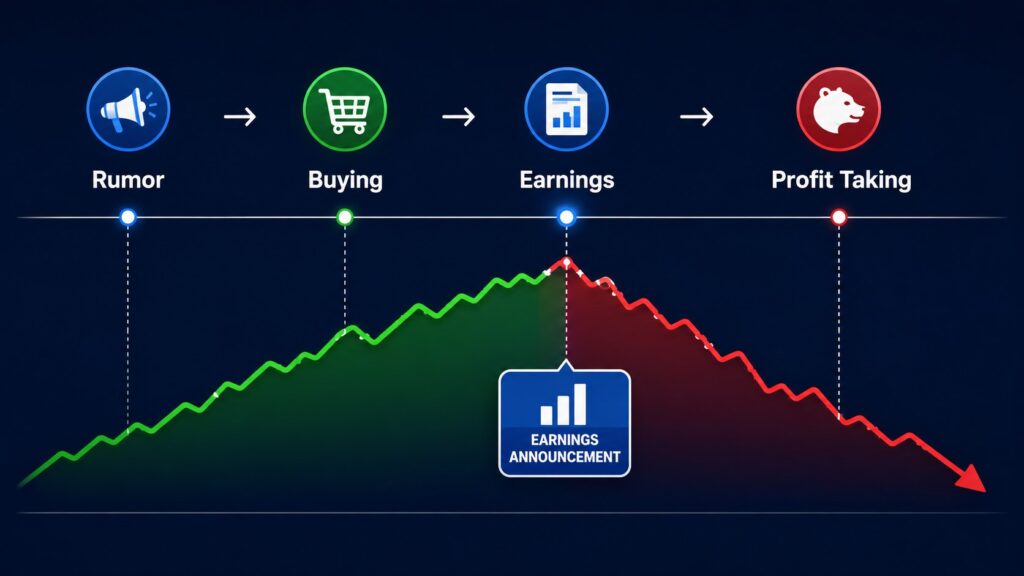
One of the oldest sayings on Wall Street is “buy the rumor, sell the news.” Although it sounds simple, many beginner investors misunderstand what it actually means.
Markets often begin moving long before official information becomes public. If investors believe a company will report excellent earnings, they may start buying weeks ahead of the announcement. By earnings day, that optimism may have already pushed the stock significantly higher.
Once the company finally confirms those expectations, many short-term traders lock in profits. The selling pressure causes the stock to fall even though the earnings report itself looks excellent.
Nothing went wrong. The future had simply been priced in earlier. This is one of the most common reasons why stocks fall after good earnings, especially among fast-growing technology companies and popular AI-related stocks.
Understanding this principle helped me stop chasing earnings headlines and start focusing on investor expectations instead.
Forward Guidance Often Matters More Than the Earnings Beat
One of the biggest lessons I have learned is that earnings numbers tell you what already happened. Guidance tells you what management believes will happen next. That difference is enormous.
This is another important reason why stocks fall after good earnings even when the headline numbers look strong.
Many beginner investors celebrate an earnings beat without paying attention to the conference call that follows. Professional investors often do the opposite. They read the earnings report first, but they spend much more time listening to management explain future demand, hiring plans, capital spending, margins, and customer activity.
Those comments frequently determine where the stock goes next. Imagine a software company reporting record revenue and higher profits. At first glance, everything looks excellent.
Then the CEO explains that enterprise customers are delaying new contracts because they expect slower economic growth next quarter. Nothing about the previous quarter changed. Only expectations for the future changed.
Within minutes, analysts lower their growth forecasts. Large institutional investors reduce their positions. The stock falls. The company did exactly what investors expected this quarter, but it failed to convince them about the next one.
That is why experienced investors often say that guidance matters more than the earnings beat itself.
For many beginner investors, this is the hardest part of understanding why stocks fall after good earnings: the market may care more about next quarter than the quarter that just ended.
Earnings numbers tell you what already happened. Guidance tells you what management believes will happen next.
Expensive Stocks Have Higher Expectations
Another reason stocks fall after good earnings is valuation. Think of valuation as the price investors are willing to pay for future growth.
If investors already believe a company will grow rapidly for many years, they are usually willing to pay a premium today. That premium creates a higher standard. A stock trading at a high valuation cannot simply deliver good results. It has to deliver exceptional results.
This is especially true for fast-growing technology companies. Whenever investors become extremely optimistic about artificial intelligence, cloud computing, or semiconductor demand, expectations rise together with stock prices. As prices climb higher, the margin for disappointment becomes much smaller.
Even a strong earnings report can trigger selling if investors expected something even better. Over the years, I have noticed that the biggest post-earnings declines often happen after companies report results that would have looked excellent under normal circumstances.
The problem was never the numbers. The expectations had simply become unrealistic. Valuation is another major reason why stocks fall after good earnings, especially when investors already paid too much for future growth.
Rising Treasury Yields Can Change Everything
One lesson I learned only after studying macroeconomics is that company earnings do not exist in isolation. The broader financial environment matters just as much.
Treasury yields are a good example. When government bond yields rise, investors can earn higher returns from relatively safe assets. That changes how they value future corporate profits.
Growth companies typically generate a larger share of their expected profits many years into the future. When interest rates increase, those future profits become less valuable in today’s dollars. As a result, investors often become less willing to pay premium valuations for growth stocks.
This explains why a technology company can report excellent earnings and still decline on the same day that Treasury yields surge. Early in my investing journey, I used to think the earnings report alone explained the entire stock reaction.
Now, one of the first charts I check after every major earnings release is the US 10-Year Treasury yield. If yields are rising sharply, I become much more cautious about interpreting a positive earnings report.
Sometimes the macro environment matters more than the company’s results. Market sentiment can also explain why stocks fall after good earnings, because even strong company results may not overcome broad selling pressure.
Market Sentiment Can Overpower Great Earnings
Not every stock reaction is company-specific. Sometimes investors are simply reducing risk across the entire market.
Imagine that inflation unexpectedly accelerates. The market begins worrying that the Federal Reserve may keep interest rates higher for longer. Technology stocks start falling together. Even companies that report excellent earnings may struggle because investors are selling the entire sector.
During these periods, good news often becomes an opportunity for institutional investors to reduce exposure instead of adding more. This is why I always look at the Nasdaq before making any conclusions about an individual earnings report.
If the entire market is under pressure, a weak stock reaction does not necessarily mean the earnings report was disappointing. Sometimes the company did everything right. The market simply cared more about inflation, interest rates, or recession risk.
Understanding this broader context has made me much more patient during earnings season. Instead of reacting immediately, I try to understand whether the selling is company-specific or driven by the overall market.
That distinction has helped me avoid several costly mistakes.
Why Great Companies Sometimes Fall 10% in One Day
Many investors assume that a double-digit decline means something must have gone terribly wrong. That is not always true.
A company may report record revenue, expanding profit margins, and strong cash flow. Yet the stock still drops 10%. How is that possible?
Usually, several small disappointments occur at the same time. Revenue beats expectations, but guidance is only maintained instead of raised. Profit margins improve, but management expects higher costs next quarter. Customer growth remains healthy, but executives sound slightly more cautious during the earnings call.
Meanwhile, Treasury yields rise, and investors become less willing to pay premium valuations. None of these developments is disastrous on its own. Together, however, they can completely change how investors value the company.
This is why successful investing requires looking beyond a single earnings headline. The market reacts to the complete picture, not just one impressive number.
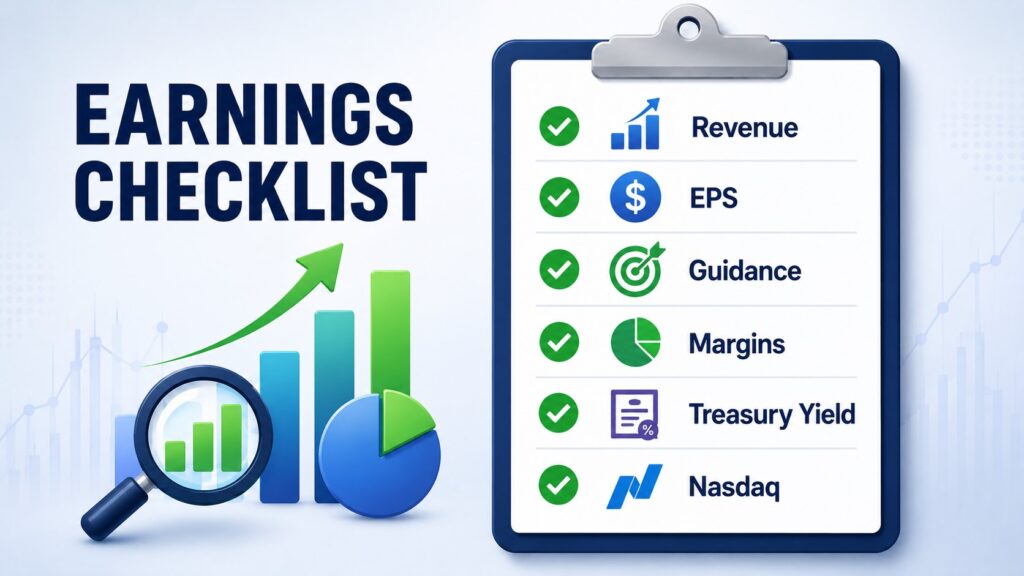
My Personal Earnings Checklist
Over time, I realized that reacting to earnings headlines was one of the fastest ways to make emotional investment decisions. Today, I follow the same checklist every earnings season. It does not guarantee better returns, but it helps me stay objective when markets become volatile.
It also helps me understand why stocks fall after good earnings instead of assuming the market is acting irrationally.
Step 1: Look Beyond EPS
Many investors focus only on whether earnings per share, or EPS, beat analyst estimates. I also compare revenue growth, gross margin, operating margin, free cash flow, and year-over-year growth.
Sometimes EPS improves because a company cuts costs rather than grows its business. Revenue trends often provide a better picture of long-term business quality.
Step 2: Read the Guidance Carefully
Next, I read management’s outlook. I ask myself three simple questions: Did management raise guidance? Did they maintain previous expectations? Did they lower future projections?
A company can report excellent results today while signaling slower growth tomorrow. That future outlook often has a greater influence on the stock price than the earnings beat itself.
For official company filings, I usually check the SEC EDGAR database. For earnings dates and analyst expectations, I also compare earnings calendars from Nasdaq and Yahoo Finance.
Step 3: Listen to Management’s Tone
Numbers tell only part of the story. The earnings call often reveals information that does not appear in the headline.
When executives repeatedly mention weaker consumer demand, slower enterprise spending, rising costs, or macro uncertainty, institutional investors notice immediately. Even subtle changes in management’s confidence can affect the market reaction.
Step 4: Check the Bigger Market
Before making any decision, I always check several macro indicators.
- Is the Nasdaq trending higher or lower?
- Are Treasury yields rising?
- Has the US Dollar strengthened?
- Are investors buying growth stocks or defensive sectors?
A strong earnings report inside a weak macro environment can produce a completely different outcome than the same report during a strong bull market. Understanding market context has probably improved my investment decisions more than any single financial ratio.
Five Common Mistakes Beginner Investors Make
1. Buying Immediately After Reading the Headline
The first news alert rarely tells the entire story. Professional investors continue analyzing conference calls, guidance, analyst revisions, and macro developments long after the earnings report is released.
Waiting an extra hour, or even until the following trading session, often provides much better information.
2. Ignoring Expectations
Good earnings do not always create higher stock prices. The real question is whether the company exceeded what investors had already expected.
Expectations drive prices. Headlines simply confirm them.
3. Forgetting About Valuation
A great company can still be an expensive investment. The higher the valuation, the higher the expectations become.
Premium stocks require exceptional execution to justify premium prices.
4. Ignoring the Overall Market
Sometimes the company performs well, but the market simply does not care. When investors are worried about inflation, recession, or higher interest rates, even excellent businesses can decline alongside the broader market.
5. Making Emotional Decisions
One of my biggest investing mistakes happened because I assumed the market would eventually realize a company’s earnings were good. Instead of asking why the stock was falling, I convinced myself the market was wrong.
Eventually, I learned an important lesson: price is information. Even when I disagree with the market, I try to understand what other investors may be seeing before making another investment decision.
A Better Framework for Reading Earnings Reports
Instead of asking, “Did the company beat earnings?” I now ask six different questions.
- Were expectations already priced into the stock?
- Did revenue grow as expected?
- Did margins improve?
- Was forward guidance stronger than expected?
- Is valuation reasonable?
- Is the current macro environment supportive?
Answering these questions provides a much more complete picture than focusing only on EPS.
Final Thoughts
Understanding why stocks fall after good earnings completely changed the way I invest. Today, I rarely judge an earnings report by its headline. Instead, I look at expectations, valuation, management guidance, Treasury yields, and the broader market before reaching a conclusion.
Sometimes a falling stock price reflects disappointment. Sometimes it reflects profit-taking. Sometimes it reflects rising interest rates or changing investor sentiment. Learning to recognize the difference takes time, but it is one of the most valuable skills any investor can develop.
The next time you see a stock decline after reporting strong earnings, resist the urge to assume the market is irrational. Instead, ask what expectations investors had before the report and whether those expectations were actually exceeded.
That simple habit can dramatically improve the way you interpret earnings season.
❓ FAQ
Q1. Why do stocks fall after good earnings?
Stocks can fall after good earnings because investors compare results with expectations rather than looking only at whether earnings were good. In most cases, why stocks fall after good earnings comes down to expectations, guidance, valuation, interest rates, or market sentiment.
Q2. Is an earnings beat always bullish?
No. An earnings beat is only one part of the report. Revenue quality, profit margins, forward guidance, and investor expectations usually have a greater influence on the stock price.
Q3. Why is forward guidance so important?
Forward guidance matters because the stock market is forward-looking. Investors care more about where profits are going than where they have already been. Weak future guidance can outweigh excellent quarterly results.
Q4. Do Treasury yields affect earnings reactions?
Yes. Higher Treasury yields increase discount rates and often reduce valuations for growth companies. This is one reason technology stocks sometimes fall despite reporting excellent earnings.
Q5. Should beginner investors buy immediately after earnings?
Not necessarily. Waiting until you understand guidance, analyst reactions, and the overall market environment often leads to better investment decisions.
📚 Related Articles
Fundamental Analysis for Beginner Investors: A Smart Guide to Better Stock Decisions
How to Read Financial Statements: A Simple and Powerful Beginner’s Guide
Interest Rates and the Stock Market: A Beginner’s Practical Guide
Why US Treasury Yields and Nasdaq Can Rise Together: A Powerful Beginner’s Guide

Stock Valuation Checklist: 7 Critical Checks Before Calling a Stock Cheap
A stock can look cheap because its price has fallen 40%, its P/E ratio is…
RSI Divergence vs MACD Crossover: Which Is More Reliable for Trading?
RSI divergence can warn that price momentum is weakening before a reversal becomes obvious. A…

Before You Buy the Dip: 5 Critical Balance Sheet Checks Every Investor Should Make
A stock that falls 20%, 30%, or even 50% can suddenly look cheap. But a…
Disclaimer: This article is for educational purposes only. It is not financial advice or a recommendation to buy or sell any specific stock, ETF, cryptocurrency, or other asset. All investment decisions are your own responsibility.