Many new investors believe recessions happen without warning. I used to think the same way. Whenever I saw the word “recession” in the news, I assumed the stock market was about to crash.
Over time, I realized that recessions rarely arrive out of nowhere. The economy usually shows signs of slowing long before an official recession is announced. While no indicator can predict the future with complete accuracy, understanding recession signals helps investors make decisions based on evidence rather than fear.
Instead of trying to guess the exact market bottom, long-term investors focus on recognizing broader economic trends. That approach makes it much easier to stay calm when markets become volatile.
Official recessions in the United States are determined by the National Bureau of Economic Research (NBER), although investors usually watch economic indicators long before a recession is officially announced.
What Are Recession Signals?
Recession signals are economic and financial indicators that suggest economic growth may be slowing.
Think of them as warning lights on a car dashboard. One light turning on doesn’t necessarily mean the engine is about to fail, but several warning lights appearing together deserve attention.
The economy works in much the same way.
Professional investors don’t rely on a single report when evaluating recession risk. Instead, they monitor a range of indicators that measure different parts of the economy, including employment, manufacturing, consumer spending, business profits, and credit conditions.
This broader view matters because every indicator tells only part of the story. Some signals tend to appear early, while others confirm trends that have already developed.
A common beginner mistake is assuming one disappointing report automatically means a recession has begun. In reality, economic data can be noisy, and false signals occur from time to time.
The goal is not to predict the future with certainty. It’s to understand how different indicators fit together so you can make better long-term investment decisions.
Why Recessions Matter to Investors
Recessions affect almost every part of the financial markets.
When economic growth slows, consumers often spend less, businesses earn lower profits, and companies become more cautious about hiring and expansion. Those changes can influence stock prices, bond markets, and interest rates.
Corporate earnings are especially important because stock prices are based largely on expectations for future profits. If investors believe companies will earn less over the coming quarters, share prices may decline before an official recession even begins.
Bond markets also react differently from stocks. During periods of uncertainty, investors often move toward high-quality government bonds, which can push bond prices higher and yields lower.
Interest rates are another key piece of the puzzle. If economic conditions weaken significantly, the Federal Reserve may lower interest rates to support borrowing and economic activity. Readers interested in monetary policy can also explore your article, Interest Rates and the Stock Market: A Beginner’s Practical Guide, for a deeper explanation of how rate changes affect investments.
The important lesson is that recessions influence many parts of the economy at once. Understanding these relationships helps investors focus on long-term trends instead of reacting to short-term market swings.
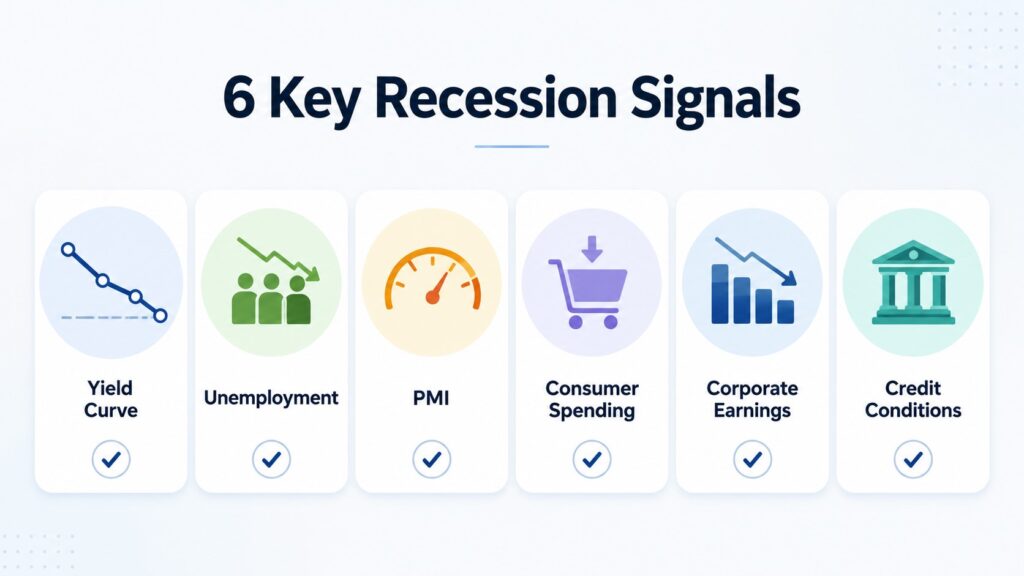
The Most Important Recession Signals
No single indicator predicts every recession.
Instead, experienced investors watch several indicators together to build a clearer picture of the economy.
Yield Curve Inversion
The yield curve is one of the best-known recession indicators.
Under normal conditions, investors expect higher returns for lending money over longer periods. Occasionally, however, short-term Treasury yields rise above long-term yields, creating what is known as a yield curve inversion.
Investors pay close attention because this has often appeared before previous recessions. It reflects expectations that economic growth and interest rates may weaken in the future.
However, an inverted yield curve is not a countdown timer. The economy can continue growing for months after an inversion occurs, which is why it should be viewed as an early warning rather than a prediction.
If you’d like to explore historical Treasury yield data, the Federal Reserve Economic Data (FRED) database is one of the best publicly available resources.
Rising Unemployment
A healthy economy usually creates jobs.
When businesses become less optimistic, they often slow hiring before reducing their workforce. If weaker demand continues, unemployment typically begins to rise.
Because employed consumers spend more money, a weakening labor market can eventually reduce household spending, which affects businesses across many industries.
Employment data is widely followed because it reflects business confidence and consumer strength.
Monthly employment reports published by the U.S. Bureau of Labor Statistics (BLS) are among the most closely watched economic releases.
Although unemployment is an important indicator, it usually reacts later than manufacturing or financial markets. That’s why investors combine it with other signals rather than relying on it alone.
Falling Manufacturing Activity
Manufacturing often slows before the broader economy.
When businesses expect lower demand, they reduce production, order fewer materials, and delay expansion plans. These decisions can appear months before slower growth shows up in other economic reports.
One of the most widely followed indicators is the Purchasing Managers’ Index (PMI), which measures business conditions in the manufacturing sector.
A declining PMI doesn’t guarantee a recession, but persistent weakness may suggest companies are becoming more cautious about future growth.
The Institute for Supply Management (ISM) publishes one of the most widely followed PMI reports, making it a valuable resource for investors who want to monitor changes in business activity.
Weak Consumer Spending
Consumer spending accounts for a large share of economic activity in the United States.
When households feel confident, they continue buying homes, cars, vacations, and everyday goods. When uncertainty increases, families often postpone large purchases and become more careful with their budgets.
That shift affects company sales, hiring plans, and ultimately corporate earnings.
Investors also pay attention to consumer confidence because spending decisions are influenced not only by income but also by how optimistic people feel about the future.
The Conference Board’s Consumer Confidence Index is one of the most widely used measures of household sentiment.
If you’re interested in how inflation influences consumer behavior, be sure to read Inflation and Stock Investing: A Smart and Essential Beginner’s Guide.
Declining Corporate Earnings
Corporate earnings provide a direct view of business performance.
When companies report slower sales or lower profits, investors often reduce their expectations for future growth.
One disappointing earnings report isn’t enough to signal a recession. However, when businesses across multiple industries begin reporting weaker results or lowering future guidance, it may indicate that economic conditions are becoming more challenging.
This is one reason the stock market sometimes declines before an official recession begins. Investors constantly adjust prices based on future expectations rather than current conditions.
Tight Credit Conditions
Credit supports both consumers and businesses.
Companies borrow money to invest and expand, while households borrow to purchase homes, vehicles, and other major expenses.
When banks become more cautious about lending or borrowing costs increase, spending and investment often slow.
A business that cannot obtain affordable financing may postpone opening a new location or hiring additional employees. Similar decisions across thousands of companies can gradually reduce economic growth.
For that reason, investors view tighter credit conditions as another important recession signal—especially when they occur alongside weakening manufacturing activity, slower earnings growth, and declining consumer confidence.
Which Indicators Usually Move First?
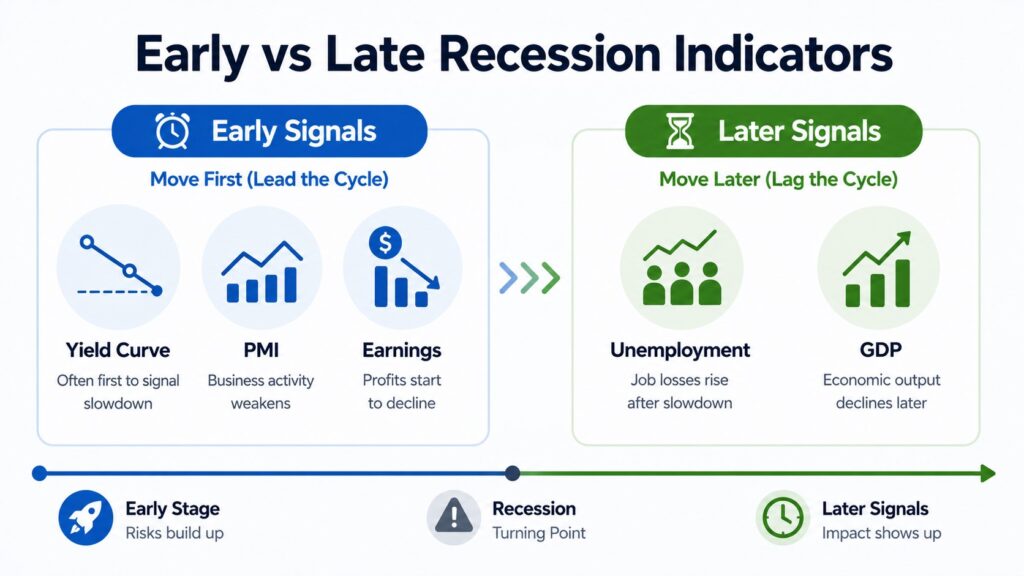
Not all recession indicators move at the same time. Some provide early warnings, while others confirm that economic conditions have already weakened.
Understanding this timing helps investors avoid overreacting to a single report and instead focus on the broader trend.
| Indicator | Early Signal? | Why Investors Watch It |
|---|---|---|
| Yield Curve | ✅ Yes | Reflects expectations for future economic growth and interest rates. |
| PMI (Manufacturing) | ✅ Yes | Businesses often reduce production before the broader economy slows. |
| Corporate Earnings | 🟡 Usually Early | Falling profits may signal weakening demand across industries. |
| Unemployment | ❌ Usually Later | Hiring often slows after businesses experience weaker sales. |
| GDP | ❌ Later | Confirms economic weakness but is not considered an early warning signal. |
Rather than focusing on one indicator, experienced investors compare several pieces of economic data. When multiple indicators begin pointing in the same direction, they provide a more reliable picture of the economy than any single report.
Can Investors Predict Every Recession?
The honest answer is no.
If recessions could be predicted with perfect accuracy, investors would know exactly when to sell before markets declined and when to buy before prices recovered. Unfortunately, investing doesn’t work that way.
Economic data changes constantly, and markets adjust as new information becomes available. Sometimes recession signals appear without leading to a significant downturn. At other times, unexpected events change the economic outlook much faster than anyone anticipated.
That’s why successful investors usually think in terms of probability rather than certainty.
Instead of asking, “Will a recession definitely happen?”, they ask:
- Are several indicators weakening at the same time?
- Is the overall trend becoming less favorable?
- Has the balance of economic risk changed?
This approach encourages patience and thoughtful decision-making instead of emotional reactions to headlines.
How Should Long-Term Investors Respond?
Understanding recession signals shouldn’t make you afraid of investing.
Instead, it should help you build a stronger investment process.
One of the biggest mistakes beginners make is trying to avoid every market decline. In reality, downturns are a normal part of investing. Every long-term bull market has included periods of economic weakness along the way.
Many successful investors continue investing regularly, even during uncertain times. Consistently adding to a diversified portfolio can reduce the pressure of trying to predict the perfect time to invest.
Diversification also plays an important role. Spreading investments across different sectors and asset classes may reduce the impact of weakness in any single part of the market.
It’s equally important to maintain an emergency fund. Having cash available for unexpected expenses can prevent you from selling long-term investments during a market decline.
The goal isn’t to avoid recessions altogether.
It’s to build a portfolio and an investment plan that you can stick with through every stage of the economic cycle.
Common Mistakes Beginners Make
Many investing mistakes happen because people react emotionally instead of focusing on long-term trends.
One common mistake is trying to predict the exact market bottom. Even professional investors rarely do this consistently.
Another is selling after stock prices have already fallen significantly. Fear often leads investors to lock in losses just before markets begin recovering.
Some beginners also pay attention to only one indicator. Watching unemployment without considering manufacturing activity, corporate earnings, or consumer spending provides an incomplete picture of the economy.
Finally, many investors spend too much time following dramatic headlines and too little time understanding the economic data behind those stories.
Successful investing usually comes from consistency, patience, and a willingness to look beyond short-term market noise.
Personal Perspective
When I first started reading about recessions, I paid far too much attention to headlines. If I saw the word “recession” in the news, I immediately assumed the stock market would crash. Looking back, I was reacting to fear rather than understanding what the data was actually saying.
Over time, I realized that experienced investors rarely focus on one indicator alone. Instead, they compare several signals to understand the broader economic picture. A weak PMI, an inverted yield curve, slowing corporate earnings, and rising unemployment don’t all carry the same message. Some tend to appear early, while others confirm trends that are already underway.
That shift in perspective made a big difference in my investing routine. Rather than trying to predict the next recession, I now focus on following a consistent long-term plan while using economic indicators as context instead of predictions. Markets will always experience periods of uncertainty, but understanding recession signals has helped me stay more patient and less emotional during market volatility.
Final Thoughts
Understanding recession signals won’t tell you exactly when the next recession will begin.
What they can do is help you interpret the economy with greater confidence.
Instead of reacting to every alarming headline, learn to look at several indicators together. The yield curve, manufacturing activity, consumer spending, corporate earnings, employment, and credit conditions each provide one piece of the larger economic picture.
The goal isn’t to predict every recession.
It’s to become a better long-term investor by understanding how economic trends influence financial markets.
Economic cycles are inevitable, but emotional investing is optional. By focusing on evidence instead of fear, you’ll be better prepared to navigate both strong markets and challenging ones.
❓ FAQ
Q1. What is the most reliable recession signal?
There isn’t one perfect indicator. Investors usually monitor several signals together, including the yield curve, manufacturing activity, unemployment, corporate earnings, and consumer spending.
Q2. Does a yield curve inversion always lead to a recession?
No. It has preceded many past recessions, but it doesn’t guarantee one will occur or indicate exactly when it might begin.
Q3. Should I stop investing if recession risks increase?
Not necessarily. Many long-term investors continue investing regularly while maintaining diversification and a long-term perspective.
Q4. Why can the stock market recover before the economy?
The stock market looks ahead. Investors often expect future improvements before economic reports show that conditions are getting better.
📚 Related Articles
Inflation and Stock Investing: A Smart and Essential Beginner’s Guide
Interest Rates and the Stock Market: A Beginner’s Practical Guide
What Is the Dollar Index? A Smart Beginner’s Guide to DXY and Global Markets
How U.S. Treasury Yields Affect Tech Stocks: A Smart and Powerful Beginner’s Guide
Stock Valuation Checklist: 7 Critical Checks Before Calling a Stock Cheap
A stock can look cheap because its price has fallen 40%, its P/E ratio is…
RSI Divergence vs MACD Crossover: Which Is More Reliable for Trading?
RSI divergence can warn that price momentum is weakening before a reversal becomes obvious. A…
Before You Buy the Dip: 5 Critical Balance Sheet Checks Every Investor Should Make
A stock that falls 20%, 30%, or even 50% can suddenly look cheap. But a…
Disclaimer: This article is for educational purposes only. It is not financial advice or a recommendation to buy or sell any specific stock, ETF, cryptocurrency, or other asset. All investment decisions are your own responsibility.