
For much of the past few years, U.S. stocks have been driven by a remarkably small group of companies. Nvidia, Microsoft, Apple, Amazon, Meta, and Alphabet accounted for a significant share of the market’s gains, while many smaller companies struggled to keep pace. That leadership was understandable. Artificial intelligence investment, resilient earnings, and strong cash flow made large technology companies attractive even during periods of high interest rates.
Recently, however, the market has started to look different. The Russell 2000 rally has brought small-cap stocks back into the spotlight, with financials, industrials, regional banks, and AI-related suppliers beginning to attract more investor attention.
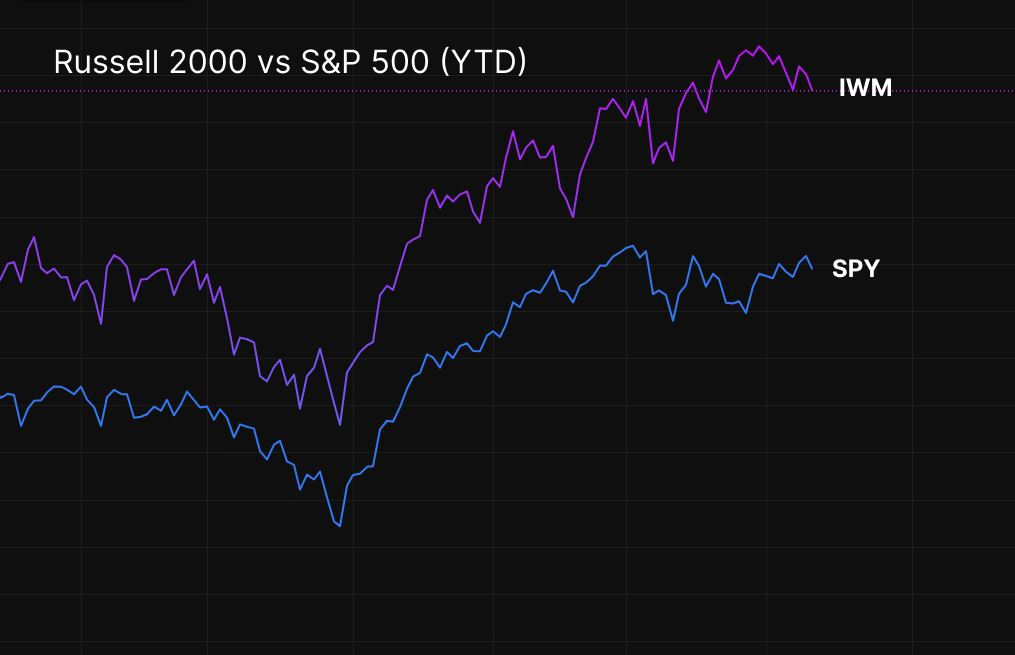
My first reaction was caution rather than excitement. Small-cap stocks have staged several impressive rebounds over the past few years, only to lose momentum once financial conditions tightened again. This time, however, the move appeared broader. It was not just the Russell 2000 moving higher; the equal-weight S&P 500, regional banks, and several cyclical sectors were also beginning to participate.
That does not automatically mean a lasting market rotation has begun. But it does raise a more important question.
Is this simply another short-term rebound, or is the U.S. market finally becoming less dependent on Big Tech?
The most important story is not whether Big Tech is losing leadership. It is whether the rest of the market is finally strong enough to participate alongside it.
What Makes the Russell 2000 Different?
Many investors think of the Russell 2000 simply as an index of approximately 2,000 smaller U.S. companies. According to the Russell index methodology, it represents the small-cap segment of the U.S. equity market. From an investment perspective, however, the index often tells a much broader story.
Unlike many of the largest companies in the S&P 500, which earn substantial revenue overseas, Russell 2000 companies tend to depend more heavily on the domestic U.S. economy. Their performance is often closely connected to consumer spending, business investment, regional economic activity, bank lending, and financing costs.
Many smaller companies also have less cash and greater borrowing needs than mega-cap technology firms. As a result, changes in interest rates and credit availability can affect their earnings more quickly. When borrowing becomes expensive, smaller businesses often feel the pressure first. When financial conditions improve, they can also be among the first to benefit.
That is why the Russell 2000 is more than a small-cap stock index. It can also serve as a practical gauge of investor confidence in the domestic economy.
| Index | What It Typically Reflects |
|---|---|
| Russell 2000 | Domestic growth, credit conditions, and smaller-company earnings |
| S&P 500 | Large-company earnings and broad U.S. equity performance |
| Nasdaq 100 | Technology leadership and long-term growth expectations |
When reviewing the Russell 2000, I find it more useful to ask what the movement says about the broader market than to focus only on the index return. A sustained rise can suggest that investors are becoming more confident about domestic growth, credit conditions, and corporate earnings outside the largest technology companies.
Why Is the Russell 2000 Rallying?
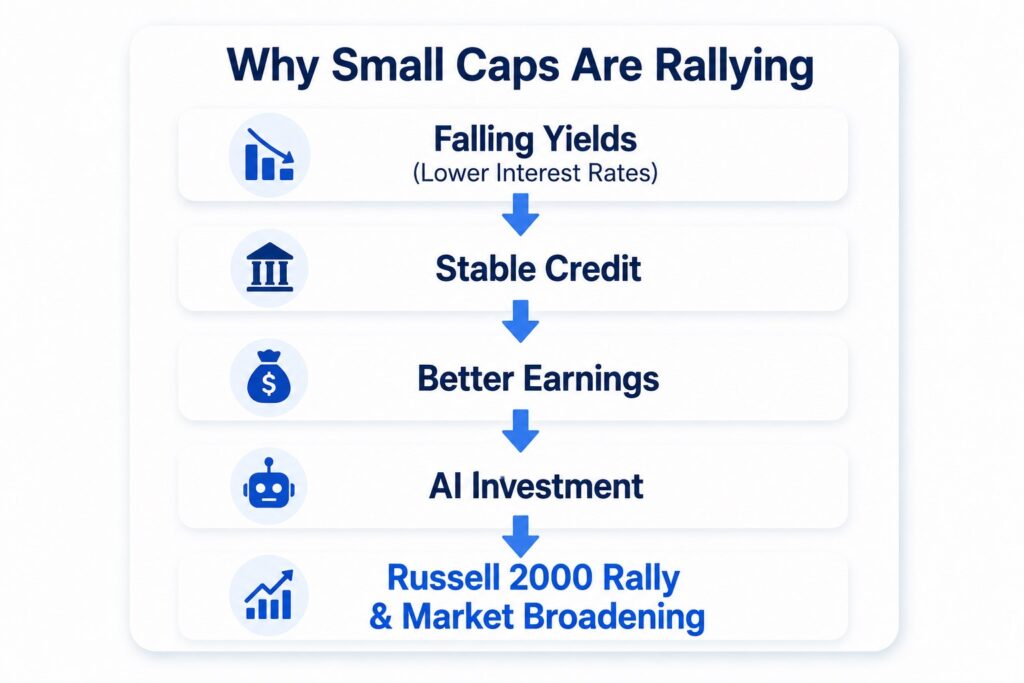
There is no single explanation for the recent rally. Instead, several supportive factors appear to be working together, including broader market participation, improving earnings expectations, attractive valuations, stable credit conditions, and the expansion of AI-related investment.
Market Leadership Is Becoming Broader
One of the most important changes is that investors are no longer focusing exclusively on a handful of mega-cap technology companies. Big Tech remains fundamentally strong, and the long-term drivers behind artificial intelligence, cloud computing, digital advertising, and data-center investment have not disappeared.
What appears to be changing is the number of companies participating in the market’s gains. Financials, industrial businesses, healthcare companies, energy producers, and selected small-cap technology stocks have started attracting more capital alongside the existing market leaders.
This is an important distinction. Sector rotation usually means investors are selling one part of the market to buy another. Market broadening means more sectors and stocks begin participating while the previous leaders remain relatively healthy.
A broader market does not require Nvidia, Microsoft, or Amazon to fall. It simply means that market performance is becoming less dependent on a few large companies. Historically, that has often been a healthier structure than a rally supported by only a narrow group of stocks.
Earnings Expectations Are Improving
Small-cap companies entered 2026 after several challenging years. Higher interest rates raised borrowing costs, economic uncertainty limited business investment, and tighter financial conditions placed pressure on profit margins. As a result, expectations for many smaller businesses became relatively low.
Low expectations can create room for positive surprises. When investors are already prepared for weak growth, even a moderate improvement in sales, margins, or financing conditions can lead to a meaningful revaluation.
This helps explain why the current rally is not based only on the hope of lower interest rates. Investors also appear to be anticipating a recovery in small-cap earnings over the coming quarters.
That distinction matters. A rally driven only by optimism or short covering can fade quickly. A rally supported by improving earnings estimates usually has a stronger and more durable foundation.
Valuations Became More Attractive
Years of underperformance left many smaller companies trading at lower valuations than the largest technology stocks. After an extended period of narrow market leadership, those discounts naturally began attracting investors looking for opportunities outside the most crowded trades.
However, valuation alone is not enough. Previous small-cap rebounds have shown that a company can remain inexpensive for a long time when its earnings, cash flow, or balance sheet fail to improve. A low price-to-earnings ratio offers limited protection if interest expenses continue rising or the business must refinance debt under difficult conditions.
For that reason, I would not judge the Russell 2000 rally solely by valuation multiples. The valuation argument becomes more convincing when it is supported by improving earnings revisions, healthier cash flow, and manageable debt.
Credit Conditions Have Remained Relatively Stable
Many investors assume small caps are rallying because Treasury yields have fallen sharply. The reality is more complicated. The U.S. 10-year Treasury yield remains elevated compared with the period before the recent inflation cycle, which means borrowing costs are still a challenge for many smaller companies.
What has helped is the relative stability of the broader credit market. Although interest rates remain relatively high, contained high-yield credit spreads suggest that investors are not demanding significantly larger risk premiums for lower-rated corporate debt.
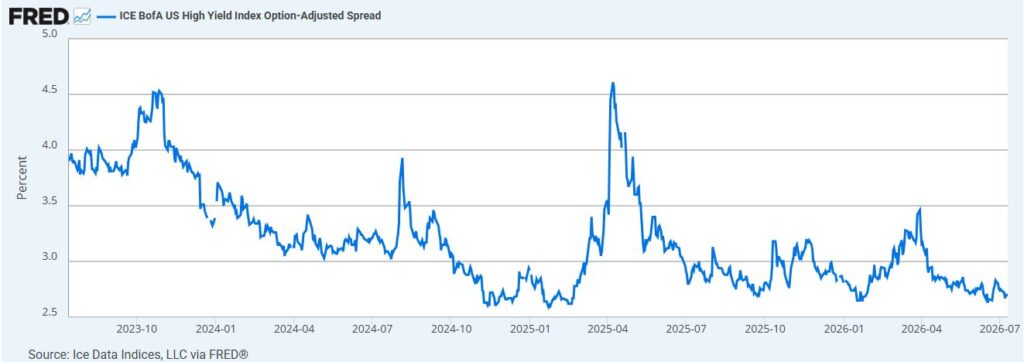
This matters because smaller companies tend to depend more heavily on banks and credit markets than cash-rich mega-cap firms. They often need outside financing to expand, refinance existing obligations, purchase equipment, or manage day-to-day operations.
As long as credit conditions remain orderly, investors may be willing to accept more risk in small-cap stocks even if Treasury yields remain relatively high. That is a more accurate explanation than simply saying the rally is being caused by falling interest rates.
AI Spending Is Reaching More Companies
The artificial intelligence investment cycle is also beginning to benefit a wider group of businesses. Most attention still goes to large chipmakers and cloud platforms, but AI infrastructure requires far more than processors and software.
Power equipment manufacturers, cooling-system providers, networking companies, engineering firms, data-center suppliers, industrial automation businesses, and energy producers can all benefit from rising AI-related capital spending. Many companies connected to these areas are smaller than the technology giants that initially led the trade.
This means the Russell 2000 rally does not necessarily represent the end of the AI theme. In some cases, it may reflect the theme spreading through a broader supply chain.
Instead of concentrating entirely on a handful of trillion-dollar companies, investors are beginning to look at the businesses supplying the electricity, equipment, financing, and infrastructure needed to support continued AI expansion.
Taken together, these factors suggest that the Russell 2000 rally is being supported by more than one short-term catalyst. Broader market participation, improving earnings expectations, discounted valuations, stable credit conditions, and expanding AI investment have all created a more favorable environment for small-cap stocks.
The key question is whether these conditions can continue long enough to support a genuine change in market leadership rather than another temporary rebound.
Final Thoughts
The Russell 2000 rally does not necessarily mean the Big Tech trade is over. Large technology companies can continue benefiting from artificial intelligence, cloud computing, and strong cash flow while smaller companies begin participating more actively in the market.
The more important development is that market leadership may be becoming broader. If financials, industrials, regional banks, healthcare companies, and smaller technology businesses continue building their own earnings and price momentum, the U.S. market could become less dependent on a few mega-cap stocks.
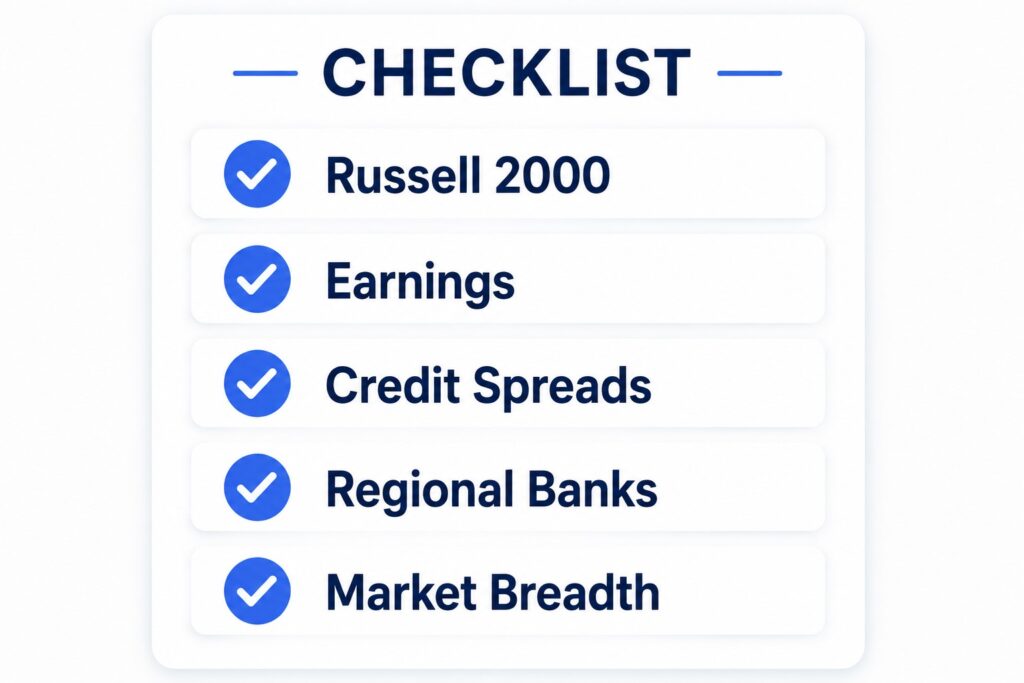
Still, one strong period is not enough to confirm a lasting rotation. Small-cap companies remain sensitive to borrowing costs, credit availability, domestic economic growth, and earnings expectations. A durable rally should eventually be supported by stable credit conditions, improving earnings revisions, stronger regional banks, and wider market participation.
For now, I would not view the Russell 2000 rally as a signal to abandon Big Tech or chase every small-cap stock. I would view it as evidence that investors are beginning to explore opportunities beyond the largest market leaders.
The key question is not whether Big Tech has stopped working. It is whether the rest of the market can continue improving without depending on another surge from a handful of technology giants.
❓ FAQ
Q1. Why is the Russell 2000 rallying?
The Russell 2000 rally appears to be supported by broader market participation, improving small-cap earnings expectations, attractive valuations, relatively stable credit conditions, and AI-related investment spreading into smaller companies and infrastructure suppliers.
Q2. Does the Russell 2000 rally mean Big Tech is finished?
No. Big Tech and small-cap stocks can rise at the same time. The current move may reflect market broadening rather than investors completely abandoning large technology companies.
Q3. Why are small-cap stocks more sensitive to interest rates?
Smaller companies often rely more heavily on bank loans and refinancing than cash-rich large corporations. Higher borrowing costs can therefore affect their earnings, cash flow, and expansion plans more quickly.
Q4. What is the most important signal to watch?
No single indicator is enough. Relative performance against the S&P 500, credit spreads, earnings revisions, regional bank performance, and market breadth should be considered together.
Q5. What could end the Russell 2000 rally?
The rally could weaken if Treasury yields rise sharply, inflation remains persistent, credit spreads widen, bank lending becomes more restrictive, or small-cap earnings estimates begin falling.
Related Reading

Stock Valuation Checklist: 7 Critical Checks Before Calling a Stock Cheap
A stock can look cheap because its price has fallen 40%, its P/E ratio is…
RSI Divergence vs MACD Crossover: Which Is More Reliable for Trading?
RSI divergence can warn that price momentum is weakening before a reversal becomes obvious. A…

Before You Buy the Dip: 5 Critical Balance Sheet Checks Every Investor Should Make
A stock that falls 20%, 30%, or even 50% can suddenly look cheap. But a…
Disclaimer: This article is for educational purposes only. It is not financial advice or a recommendation to buy or sell any specific stock, ETF, cryptocurrency, or other asset. All investment decisions are your own responsibility.