

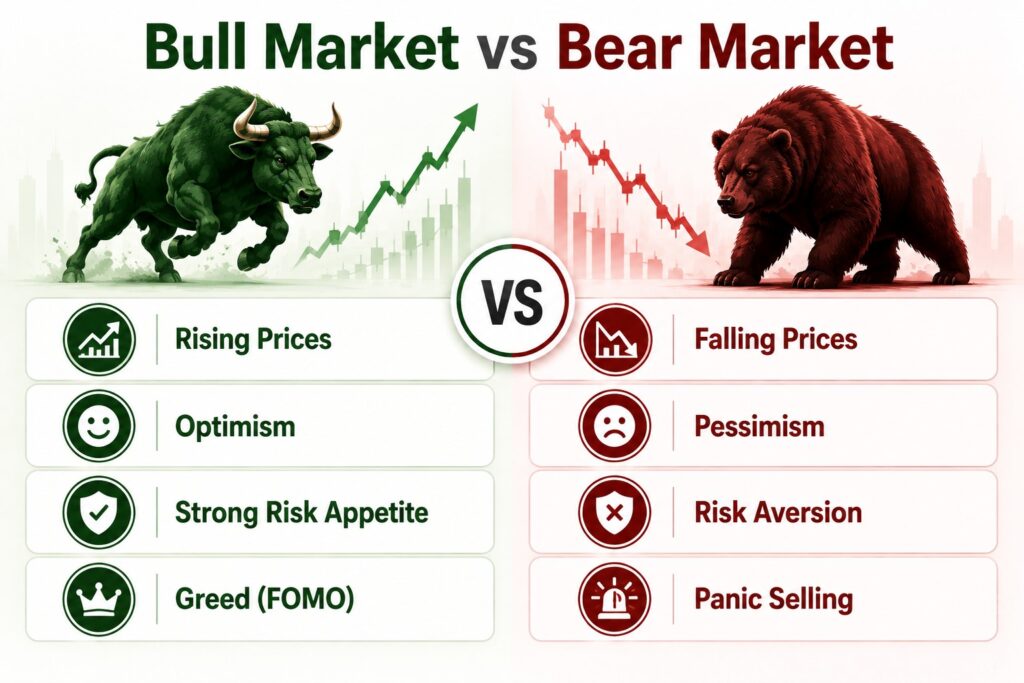
A Bull vs Bear Market comparison starts with a simple distinction: bull markets generally rise, while bear markets generally fall.
But price direction is only part of the story.
Bull and bear markets also reflect changes in investor expectations, corporate earnings, economic conditions, interest rates, and market psychology. Understanding those forces can help beginners interpret market moves without treating every rally or decline as a signal to buy or sell.
Bull vs Bear Market: The Quick Difference
Investor.gov’s bull market definition describes a bull market as a period of rising stock prices and optimistic market sentiment. It generally describes a rise of 20% or more in a broad market index over at least two months.
A bear market is the opposite. Investor.gov generally describes it as a decline of 20% or more in a broad market index over at least two months, accompanied by pessimistic sentiment.
| Feature | Bull Market | Bear Market |
|---|---|---|
| General price trend | Rising | Falling |
| Investor sentiment | More optimistic | More pessimistic |
| Risk appetite | Often stronger | Often weaker |
| Typical emotion | FOMO | Fear |
| Common beginner mistake | Chasing gains | Panic selling |
| Common benchmark | About +20% | About -20% |
These definitions are useful, but the 20% level should not be treated as a precise trading signal.
Markets do not suddenly become fundamentally different because an index crosses one percentage threshold.
What Is a Bull Market?
In a Bull vs Bear Market comparison, a bull market is the period in which stock prices generally trend higher.
Bull markets often develop when investors become more confident about future corporate earnings and economic conditions. Falling interest rates, improving growth expectations, or stronger company results can also support prices.
The important word is expectations.
Stock prices are forward-looking. Investors do not evaluate only what companies are earning today. They also estimate what those businesses may earn in the future.
Suppose investors expect profits across major companies to improve during the next year. They may become willing to pay higher prices for stocks before those earnings actually appear.
That can create a reinforcing cycle:
Improving expectations → more buying → rising prices → stronger confidence
A bull market does not mean every stock rises. Some industries or individual companies can perform poorly even while a broad index trends higher.
What Is a Bear Market?
On the other side of a Bull vs Bear Market comparison, a bear market is an extended period when stock prices broadly decline and investor sentiment becomes more pessimistic.
Several conditions can contribute.
A recession can weaken corporate profits. Persistent inflation can pressure business costs and household spending. Higher interest rates can increase borrowing costs and reduce the value investors assign to future earnings.
Unexpected financial shocks can also cause investors to become more defensive.
The process can reinforce itself:
Worsening expectations → more selling → falling prices → weaker confidence
Fear does not create every bear market, but once a decline becomes severe, investor psychology can amplify volatility.
Why the 20% Rule Has Limitations
One of the most useful lessons in a Bull vs Bear Market comparison is that the label usually arrives after a substantial price move has already happened.
Consider a hypothetical index that peaks at 5,000.
If it falls:
- 5% to 4,750
- 10% to 4,500
- 15% to 4,250
- 20% to 4,000
the market environment did not suddenly deteriorate only when the index reached 4,000.
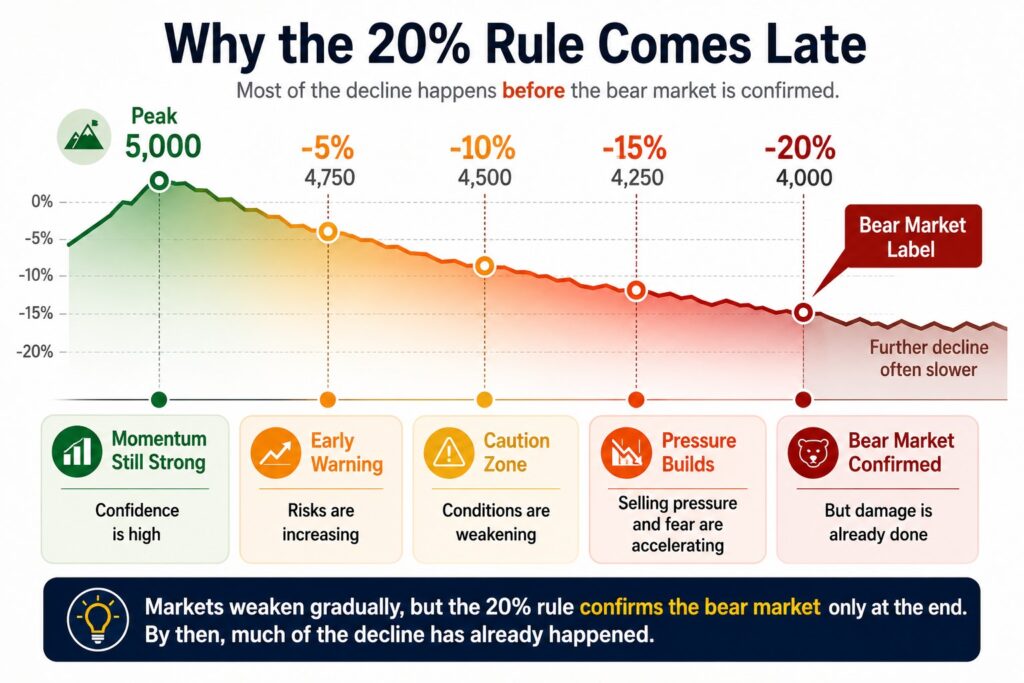
Earnings expectations, interest rates, market breadth, or investor confidence may have been weakening throughout the decline.
The same issue applies to recoveries. By the time an index has risen enough from a low to satisfy a common bull-market definition, a meaningful portion of the rebound has already occurred.
That is why the 20% benchmark is more useful for describing what has happened than for predicting the exact turning point.
A practical way to approach this is to look beyond the label. The broader trend, earnings expectations, interest rates, and whether weakness is spreading across the market often provide more context than asking whether an index has crossed exactly 20%.
Market Correction vs Bear Market
In a Bull vs Bear Market comparison, a sharp decline is not automatically evidence that a bear market has begun.
FINRA describes a market correction as a reversal of at least 10%, although the term is usually used for price declines.
A correction can occur during a longer bull market.
For example, imagine a broad index rises steadily for a year, falls 12% as investors reassess interest-rate expectations, and later resumes its longer-term upward trend.
That temporary decline could be described as a correction rather than a full bear market.
The distinction helps beginners avoid a common mistake: assuming that every uncomfortable drop means the long-term trend has permanently changed.
Bull Market Does Not Mean a Strong Economy
Understanding a Bull vs Bear Market also requires separating stock-market conditions from the broader economy.
Markets often move before economic conditions clearly improve or deteriorate because investors are trying to price in the future.
Stocks may begin recovering while unemployment or economic data still looks weak if investors expect conditions to improve several months later.
The reverse can also happen. Economic data may still look strong while stock prices weaken because investors expect slower growth, lower earnings, or tighter financial conditions ahead.
This is why apparently “good” economic news does not always push stocks higher, and “bad” news does not always push them lower.
What matters is often the difference between the news itself and what investors had already expected.
How Interest Rates Affect Market Cycles
Interest rates can influence both bull and bear markets.
Higher rates increase borrowing costs for companies and consumers. They can also make bonds and cash-like investments relatively more attractive compared with stocks.
Growth companies can be particularly sensitive because a larger share of their estimated value may depend on earnings expected far in the future.
Lower rates can provide support by reducing financing costs and changing valuation assumptions.
Still, lower rates do not automatically create a bull market.
A central bank cutting rates because inflation is cooling while growth remains stable creates a different environment from cutting rates because the economy is entering a severe downturn.
This is where context matters. “Rates down equals stocks up” is too simple to work as a reliable investing rule.
How to Read Bull and Bear Markets on a Chart
Price structure can provide useful context when evaluating Bull vs Bear Market conditions.
An established uptrend often produces higher highs and higher lows. A sustained downtrend often produces lower highs and lower lows.
Moving averages can make the broader direction easier to see, while trading volume can help investors judge participation behind price movements.
For beginners, daily and weekly charts are usually more useful for identifying broad market trends than reacting to every short-term move.
A simple review can follow this order:
- Identify the broad trend.
- Compare recent highs and lows.
- Check important support and resistance areas.
- Look at the direction of major moving averages.
- Review whether trading volume supports the move.
- Compare price action with the broader economic environment.
The order matters because indicators are easier to interpret after the larger trend is clear.
One unusually strong or weak trading day is rarely enough evidence to conclude that an entire market cycle has changed.
The Biggest Beginner Mistake in a Bull Market
Bull markets can make investing look easier than it really is.
When prices rise for months, investors may begin believing that recent performance will continue indefinitely.
That can lead to FOMO, or fear of missing out.
A beginner may buy an investment primarily because its price has already risen sharply rather than because the underlying investment still makes sense.
Strong markets can hide poor decisions for a while. Speculative companies may rally, valuations may become stretched, and favorable market conditions can be mistaken for investing skill.
A useful question is:
Would I still understand why I own this investment if the market stopped rising tomorrow?
The Biggest Beginner Mistake in a Bear Market
Bear markets create the opposite emotional pressure.
Falling prices and negative headlines can make selling immediately feel like the safest response.
That is where panic selling becomes a risk.
The SEC’s Office of Investor Education and Advocacy has warned about the risks of short-term trading during volatile markets, particularly when investors follow crowd behavior.
That does not mean deteriorating fundamentals should be ignored.
It means fear alone is not an investment thesis.
The more useful question is whether the reason for owning the investment has changed or whether only its market price has changed.
What Should Investors Watch During a Market Cycle?
Trying to identify Bull vs Bear Market conditions from one indicator is rarely useful.
Instead, build a broader picture.
Price Trend
Is the market forming higher highs and higher lows, or lower highs and lower lows?
Market Breadth
Are many companies participating in the move, or are only a few large stocks driving the index?
Corporate Earnings
Are company profits and forward earnings expectations improving or weakening?
Interest Rates and Inflation
Are borrowing conditions becoming easier or tighter? Is inflation changing expectations for future interest rates?
Economic Growth
Are employment, consumer spending, and business activity strengthening or weakening?
These indicators will not always point in the same direction.
That is normal.
Market analysis is about building context from several pieces of evidence, not finding one perfect signal.
A Practical Investor Framework
Understanding Bull vs Bear Market conditions matters less than understanding what has actually changed beneath the market move.
When volatility increases, three questions can keep the analysis focused:
- What is the broader trend?
- What is driving that trend?
- Has the reason for owning the investment actually changed?
Then review practical risks such as diversification, position size, liquidity needs, leverage, and time horizon.
This framework cannot predict the next market bottom or peak. Its purpose is simpler: separating evidence from emotion.
Final Thoughts
Understanding Bull vs Bear Market conditions is less about memorizing a 20% threshold and more about understanding market behavior.
Bull markets generally combine rising prices with stronger optimism. Bear markets combine sustained declines with weaker sentiment. Corrections can occur within longer trends, and none of these labels tells investors exactly what happens next.
The practical lesson is behavioral as much as analytical.
Bull markets can encourage excessive confidence and FOMO. Bear markets can encourage fear and panic.
Instead of trying to guess the exact day one market cycle ends and another begins, focus on the broader trend, the forces driving it, and whether your investment assumptions have actually changed.
FAQ
Q1. What is the main difference between a bull and bear market?
The main Bull vs Bear Market difference is direction and sentiment. A bull market generally features sustained rising prices and more optimistic sentiment, while a bear market features sustained declines and more pessimistic sentiment.
Q2. Is a 20% move an exact bull or bear market signal?
No. The 20% threshold is a commonly used benchmark for describing market cycles, not a precise signal that tells investors when to buy or sell.
Q3. Is a 10% decline a bear market?
Usually not. A decline of around 10% is commonly described as a market correction. Corrections can occur during longer-term bull markets.
Q4. Can stocks rise during a bear market?
Yes. Bear markets can contain strong temporary rallies. A short-term rebound does not necessarily mean the broader downtrend has ended.
Q5. Should investors sell when a bear market starts?
There is no universal answer. Decisions depend on factors such as investment objectives, time horizon, diversification, liquidity needs, risk tolerance, and whether the underlying investment thesis has changed.
📚 Related Articles
How to Read Stock Chart Trends: A Smart Beginner’s Guide
Interest Rates and the Stock Market: A Beginner’s Practical Guide
Recession Signals: An Essential Beginner’s Guide to Reading the Economy and Stock Market

Stock Valuation Checklist: 7 Critical Checks Before Calling a Stock Cheap
A stock can look cheap because its price has fallen 40%, its P/E ratio is…
RSI Divergence vs MACD Crossover: Which Is More Reliable for Trading?
RSI divergence can warn that price momentum is weakening before a reversal becomes obvious. A…

Before You Buy the Dip: 5 Critical Balance Sheet Checks Every Investor Should Make
A stock that falls 20%, 30%, or even 50% can suddenly look cheap. But a…
Disclaimer: This article is for educational purposes only. It is not financial advice or a recommendation to buy or sell any specific stock, ETF, cryptocurrency, or other asset. All investment decisions are your own responsibility.