
Dividend yield is often one of the first numbers investors notice when comparing dividend-paying stocks.
It looks simple. A company pays an annual dividend, and investors compare that payment with the current share price.
But a high dividend yield can appear for two very different reasons. The company may have increased its dividend, or the share price may have fallen sharply.
When I first compared stocks with a dividend screener, I naturally noticed the highest yields first. Over time, I realized that some of those attractive percentages appeared only after investors had become concerned about the company’s earnings, debt, or future dividend payments.
One pattern that changed how I use dividend screeners was seeing stocks move toward the top of the yield rankings without any dividend increase. The yield looked more attractive, but the real change was a falling share price. Since then, I have checked what happened to the price before treating a high yield as an opportunity.
This guide explains how dividend yield works, why unusually high yields can become a warning sign, and how beginner investors can evaluate dividends using a practical research routine.
What Is Dividend Yield?
Dividend yield measures a company’s annual dividend payments relative to its current share price.
The formula is:
Dividend Yield = Annual Dividend per Share ÷ Current Share Price × 100
Suppose a company pays $4 in annual dividends per share and its stock trades at $100.
The dividend yield is 4%.
An investor buying the stock at that price would receive dividend payments equal to approximately 4% of the purchase price, assuming the company maintains the same dividend.
That assumption matters.
Dividend yield is based on the current dividend and current market price. It is not a guaranteed return, and companies can reduce or suspend dividend payments.
Why Dividend Yield Matters
Dividend yield gives investors a quick way to estimate how much current income a stock may generate.
It can be especially useful when comparing mature companies that regularly return part of their cash to shareholders.
Dividend-paying businesses are often found in sectors such as utilities, consumer staples, financials, energy, telecommunications, and real estate.
However, yields should usually be compared with similar businesses.
A yield that looks unusually high in one industry may be normal in another because business models, growth rates, capital requirements, and payout structures differ.
That is why I see dividend yield as a starting point rather than a measure of investment quality.
Why a High Dividend Yield Can Be a Warning Sign
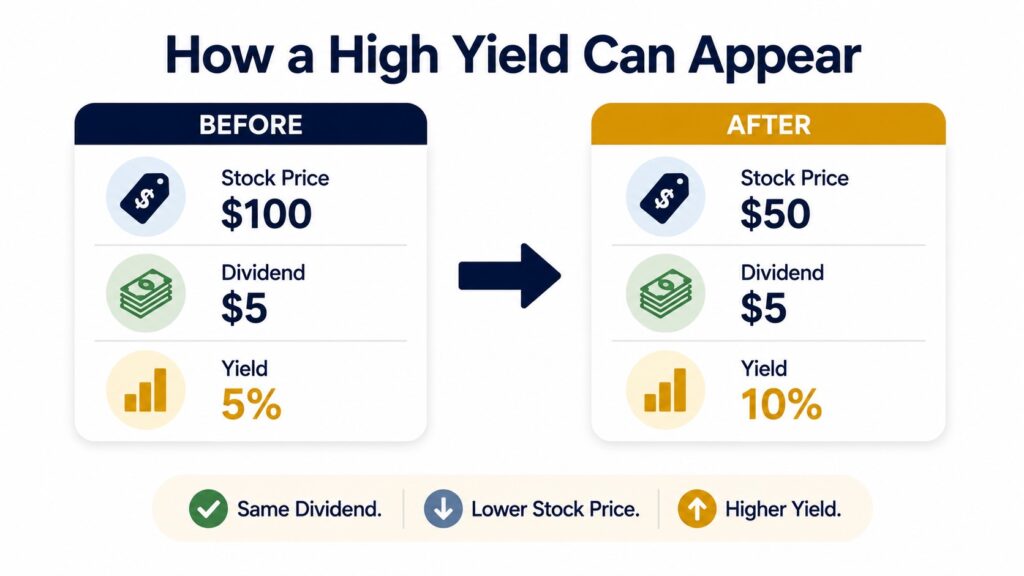
Imagine a company that pays an annual dividend of $5 per share.
When its stock trades at $100, the dividend yield is 5%.
Now suppose the share price falls to $50 because profits are slowing or investors have become worried about the company’s debt.
The dividend payment is still $5, but the yield has risen to 10%.
The company did not suddenly become more generous. The higher yield was created by a lower stock price.
This can become a dividend yield trap, sometimes called a yield trap. The income looks attractive, but the market may be signaling concerns about whether the current dividend can be maintained.
If management later reduces the dividend, an investor could face both lower income and a weaker share price.
A high yield is not automatically unsafe.
It simply makes me ask a more useful question:
Why is the yield this high?
Dividend Yield vs. Dividend Growth
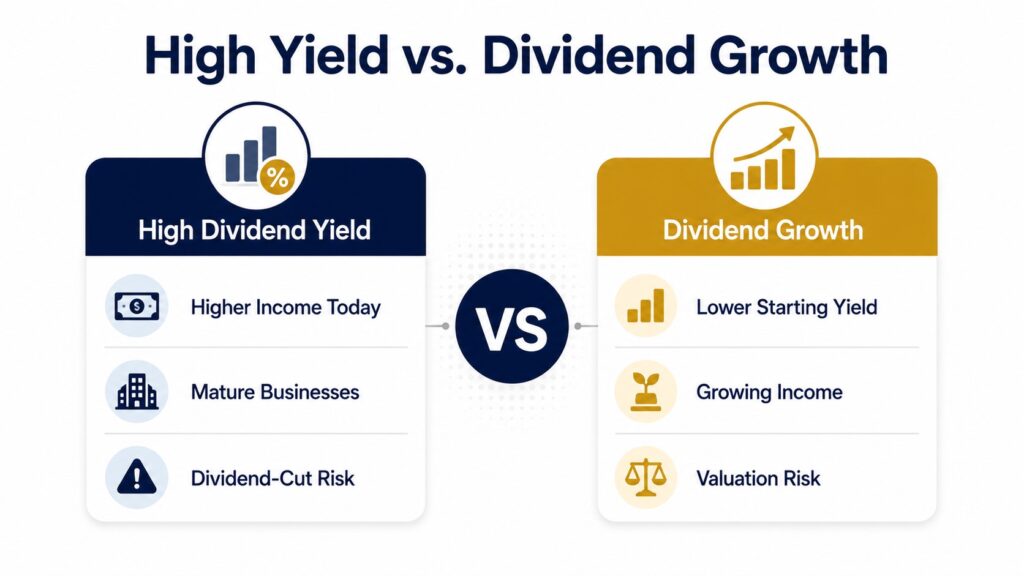
Some investors prioritize income today. Others prefer companies that start with a lower yield but have a history of increasing their dividends.
| Category | High Dividend Yield | Dividend Growth |
|---|---|---|
| Primary focus | Current income | Long-term income growth |
| Typical businesses | Mature or slower-growing companies | Companies with expanding earnings and cash flow |
| Starting yield | Usually higher | Often lower |
| Main advantage | More immediate cash flow | Potential for rising future income |
| Main risk | Dividend cuts or weaker fundamentals | Low initial income or expensive valuation |
| Common goal | Current portfolio income | Long-term income growth and total return |
Neither approach is automatically better.
A company with a high yield may still have stable cash flow and a sustainable dividend. A dividend-growth company may have excellent fundamentals but trade at a valuation that already reflects much of that quality.
Dividend yield is only one part of that comparison.
My Practical Dividend Research Routine
I try not to begin my analysis with the yield itself.
Before deciding whether a dividend looks attractive, I check how the payment is being supported.
1. Compare the Payout Ratio With the Right Context
The dividend payout ratio compares dividend payments with company earnings.
Rather than using one payout-ratio cutoff, I compare the current figure with the company’s own history and with similar businesses in the same industry.
A higher ratio is not automatically a problem.
Utilities, real estate investment trusts, and other income-focused businesses can have very different payout structures from companies that need to reinvest heavily in growth.
I usually start with the company’s annual report, quarterly filings, and investor relations materials rather than relying only on a stock screener.
For U.S. listed companies, official filings such as 10-K and 10-Q reports can also be found through the SEC’s EDGAR database.
2. Review Several Years of Dividend History
One recent dividend increase does not tell me very much.
I prefer to look across several years and check whether the dividend has grown, remained flat, or been reduced.
I also pay attention to weaker periods.
How did management handle the dividend when earnings slowed? Was it maintained, frozen, or cut?
Past dividend payments do not guarantee future payments, but the history can reveal how management has approached capital allocation when conditions became difficult.
3. Check Free Cash Flow and Debt
Dividends ultimately require cash.
That is why I do not rely only on reported earnings.
A basic way to estimate free cash flow is:
Free Cash Flow = Operating Cash Flow − Capital Expenditures
I look at the cash-flow statement and ask whether free cash flow has been positive and reasonably consistent.
Then I compare that cash generation with the amount being paid in dividends.
Debt comes next.
A company might still cover its dividend today while facing rising interest expenses or significant debt maturities later. That does not guarantee a dividend cut, but it can reduce management’s financial flexibility.
This is one reason I prefer official company filings when I want to understand the dividend rather than just compare headline yields.
A More Realistic Dividend Comparison
Consider two dividend-paying companies.
Company A
Company A offers an 8% dividend yield.
Its current cash flow still covers the dividend, so there is no obvious immediate problem. However, earnings growth has slowed and debt has gradually increased.
The high yield may still appeal to an income-focused investor, but future dividend growth could become more difficult if business conditions weaken.
Company B
Company B offers a 3% dividend yield.
Cash flow is growing, debt appears manageable, and the company has regularly increased its dividend.
However, its shares also trade at a relatively high valuation.
Even a financially strong company can produce disappointing investment results if the price paid for the stock is too demanding.
This is closer to how dividend decisions look in practice.
Company A is not automatically a bad investment, and Company B is not automatically a good one.
Dividend sustainability matters, but so do valuation, business quality, and the investor’s objective.
Common Dividend Yield Mistakes
Chasing the Highest Yield
Stock screeners make it easy to rank companies by yield.
That can be useful for finding ideas, but I would not treat the highest result as the best result. Often, it is the company that deserves the most investigation.
Ignoring Why the Yield Increased
A higher yield can result from a larger dividend.
It can also result from a falling stock price.
Those two situations tell very different stories.
Comparing Payout Ratios Without Industry Context
A payout ratio becomes more meaningful when compared with the company’s history, cash flow, and peers.
One percentage alone rarely tells the full story.
Forgetting Total Return
Dividend income is only part of an investment result.
A high yield may not compensate for a large decline in the stock price or a future dividend reduction.
Assuming Dividends Are Guaranteed
Common-stock dividends can be reduced, suspended, or eliminated when a company’s financial priorities change.
A Seven-Point Dividend Checklist
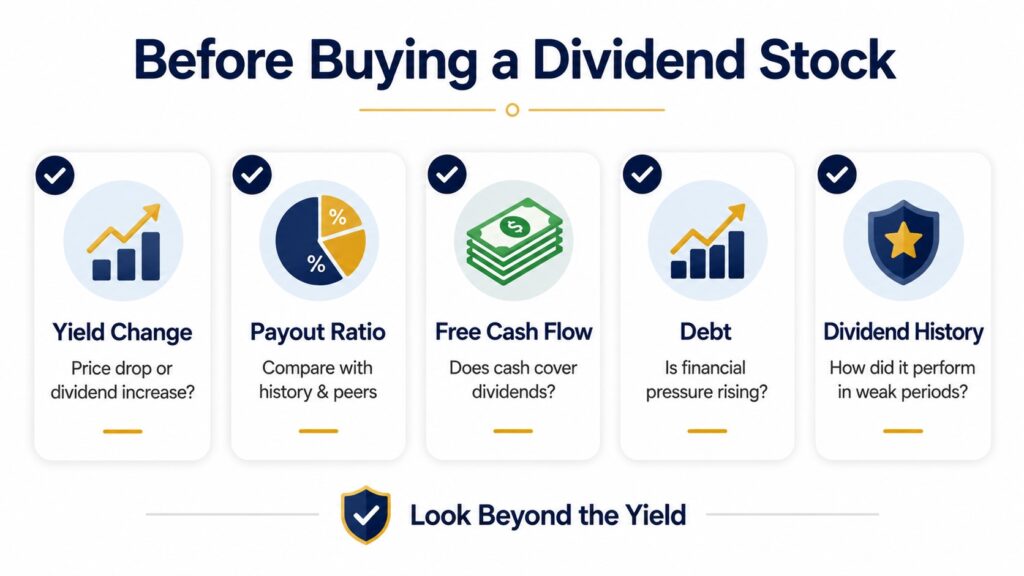
Before becoming interested in a dividend stock, I check:
- Did the yield rise because of a dividend increase or a share-price decline?
- Is the payout ratio reasonable compared with the company’s history and industry?
- Does free cash flow cover the dividend?
- Are earnings and cash flow reasonably stable?
- Is debt becoming more difficult or expensive to manage?
- How did the dividend behave during weaker business periods?
- Am I considering total return rather than dividend income alone?
This checklist cannot predict which stock will perform best.
Its purpose is simpler: to stop one attractive percentage from becoming an entire investment thesis.
Final Thoughts
Dividend yield is useful, but I treat it as a starting point rather than a measure of investment quality.
When a yield looks unusually high, I first ask what caused it to rise. From there, I check free cash flow, dividend history, debt, and valuation before deciding whether the income actually looks sustainable.
A high percentage can get my attention.
It cannot make the investment decision for me.
This article is for educational purposes only and does not provide individualized investment advice.
FAQ
Q1. What is a good dividend yield?
There is no universal good dividend yield. It depends on the company’s industry, financial condition, dividend history, valuation, and broader market environment.
Q2. Is a 10% dividend yield safe?
Not necessarily. A very high yield can reflect a falling share price, greater business risk, or expectations that the dividend may eventually be reduced.
Q3. What is a dividend yield trap?
A dividend yield trap occurs when a stock appears attractive because of its high yield, but the underlying business may struggle to maintain that dividend.
Q4. Is dividend yield the same as total return?
No. Total return includes both dividend income and changes in the stock price.
Q5. Should I check earnings or free cash flow?
Both are useful. Earnings help show profitability, while free cash flow helps show whether the business is generating enough cash to support dividends.
Q6. Can a low-yield stock still be attractive?
Yes. A lower-yielding company may have stronger dividend growth, healthier finances, or better long-term business prospects. Valuation still matters.
📚 Related Articles
How to Read Financial Statements: A Simple and Powerful Beginner’s Guide
Fundamental Analysis for Beginner Investors: A Smart Guide to Better Stock Decisions
ETF Investing for Beginners: A Smart and Practical First Guide
Is a Low P/E Ratio Always Better? 5 Costly Mistakes to Avoid

Market Capitalization Explained: The Costly Mistake Beginner Investors Make
Market capitalization is one of the first numbers investors see when researching a stock. It…
Why Stocks Rise on Bad News: What Beginner Investors Should Know
Many beginner investors wonder why stocks rise on bad news, especially when the headlines seem…
Is a Low P/E Ratio Always Better? 5 Costly Mistakes to Avoid
When I first began studying stock valuation, the P/E ratio seemed like the easiest number…
Disclaimer: This article is for educational purposes only. It is not financial advice or a recommendation to buy or sell any specific stock, ETF, cryptocurrency, or other asset. All investment decisions are your own responsibility.