
If you have been investing for a while, you have probably noticed that CPI day feels like one of the biggest market events of every month. Financial news breaks within seconds, Treasury yields move almost immediately, and stock prices can swing sharply before many investors have even finished reading the report.
When I first started following macroeconomic data, I assumed CPI was the only inflation report that really mattered. A lower-than-expected CPI seemed like good news for stocks, while a hotter reading looked like an obvious reason to expect higher interest rates and falling growth stocks.
For a while, that simple way of thinking seemed reasonable. Then I experienced something that changed how I read inflation data.
One month, CPI came in softer than expected and the market rallied immediately. I assumed the trend had already been decided and became more optimistic about equities. A few weeks later, however, the Core PCE report painted a less encouraging picture. Treasury yields reversed higher as markets pushed back expectations for Fed rate cuts.
That experience taught me an important lesson.
CPI often creates the market’s first reaction, but Core PCE often explains how the Federal Reserve is likely to think about inflation over the coming months.
Since then, I have stopped treating CPI as the final answer. Instead, I look at it as the first piece of a much larger puzzle.
Understanding PCE vs CPI is not simply about learning two inflation indicators. It helps investors understand why markets sometimes react one way on CPI day, while the Federal Reserve may reach a different conclusion after looking at broader inflation trends.
What Does CPI Actually Measure?
The Consumer Price Index (CPI) measures how the prices of a relatively fixed basket of goods and services change over time. Published monthly by the U.S. Bureau of Labor Statistics, CPI tracks many expenses households experience directly, including housing, food, energy, transportation, medical care, and recreation.
Because these are costs consumers actually pay, CPI receives enormous attention from both the media and financial markets. It is also released before PCE each month, making it the first major inflation report investors see.
When CPI comes in above or below expectations, markets usually react immediately. Treasury yields may rise or fall, the U.S. dollar can strengthen or weaken, and stock indexes often experience significant volatility within minutes.
However, experienced investors know that the first market reaction is not always the final one.
Why PCE Measures Inflation Differently
The Personal Consumption Expenditures (PCE) Price Index also measures inflation, but it approaches the economy differently. Rather than relying primarily on a relatively fixed basket of consumer purchases, PCE uses broader spending data and updates spending weights more frequently as consumer behavior changes.
Imagine beef prices suddenly rise. Many households may decide to buy chicken instead. CPI captures price changes within its basket, but PCE adjusts more naturally because it recognizes that consumers often substitute one product for another when prices change.
This flexibility allows PCE to provide a broader picture of inflation across the economy rather than assuming consumers continue purchasing exactly the same goods regardless of price. For investors, the most important fact is simple: the Federal Reserve does not define its long-run inflation target using CPI.
Instead, the Fed’s official 2% inflation objective is measured using the PCE Price Index. That single difference explains why professional investors pay close attention to both reports rather than relying on CPI alone.
This is why understanding PCE vs CPI matters for investors who want to interpret inflation data beyond the first market reaction.
PCE vs CPI: What’s the Difference?
When comparing PCE vs CPI, the key point is that both measure inflation, but they are not identical. They use different data sources, different weighting methods, and ultimately serve different purposes.
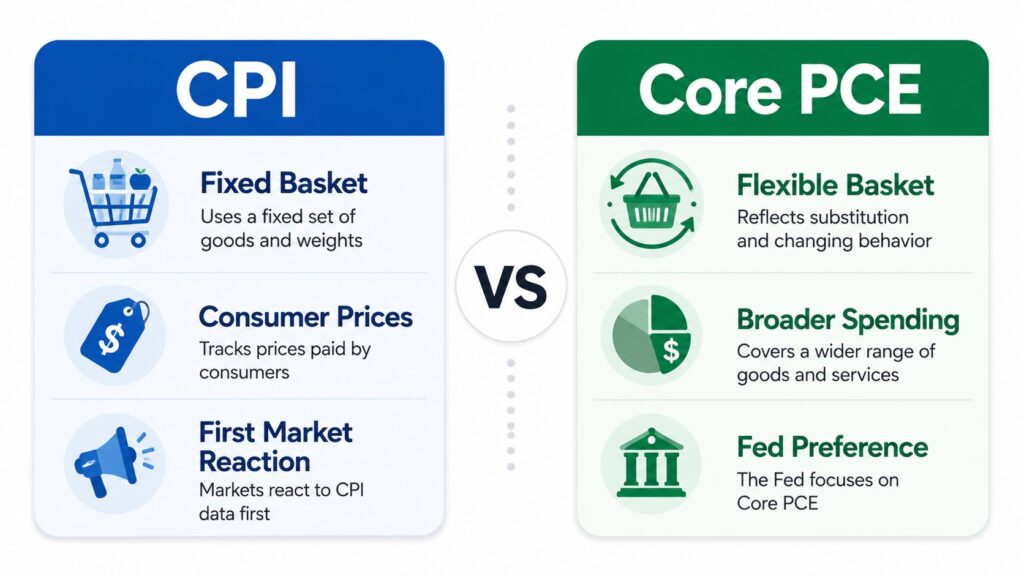
| Feature | CPI | PCE |
|---|---|---|
| Published by | Bureau of Labor Statistics (BLS) | Bureau of Economic Analysis (BEA) |
| Main focus | Consumer prices | Overall household consumption |
| Spending basket | Relatively fixed | Updated more frequently |
| Consumer substitution | Limited | Better reflected |
| Coverage | Narrower | Broader |
| Fed’s preferred inflation measure | No | Yes |
A simple way to think about it is this:
CPI answers: “What are consumers paying today?”
PCE answers: “How is inflation evolving across the broader economy?”
Neither measure is more “correct” than the other. They simply answer different questions. CPI is useful for understanding the inflation consumers experience directly, while PCE provides policymakers with a broader view of underlying price pressures.
Why the Fed Prefers PCE Over CPI
This is the part of the PCE vs CPI debate that matters most for investors.
Once I understood the differences between the two reports, another question naturally followed.
Why does the Fed consistently focus on PCE instead of the report that receives most of the headlines?
The answer has less to do with today’s prices and more to do with tomorrow’s inflation.
The Federal Reserve is responsible for maintaining price stability over the long run. Instead of reacting to every monthly fluctuation, policymakers want to understand whether inflation is becoming persistent throughout the economy. PCE helps answer that question more effectively.
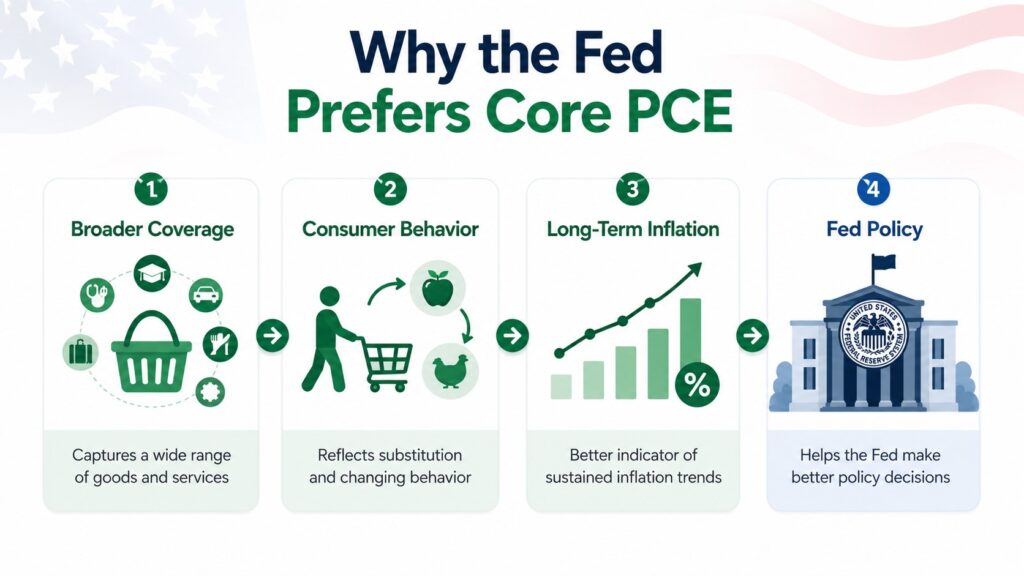
Broader Coverage
One reason the Fed prefers PCE is its broader coverage.
Unlike CPI, PCE includes certain expenditures made on behalf of households, such as employer-paid healthcare. This provides policymakers with a more complete picture of overall consumer spending rather than focusing only on out-of-pocket expenses.
For investors, that broader perspective matters because monetary policy is based on the entire economy, not just the prices consumers notice most often.
Better Reflects Changing Consumer Behavior
Consumers rarely continue buying exactly the same products when prices change.
If beef suddenly becomes much more expensive, many families will buy chicken instead. If airline tickets become expensive, some people may choose road trips instead of flying.
PCE adjusts its spending weights more frequently, allowing it to capture these real-world changes more effectively than CPI.
That flexibility makes PCE a better measure of how inflation evolves over time instead of assuming spending habits never change.
Better Fits the Fed’s Policy Framework
Another reason is consistency.
PCE is closely integrated with the National Income and Product Accounts (NIPA), allowing the Federal Reserve to evaluate inflation alongside GDP, personal income, and consumer spending using one consistent framework.
Rather than looking at inflation in isolation, policymakers can see how prices, spending, wages, and economic growth interact.
This broader framework is one reason PCE has become the Fed’s preferred inflation gauge.
Why Core PCE Matters More Than Headline Inflation
Many investors pay attention only to headline inflation because that is what dominates financial news.
The Fed often looks deeper.
While headline PCE includes every category, Core PCE excludes food and energy prices, which tend to fluctuate because of weather, geopolitical events, or temporary supply disruptions.
That does not mean food and gasoline are unimportant. Everyone feels those price changes in everyday life.
However, if policymakers reacted to every spike in oil prices or every temporary jump in food costs, monetary policy would become unnecessarily volatile.
The Fed is not simply asking whether inflation was high this month. It is asking whether inflation is becoming persistent enough to require a change in monetary policy.
That distinction completely changed how I interpret inflation reports.
Earlier in my investing journey, I focused almost entirely on the headline CPI number. If it surprised the market, I assumed I already knew what the Fed would do next.
After following several inflation cycles, I realized that policymakers often pay far more attention to whether Core PCE is moving toward—or away from—their long-run inflation target.
Today, when I see a strong market reaction immediately after CPI, I remind myself that the story is still incomplete.
I wait for the Core PCE report before deciding whether the broader inflation trend has actually changed. That small adjustment has helped me avoid reacting emotionally to short-term headlines more than once.
In my experience, some of the biggest investing mistakes happen when we confuse the market’s first reaction with the final conclusion.
How Core PCE Shapes Market Expectations
One lesson has become clearer to me after following inflation reports for several years: markets do not react to inflation itself—they react to what inflation means for future Federal Reserve decisions.
That may sound like a small distinction, but it completely changes how investors should interpret inflation reports.
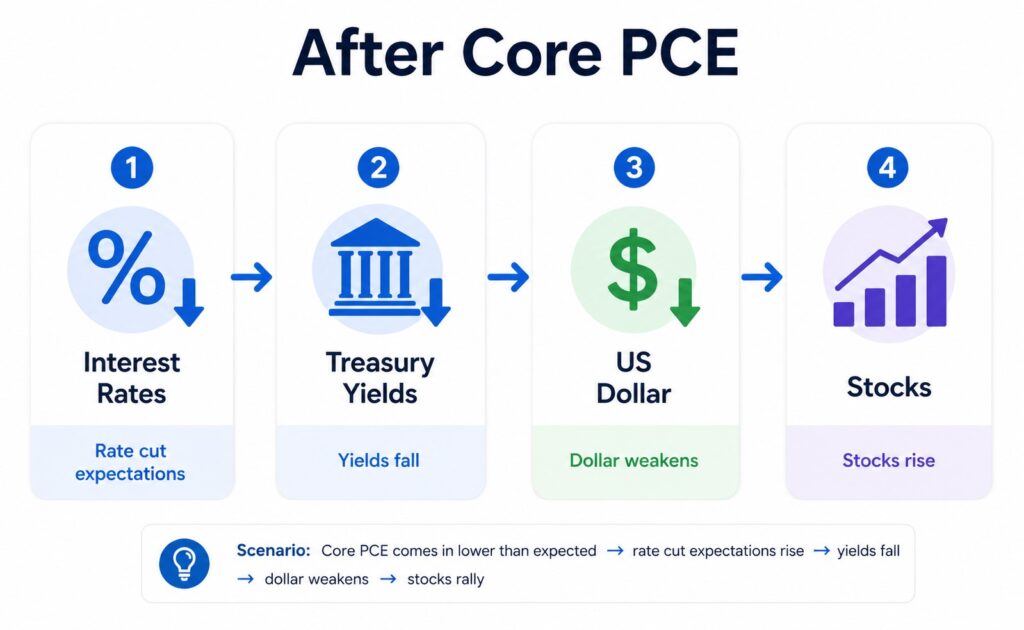
A CPI or Core PCE release does not move markets simply because prices increased or decreased. Instead, investors immediately begin asking whether the data makes future interest-rate hikes, rate cuts, or a prolonged pause more likely.
That shift in expectations influences nearly every major asset class.
Interest Rates
When Core PCE remains stubbornly high, investors often expect the Fed to keep interest rates elevated for longer.
On the other hand, if Core PCE continues to cool over several months, markets may begin pricing in future rate cuts even before the Fed officially changes policy.
In other words, inflation data influences expectations first—and policy decisions later.
Treasury Yields
Treasury yields are often one of the fastest markets to react after an inflation report.
If investors believe inflation will remain persistent, longer-term Treasury yields usually move higher as markets adjust to the possibility of tighter monetary policy.
When inflation shows convincing signs of slowing, yields often decline because investors begin anticipating lower future interest rates.
Watching Treasury yields after an inflation report has become one of my favorite ways to understand how professional investors are interpreting the data.
The U.S. Dollar
Inflation also affects the value of the U.S. dollar.
A stronger inflation report can support the dollar if markets expect the Fed to keep rates higher for longer. Higher interest rates generally make dollar-denominated assets more attractive to global investors.
Conversely, cooling inflation may weaken the dollar if markets believe rate cuts are becoming more likely.
Stock Market Sentiment
Many new investors assume that lower inflation automatically means higher stock prices.
Reality is rarely that simple.
Stocks react to changes in expectations, not just the inflation number itself.
Sometimes inflation comes in slightly above expectations, yet stocks rally because investors believe the overall trend is still improving. Other times, inflation looks encouraging, but stocks fall because markets had expected an even bigger improvement.
Understanding that difference helped me stop judging every inflation report as either “good” or “bad.”
Instead, I began asking whether the report actually changed the market’s expectations for future Federal Reserve policy.
How I Personally Read CPI and Core PCE Each Month
Over time, I realized that reacting immediately after every CPI release usually created more stress than better investment decisions.
Today, my routine is much simpler.
In the past, I often opened my brokerage account within minutes of the CPI release, convinced I needed to act immediately. More often than not, I realized a few days later that I had reacted to the headline rather than the broader trend.
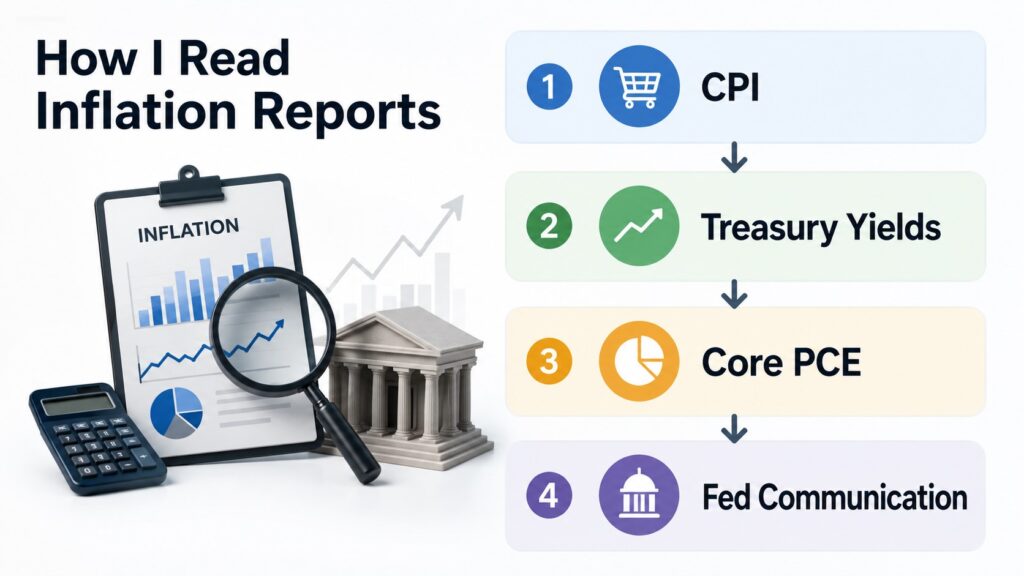
Today, I try to slow down. I still pay close attention to CPI, but I no longer treat CPI day as the final answer. I treat it as the first signal that needs to be confirmed by Core PCE, Treasury yields, and Fed communication.
That mindset has helped me become much more patient during volatile inflation weeks.
Step 1: Compare CPI With Market Expectations
The first thing I check is whether CPI came in above, below, or in line with consensus expectations.
Markets usually respond to surprises rather than the headline number itself.
A high inflation reading is not necessarily bearish if investors had expected something even worse.
Step 2: Watch Treasury Yields and the U.S. Dollar
Immediately after CPI, I pay close attention to Treasury yields and the U.S. Dollar Index.
If yields rise sharply while the dollar strengthens, markets are usually pricing in a more hawkish Federal Reserve.
If both begin moving lower, investors may believe the inflation trend is becoming more favorable.
Rather than trying to predict the market myself, I let these two indicators show me how institutional investors are reacting.
Step 3: Wait for Core PCE
This is the step I ignored when I first started investing.
Now, I intentionally wait for the Core PCE report before making any major conclusions about inflation.
If both CPI and Core PCE point toward easing inflation, I become more confident that the trend is improving.
If they send conflicting signals, I become much more cautious about changing my portfolio.
Waiting just a little longer has saved me from making several emotional decisions over the years.
Step 4: Compare Everything With Recent Fed Communication
Finally, I compare the inflation data with recent speeches, FOMC meeting minutes, and comments from Fed officials.
The question I ask myself is no longer:
Was inflation higher or lower?
Instead, I ask:
Will this report meaningfully change how the Fed is likely to think about policy over the next few meetings?
That single question has improved my decision-making more than trying to predict every monthly inflation report.
Practical Investor Checklist
Before making assumptions after any inflation release, I try to answer these questions.
| Checklist | Why It Matters |
|---|---|
| Did CPI beat or miss expectations? | Markets react more to surprises than to the number itself. |
| Did Core PCE confirm the same trend? | It provides a clearer picture of underlying inflation. |
| How did Treasury yields respond? | Yields reveal how the bond market interprets inflation. |
| Did the U.S. Dollar strengthen or weaken? | Currency markets quickly reflect changes in policy expectations. |
| Has the Fed recently emphasized inflation or employment? | Policy priorities influence how officials interpret new data. |
| Does this report change the long-term trend or only one month? | One report rarely tells the whole story. |
Looking at these indicators together gives me a much better understanding of the market than focusing on a single CPI headline.
More importantly, it helps me avoid making emotional investment decisions during one of the most volatile weeks of every month.
❓ FAQ
Q1. What is the difference between CPI and PCE?
The main difference in PCE vs CPI is that both measure inflation, but they use different methodologies. CPI focuses on prices consumers pay directly, while PCE measures broader household consumption and updates spending weights more frequently. Because of these differences, the two reports can sometimes show slightly different inflation trends.
Q2. Why does the Federal Reserve prefer Core PCE instead of CPI?
The Federal Reserve prefers Core PCE because it provides broader coverage, better reflects changing consumer behavior, and excludes the short-term volatility of food and energy prices. It is also integrated into the broader national economic accounts that policymakers use when evaluating economic conditions.
Q3. Why does Core PCE exclude food and energy prices?
Food and energy prices can fluctuate sharply due to weather, geopolitical events, and supply disruptions. Removing these categories helps policymakers focus on underlying inflation trends that are more relevant for long-term monetary policy decisions.
Q4. Can CPI and Core PCE move in different directions?
Yes. Although both generally follow the same long-term inflation trend, they use different weighting systems and data sources. As a result, one report may show stronger or weaker inflation than the other in certain months.
Q5. Which inflation report should investors pay more attention to?
Both reports are important. CPI usually drives the market’s immediate reaction because it is released first, while Core PCE provides additional insight into how the Federal Reserve may interpret inflation when making future interest-rate decisions.
Q6. How should investors use CPI and Core PCE together?
Rather than focusing on only one report, investors should compare CPI with market expectations, watch how Treasury yields and the U.S. dollar react, then see whether Core PCE confirms the same inflation trend. Looking at all of these indicators together usually provides a more balanced view of the market than relying on a single headline.
Q7. Is Core PCE released before or after CPI?
Core PCE is usually released after CPI. That is why CPI often drives the first market reaction, while Core PCE helps investors understand whether the broader inflation trend confirms or challenges that initial reaction.
Conclusion
Understanding PCE vs CPI is not about deciding which inflation measure is “better.” Both reports provide valuable information, but they serve different purposes.
CPI tells us how prices are affecting consumers today. That is why it often drives the market’s immediate reaction and dominates financial headlines.
Core PCE, on the other hand, helps the Federal Reserve evaluate whether inflation is becoming persistent enough to influence future monetary policy. Because of that, it often plays a much bigger role in shaping long-term expectations for interest rates, Treasury yields, and the broader financial markets.
One of the biggest mistakes I made as a beginner investor was reacting too quickly to every CPI release. If inflation came in higher than expected, I assumed the market would continue falling. If it came in lower, I expected stocks to rally for weeks.
Experience taught me that investing rarely works that way.
Today, I pay attention to CPI because it provides the market’s first signal. But before changing my portfolio or making a major investment decision, I also wait for Core PCE, monitor Treasury yields, and compare both reports with recent Federal Reserve communication.
That simple change has helped me become a much calmer investor.
Instead of asking whether inflation was “good” or “bad,” I now ask a different question:
Does this report actually change what the Federal Reserve is likely to do next?
Markets will always react to inflation headlines. The challenge for investors is deciding whether those reactions actually change the bigger picture.
In my experience, learning to separate short-term market noise from long-term monetary policy has been one of the most valuable investing lessons I have learned.
For beginner investors, that perspective can make inflation reports feel less confusing and more useful.
📚 Related Articles
How to Read US CPI Data: What Every Investor Should Know
Inflation and Stock Investing: A Smart and Essential Beginner’s Guide
Interest Rates and the Stock Market: A Beginner’s Practical Guide
What Is the Dollar Index? A Smart Beginner’s Guide to DXY and Global Markets

Stock Valuation Checklist: 7 Critical Checks Before Calling a Stock Cheap
A stock can look cheap because its price has fallen 40%, its P/E ratio is…
RSI Divergence vs MACD Crossover: Which Is More Reliable for Trading?
RSI divergence can warn that price momentum is weakening before a reversal becomes obvious. A…

Before You Buy the Dip: 5 Critical Balance Sheet Checks Every Investor Should Make
A stock that falls 20%, 30%, or even 50% can suddenly look cheap. But a…
Disclaimer: This article is for educational purposes only. It is not financial advice or a recommendation to buy or sell any specific stock, ETF, cryptocurrency, or other asset. All investment decisions are your own responsibility.
Pingback: US Consumer Spending 2026: Strong but Less Affordable