
Growth vs Value Stocks can sound like a simple choice: buy companies that grow quickly or buy companies that look cheap.
In practice, neither approach is that simple.
A fast-growing business can still be a poor investment if its stock price assumes unrealistic future growth. A low-P/E company can still disappoint investors if its profits, cash flow, or competitive position are deteriorating.
A more useful way to compare the two styles is to focus on three things:
price, fundamentals, and expectations.
Instead of asking which style is always better, ask: What am I paying today, what is the business producing now, and what future performance does the stock price already seem to assume?
That framework turns growth and value from market labels into practical tools for analyzing stocks.
What Are Growth Stocks?
A growth stock is generally associated with a company expected to increase earnings, revenue, or other important business measures faster than average.
The SEC’s Investor.gov guide to stocks explains that growth stocks have earnings growing faster than the market average and that they rarely pay dividends because investors often own them in hopes of capital appreciation.
Growth companies often reinvest cash into areas such as:
- research and development,
- new products,
- technology,
- additional employees,
- manufacturing capacity, and
- expansion into new markets.
Growth does not necessarily mean “small,” “new,” or “unprofitable.” Large and established businesses can also display strong growth characteristics.
Fidelity’s guide to growth stocks similarly describes them as companies expected to increase sales and earnings faster than average.
That last point matters.
Growth investing is not only about finding a company with rapidly rising revenue. Investors also need to ask how much of that future growth is already reflected in the share price.
This is the first key distinction to understand when comparing Growth vs Value Stocks.
What Are Value Stocks?
Value investing starts from a different question.
A value investor looks for a stock whose market price appears relatively low compared with the company’s underlying financial fundamentals.
Common valuation measures include:
- price-to-earnings (P/E) ratio,
- price-to-book (P/B) ratio,
- price-to-sales (P/S) ratio,
- free cash flow yield, and
- dividend yield.
Investor.gov describes value stocks as stocks with relatively low P/E ratios and notes that investors may buy them when they believe the market has reacted too negatively to a company.
But a low valuation is not automatically evidence of undervaluation.
A company might trade at a low P/E ratio because:
- earnings are expected to decline,
- debt is too high,
- profit margins are weakening,
- competitors are gaining market share, or
- the industry faces long-term challenges.
This distinction is central to value investing:
A cheap-looking stock is not necessarily an undervalued stock.
One useful analytical habit is to treat an unusually low valuation as a question rather than an answer.
Instead of saying, “The P/E is low, so this must be a bargain,” ask:
Why is the market willing to value this business so cheaply?
That question usually leads to more useful analysis than the ratio alone.
For beginners, this is why Growth vs Value Stocks should never be compared using valuation ratios alone.
Growth vs Value Stocks: The Main Differences
The easiest way to understand Growth vs Value Stocks is to compare what investors are paying for and what they expect from the business.
| Factor | Growth Stocks | Value Stocks |
|---|---|---|
| Main attraction | Faster expected business growth | Potential undervaluation |
| Typical valuation | Often higher | Often lower |
| Earnings expectations | Usually higher | Often more moderate |
| Dividends | Often lower or absent | More common, but not guaranteed |
| Reinvestment | Often substantial | May be less aggressive |
| Key question | Can future growth justify the price? | Why is the stock trading cheaply? |
| Common risk | Paying too much for expected growth | Buying a value trap |
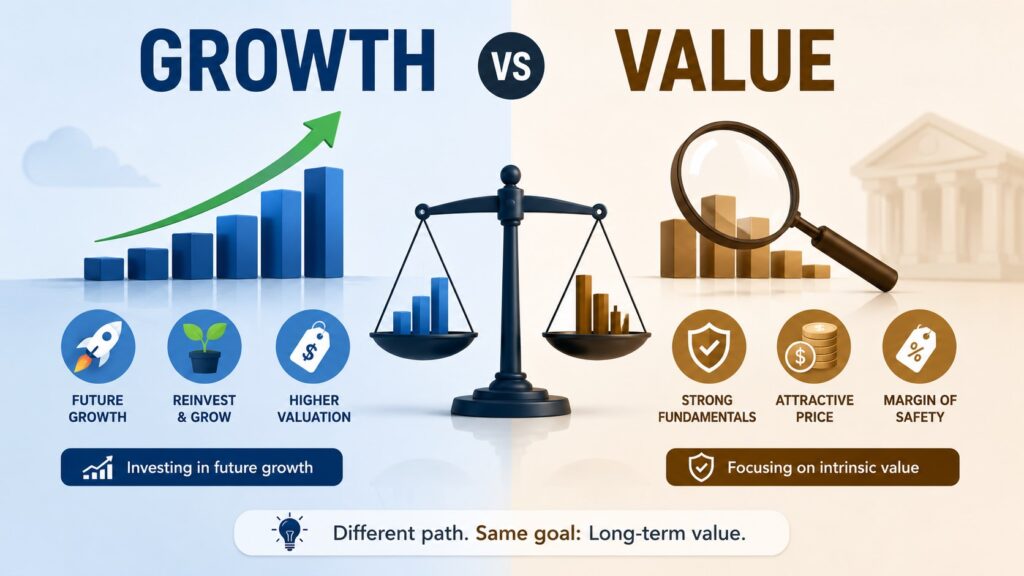
These are broad tendencies, not permanent rules.
Growth characteristics are often associated with businesses that reinvest heavily in expansion and innovation. Technology companies frequently fit that pattern, but growth stocks can exist in many industries. Investor.gov, for example, gives a start-up technology company as a likely growth-stock example, while Fidelity notes that growth stocks can come from different company sizes and industries.
Value characteristics are frequently associated with more mature businesses, but sector alone should never determine whether a stock is “growth” or “value.”
Professional index providers also use more than one simple measure.
The current S&P U.S. Style Indices methodology measures growth and value using formal style scores rather than a single valuation ratio.
That is a useful reminder that growth and value are analytical classifications—not permanent identities stamped onto companies.
Why Investors Pay More for Growth
Consider two hypothetical companies.
Company A
- Earnings per share: $5
- Stock price: $75
- P/E ratio: 15
- Hypothetical expected earnings growth: 5% per year
Company B
- Earnings per share: $5
- Stock price: $150
- P/E ratio: 30
- Hypothetical expected earnings growth: 20% per year
Both companies currently earn $5 per share, but investors are paying twice as much for each dollar of Company B’s earnings.
Why?
Because investors expect Company B to grow much faster.
Suppose Company B actually increases earnings by 20% annually for three years.
Year 1
$5.00 × 1.20 = $6.00
Year 2
$6.00 × 1.20 = $7.20
Year 3
$7.20 × 1.20 = $8.64
If those expectations are achieved, the original high valuation may become easier to justify as earnings rise.
Now imagine earnings increase by only 5%.
The company is still growing, but investors may decide that a P/E ratio of 30 is no longer appropriate for the slower growth rate.
The stock could then face two pressures at the same time:
- expected future earnings are revised lower; and
- investors become willing to pay a lower valuation multiple.
This is one of the most important ideas in growth investing.
A company does not need to be failing for its stock price to fall.
Sometimes the business simply performs less well than the stock price already assumed it would.
A Better Way to Evaluate Growth Stocks
When comparing growth companies, headline growth should not be the first and last number you consider.
A stronger framework starts with the valuation.
When I first started comparing growth stocks, I tended to focus too much on revenue growth. A company growing sales by 30% simply looked more attractive than one growing at 10%.
Over time, I found that this approach missed an important question: how much growth was already reflected in the stock price? I now check the valuation and market expectations before deciding whether a high growth rate is actually attractive.
Ask:
What level of future growth does this price appear to require?
Then compare that implied expectation with the company’s actual:
- revenue growth,
- earnings growth,
- profit margins,
- cash flow,
- competitive position, and
- reinvestment requirements.
This separates two questions beginners often combine:
Is this an attractive business?
and
Is this an attractive stock at the current price?
A company can be excellent while its shares are priced too aggressively.
Fidelity also emphasizes that growth is an expectation rather than a guarantee and warns that growth stocks can decline sharply when a company fails to meet elevated expectations.
That is why the starting valuation matters almost as much as the growth story itself.
Why Interest Rates Can Matter for Growth Stocks
Interest rates affect many parts of the stock market, but they can be especially relevant when much of a company’s perceived value depends on profits expected far into the future.
A simple present-value example shows why.
Suppose you expect to receive $100 ten years from now.
At a 5% annual discount rate:
$100 ÷ (1.05)^10 ≈ $61.39
At an 8% annual discount rate:
$100 ÷ (1.08)^10 ≈ $46.32
The future amount is still $100.
What changed is the discount rate used to translate that future amount into today’s value.
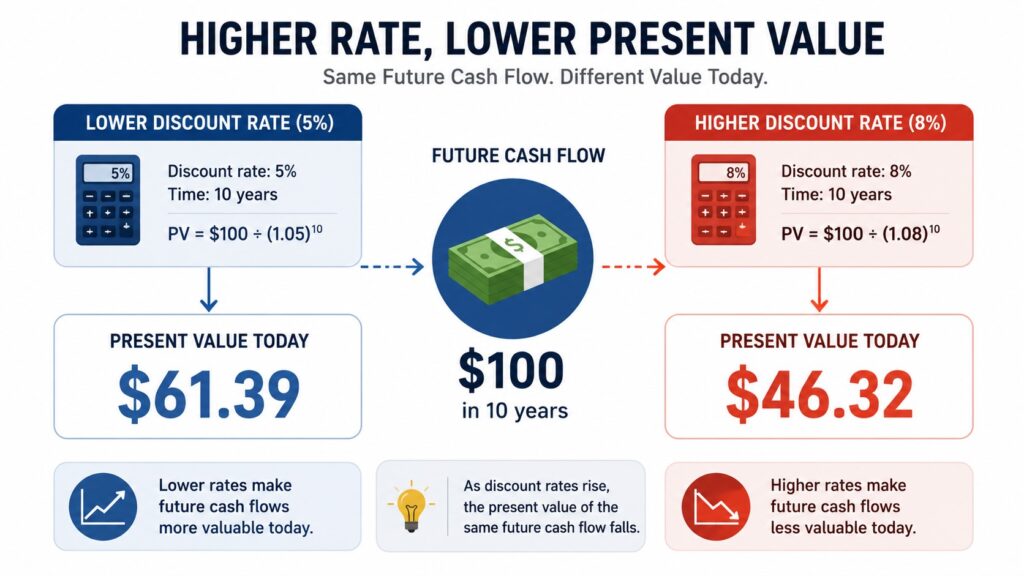
As the discount rate increases, distant future cash flows become less valuable in present-value terms.
This can create valuation pressure for companies whose expected profits lie farther in the future.
However, the relationship should not be turned into a trading rule such as:
“Interest rates rise, therefore growth stocks must fall.”
Stock prices also respond to earnings, economic growth, inflation, competitive developments, investor expectations, and changes in risk appetite.
A growth company delivering much stronger results than expected can perform well even when interest rates are relatively high.
Interest rates are an important valuation input—not a guaranteed market signal.
Two Traps Every Beginner Should Understand
One of the clearest ways to understand Growth vs Value Stocks is to look at how each approach can go wrong.
Growth and value investors often make opposite versions of the same mistake: they focus on one attractive characteristic while ignoring the price and underlying business.
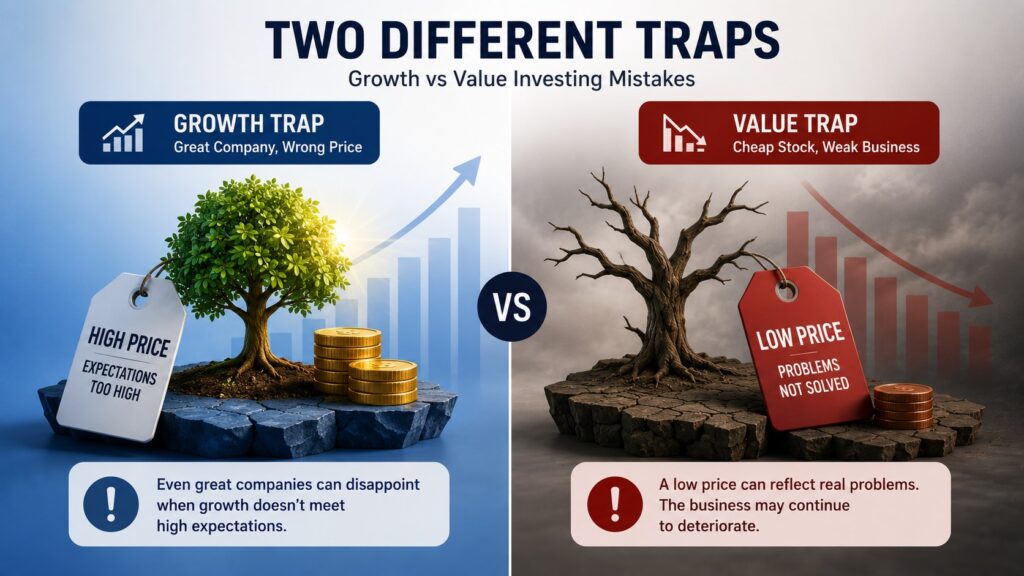
Growth Trap: Great Company, Wrong Price
Suppose a hypothetical company earns $2 per share and trades at $100.
Its P/E ratio is:
$100 ÷ $2 = 50
Now suppose the company increases earnings by 15%.
That sounds impressive.
But what if investors had priced the stock assuming 30% growth?
The company may remain profitable and financially healthy while its stock falls because actual performance did not match expectations.
This is why these two ideas should be kept separate:
A great business is not automatically a great investment at every price.
When evaluating a growth stock, the useful question is not just “How quickly is this company growing?”
It is:
How much growth am I already paying for?
Value Trap: Cheap Stock, Weak Business
Now imagine a stock falls from $80 to $40.
It appears much cheaper.
Further analysis, however, shows that:
- revenue is declining,
- margins are shrinking,
- debt is increasing,
- free cash flow is weakening, and
- competitors are taking market share.
The lower stock price may accurately reflect a deteriorating business.
Fidelity’s guide to value stocks highlights the risk of value traps—stocks that appear cheap but remain inexpensive because of underlying business problems.
For that reason, a low P/E should be the beginning of the analysis rather than its conclusion.
I use a similar rule with value stocks. When a P/E ratio looks unusually low, I do not treat it as a bargain immediately. I first check whether earnings estimates, free cash flow, debt, or competitive position have recently deteriorated.
When a stock looks unusually inexpensive, ask:
What changed in earnings, cash flow, debt, or competitive position to produce this valuation?
If there is no convincing answer, the apparent bargain deserves extra caution.
Growth vs Value Stocks and Dividends
Dividends are another common distinction between the two styles, although the relationship is not absolute.
Growth companies frequently retain earnings because management believes that cash can generate attractive returns by funding further expansion.
Fidelity notes that growth stocks generally do not pay dividends because these businesses often reinvest cash to continue growing.
Many value companies are more mature and may have fewer high-growth reinvestment opportunities. Fidelity notes that value stocks may therefore be more likely to pay dividends.
But investors should avoid another shortcut:
Dividend = value = safe.
A dividend can be reduced or eliminated.
A stock can also show an unusually high dividend yield simply because its share price has fallen sharply as the underlying business weakens.
Dividend analysis should therefore include:
- earnings,
- free cash flow,
- debt,
- payout ratio, and
- the sustainability of the business itself.
A dividend yield is useful information, but it is not a substitute for fundamental analysis.
Which Performs Better: Growth or Value?
There is no permanent winner in Growth vs Value Stocks.
Market leadership changes because returns depend on variables such as:
- starting valuation,
- earnings growth,
- interest rates,
- economic conditions,
- industry cycles, and
- investor expectations.
Growth can perform strongly when businesses deliver rapid earnings expansion and investors remain willing to pay higher valuations for future growth.
Value can become more attractive when investors place greater emphasis on current earnings, cash flow, dividends, or lower starting valuations.
Neither outcome is automatic.
A rapidly growing company can produce disappointing stock returns when investors initially pay too much for its expected growth.
A low-P/E stock can continue falling when profits deteriorate faster than expected.
For beginners, trying to predict whether “growth” or “value” will win next year is usually less useful than understanding what the current price already assumes.
A better question is:
What needs to happen for this valuation to make sense?
Can a Stock Be Both Growth and Value?
Yes.
Growth and value characteristics can overlap.
S&P Dow Jones Indices’ broad U.S. style series divide benchmark capitalization into growth and value components, while its narrower Pure Style indices focus on stocks exhibiting stronger style characteristics.
S&P has also explained that companies exhibiting both growth and value characteristics can have their market capitalization distributed between the two broad style categories.
This makes sense when you consider that both price and business fundamentals change over time.
Imagine a rapidly growing company whose stock price falls substantially while its business remains healthy. Its valuation could eventually become attractive enough to display stronger value characteristics.
The opposite can also happen.
A mature company associated with value investing might improve its growth profile by launching successful products, expanding margins, or entering new markets.
Prices change.
Fundamentals change.
Expectations change.
Style classifications can change with them.
How Beginners Can Compare Growth vs Value Stocks
When analyzing Growth vs Value Stocks, do not begin by deciding which label you prefer.
Begin with the company and the price.
A practical review can follow this sequence.
1. Revenue Growth
Is the business expanding sales?
Then ask whether the growth appears sustainable or is largely the result of a temporary event.
2. Earnings and Margins
Are profits growing along with revenue?
Rapid sales growth is less impressive if profit margins are deteriorating sharply.
3. Cash Flow
Does reported profit translate into cash?
Cash generation can help investors evaluate the quality and sustainability of a company’s earnings.
4. Valuation
What are investors paying for earnings, sales, book value, or cash flow?
Never interpret a valuation ratio without considering growth prospects, business quality, and risk.
5. Balance Sheet
How much debt does the company carry?
Could it continue meeting its obligations if economic conditions became less favorable?
6. Competitive Position
Why should customers continue choosing this company?
Historical growth becomes less meaningful if competitors are rapidly eroding the company’s advantages.
7. Expectations
This is the step many beginners overlook.
Ask what level of future success the current price already appears to assume.
A company can report objectively strong results and still disappoint shareholders when investors expected even more.
8. What Could Make the Thesis Wrong?
Identify the evidence that would challenge your original analysis.
For a growth stock, that might include slowing sales, margin pressure, or rising competition.
For a value stock, it might be evidence that a supposedly temporary problem is actually structural.
This review process turns Growth vs Value Stocks from a category comparison into a repeatable stock-analysis framework.
Should Beginners Own Growth, Value, or Both?
When considering Growth vs Value Stocks, investors do not necessarily need to choose one style exclusively.
A diversified portfolio can contain both growth and value companies. Broad-market funds may also provide exposure to both styles.
Diversification can reduce dependence on a single company, industry, or investing style, but it cannot eliminate stock-market risk.
Investor.gov emphasizes that stocks can rise or fall and that investors can lose money. It also notes that there is no guarantee a company will grow and perform well.
The appropriate portfolio mix depends on factors such as:
- financial goals,
- investment horizon,
- risk tolerance,
- income needs, and
- existing portfolio exposure.
There is no universal growth-versus-value percentage that is appropriate for every investor.
For someone learning how to evaluate stocks, understanding why each style behaves differently is more important than trying to select a permanent winner.
Three Questions to Remember
If the details become complicated, reduce Growth vs Value Stocks to three questions.
1. What Is the Business Producing Today?
Look at revenue, earnings, margins, cash flow, debt, and competitive strength.
2. What Future Performance Does the Price Assume?
A higher valuation generally requires stronger future results to justify it.
Do not evaluate expected growth separately from the price you are being asked to pay for it.
3. Why Might the Market Be Wrong—or Right?
For a growth stock, ask whether expectations have become too optimistic.
For a value stock, ask whether the apparently cheap valuation reflects temporary pessimism or genuine business deterioration.
These questions are more useful than treating either “growth” or “value” as an automatic buy signal.
Key Takeaway
The central lesson is not that one investing style is superior.
Growth stocks often require investors to pay more today for stronger expected results tomorrow. Value stocks attract investors when their prices appear low relative to their underlying fundamentals.
In both cases, the most useful approach is to evaluate price, fundamentals, and expectations together rather than relying on the growth or value label alone.
FAQ
Q1. Are growth stocks riskier than value stocks?
Not automatically. Growth stocks can be particularly sensitive to disappointing results when their valuations reflect high expectations. Value stocks face different risks, including deteriorating businesses and value traps. Risk should be evaluated at the individual-company and portfolio level rather than from the style label alone.
Q2. Are value stocks always cheaper than growth stocks?
Value stocks generally have lower valuations according to measures such as P/E, P/B, or P/S. However, a lower valuation does not automatically mean a stock is undervalued. Weak fundamentals or declining future earnings can justify a low price.
Q3. Do growth stocks pay dividends?
Some do. Many growth companies retain more cash to fund expansion, so dividends tend to be less common. Dividend policy by itself is not enough to classify a stock as growth or value.
Q4. Can a stock be both growth and value?
Yes. Growth and value characteristics can overlap, and classification methodologies differ. A company’s characteristics can also change as its business fundamentals, valuation, and stock price change.
Q5. What Is the Main Difference in Growth vs Value Stocks?
The main difference is how investors balance current valuation against expected future business performance. Growth investing typically places greater emphasis on future expansion, while value investing focuses more heavily on whether the current price appears low relative to fundamentals.
📚 Related Articles
Is a Low P/E Ratio Always Better? 5 Costly Mistakes to Avoid
Fundamental Analysis for Beginner Investors: A Smart Guide to Better Stock Decisions
How to Build Your First Stock Portfolio: A Smart and Simple Beginner’s Guide
Interest Rates and the Stock Market: A Beginner’s Practical Guide

Stock Valuation Checklist: 7 Critical Checks Before Calling a Stock Cheap
A stock can look cheap because its price has fallen 40%, its P/E ratio is…
RSI Divergence vs MACD Crossover: Which Is More Reliable for Trading?
RSI divergence can warn that price momentum is weakening before a reversal becomes obvious. A…

Before You Buy the Dip: 5 Critical Balance Sheet Checks Every Investor Should Make
A stock that falls 20%, 30%, or even 50% can suddenly look cheap. But a…
Disclaimer: This article is for educational purposes only. It is not financial advice or a recommendation to buy or sell any specific stock, ETF, cryptocurrency, or other asset. All investment decisions are your own responsibility.