
One of the hardest parts of investing is deciding when to buy.
A market decline can make you want to wait for an even lower price. A strong rally can create the opposite pressure: the fear that you will miss out if you do not invest immediately. The uncomfortable part is that the decision often feels hardest exactly when prices are moving the fastest.
Either way, trying to predict the perfect entry point can turn a long-term investment decision into a series of short-term guesses.
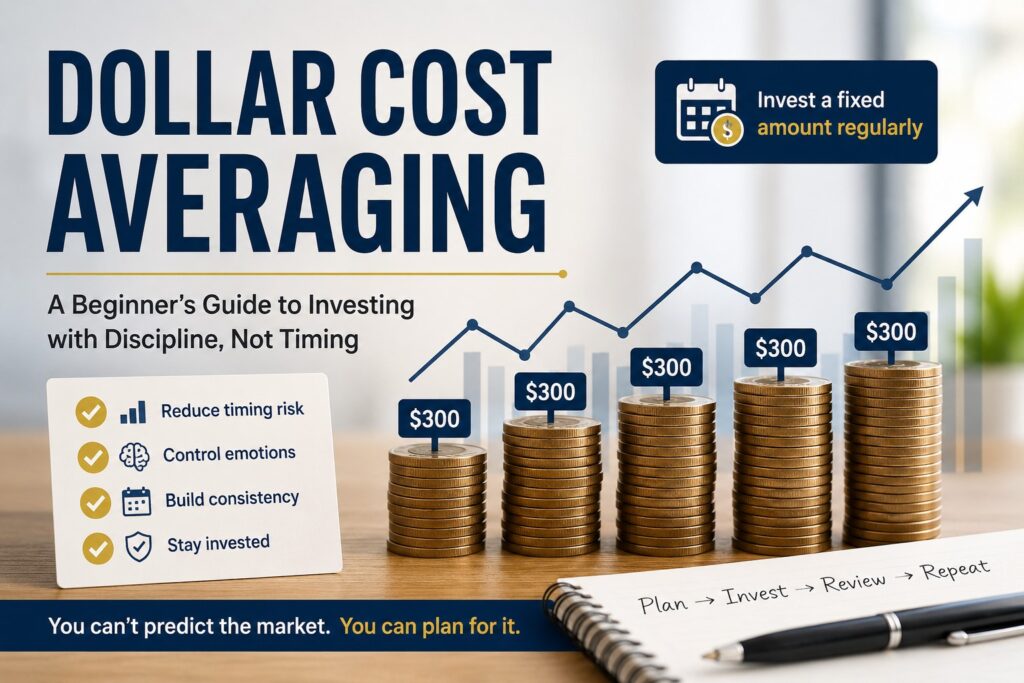
Dollar Cost Averaging offers another approach. You invest a fixed amount at regular intervals, regardless of whether prices are rising or falling.
The strategy does not eliminate investment risk or guarantee better returns. Its real value is that it creates a repeatable process, reducing how much each investment decision depends on predicting the next market move.
What Is Dollar Cost Averaging?
Dollar Cost Averaging, often shortened to DCA, is an investment strategy in which you invest equal amounts of money at regular intervals regardless of market conditions.
For example, instead of trying to choose the perfect day to invest $6,000, you might invest $500 every month for 12 months.
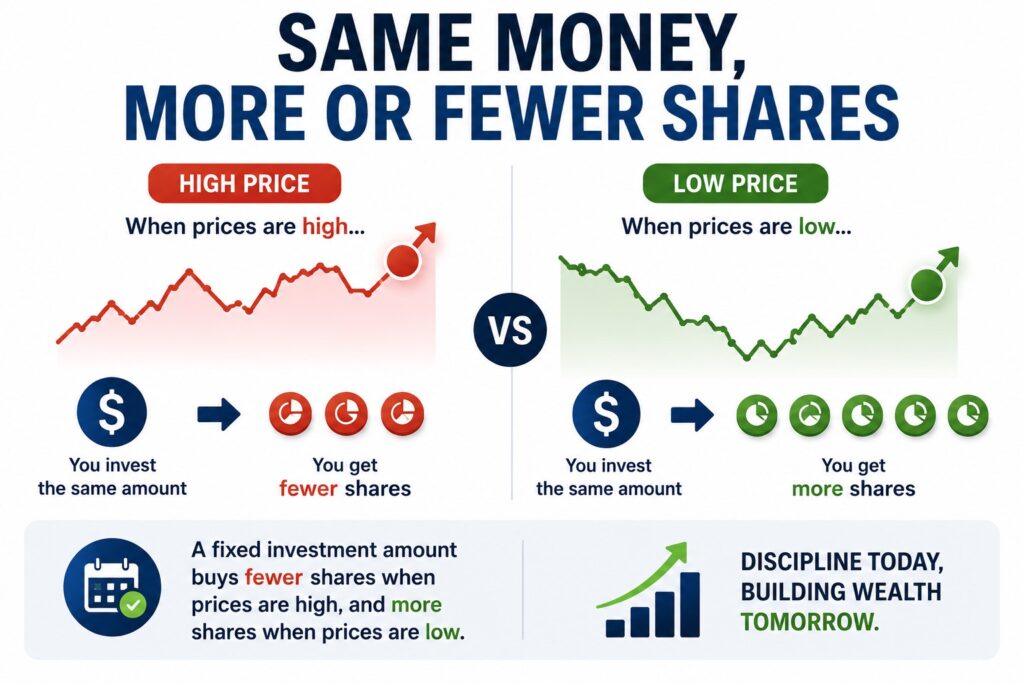
Investor.gov defines dollar-cost averaging as investing equal portions at regular intervals regardless of market ups and downs. With a fixed contribution, you naturally buy more shares when prices are lower and fewer shares when prices are higher.
That mechanism is easier to understand with a simple example.
How Dollar Cost Averaging Works
Suppose an investor contributes $300 to the same investment every month.
| Month | Share Price | Amount Invested | Shares Purchased |
|---|---|---|---|
| January | $100 | $300 | 3.00 |
| February | $75 | $300 | 4.00 |
| March | $60 | $300 | 5.00 |
| April | $75 | $300 | 4.00 |
| May | $100 | $300 | 3.00 |
Key DCA Calculation Result
- Total Invested: $1,500 ($300 × 5 months)
- Total Shares Purchased: 19 shares
- Average Price Paid: approximately $78.95 per share
- Average of the Five Monthly Market Prices: $82.00 per share
In this hypothetical example, the investor’s average purchase cost is lower than the simple average of the five monthly market prices because the fixed $300 contribution bought more shares when prices were lower.
At $100 per share, $300 purchased only three shares. At $60, the same contribution purchased five.
That is the basic mechanism behind Dollar Cost Averaging: the amount invested remains constant while the number of shares purchased changes with the market price.
But this example should not be interpreted as a guarantee that DCA will always produce a lower average cost. The result depends on the path prices take during the investment period.
A falling price also does not automatically make an investment attractive. If an asset keeps losing value because its underlying fundamentals are deteriorating, continuing to buy can still produce substantial losses.
Why Investors Use Dollar Cost Averaging
It Reduces the Need to Time the Market
Market timing sounds straightforward in hindsight: buy near a low and avoid buying near a high.
In real time, the problem is much harder.
After a 10% decline, nobody knows whether the market is close to a bottom or halfway through a much larger drop. Likewise, a market trading near an all-time high could fall next week or continue rising.
DCA changes the question.
Instead of repeatedly asking:
“Is today the right day to invest?”
you follow a contribution schedule established in advance.
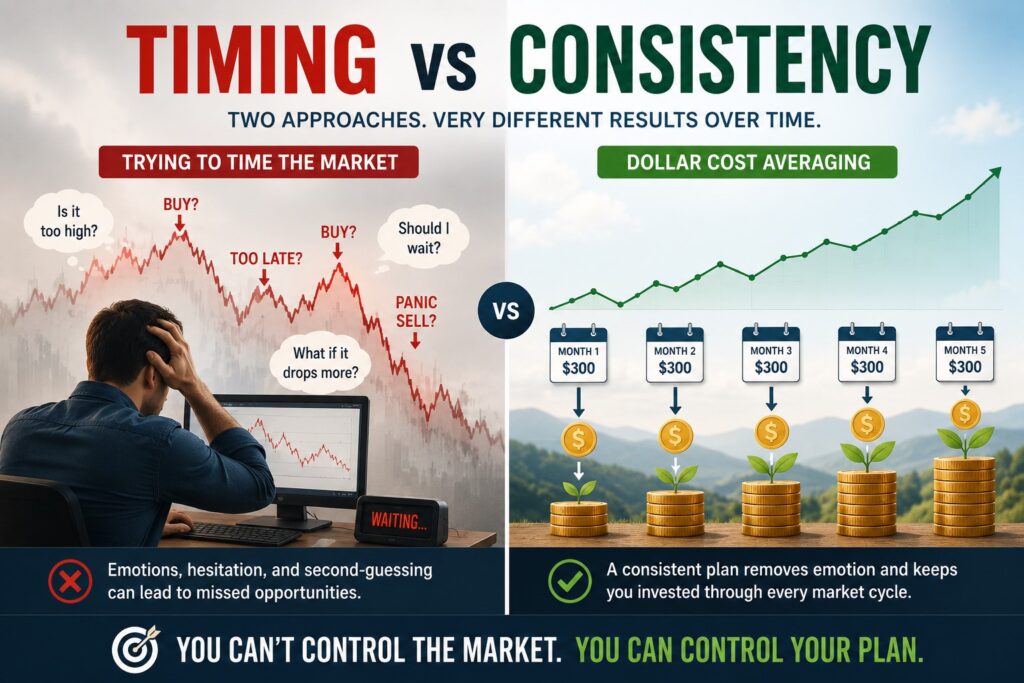
FINRA’s guide to Dollar Cost Averaging explains that a disciplined schedule can reduce some of the emotion involved in investing and may help investors avoid impulsive decisions during market swings.
It Can Reduce Emotional Decisions
This benefit becomes easier to understand when you picture an actual investing decision.
Imagine that the market has dropped sharply over several weeks. A beginner opens a brokerage app, sees the portfolio down 10%, and suddenly hesitates to make the contribution that felt easy when prices were rising.
Nothing about the long-term plan may have changed. The emotional environment has.
A predetermined DCA schedule can reduce the influence of that split-second decision. It does not remove fear, but it reduces the number of times an investor has to decide whether the market feels safe enough to buy.
The opposite can happen during a rally. Rapidly rising prices can encourage investors to abandon their normal plan and buy more because they fear missing out.
A consistent schedule creates a rule before either emotion appears.
It Fits Naturally With Regular Income
Many investors do not begin with a large pool of cash.
They invest money as they earn it.
Someone contributing part of each paycheck to a 401(k), for example, may already be investing at regular intervals.
This distinction matters when comparing DCA with lump-sum investing.
If $12,000 is already sitting in cash and available to invest today, gradually deploying it is a deliberate decision to keep some of that money uninvested.
If the $12,000 will only become available over the next year through future paychecks, there is no $12,000 lump sum waiting on the sidelines.
Those are different situations.
Dollar Cost Averaging vs. Lump-Sum Investing
Suppose two investors each have $12,000 available today.
Investor A invests all $12,000 immediately.
Investor B invests $1,000 per month for 12 months.
Investor A is using lump-sum investing. Investor B is using Dollar Cost Averaging.
Which investor will earn the higher return?
That cannot be known in advance because it depends on what markets do next.
If prices rise soon after the decision, Investor A generally benefits because the full $12,000 was exposed to those gains earlier.
If prices fall sharply, Investor B still has cash available and can make later purchases at lower prices.
Over long periods, however, keeping investable money in cash creates an opportunity cost.
Vanguard research comparing lump-sum investing and cost averaging found that lump-sum investing historically outperformed common cost-averaging strategies roughly two-thirds of the time in the periods and scenarios studied.
The reason is intuitive: when assets have a positive expected return relative to cash, delaying investment can mean giving up part of the potential return from being invested.
That does not mean lump-sum investing will outperform during every future period.
It means investors should avoid assuming that gradually entering the market automatically produces better returns.
The practical decision also involves behavior. A strategy with a higher expected return is not very useful if an investor becomes uncomfortable after a large immediate loss and abandons the plan.
For some investors, entering gradually may make market exposure psychologically easier to maintain even when the expected-return trade-off favors investing sooner.
That is a more useful way to compare the two approaches than asking which strategy “always wins.”
The Risks and Limitations Beginners Should Understand
Dollar Cost Averaging Does Not Prevent Losses
DCA changes the timing of purchases. It does not make the underlying investment safe.
Imagine repeatedly purchasing shares in a business that is losing customers, accumulating unsustainable debt, and becoming less competitive.
A falling share price allows each contribution to buy more shares, but that may simply increase exposure to a deteriorating company.
All investments involve risk, including the possibility of losing principal.
DCA controls when you invest.
It does not determine what you invest in.
Holding Cash Can Reduce Returns
When an investor already has money available but spreads investments over several months, part of that money remains in cash.
If the market rises during that period, the uninvested portion does not fully participate.
FINRA identifies this as an important limitation of DCA: gradual investing can reduce the impact of a short-term decline, but it can also sacrifice potential gains while money remains on the sidelines.
This opportunity-cost argument is different when you are simply investing money as you earn it rather than deliberately holding an existing lump sum for future investment.
Fees Still Matter
More transactions can mean more costs, depending on the brokerage account and investment product.
Even where trading commissions are zero, investors may still face fund expense ratios, account fees, spreads, or other investment costs.
Investor.gov’s guidance on investment fees and expenses explains that seemingly small fees can have a meaningful effect on portfolio value over long periods because they reduce the amount of money remaining invested.
Fees should therefore be considered alongside contribution frequency, fund selection, and expected holding period.
DCA Is Not Diversification
This is one of the most important distinctions for a beginner to understand.
Suppose you invest $500 every month in one individual stock.
You are using Dollar Cost Averaging.
You are not necessarily diversified.
Diversification involves spreading money among different investments rather than depending heavily on a single holding or narrow group of holdings.
A recurring purchase schedule and portfolio diversification solve different problems.
A Common Beginner Mistake: Averaging Down Without Reassessing the Investment
“Buy the dip” can make every falling price look like an opportunity.
That can be dangerous because the reason for the decline matters.
Consider two hypothetical investments.
Investment A is a broadly diversified market fund declining during a market-wide correction.
Investment B is an individual company falling because sales are weakening, debt is climbing, and the original investment thesis is deteriorating.
Both investments have lower prices.
That does not make the two situations equivalent.
Automatically buying more of Investment B simply because the stock is cheaper can increase concentration in a failing investment.
This distinction matters because DCA and averaging down can look identical in a brokerage account, even though the reasoning behind them may be completely different.
Before averaging down, check:
- Has the original reason for owning the investment changed?
- Is the decline company-specific or part of a broader market move?
- Have revenue, cash flow, debt, or competitive conditions materially weakened?
- Would another purchase make this position too large relative to the rest of the portfolio?
A lower price alone is not evidence that an investment has become a better value.
The key question is not simply “Is it cheaper?”
It is “Has the investment thesis changed?”
Dollar Cost Averaging and Diversified ETFs
DCA is often discussed alongside exchange-traded funds, or ETFs.
An ETF can hold many securities in a single fund, which can make recurring investing easier to combine with diversification.
If you are new to this type of investment, ETF Investing for Beginners A Smart and Practical First Guide is a useful related article.
However, the word “ETF” does not automatically mean an investment is broadly diversified.
A technology-sector ETF, for example, may own many companies but still have substantial exposure to the same sector, economic forces, and valuation risks.
The investment itself therefore still needs to be evaluated for diversification, fees, strategy, and risk.
The schedule tells you when money is invested.
The investment determines what risks you own.
How to Build a Simple DCA Framework
A useful Dollar Cost Averaging plan does not need many rules.
Four questions cover most of the important decisions.
1. What Are You Investing For?
Start with the goal.
Money intended for retirement decades from now can generally tolerate a different level of short-term volatility from money needed for a major purchase next year.
Your time horizon should influence the type of investment you choose before you worry about the exact contribution schedule.
2. How Much Can You Invest Consistently?
A recurring amount should be sustainable.
Investing $1,000 per month for two months and then stopping because your budget cannot support it may be less practical than consistently investing $300.
For many beginners, this may be the most useful question in the entire framework:
Can this contribution continue during an ordinary month without forcing you to sell investments or take on expensive debt when an unexpected expense appears?
Consistency works best when the contribution fits your actual finances.
3. What Investment Are You Buying?
Do not let an automatic contribution schedule replace investment analysis.
Consider diversification, fees, risk, and the role the investment plays in your broader portfolio.
Dollar Cost Averaging into a broadly diversified portfolio is very different from repeatedly adding money to one speculative stock simply because its price keeps falling.
For more on portfolio construction, see How to Build Your First Stock Portfolio: A Smart and Simple Beginner’s Guide.
4. What Is the Schedule?
Weekly, biweekly, or monthly contributions can all create a systematic process.
The specific frequency is usually less important than having a clear rule that you can follow without reacting to every market headline.
Automation can help because it reduces repeated decisions about whether a particular day feels “safe” enough to invest.
When Dollar Cost Averaging May Be Useful
Dollar Cost Averaging may be practical if you invest part of each paycheck, are gradually building a long-term portfolio, or tend to delay investing while waiting for a better entry point.
It may be less attractive when a large amount of cash is already available for long-term investment and you are comfortable accepting immediate market exposure.
The distinction matters because Dollar Cost Averaging is not primarily a tool for maximizing returns in every market environment. It is a tool for creating a structured investing process.
What Dollar Cost Averaging Cannot Solve
A recurring investment schedule can be useful, but it cannot compensate for every investment mistake.
DCA cannot:
- guarantee a profit;
- guarantee a lower average purchase price;
- turn a fundamentally poor investment into a good one;
- protect a portfolio from a prolonged market decline;
- replace diversification;
- eliminate investment fees;
- determine the right level of risk for your financial situation.
The strategy should therefore be viewed as one part of an investment plan rather than the plan itself.
Final Takeaway
Dollar Cost Averaging replaces the search for a perfect entry date with a repeatable contribution schedule.
That can reduce dependence on market timing, make emotional decisions less influential, and fit naturally with money invested from regular income.
But the trade-offs matter.
If you already have a lump sum available, gradually investing it means leaving some money out of the market. Historically, that has often reduced returns compared with investing available money immediately. And no contribution schedule can rescue a poor investment simply by purchasing it at lower prices.
For beginners, the most useful lesson is not that DCA is always better.
It is that the investing schedule, the quality of the investment, diversification, fees, time horizon, and your ability to stay with the plan all matter together.
FAQ
Q1. Is Dollar Cost Averaging good for beginners?
It can be useful for beginners because it creates a regular investment schedule and reduces the need to repeatedly decide when to enter the market. However, the strategy does not remove investment risk, and the underlying investment still needs to be appropriate.
Q2. Is it better to invest monthly or all at once?
Neither method will win in every future period. Investing a lump sum gives available money more time in the market, while gradual investing reduces how much money is exposed to an immediate decline. Historical Vanguard research has favored lump-sum investing more often, but future results depend on market performance.
Q3. Does Dollar Cost Averaging guarantee a lower average price?
No. A fixed contribution buys more shares when prices are low and fewer when they are high, but there is no guarantee that the final average purchase price will be lower than the price available when you began investing.
Q4. Can I use DCA with ETFs?
Yes. Recurring purchases can be made with many ETFs when supported by the brokerage. However, ETFs differ significantly in diversification, strategy, fees, and risk. A narrowly focused ETF may still be highly concentrated.
Q5. Should I stop DCA when the market falls?
A market decline alone does not automatically mean a long-term investment plan should stop. The more important questions are why the investment is falling and whether your financial situation, risk tolerance, or original investment thesis has materially changed.
📚 Related Articles
ETF Investing for Beginners A Smart and Practical First Guide
How to Build Your First Stock Portfolio: A Smart and Simple Beginner’s Guide
What Is a Stock? A Simple and Effective Beginner’s Guide

Stock Valuation Checklist: 7 Critical Checks Before Calling a Stock Cheap
A stock can look cheap because its price has fallen 40%, its P/E ratio is…
RSI Divergence vs MACD Crossover: Which Is More Reliable for Trading?
RSI divergence can warn that price momentum is weakening before a reversal becomes obvious. A…

Before You Buy the Dip: 5 Critical Balance Sheet Checks Every Investor Should Make
A stock that falls 20%, 30%, or even 50% can suddenly look cheap. But a…
Disclaimer: This article is for educational purposes only. It is not financial advice or a recommendation to buy or sell any specific stock, ETF, cryptocurrency, or other asset. All investment decisions are your own responsibility.