
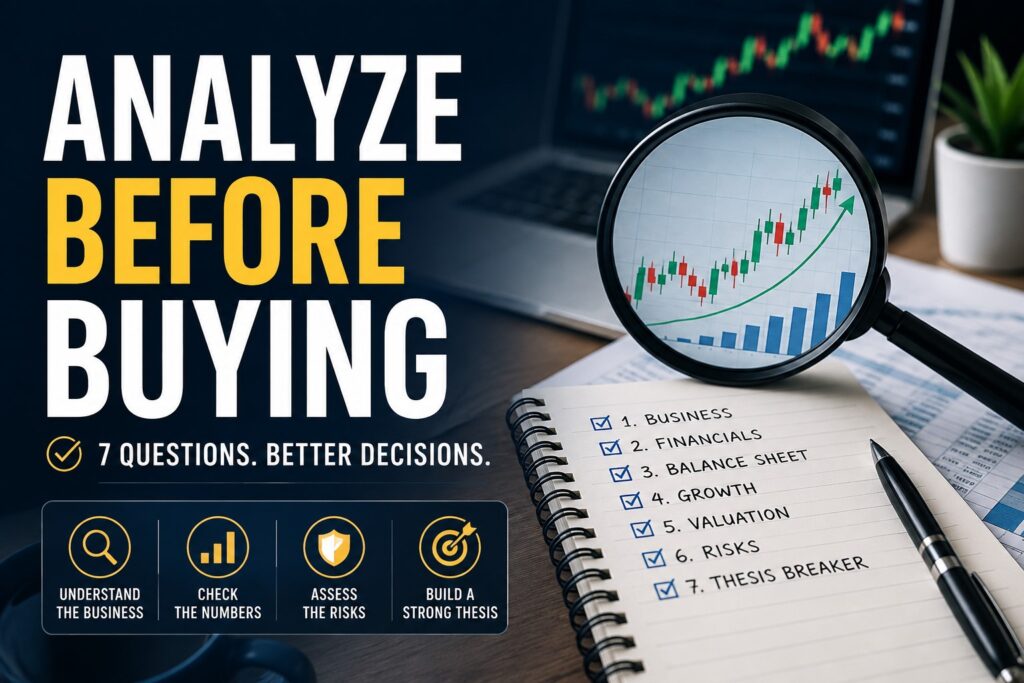
Learning how to analyze a stock before buying is not about finding one perfect ratio or checking seven boxes that automatically produce a “buy” decision.
It is about building a repeatable way to think.
A company can report impressive revenue growth while its cash generation deteriorates. A stock can trade at a low P/E ratio because it is genuinely undervalued—or because investors expect earnings to fall. Even an excellent business can become a disappointing investment if the price already assumes years of exceptional performance.
The goal of this checklist is to help you answer four bigger questions:
What do I understand? What am I assuming? What is already reflected in the price? What would make me change my mind?
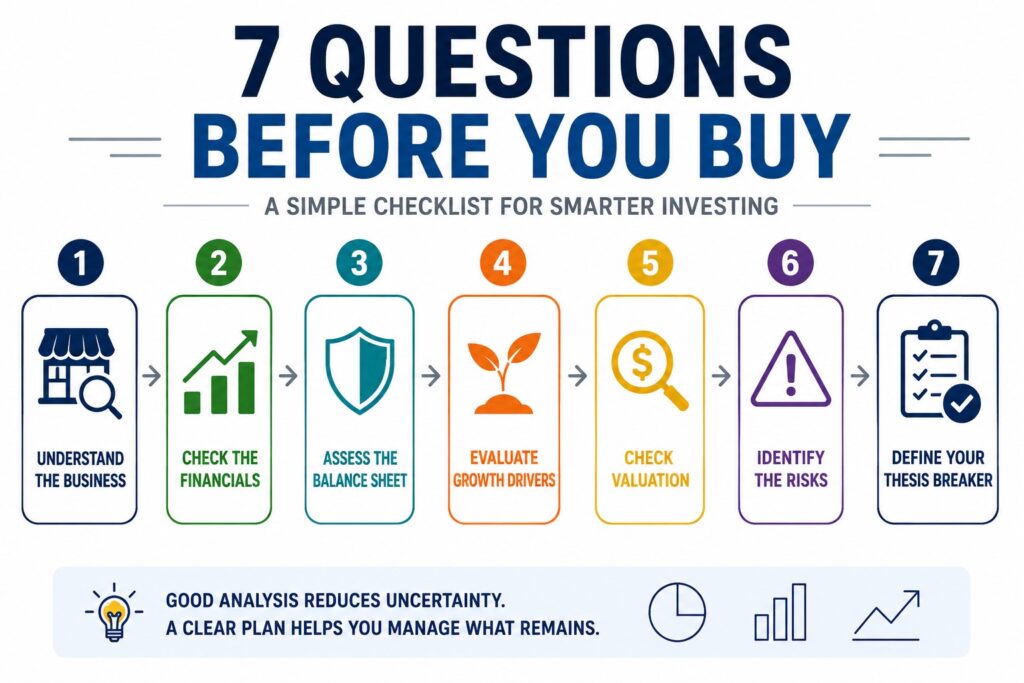
The 7 Questions to Ask Before Buying a Stock
Keep these seven questions in your notes and use them whenever you research a company:
- Do I understand how the company actually makes money?
- Are revenue, profit, and cash flow moving in a healthy direction?
- Is the balance sheet strong enough to handle a difficult period?
- What is really driving growth, and can it continue?
- What expectations are already reflected in the valuation?
- What could make my investment thesis wrong?
- What evidence would make me change my mind?
The last two questions are especially important.
Research becomes much more useful when you are looking not only for reasons to own a stock, but also for evidence that could prove your original reasoning wrong.
Step 1: Understand How the Company Really Makes Money
The first step in learning how to analyze a stock before buying is being able to explain the underlying business in plain English.
Ask:
- What does the company sell?
- Who pays it?
- Why do customers buy from this company instead of another one?
- Which products, services, or business segments drive its economics?
- What has to happen for the company to make more money?
The SEC identifies the Business section of Form 10-K as an important place to understand what a public company does. A 10-K also provides detailed information about financial condition, operating results, and significant risks.
A familiar brand can still have a business model that is more complicated than it first appears.
Coca-Cola, for example, does not simply manufacture and distribute every finished bottle itself. Its system includes concentrate operations and bottling partners, which means investors need to understand concepts such as concentrate sales, volume, and price/mix when interpreting growth.
You do not need to master every detail immediately.
But if you cannot explain how the business earns money in two or three clear sentences, valuation probably comes too early.
Investor Check:
Could I explain this company’s business model without copying language from its investor presentation?
Step 2: Follow Revenue, Profit, and Cash—Not Just the Headline
Once you understand the business, check whether the financial statements support the story.
Three areas provide a useful starting point:
- Revenue: money generated from customers.
- Profit: what remains after relevant expenses.
- Cash flow: how cash is actually generated and used by the business.
When learning how to analyze a stock before buying, these numbers become much more useful when you examine how they move together rather than treating each one in isolation.
Consider this hypothetical company:
| Metric | Year 1 | Year 2 | Year 3 |
|---|---|---|---|
| Revenue | $1.00B | $1.15B | $1.30B |
| Net Income | $100M | $120M | $150M |
| Operating Cash Flow | $130M | $155M | $190M |
Revenue, net income, and operating cash flow are all moving in the same general direction.
That does not prove the stock is attractive, but it gives you a reasonably coherent financial pattern to investigate.
Now consider a different hypothetical business:
| Metric | Year 1 | Year 2 | Year 3 |
|---|---|---|---|
| Revenue | $1.00B | $1.25B | $1.50B |
| Net Income | $100M | $75M | $40M |
| Operating Cash Flow | $120M | $80M | $35M |
The second company is growing revenue faster.
But profit and operating cash flow are deteriorating.
Instead of concluding that the company is either “good” or “bad,” ask the more useful question:
Why is every additional dollar of revenue producing less profit and cash?
Maybe management is investing heavily for future growth, costs may be rising, or the underlying economics may be deteriorating.
The financial statements show the pattern. Your job is to investigate the cause.
The SEC notes that Forms 10-K and 10-Q provide detailed information about a company’s business, risks, operating results, and financial results, while management discussion can help investors understand what is driving those results.
What I Would Check Next
When revenue growth looks impressive, I would examine what the company had to spend to produce that growth.
If operating expenses, customer acquisition costs, capital expenditures, or other costs are rising much faster than the economic benefit they create, headline growth deserves closer scrutiny.
The better question is not simply:
“Is the company getting bigger?”
It is:
“Is the underlying business becoming stronger as it gets bigger?”
Step 3: Test the Company’s Financial Resilience
A profitable company can still have a fragile financial structure.
This is where the balance sheet becomes important.
At a minimum, examine:
- cash and liquid assets;
- short- and long-term debt;
- interest expense;
- operating cash generation;
- major financial obligations.
The goal is not to find a business with zero debt.
A practical approach to how to analyze a stock before buying is to ask whether the balance sheet gives the company enough flexibility when conditions become difficult.
Debt can be productive when a company can comfortably service it and invest the borrowed capital at attractive returns. Problems arise when debt reduces a company’s ability to respond to weaker business conditions.
Imagine two hypothetical companies each borrow $2 billion.
Company A uses the money to expand a profitable business while continuing to generate substantial cash.
Company B borrows because its existing operations are no longer producing enough cash to fund normal needs.
The debt amount is identical.
The financial situation is not.
If debt increased sharply, do not stop at the percentage. Check whether the borrowing funded productive investment, an acquisition, refinancing, or simply weak internal cash generation.
A useful stress question:
If business conditions became significantly worse for a year or two, would the balance sheet give management options—or take options away?
Step 4: Separate Growth From Sustainable Growth
High growth rates attract attention.
The harder part is identifying what actually produced them.
Revenue can grow because of:
- higher unit sales;
- price increases;
- acquisitions;
- geographic expansion;
- new products;
- new stores or locations;
- favorable industry conditions;
- temporary supply or demand imbalances.
Those sources of growth are not economically identical.
Suppose two retailers each report 20% revenue growth. One achieved it through stronger sales at existing locations; the other acquired another company.
The headline growth rate is identical, but the questions are different. For the first, ask whether customer demand can persist. For the second, examine the acquisition price, financing, and whether the acquired revenue can produce attractive returns.
Find the Growth Engine
When learning how to analyze a stock before buying, I would spend less time asking whether growth is “high” and more time figuring out exactly what is powering it.

Then ask:
Can that engine keep working?
A company relying on price increases may eventually face customer resistance, while acquisition-driven growth depends on finding attractive targets and financing them well. Temporary industry shortages can also make growth look more durable than it really is.
Growth becomes more meaningful once you understand both its source and its durability.
Investor Check:
Is this company becoming competitively stronger, or is a temporary industry tailwind making almost every company look strong?
Step 5: Ask What the Valuation Already Assumes
A strong company and an attractive stock are not necessarily the same thing.
Price still matters.
One familiar valuation measure is the price-to-earnings ratio, or P/E:
P/E Ratio = Share Price ÷ Earnings Per Share
Suppose two hypothetical companies each earn $5 per share.
Company A trades at $50:
$50 ÷ $5 = 10× P/E
Company B trades at $150:
$150 ÷ $5 = 30× P/E
Company A looks cheaper.
But you still do not have enough information to decide which investment offers better value.
Perhaps Company B has stronger growth, recurring revenue, higher returns on capital, and a better competitive position.
Or perhaps Company A operates in a cyclical industry and its current earnings are unusually high.
That leads to a much more useful valuation question:
Why Is the Stock Cheap—or Expensive?
When I see an unusually low P/E ratio, the first thing I would check is whether current earnings are unusually strong or future earnings are expected to weaken.
A stock can look statistically cheap just before profits decline.
That is one way a value trap can emerge: the valuation appears inexpensive, but the low multiple reflects deteriorating fundamentals rather than a market mistake.
An exceptional company may deserve a premium valuation, but the higher the expectations embedded in the price, the less room there may be for disappointing growth or margins.
This is why how to analyze a stock before buying should never become a search for the lowest P/E ratio.
Instead ask:
What does this company need to accomplish for today’s valuation to make sense?
That question connects price with the assumptions behind the investment.
Step 6: Build the Bear Case Before You Build Confidence
Once you like a company, supportive evidence becomes easier to notice.
That creates a problem.
If your research process contains only reasons the stock could work, you have not really tested the thesis.
That is why how to analyze a stock before buying should include an intentional search for evidence against your original idea, not just evidence supporting it.
Build the strongest reasonable argument against it.
Possible risks include:
- stronger competition;
- slowing demand;
- excessive leverage;
- shrinking margins;
- technological or regulatory disruption;
- execution problems;
- expectations that are already too optimistic.
A company’s Form 10-K includes a Risk Factors section describing significant risks facing the business. The SEC specifically points investors toward this section when evaluating public-company filings.
Do not simply count the risks.
Instead ask which ones threaten the assumptions that matter most to your valuation.
Suppose your thesis depends on operating margins improving over the next three years.
A competitor begins cutting prices aggressively.
The useful question is no longer:
“Does this company face competition?”
Almost every business does.
Ask instead:
“Does stronger price competition make my margin assumption materially less credible?”
The One-Assumption Test
Try to identify the single assumption that would change your view of the company’s value the most if it turned out to be wrong.
It might be:
customer growth, pricing power, operating margins, commodity costs, retention, market share, or access to financing.
That variable deserves extra attention in future earnings reports.
The purpose of risk analysis is not to become pessimistic.
It is to find out where your thesis is most fragile.
Step 7: Write a Thesis—and a Thesis Breaker
The final step in how to analyze a stock before buying is not predicting whether the price will rise next week. It is documenting the assumptions behind your decision.
Write down your reasoning.
A useful investment thesis explains:
- why the business may become more valuable;
- what is driving its economics;
- what assumptions you are making;
- what today’s valuation requires to go right.
Then write a second statement:
The Thesis Breaker
A thesis breaker is evidence that would force you to reconsider one of the important assumptions behind the investment.
Consider this hypothetical example.
Investment Thesis:
Revenue can continue growing at a healthy rate as the company gains customers, while operating leverage gradually improves margins. The balance sheet provides enough flexibility to support expansion.
Thesis Breaker:
Two consecutive reporting periods of weakening core customer demand combined with declining margins would challenge both the growth and profitability assumptions behind the thesis.
Notice what the thesis does not say:
“This stock will go up.”
An investment thesis is a set of assumptions that can be tested as new evidence arrives, not a prediction of the next stock-price move.
Before considering a stock, try answering these four questions:
- Why could this business become more valuable?
- Which assumptions does that argument depend on?
- What does today’s valuation require to go right?
- What evidence would make me change my mind?
The fourth question may be the most valuable.
If nothing could ever change your mind, you do not have a testable investment thesis. You have a belief.

Mini Case Study: Applying the Checklist to Coca-Cola
A real company can make how to analyze a stock before buying much more concrete by showing how the seven questions connect in practice.
This example is not a recommendation to buy or sell Coca-Cola stock. It is simply a demonstration of the research process using public information.
1. Understand the Business
Coca-Cola operates a broader beverage system that includes concentrate operations and bottling partners rather than simply manufacturing and distributing every beverage in the same way.
That means an investor needs to understand the relationship between unit case volume, concentrate sales, pricing, product mix, and bottling operations before interpreting revenue growth. Coca-Cola’s 2025 Form 10-K provides the underlying business and financial disclosures for that analysis.
2. Follow the Financial Direction
In its full-year 2025 results, Coca-Cola reported net revenues of approximately $47.9 billion, up 2%, while organic revenue grew 5%.
The company attributed full-year organic revenue growth to 4% growth in price/mix and a 1% increase in concentrate sales.
This is where analysis starts rather than ends.
The headline question is:
“Did revenue grow?”
The more useful questions are:
How much came from pricing? How much came from underlying sales activity? What drove product mix? How repeatable are those contributions?
3. Examine Financial Resilience
Next, use the 10-K to examine cash generation, debt, liquidity, and major financial obligations.
The goal is not to label debt as simply “high” or “low,” but to understand how much financial flexibility the company has if conditions weaken.
4. Identify the Growth Engine
Coca-Cola’s 2025 results illustrate why headline growth needs decomposition.
Organic revenue grew 5%, but the company’s reported drivers included a substantially larger contribution from price/mix than from concentrate-sales growth.
That leads to questions such as:
How much future growth can come from pricing? What happens to volumes if prices rise? Which regions or categories are contributing most?
The goal is not to answer every question from one earnings release, but to identify what deserves further investigation.
5. Evaluate the Price Separately From the Company
Even if Coca-Cola appears to be a strong business, that does not automatically make the stock attractive at the current price.
Compare the valuation with realistic assumptions about growth, margins, cash generation, competitive durability, and risk at the time you are evaluating the stock.
6. Find the Assumption Most at Risk
Identify which disclosed risks could directly challenge the assumptions behind your thesis.
If the thesis depends heavily on pricing power, for example, consumer demand and competitive pricing deserve more attention than risks with little connection to that assumption.
7. Write the Thesis Breaker
Only after the previous steps would I try to write the investment thesis.
Then I would write the evidence that could break it.
That final exercise keeps these two ideas separate:
“I like this business.”
and
“This stock is attractive at this price under these assumptions.”
Those are not the same conclusion.
How to Analyze a Stock Before Buying: The Decision Framework
Your research notes should eventually answer something like this:
| Area | Core Question | Warning Sign |
|---|---|---|
| Business | How does the company actually make money? | You cannot explain the business simply |
| Financials | Are revenue, profit, and cash moving together? | Growth requires worsening economics |
| Balance Sheet | Can the company handle a difficult period? | Debt removes financial flexibility |
| Growth | What specifically drives growth? | Temporary tailwinds are treated as permanent |
| Valuation | What expectations are reflected in the price? | “Low P/E = cheap” becomes the entire thesis |
| Risk | What could invalidate an important assumption? | Research contains only bullish evidence |
| Thesis | What evidence would change my mind? | No clear thesis breaker exists |
This is not a scoring model.
Seven check marks do not make a stock attractive.
The framework is designed to reveal what you still do not understand before committing capital.
Three Beginner Mistakes This Process Helps Prevent
1. Confusing Share Price With Valuation
A $20 stock is not automatically cheaper than a $200 stock.
Share price tells you what one share costs. It does not tell you whether the underlying company is inexpensive relative to its earnings, cash flow, assets, growth prospects, or other relevant fundamentals.
2. Extrapolating One Good Quarter
A strong quarter can result from pricing, acquisitions, temporary demand, favorable timing, easy comparisons with the prior year, or other effects that may not repeat.
Compare several periods and investigate why the numbers changed before treating one quarter as the new normal.
3. Researching Only the Bull Case
Once you become interested in a stock, favorable evidence can feel more convincing than unfavorable evidence.
Deliberately look for the strongest reasonable argument against the investment.
The goal is not to talk yourself out of every stock.
It is to determine whether the thesis can survive serious scrutiny.
Where Can Beginners Find Reliable Stock Information?
For U.S. public companies, you can perform a substantial amount of research without paying for a stock-research platform.
The SEC’s EDGAR database provides free public access to company filings and financial information. A Form 10-K includes annual financial information and discussion of material risks, while Forms 10-Q provide quarterly updates and Forms 8-K disclose certain significant corporate events.
A practical research sequence is:
Latest 10-K → latest 10-Q → relevant 8-K filings → earnings release → investor presentation when useful
Company presentations can be useful, but they should not replace regulatory filings. Presentations emphasize management’s story, while filings provide the financial statements, risks, accounting disclosures, and operating details needed to test that story.
One Final Question: Does the Stock Fit the Portfolio?
Analyzing a company and constructing a portfolio are different decisions.
You might perform careful research and still create unnecessary risk by concentrating too much of your portfolio in one company.
That means the final question after how to analyze a stock before buying is not purely about the stock:
Even if my thesis is reasonable, how much company-specific risk am I willing to take?
Good company analysis can reduce uncertainty, but it does not eliminate the consequences of being wrong.
A Better Goal Than Finding the “Perfect” Stock
Learning how to analyze a stock before buying cannot remove uncertainty. Competitors, consumer behavior, economic conditions, and management execution can all change.
A useful analysis has a more realistic goal: separating what you know, what you assume, what the market may already expect, and what evidence could prove you wrong.
Before buying a stock, try completing this sentence:
“I am interested in this stock because ________, but I would reconsider the thesis if ________.”
The first blank forces you to explain the opportunity; the second defines the limit of your confidence.
If you can fill in the first but not the second, the research probably is not finished.
FAQ
Q1. What should I analyze first before buying a stock?
Start with the business model. Understand what the company sells, who pays it, what drives demand, and how the business generates profit and cash. Financial ratios become much easier to interpret once you understand the business behind them.
Q2. How many years of financial statements should I review?
There is no universal number for every business. Looking across multiple annual periods can help distinguish persistent trends from temporary quarterly changes. Cyclical companies may require an even longer perspective because peak-year earnings can make valuation ratios look deceptively low.
Q3. Is a low P/E ratio a sign that a stock is undervalued?
Not necessarily. A low P/E can reflect undervaluation, but it can also reflect expectations for falling earnings, weak growth, cyclical peak profits, or elevated business risk. The more important question is why the market is assigning the company a low multiple.
Q4. Can I analyze a stock using free information?
Yes. U.S. public-company filings are freely available through the SEC’s EDGAR system, including Forms 10-K, 10-Q, and 8-K. These documents can provide information about the company’s business, financial statements, material risks, and significant corporate developments.
Q5. What should make me reconsider an investment thesis?
Evidence that undermines one of your important assumptions should trigger a reassessment. If the thesis requires continued customer growth and improving margins, for example, sustained deterioration in both could become a thesis breaker. Define those conditions before investing rather than inventing them after the stock price moves against you.
📚 Related Articles
How to Read Financial Statements: A Simple and Powerful Beginner’s Guide
Is a Low P/E Ratio Always Better? 5 Costly Mistakes to Avoid
Fundamental Analysis for Beginner Investors: A Smart Guide to Better Stock Decisions
How to Build Your First Stock Portfolio: A Smart and Simple Beginner’s Guide
Stock Valuation Checklist: 7 Critical Checks Before Calling a Stock Cheap
A stock can look cheap because its price has fallen 40%, its P/E ratio is…
RSI Divergence vs MACD Crossover: Which Is More Reliable for Trading?
RSI divergence can warn that price momentum is weakening before a reversal becomes obvious. A…

Before You Buy the Dip: 5 Critical Balance Sheet Checks Every Investor Should Make
A stock that falls 20%, 30%, or even 50% can suddenly look cheap. But a…
Disclaimer: This article is for educational purposes only. It is not financial advice or a recommendation to buy or sell any specific stock, ETF, cryptocurrency, or other asset. All investment decisions are your own responsibility.