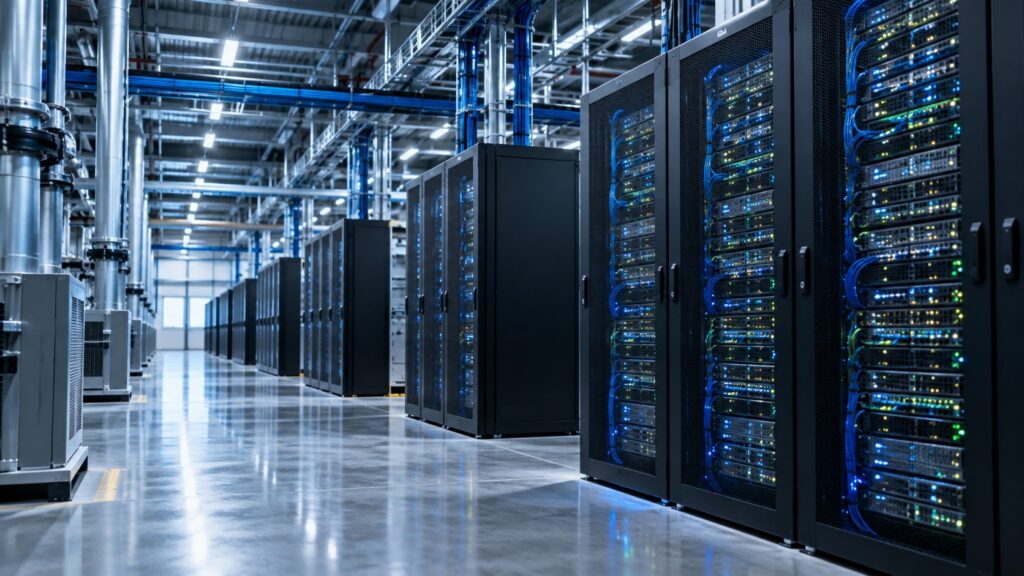
Microsoft, Alphabet, Meta, and other technology giants are spending enormous amounts of capital on AI infrastructure.
That raises an obvious question: How long can AI data center investment keep growing?
The answer cannot be found in CAPEX alone.
Eventually, companies must determine whether each additional dollar invested in computing capacity produces enough additional economic value to justify the next round of spending.
What Investors Should Watch
The turning point is unlikely to be defined by falling CAPEX alone. What matters is whether AI demand, monetization, margins, and cash generation continue to justify new capacity—or whether Big Tech begins shifting from expansion toward efficiency.
The underlying capital cycle looks like this:
AI Demand → CAPEX → Depreciation & Operating Costs → Revenue & Margins → Cash Flow → Next CAPEX
As of 2026, Microsoft, Meta, and Alphabet are still committing substantial capital to AI and technical infrastructure. But rising AI demand does not guarantee that infrastructure spending will keep growing at the same rate.
The more useful question is:
When will Big Tech begin demanding more productivity from the next dollar of AI investment?
2026 Big Tech AI CAPEX: Microsoft, Meta, and Alphabet
The scale of 2026 spending shows why the AI data center investment cycle matters.
Microsoft reported $41 billion of capital expenditures in fiscal Q4 2026. Roughly two-thirds went toward shorter-lived assets, primarily CPUs and GPUs, while the remainder went toward longer-lived assets.
Meta reported $31.08 billion of Q2 capital expenditures, including principal payments on finance leases. The company also narrowed its full-year 2026 CAPEX outlook to $130 billion to $145 billion.
Alphabet has projected $175 billion to $185 billion of 2026 CAPEX. The company said the spending would support AI compute capacity for Google DeepMind, Google Services, Cloud demand, and other growth opportunities.
These figures show that the infrastructure buildout remains substantial. But not every dollar of Big Tech CAPEX should be treated as AI data center spending.
CAPEX can include servers, networking equipment, buildings, land, and other property. Lease accounting and company definitions can also differ.
For investors, the useful question is therefore not which company reports the largest headline number. It is whether the capital burden is rising and whether the infrastructure produces enough economic value to support continued investment.
Why AI Data Center Investment Requires Continuous Reinvestment
AI data centers combine assets with very different economic lives.
Land, buildings, electrical systems, cooling infrastructure, and networking assets can remain useful for many years. GPUs, CPUs, servers, and related computing equipment may need to be expanded or replaced much sooner.
Microsoft illustrates the difference. Roughly two-thirds of its fiscal Q4 2026 CAPEX went toward shorter-lived assets, primarily CPUs and GPUs.
Alphabet has described a similar split. Approximately 60% of its 2025 technical-infrastructure investment went toward servers, while about 40% went toward longer-duration assets such as data centers and networking equipment. The company said it expected a fairly similar mix in 2026.
AI data centers therefore require not only large upfront construction spending but potentially substantial ongoing reinvestment.
That makes their economics different from the traditional software model, where an existing product can often be distributed to additional users at relatively low incremental cost.
Today’s AI CAPEX Becomes Tomorrow’s Cost
Suppose a hypothetical company spends $10 billion on servers and data center infrastructure.
That entire amount generally does not hit the income statement immediately. Capitalized assets are depreciated over their useful lives.
Today’s CAPEX can therefore become tomorrow’s depreciation expense.
There are operating costs as well. AI infrastructure requires electricity, cooling, maintenance, networking, and other resources.
The financial chain does not stop when a data center is built:
CAPEX → Depreciation & Operating Costs → Margins → Cash Flow
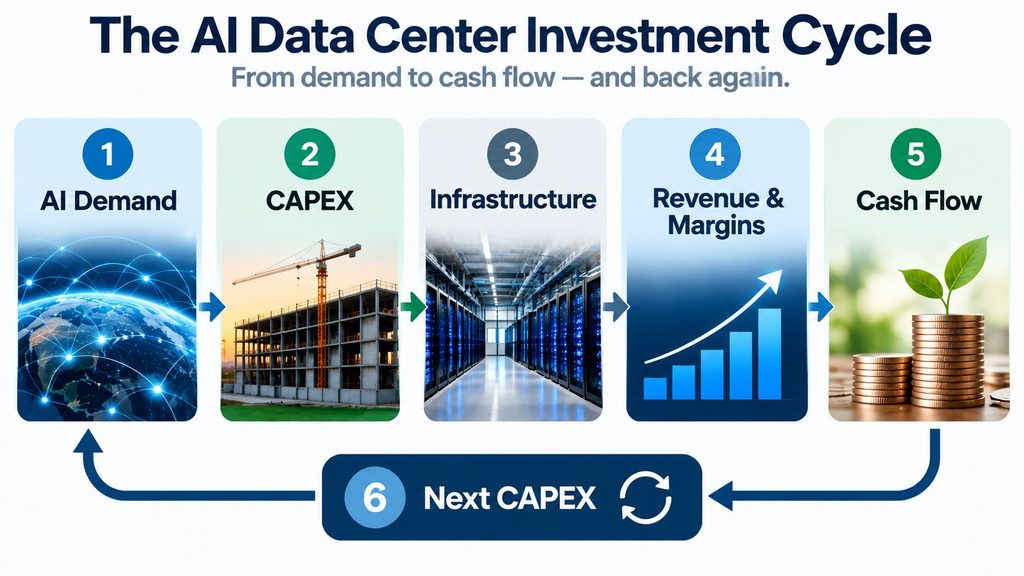
This is why AI data center investment is not only a technology race. It is also a capital-allocation problem.
AI Growth and AI Capital Productivity Are Not the Same Thing
A growing AI business does not automatically mean that each additional dollar of investment is becoming more productive.
Consider a hypothetical example.
A company invests an additional $100 in AI infrastructure and generates $30 of incremental cash flow. A year later, it invests another $200 but generates only $35 of additional cash flow.
The business is still growing.
But the economic output generated by each additional unit of capital has deteriorated.
Outside investors cannot calculate a precise companywide “AI ROI” from public financial statements.
Big Tech CAPEX includes more than AI, while AI can create value through cloud consumption, advertising, paid software, internal productivity, and improvements to existing products.
Rather than searching for one precise ROI number, investors can ask whether demand, revenue, capacity constraints, depreciation, margins, and cash generation tell a consistent story.
That is a more realistic way to evaluate the economics behind AI data center investment than relying on a single estimated ROI figure.
Big Tech Cash Flow Shows the Investment Burden
Cash flow helps show how large the infrastructure commitment has become.
Microsoft generated $55.4 billion in operating cash flow during fiscal Q4 2026. Total CAPEX was $41 billion, including finance leases, while cash paid for property and equipment was $35.8 billion. Microsoft reported $19.6 billion of free cash flow for the quarter.
Importantly, Microsoft’s free cash flow calculation reflects cash capital spending rather than simply subtracting the full $41 billion headline CAPEX figure from operating cash flow.
Meta generated $31.86 billion of operating cash flow in Q2 2026 and reported $31.08 billion of capital expenditures, including principal payments on finance leases. Reported free cash flow was $784 million.
These figures do not prove that either company’s AI investments are succeeding or failing. Quarterly cash flow can be affected by the timing of equipment purchases, lease payments, taxes, working capital, and other factors.
They do show something more basic:
Infrastructure investment has become large enough to absorb a substantial amount of operating cash generation.
| Company | Period | CAPEX / Investment Metric | Cash Flow Context | Important Limitation |
|---|---|---|---|---|
| Microsoft | FY2026 Q4 | $41.0B total CAPEX | $55.4B operating cash flow; $35.8B cash PP&E spending; $19.6B FCF | Total CAPEX includes finance leases; FCF reflects cash capital spending |
| Meta | 2026 Q2 | $31.08B CAPEX | $31.86B operating cash flow; $0.78B FCF | CAPEX includes principal payments on finance leases |
| Alphabet | 2026 guidance | $175B–$185B expected CAPEX | Full-year investment guidance, not a quarterly cash-flow comparison | Spending supports multiple businesses and workloads |
This table should not be used to rank the companies by investment efficiency.
Their reporting periods, business models, CAPEX definitions, asset mixes, and lease structures differ.
5 Signals of a Turning Point in the AI Data Center Investment Cycle
Predicting the exact year when AI data center investment peaks is less useful than identifying the conditions that would change the economic logic behind continued spending.
These five signals provide a practical framework.
1. Is AI Demand Turning Into Revenue?
Rapid growth in AI users, tokens, customers, or workloads demonstrates demand, but infrastructure ultimately needs to produce an economic benefit.
Microsoft Cloud revenue reached $59.3 billion in fiscal Q4 2026, up 27% year over year, while the company continued to report strong demand across Azure and its AI applications and services.
The warning sign would not be one weak quarter.
A more meaningful concern would be CAPEX continuing to rise rapidly over several periods while the businesses expected to monetize that infrastructure fail to generate corresponding economic growth.
Usage matters. For the durability of the investment cycle, monetization matters more.
2. Are AI Capacity Constraints Starting to Ease?
When customers want more computing capacity than a company can provide, additional infrastructure has a clear economic rationale.
Once those shortages ease, the question changes:
Can the new capacity remain sufficiently utilized?
Supply normalization is not automatically negative. It could simply mean capacity has caught up with still-growing demand.
What matters is utilization and monetization after supply catches up.
Microsoft said in its fiscal Q4 2026 earnings call that customer demand continued to exceed supply. It also said it had added another gigawatt of capacity during the quarter and remained on track to roughly double overall capacity over two years.
For the AI data center investment cycle, the eventual disappearance of supply constraints would make utilization increasingly important.
3. Are Depreciation and Infrastructure Costs Pressuring Margins?
Large infrastructure investments do not disappear after the cash is spent.
They return through depreciation and operating expenses.
Microsoft reported a Microsoft Cloud gross margin percentage of 65% in fiscal Q4 2026. The company said the year-over-year decline reflected, among other factors, continued AI infrastructure investment and increased product usage, partially offset by efficiency gains.
Investors therefore need to ask more than whether AI-related revenue is growing.
Are revenue and gross profit growing fast enough to absorb the infrastructure costs required to produce them?
If revenue remains strong but depreciation and operating costs consistently grow faster, the hurdle rate for additional investment may eventually rise.
4. Is Cash Generation Keeping Up With CAPEX?
Big Tech can sustain investment levels that would be impossible for weaker businesses, but even these companies face capital-allocation trade-offs.
Cash committed to infrastructure cannot simultaneously fund acquisitions, dividends, share repurchases, debt reduction, or other investments.
The sustainability of AI data center investment therefore depends partly on whether cash generation can keep pace with the growing capital burden.
Rather than focusing on one quarter, investors can track several periods and ask:
- Is CAPEX growing faster than operating cash flow?
- Is free cash flow structurally weakening or merely experiencing temporary volatility?
- Are earlier infrastructure investments beginning to support stronger margins and cash generation?
The trend matters more than a single quarterly number.
5. Is Management’s Language Shifting From Capacity to Efficiency?
The final signal may appear in earnings calls before it becomes obvious in headline financial numbers.
During aggressive expansion, management is likely to emphasize capacity additions, supply constraints, customer demand, GPU availability, and construction.
Later, the language may shift:
Capacity expansion → utilization
Supply shortages → supply normalization
Rapid buildout → optimization
More infrastructure → higher returns on existing infrastructure
Growth spending → capital discipline
One phrase does not prove that an investment cycle has turned.
But if several large AI infrastructure buyers begin emphasizing utilization, efficiency, and returns rather than shortages and new capacity, the underlying economic question may be changing.
Instead of asking, “How quickly can we build more compute?” management may increasingly ask, “How much economic value can we extract from the compute we already have?”
That shift would be an important signal that AI data center investment is entering a more mature phase.
Why Lower AI CAPEX Is Not Automatically Bad News
This distinction becomes especially important when CAPEX growth eventually slows.
Better GPUs can deliver more computation per dollar. Models can become more efficient. Software can improve hardware utilization, while existing data centers can process more workloads.
Microsoft provides a current example of the efficiency side of this equation.
In fiscal Q4 2026, the company said it had increased throughput for Copilot workloads fourfold since the start of the year. It also said its Maia 200 accelerator delivered 30% better performance per dollar than the latest-generation hardware in its fleet.
A company could therefore continue increasing AI usage and revenue while needing less incremental capital for each unit of compute.
At the same time, slower infrastructure growth could have other causes.
Demand may weaken. Or demand may remain strong while electricity availability, substations, grid connections, cooling systems, networking equipment, or construction constraints delay additional capacity.
That means a slowdown in AI data center investment can reflect at least three very different mechanisms:
weaker demand, physical supply constraints, or improving capital efficiency.
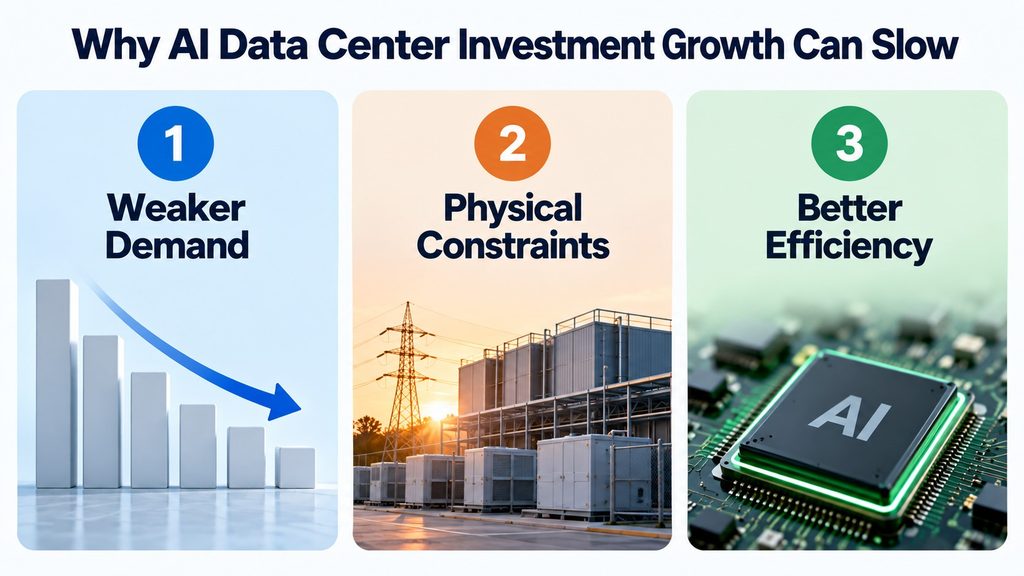
The headline CAPEX number alone cannot tell investors which one is occurring.
The Real Question Is the Productivity of the Next Dollar
As of 2026, disclosed investment plans and demand commentary from major technology companies provide limited evidence that the AI data center investment cycle is simply ending.
But spending cannot be assumed to increase at the same rate indefinitely.
The eventual turning point is likely to depend on a more fundamental question:
How much additional economic value does the next dollar of investment create?
A slowdown caused by weaker demand would mean something very different from one caused by better chips, more efficient models, improved software, and higher infrastructure utilization.
Investors therefore should not treat the direction of CAPEX as the conclusion. It is the starting point for asking why the capital requirement is changing.
If Big Tech’s focus eventually shifts from acquiring as much computing capacity as possible to earning more from the capacity already installed, the AI infrastructure cycle may be moving from an expansion race toward an efficiency race.
The number of new data centers will not tell us exactly when that happens.
The productivity of the next dollar might.
Disclaimer: Company financial figures and guidance in this article were checked against official company disclosures available as of September 21, 2026. Financial results and investment plans may change. This article is for educational purposes only and is not a recommendation to buy or sell any security.
📚 Related Articles
AI Marginal Cost: Why AI Is More Expensive Than Software
AI Electricity Demand: The Critical Power Constraint Investors Cannot Ignore
AI vs IT: The Critical Economic Difference Investors Must Understand

High Interest Rates and the Economy: Why Can Growth Stay Strong?
If high interest rates are supposed to slow the economy, why can consumers keep spending,…

Can AI Become a Monopoly? Where the Real Economic Moats Are
Artificial intelligence appears to have many ingredients that could produce powerful monopolies. Training frontier models…

Can Big Tech Maintain Its Profit Margins in the AI Era?
Artificial intelligence is creating new revenue opportunities for Big Tech, but it is also changing…