
The Hidden Cost Behind Every AI Answer
When I look beyond the AI hype, one question keeps coming back: Why does AI become more expensive as people use it more, while traditional software became cheaper to distribute at scale?
At first, I assumed AI would eventually follow the same economic path as cloud software: high development costs followed by increasingly cheap distribution.
But the more technology earnings reports I read, the more often I saw companies discussing GPU capacity, data-center construction, depreciation, electricity demand, and infrastructure spending.
That changed the way I looked at AI growth.
An AI chatbot can summarize a report, write code, or generate an image within seconds. From the user’s perspective, the experience can feel almost free.
Behind the scenes, however, every request triggers fresh computation. AI chips process tokens, memory systems move data, servers communicate through high-speed networks, and data centers consume electricity while cooling systems keep the hardware running.
Unlike traditional software, generative AI creates a meaningful operating cost whenever someone uses it.
Understanding this concept helps explain why AI companies increasingly discuss inference efficiency, GPU utilization, capital expenditure, and pricing—not just user growth or model performance.
What AI Marginal Cost Really Means
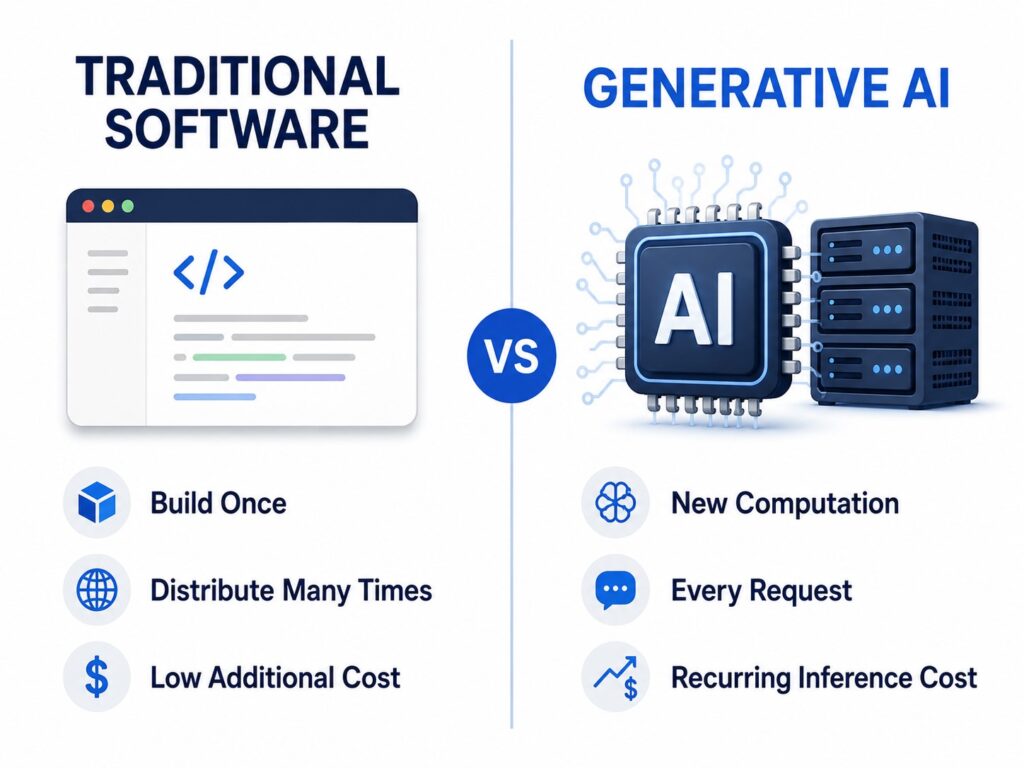
Marginal cost is the additional cost of producing one more unit or serving one more customer.
For a manufacturer, it might include the materials and labor needed to produce another product.
For traditional software, adding another customer was often relatively inexpensive. Once the software had been developed, the same product could be distributed to millions of users without being rebuilt each time.
Generative AI is different.
Every additional prompt, image, document analysis, or coding request requires the system to perform new computation.
Traditional software mainly distributes an existing product.
Generative AI performs new work whenever a user requests an output.
Marginal cost is not the same as total cost.
A company may spend billions developing a product while serving additional users at little extra expense. Another company may complete product development but continue paying meaningful costs every time the product is used.
The difference is easier to see in a direct comparison.
Traditional software and generative AI have fundamentally different scaling economics.
| Cost Structure | Traditional Software | Generative AI |
|---|---|---|
| Upfront investment | Software development | Model development and training |
| Cost after launch | Usually relatively low | Recurring inference cost |
| Main computing device | Often the customer’s device | Provider-operated infrastructure |
| Scaling pattern | Revenue can grow faster than cost | Revenue and compute cost may rise together |
| Key business question | How fast are users growing? | Is revenue growing faster than serving cost? |
The key difference is that distributing another copy of software was usually inexpensive compared with building it in the first place.
Why Traditional Software Scaled So Well
For decades, software was considered one of the most attractive business models.
Developing an operating system, accounting platform, or design application could require years of engineering work. Once completed, however, the same code could be sold to millions of customers.
Customers supplied most of the computing resources themselves, allowing software companies to scale revenue much faster than operating costs. This operating leverage became one of the defining advantages of the traditional software business model.
As revenue increased, the cost of serving each additional customer often became less significant. Successful software companies could therefore generate high gross margins and strong free cash flow.
Why AI Changes the Equation
Generative AI follows a different economic model.
A chatbot does not simply retrieve a finished answer stored in a database. It performs AI inference whenever a user submits a request.
The process can be simplified as follows:
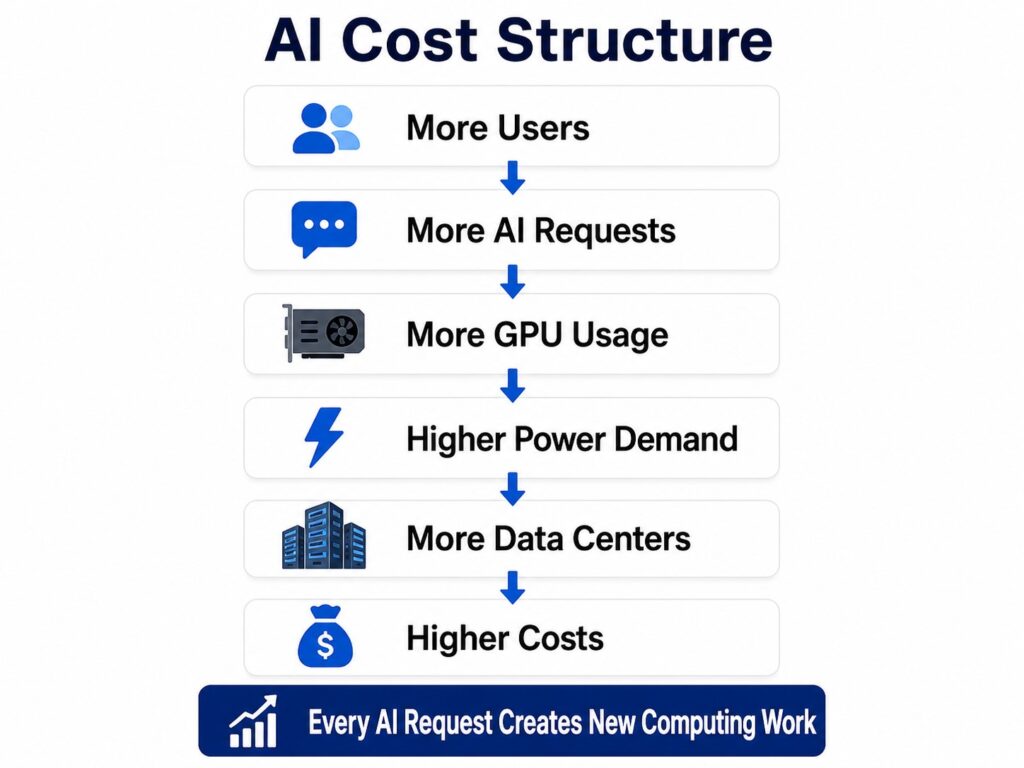
Every stage consumes resources that the provider must pay for, which means AI marginal cost depends heavily on how efficiently each request is processed.
Some requests require very little computation, while others—such as video generation, long-document analysis, or AI agents—consume significantly more resources.
As a result, the cost of serving one AI request can vary dramatically depending on the task being performed.
There is therefore no universal cost for an AI query.
The cost depends on factors such as:
- Model size
- Input and output length
- Type of output
- Response-speed requirements
- Hardware efficiency
- GPU utilization
- Infrastructure and electricity costs
Two companies may report similar user growth while facing very different economics.
One may serve short text requests through efficient models. Another may generate images, video, long reports, or complex reasoning outputs that require much more computation.
User numbers alone reveal little about the quality of an AI business.
Training Cost vs. Inference Cost
AI costs are usually divided into training and inference.
AI training creates the model. It requires large datasets, specialized chips, engineering teams, and significant computing capacity.
Inference begins after training is complete. Every question, document summary, coding request, or generated image requires the model to perform new computation.
Training builds the factory.
Inference operates the factory whenever an order arrives.
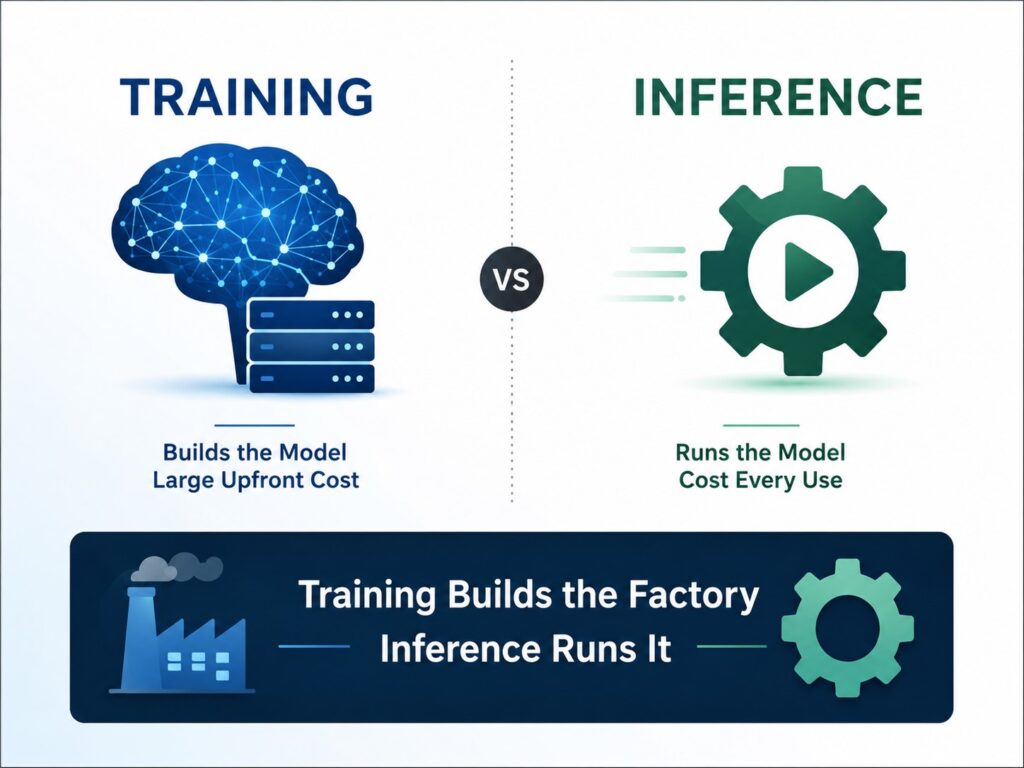
The comparison is not perfect, but it highlights an important business reality.
Building an AI capability is only the first step. Delivering that capability continues to consume resources throughout the product’s life, making inference one of the main drivers of AI marginal cost.
This distinction changed the way I read AI earnings reports.
I used to view rising capital expenditure mainly as a sign that management expected strong future demand. Now I also ask how quickly that spending can translate into additional revenue, stronger customer retention, or improved margins.
This realization led me to a much broader conclusion.
AI is no longer just a software story. It is increasingly an infrastructure and economics story.
Large infrastructure investment may support growth, but investment alone does not prove that the economics of the service are improving.
The more important question is whether revenue per customer is improving faster than the cost of serving that customer.
Why AI Marginal Cost Makes User Growth More Complicated
A common mistake is assuming AI companies will scale exactly like traditional software companies.
They may not.
For a traditional software business, adding another thousand customers might create only a modest increase in operating expenses.
For an AI company, more users often mean:
- More inference requests
- Higher GPU demand
- Larger cloud bills
- More electricity consumption
- Additional networking capacity
- Greater data-center investment
Revenue can grow rapidly, but infrastructure costs often rise alongside it. Although economies of scale improve efficiency, they do not eliminate AI marginal cost. As a result, even companies with strong user growth can struggle if customers consume more computing resources than they can profitably support.
That is why usage limits, premium tiers, API pricing, and enterprise contracts matter so much.
How AI Companies Reduce Marginal Cost
Lowering AI marginal cost has become one of the industry’s most important competitive advantages.
Companies are using several methods to improve inference efficiency.
Smaller Models
Not every request requires the most powerful model.
Simple classification, summarization, and customer-support tasks can often run on smaller models that use less computation.
Model Routing
AI systems can send simple requests to cheaper models and reserve larger models for difficult tasks.
This allows providers to balance performance and cost.
Quantization
Quantization reduces the numerical precision used by a model.
When applied effectively, it can lower memory and computing requirements without causing a major decline in output quality.
Caching and Batching
Repeated requests can be cached, while multiple requests can be processed together.
Both methods improve hardware utilization and reduce cost per output.
Custom Chips and On-Device AI
Large technology companies are developing custom AI accelerators to reduce dependence on expensive third-party hardware.
Some workloads may also move onto laptops and smartphones, shifting part of the computing burden away from centralized data centers.
The competition is no longer only about building the smartest model.
It is increasingly about delivering the most useful result at the lowest sustainable cost.
Companies that consistently lower AI marginal cost may be able to offer more competitive prices without sacrificing gross margins.
Why Cheaper AI May Still Increase Total Spending
Lower inference costs may appear to solve AI’s economic challenge.
If each request becomes cheaper, total computing expenses should eventually fall.
But that is not necessarily what happens.
Economists have long studied the rebound effect, often associated with Jevons paradox. When a technology becomes more efficient and less expensive, people may use much more of it.
AI is already showing signs of this pattern.
Coding assistants can remain active throughout the workday, suggesting code, explaining errors, writing tests, and answering follow-up questions.
Office workers can use AI to summarize meetings, review documents, draft emails, analyze spreadsheets, and prepare presentations.
As AI becomes cheaper, occasional use can turn into constant use.
The cost of each request may fall while the total number of requests grows much faster.
For infrastructure providers, this can be positive because demand for chips, electricity, networking equipment, and data centers may continue rising.
For application companies, however, growing usage must also generate enough revenue to cover the additional computing cost.
Why Pricing Power Matters
AI companies monetize their products through subscriptions, enterprise contracts, APIs, and usage-based pricing.
Not every AI feature has the same pricing power.
A basic writing assistant may quickly become something users expect for free. An AI system that saves thousands of engineering hours or automates a valuable business process may justify a much higher price.
The strongest AI businesses are therefore likely to combine two advantages:
- Low cost per useful output
- High customer willingness to pay
A product with low pricing power or extremely high delivery costs may struggle to generate sustainable profitability.
Sustainable profitability requires both sides of the equation to improve.
What AI Marginal Cost Means for Application Companies
Many AI companies do not train their own foundation models.
Instead, they build applications using third-party models through APIs. These products may include legal research tools, coding assistants, customer-service platforms, marketing software, and financial research services.
Their profitability depends on how much remains after AI model costs, cloud infrastructure, and other operating expenses are deducted from customer revenue.
When customers heavily use an AI application, model and infrastructure expenses can rise meaningfully because the company absorbs an AI marginal cost for each additional request.
An application may attract millions of users but still struggle if each customer produces expensive requests without generating enough revenue.
Successful AI application companies therefore need to answer several questions:
- Can expensive requests be priced separately?
- Can simple tasks use smaller models?
- Does the product contain proprietary data or workflow advantages?
- Does the service save enough time or labor to justify its price?
A company that simply adds a new interface to a third-party model may have limited pricing power.
A company that integrates AI deeply into a valuable workflow may build a much stronger business.
What Investors Should Watch
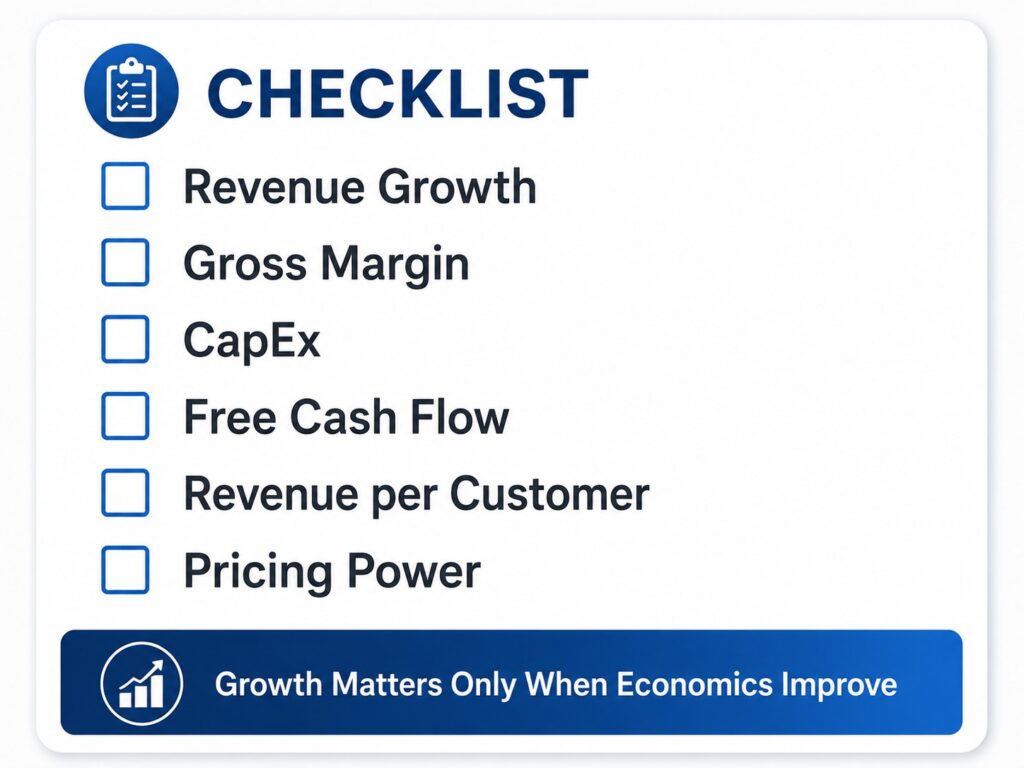
When evaluating AI businesses, I now look at gross margin and free cash flow before becoming too impressed by user growth.
If usage is rising but margins continue to weaken, I treat that as a reason to examine infrastructure costs, pricing, and customer behavior more closely.
Because companies rarely disclose AI marginal cost directly, the following six indicators provide a practical starting point.
1. Revenue Growth
Revenue growth shows whether customers are willing to pay for the product.
It should always be compared with the rate at which costs are increasing.
2. Gross Margin
Gross margin can show whether the cost of delivering the service is improving.
Stable or rising margins may indicate better efficiency or stronger pricing power.
3. Capital Expenditure
Capital expenditure reveals how much the company is investing in data centers, chips, and networking infrastructure.
High spending may support growth, but investors should watch whether it produces measurable returns.
4. Free Cash Flow
Free cash flow shows what remains after operating expenses and capital investment.
A company can report strong revenue growth while generating weak cash flow if infrastructure requirements remain too high.
5. Revenue per Customer
User growth becomes more valuable when revenue per customer is also improving.
If usage rises faster than monetization, serving costs may become difficult to manage.
6. Pricing Power
Investors should watch whether the company can introduce premium tiers, raise prices, or charge separately for expensive workloads without losing customers.
No single metric tells the whole story, but together these indicators help investors judge whether growing AI usage is translating into stronger business economics.
A Balanced View of AI Economics
None of this means AI economics are destined to remain difficult.
The industry is improving rapidly.
Better chips, smaller models, lower-precision computing, smarter routing, and more efficient infrastructure continue reducing the cost of running AI systems.
Competition between model providers may also lower prices and give application companies more flexibility.
Enterprise AI products may support higher prices because they automate valuable work rather than simply provide convenient features.
AI may therefore become highly profitable in specific areas.
But it is unlikely to become economically identical to traditional software.
Traditional software mainly distributes something that has already been created.
Generative AI continues performing computation whenever users ask it to produce something new.
That difference is likely to remain one of the defining characteristics of the AI economy.
Conclusion
For decades, software companies benefited from an attractive model: high development costs followed by relatively inexpensive distribution.
Generative AI changes that relationship.
Building a powerful model requires substantial upfront investment, but the spending does not stop after training. Every prompt, image, document, and coding request requires fresh computation.
AI economics are improving. Better hardware, smaller models, and smarter infrastructure continue lowering the cost of each interaction.
However, lower unit costs do not automatically recreate the software economics of the past. Cheaper AI may encourage people to use it more often, causing total infrastructure demand to continue rising.
For investors, the key question is not simply whether AI usage will grow.
It is whether companies can convert that usage into revenue and free cash flow faster than the full cost of delivering the service increases.
In the years ahead, understanding AI marginal cost may become one of the clearest ways to separate sustainable AI businesses from those that merely grow users without building lasting profitability.
Related Reading
- AI vs IT: The Critical Economic Difference Investors Must Understand
- How U.S. Treasury Yields Affect Tech Stocks: A Smart and Powerful Beginner’s Guide
- How to Read Financial Statements: A Simple and Powerful Beginner’s Guide
- Fundamental Analysis for Beginner Investors: A Smart Guide to Better Stock Decisions

Stock Valuation Checklist: 7 Critical Checks Before Calling a Stock Cheap
A stock can look cheap because its price has fallen 40%, its P/E ratio is…

RSI Divergence vs MACD Crossover: Which Is More Reliable for Trading?
RSI divergence can warn that price momentum is weakening before a reversal becomes obvious. A…

Before You Buy the Dip: 5 Critical Balance Sheet Checks Every Investor Should Make
A stock that falls 20%, 30%, or even 50% can suddenly look cheap. But a…
Disclaimer: This article is for educational purposes only and should not be considered financial or investment advice. Always conduct your own research before making investment decisions.