
Every AI prompt feels almost weightless.
A question is typed, and an answer appears within seconds. From the user’s perspective, artificial intelligence looks like pure software.
Behind that simple interaction, however, is a physical system of GPUs, servers, networking equipment, cooling systems, backup power, and data centers connected to the electricity grid.
This is why AI electricity demand is becoming more than a technology story. It is also an energy, infrastructure, and capital-spending story.
When I first began reviewing AI-related company disclosures, I focused mainly on user growth, product launches, and revenue opportunities. But after comparing those expectations with rising capital expenditure, one gap became difficult to ignore.
The spending was already visible in financial statements, while much of the expected return was still described as a future opportunity.
Since then, I have started separating AI demand from the infrastructure required to serve that demand.
When reviewing an AI-related company or data center project, I now ask three questions:
- How quickly is capital expenditure rising?
- Has the company secured electricity and grid capacity?
- Can the infrastructure eventually produce an acceptable return?
A company may have enough money to purchase advanced chips but still struggle to operate them if electricity, transformers, cooling systems, or transmission capacity are delayed.
AI may look like software, but its growth depends on physical infrastructure: chips, electricity, cooling, and the grid.
Key Takeaways
- AI uses electricity during both model training and everyday use.
- GPUs are only one part of total data center electricity consumption.
- More efficient chips may lower energy use per task without reducing total demand.
- Power access, utilization, and cash flow may matter more than project announcements.
For a broader view of how artificial intelligence is reshaping global energy systems, the International Energy Agency’s Energy and AI report provides a useful starting point.
Why AI Electricity Demand Begins in the Cloud
The word “cloud” makes computing sound abstract.
In reality, cloud services run inside physical buildings filled with servers and electronic equipment.
When a user submits an AI request, specialized chips perform calculations, servers move and store information, networking equipment transfers data, and cooling systems remove the heat created by the hardware.
The electricity required for each task can vary significantly.
A short text response is not the same as generating an image, analyzing a long report, producing software code, or creating video. Energy use depends on:
- model size
- prompt and output length
- type of content
- hardware efficiency
- server utilization
- cooling design
The mistake is focusing too heavily on a single prompt.
One request may not appear meaningful on its own. The larger issue is what happens when AI is used repeatedly across search engines, office software, coding tools, customer service systems, advertising platforms, and automated business applications.
The main driver of AI electricity demand is not one prompt. It is repeated use across millions of users and applications.
Training and Inference Create Different Power Demands
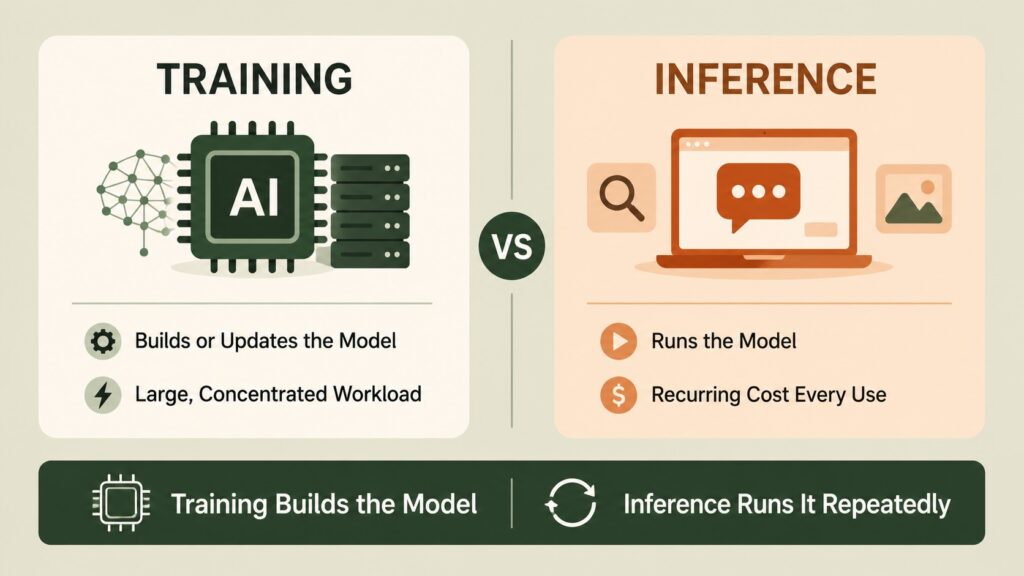
AI electricity demand comes mainly from two types of activity: training and inference.
| Training | Inference |
|---|---|
| Builds or updates an AI model | Uses a completed model |
| Requires large computing clusters | Occurs whenever AI performs a task |
| Heavy but concentrated | Recurring and potentially continuous |
| Linked to model development | Linked to everyday usage |
Training
Training is the process of teaching an AI model to recognize patterns and produce useful outputs.
Large clusters of accelerators may run intensively during this stage. Networking equipment also matters because thousands of processors may need to exchange large amounts of data.
Training receives considerable attention because the projects are expensive and highly visible.
Inference
Inference happens whenever the trained model is used.
A chatbot response, AI search result, translation, coding suggestion, generated image, or automated software action all require inference.
Over time, inference may become the more important part of the electricity-demand story.
Training is concentrated around model creation and updates. Inference can happen continuously across millions of users, devices, and business systems.
Training builds the model once. Inference creates a new computing cost every time the model is used.
It is easy to assume that model training will always consume most AI-related electricity.
That may not remain true.
If AI becomes embedded in search, smartphones, enterprise software, video tools, and digital agents, recurring inference workloads could expand rapidly.
The exact balance remains uncertain. Investors should therefore monitor actual usage volume rather than focusing only on major model launches.
GPUs Are Only Part of Data Center Electricity Use
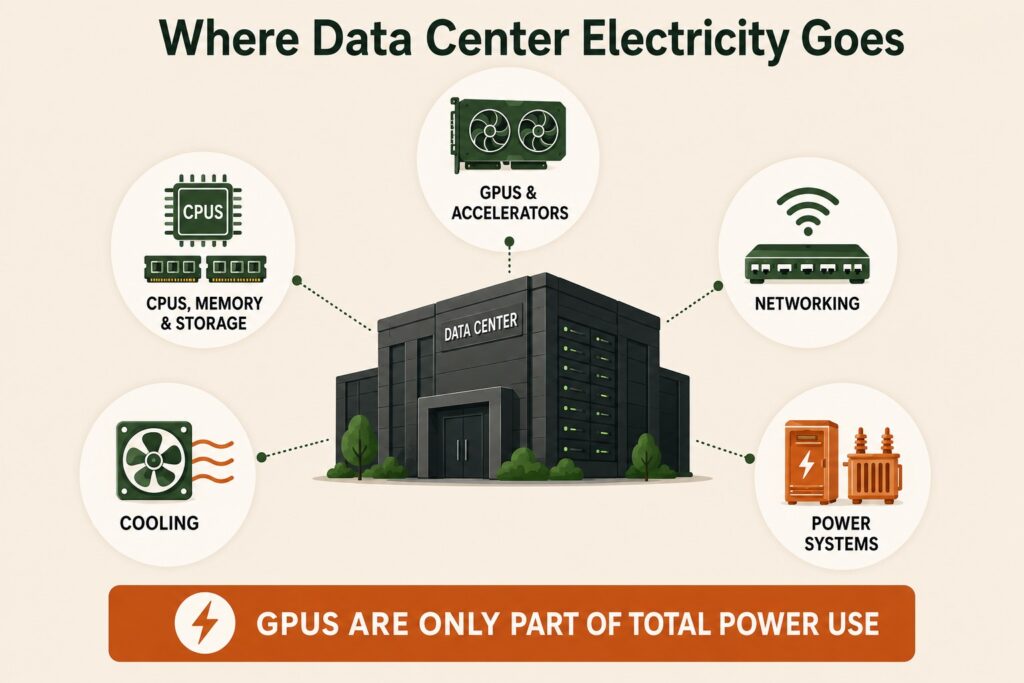
Most discussions about AI power consumption begin with GPUs.
That makes sense. GPUs and other accelerators perform much of the intensive computation required for training and inference.
But they do not operate alone.
| Component | Why It Matters |
|---|---|
| GPUs and accelerators | Perform AI computation |
| CPUs, memory, and storage | Move and hold data |
| Networking equipment | Connect large server clusters |
| Cooling systems | Remove heat and protect equipment |
| Power and backup systems | Deliver stable electricity |
A data center therefore consumes electricity both for computing and for supporting the equipment that performs the computing.
PUE in Plain English
Power Usage Effectiveness, usually called PUE, compares the total electricity used by a data center with the electricity delivered directly to its computing equipment.
A lower PUE generally means less additional energy is being consumed by cooling, power conversion, lighting, and other facility systems.
However, I do not treat a low PUE figure as proof that a project is financially attractive.
A technically efficient facility may still face:
- delayed grid access
- weak customer demand
- low utilization
- high construction costs
- poor pricing power
- unattractive returns on invested capital
An efficient data center is not automatically a profitable data center.
PUE is useful for evaluating operational efficiency, but investors must examine it together with construction costs, occupancy, electricity prices, customer contracts, and cash flow.
For detailed estimates of U.S. data center electricity consumption, readers can review the 2024 United States Data Center Energy Usage Report published by Lawrence Berkeley National Laboratory.
Better Chips May Still Increase Total Electricity Demand
New generations of AI hardware are likely to become more efficient.
Improved chips may perform more calculations per unit of electricity. Better software may reduce unnecessary computing. Smaller models may also handle routine tasks without relying on the largest available systems.
Understanding AI electricity demand requires looking beyond efficiency per task and examining how quickly total usage is expanding.
At first glance, this suggests that AI electricity demand should decline.
But lower energy use per task does not necessarily mean lower total consumption.
If AI becomes cheaper and more useful, companies may integrate it into more products. Users may generate longer answers, more images, and more video. Automated agents may operate continuously without waiting for a human prompt.
This possibility is often discussed through the idea of Jevons Paradox.
The concept does not mean that efficiency must always increase total energy use. It means that lower unit costs can encourage enough additional usage to offset some or all of the efficiency gains.
Lower electricity use per task does not guarantee lower total demand when the number and complexity of AI tasks keep rising.
A Simple Example
Suppose a new chip reduces electricity consumption per AI task by 30%.
That would be a meaningful improvement.
However, if the number of AI tasks doubles because the service becomes cheaper and more widely adopted, total electricity consumption could still increase.
For this reason, hardware efficiency should be analyzed together with:
- inference volume
- user and customer growth
- average task complexity
- server utilization
- total capital expenditure
Efficiency per task and total electricity demand are not the same measurement.
The IEA’s analysis of energy demand from AI offers additional context on why efficiency gains and total electricity consumption can move in different directions.
Power Access May Become a Bigger Constraint Than Chips
Technology companies can place orders for more processors.
Electricity infrastructure is often more difficult to scale.
A large AI data center may require:
- a grid connection
- new substations and transformers
- transmission upgrades
- cooling infrastructure
- backup power
- local permits
This infrastructure bottleneck is one reason AI electricity demand cannot be analyzed through GPU shipments alone.
Many of these projects take years rather than months.
A company may therefore announce a major facility long before it can begin serving customers or generating revenue.
Common causes of delay include grid connection queues, limited transmission capacity, transformer shortages, water constraints, permitting problems, and local opposition.
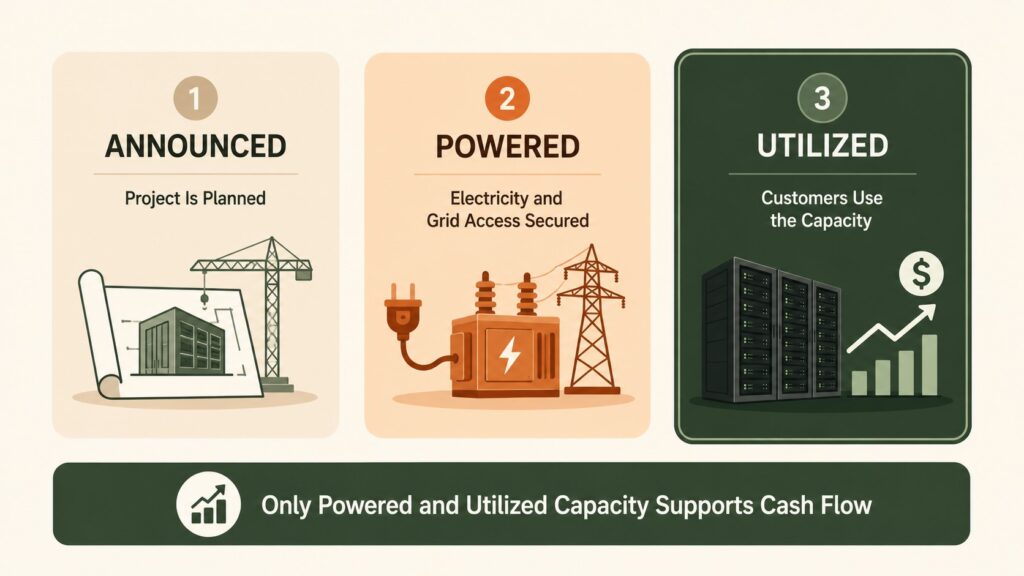
When I review a new data center announcement, I separate the project into three stages.
| Stage | What It Means |
|---|---|
| Announced | The company intends to build the project |
| Powered | Electricity supply and grid access are secured |
| Utilized | Customers are actively using the completed capacity |
An announced data center supports a growth story. A powered and utilized data center is what begins to support revenue and cash flow.
These stages should not be treated as equivalent.
An announced project may attract attention, but a powered project has cleared a major infrastructure hurdle. A utilized project is much more relevant to actual revenue and financial returns.
Questions I Use When Reviewing a Project
- Has the project secured a credible power source?
- Is there a realistic grid connection timeline?
- How much capital must be spent before revenue begins?
- Who pays for required grid upgrades?
- Are customer contracts already in place?
- How quickly can the facility reach an acceptable utilization rate?
These questions help distinguish a genuine operating opportunity from a long-term proposal that may face years of delays.
Which Industries Are Connected to AI Electricity Demand?
The investment impact of AI electricity demand extends far beyond semiconductor designers.
| Industry | Possible Opportunity | Main Risk |
|---|---|---|
| Electric utilities | Higher electricity sales | Heavy investment and regulated returns |
| Power generators | Long-term supply contracts | Fuel and policy risk |
| Grid equipment suppliers | Transformer and switchgear demand | Supply cycles and overbuilding |
| Nuclear and gas power | Stable or flexible generation | Construction and regulatory risk |
| Renewables and storage | Additional supply and grid balancing | Intermittency and project economics |
| Data center developers | Higher computing demand | Low utilization and financing risk |
| Cooling companies | Higher-density computing needs | Technology changes |
This does not mean every company in these industries will benefit.
Higher electricity demand can increase revenue, but it may also require substantial investment. A utility may spend heavily before earning a regulated return. A data center developer may construct capacity that customers do not fully use.
A growing industry can still produce disappointing shareholder returns when debt, delays, competition, or valuation become excessive.
The Six Numbers Investors Should Check
A dramatic AI electricity demand forecast is not enough to identify a profitable investment.
Investors need evidence that demand is moving into contracts, construction, utilization, and cash flow.
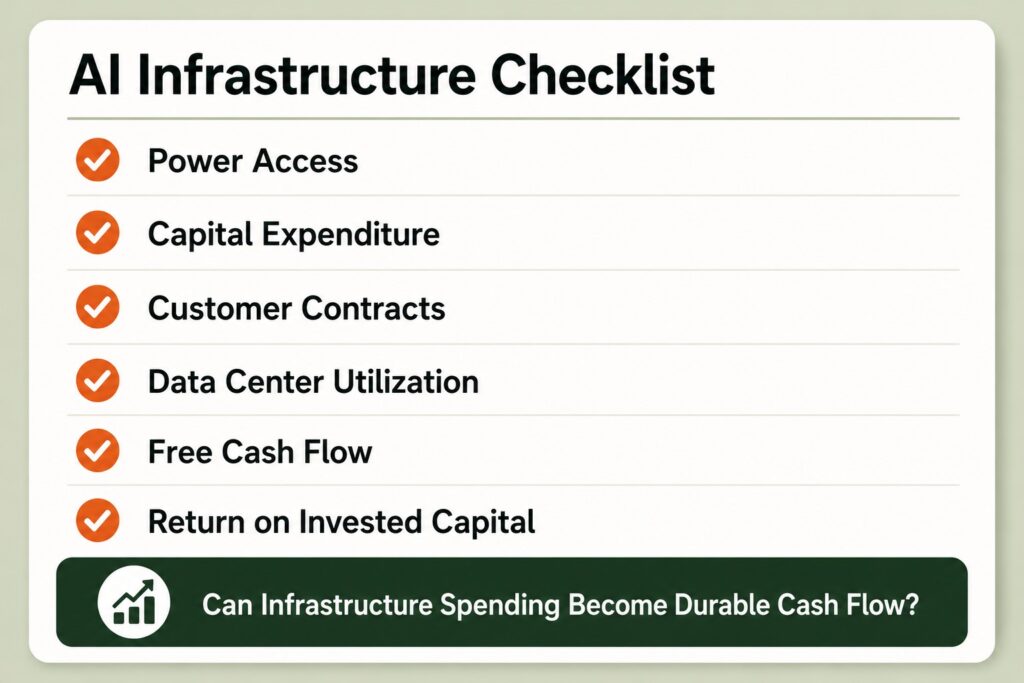
1. Power Access and Grid Timeline
Has the project secured electricity, and can it connect to the grid on schedule?
A delay in grid access can postpone revenue even when the building and computing equipment are ready.
2. Capital Expenditure
How much must the company spend before the project begins generating revenue?
Rising capital expenditure is not automatically negative, but investors should understand the expected payback period.
3. Customer Contracts
Are customers committed to using the capacity, or is the facility being built mainly on future demand assumptions?
Long-term contracts can reduce risk, although customer concentration still matters.
4. Data Center Utilization
Are completed facilities being actively used?
A fully constructed but underutilized data center may produce weak returns despite strong industry growth.
5. Free Cash Flow
Is the company generating cash after funding its infrastructure needs?
Revenue growth can look impressive while free cash flow remains under pressure from construction, equipment purchases, and financing costs.
6. Return on Invested Capital
Is the company earning an acceptable return on the capital committed to AI infrastructure?
This is ultimately more important than the number of facilities announced.
The real question is not how much AI infrastructure a company can build, but how much cash flow that infrastructure can produce.
AI Electricity Demand Is Also a Regional Story
AI infrastructure will not develop evenly across countries or regions.
The best location is not simply the place with the cheapest land.
Companies must also consider electricity prices, grid reliability, transmission access, cooling conditions, water availability, permitting rules, and local support.
| Regional Advantage | Why It Matters |
|---|---|
| Affordable electricity | Reduces operating costs |
| Reliable grid | Lowers outage risk |
| Fast permitting | Shortens project timelines |
| Cool climate | May reduce cooling requirements |
| Nuclear, hydro, or gas access | Supports stable generation |
| Transmission capacity | Connects power to the facility |
A region may have abundant renewable energy but insufficient transmission. Another may have cheap natural gas but face permitting resistance.
Regions with stable, scalable, and competitively priced electricity may gain an advantage in attracting AI infrastructure.
However, local communities may also face higher grid costs, water concerns, and questions about who should pay for infrastructure upgrades.
AI electricity demand is therefore both a global technology theme and a local economic issue.
The U.S. Department of Energy’s Electricity Demand Growth Resource Hub provides additional information on data centers, grid capacity, and rising electricity demand.
What Could Slow AI Power Demand?
The bullish case is not guaranteed.
Several developments could reduce or delay electricity-demand growth:
- more efficient models and chips
- slower consumer or enterprise adoption
- high financing costs
- electricity-price increases
- data center overcapacity
- construction delays
- tighter regulation or public opposition
One of the most important risks is overbuilding.
Technology companies may construct infrastructure based on aggressive assumptions about future AI usage. If adoption grows more slowly than expected, or if new hardware becomes much more efficient, utilization rates could remain low.
Forecasts Are Not Financial Results
A large market forecast is not the same as guaranteed company revenue.
Between an electricity-demand forecast and a company’s income statement are permits, financing, equipment, power contracts, construction, customer demand, operating costs, and utilization.
Investors should examine that full chain rather than assuming that every company associated with AI power demand will benefit.
A Practical Framework for Evaluating AI Infrastructure
When the AI electricity story becomes complicated, I organize the analysis into five stages.
| Stage | What to Check |
|---|---|
| Demand | Is AI usage growing in real products and applications? |
| Power Access | Have electricity supply and grid connections been secured? |
| Construction | Can the project be completed on time and within budget? |
| Utilization | Are customers using the completed capacity? |
| Cash Flow | Is the investment producing acceptable returns? |
This framework helps avoid two common mistakes.
The first is treating AI as pure software while ignoring its physical infrastructure requirements.
The second is assuming that every utility, power producer, data center developer, or equipment supplier will automatically become a successful investment.
The strongest opportunities are more likely to appear where actual demand, available power, disciplined construction, high utilization, and attractive economics come together.
Final Thoughts
AI looks like software from the user’s perspective.
Behind every model, however, is a physical system of chips, servers, cooling equipment, power infrastructure, and electricity networks.
The growth of AI electricity demand could reshape utility investment, grid construction, data center locations, energy policy, and corporate capital expenditure.
But the opportunity is not simply that AI uses more electricity.
The more important questions are whether companies can secure power, connect projects to the grid, reach high utilization, and convert infrastructure spending into durable cash flow.
More efficient chips could reduce power use per task. Infrastructure delays could slow deployment. Overbuilding could weaken returns. Regulation and local opposition could also reshape where projects are developed.
Investors should therefore look beyond GPUs and headline electricity forecasts.
The companies that benefit most may be those that can secure power, complete projects efficiently, attract customers, and earn acceptable returns on the capital they invest.
This article is for educational purposes only and does not provide personalized investment advice.
In the next article, we will examine why rising power demand is pushing technology companies to expand data center investment—and why capital expenditure may remain elevated for years.
FAQ
Q1. Why does AI use so much electricity?
AI models perform large numbers of calculations using specialized chips. Servers, networking equipment, storage, cooling, and power systems also consume electricity. The larger issue is repeated use across millions of users and applications.
Q2. Does one AI prompt consume a large amount of power?
It depends on the model, task, output length, hardware, and data center. A short text response and a generated video can require very different amounts of computing.
Q3. Will more efficient AI chips reduce electricity demand?
They may reduce the electricity used for each task. Total demand could still increase if AI adoption and inference volume grow faster than efficiency improves.
Q4. Why can power access be more important than chip availability?
A company may be able to purchase computing equipment but still face long delays in securing electricity, transformers, transmission access, permits, and cooling infrastructure.
Q5. Which industries may benefit from rising AI electricity demand?
Utilities, power generators, grid-equipment suppliers, data center developers, cooling specialists, and energy-storage providers may see opportunities. Investors still need to examine debt, regulation, utilization, valuation, and return on capital.
Related Reading

Stock Valuation Checklist: 7 Critical Checks Before Calling a Stock Cheap
A stock can look cheap because its price has fallen 40%, its P/E ratio is…

RSI Divergence vs MACD Crossover: Which Is More Reliable for Trading?
RSI divergence can warn that price momentum is weakening before a reversal becomes obvious. A…

Before You Buy the Dip: 5 Critical Balance Sheet Checks Every Investor Should Make
A stock that falls 20%, 30%, or even 50% can suddenly look cheap. But a…
Disclaimer: This article is for educational purposes only and should not be considered financial or investment advice. Always conduct your own research before making investment decisions.
Pingback: Google Earnings and Semiconductor Stocks: A Powerful Signal for AI Growth