
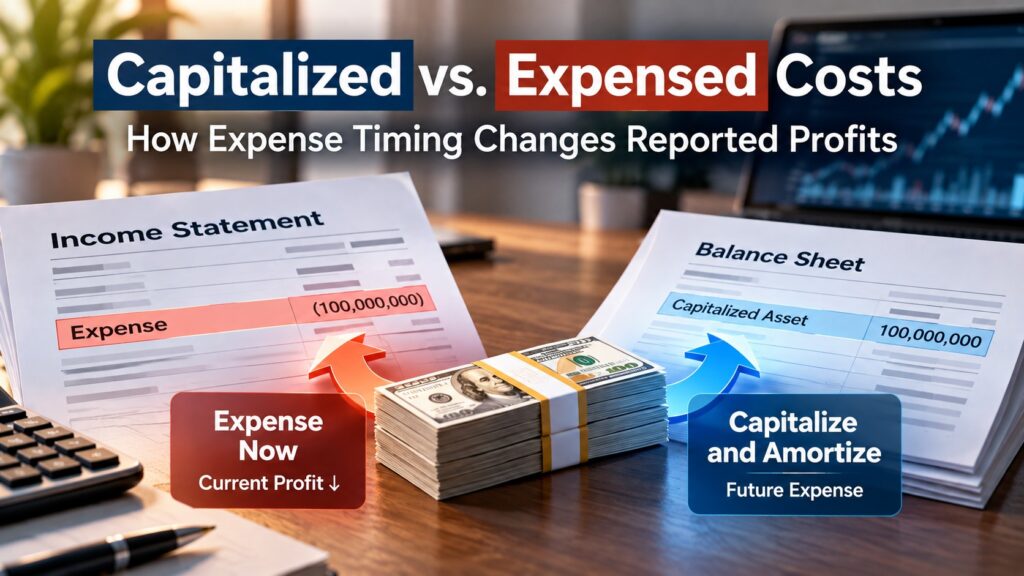
A company spends $100 million developing technology. If the cost is expensed today, current profit falls sharply. If qualifying costs are capitalized, part of the expense may instead reach the income statement over future periods.
The cash expenditure is real either way. What changes is when the cost affects reported earnings.
Investor Takeaway: Capitalization does not eliminate a cost. It changes when that cost reaches earnings. Investors should ask whether stronger profitability reflects better business economics, different expense timing, or both.
Understanding capitalized vs expensed costs is therefore important when comparing profitability across companies and across time.
Capitalized vs. Expensed Costs: The Core Difference
An expensed cost reduces earnings when the expense is recognized. A qualifying capitalized cost is initially recorded as an asset and generally reaches the income statement later through depreciation or amortization.
Consider a simplified example.
A company spends $100 million on a qualifying project. If the entire amount is expensed immediately, the current-year expense is $100 million.
Now suppose, purely for illustration, that the entire amount qualifies for capitalization and is amortized evenly over five years, with a full year of amortization recognized in the first year:
$100 million ÷ 5 = $20 million per year
| Hypothetical treatment | Immediate expensing | Capitalize and amortize |
|---|---|---|
| Cash expenditure | $100M | $100M |
| First-year expense | $100M | $20M |
| Initial capitalized asset | $0 | $100M |
| First-year pre-tax income impact | -$100M | -$20M |
| Expense remaining for future periods | $0 | $80M |
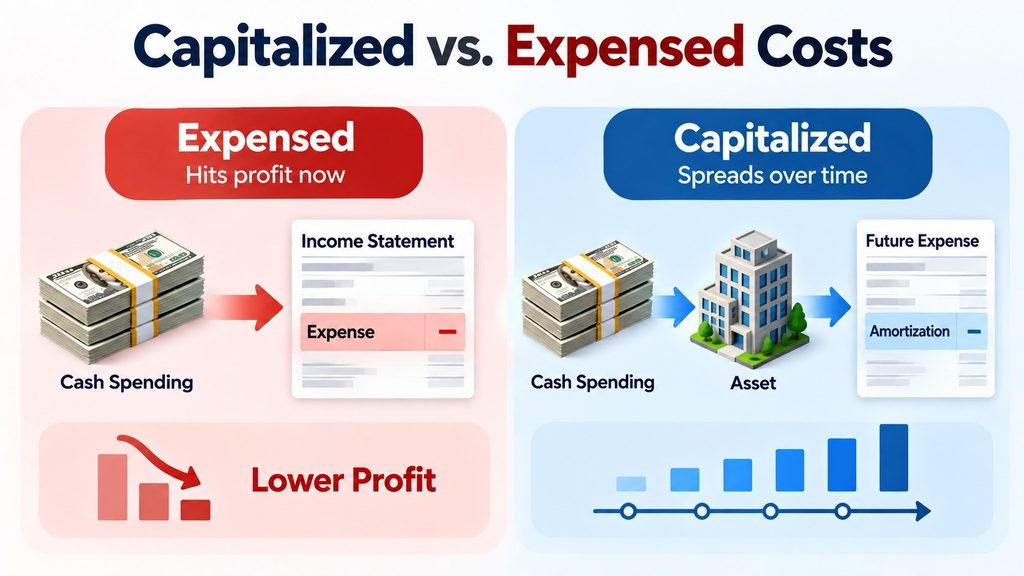
The $80 million first-year difference does not represent additional economic value. Most of the expense recognition has simply moved into later periods.
The key distinction is economic spending versus the timing of expense recognition.
Capitalization Is Not Automatically a Red Flag
Capitalizing costs is not inherently suspicious. Accounting standards determine which expenditures should be recognized immediately and which qualify for capitalization.
Software illustrates why investors should avoid simplistic rules.
Under the current guidance before adoption of ASU 2025-06, internal-use software costs have historically been evaluated partly according to the nature of the cost and the project stage in which they are incurred.
FASB’s ASU 2025-06 changes aspects of that framework, including removing references to software-development project stages. The amendments are effective for annual reporting periods beginning after December 15, 2027, including interim periods within those annual periods, with early adoption permitted.
The practical lesson is more important than the technical detail:
Read the accounting policy actually applied in the company’s reporting period.
Then ask whether the capitalization pattern has changed materially and whether the economics support that change.
Has the Capitalization Pattern Changed?
Suppose relevant development spending is $200 million and the company capitalizes $40 million:
$40M ÷ $200M = 20%
The next year, spending remains $200 million but capitalized costs rise to $80 million:
$80M ÷ $200M = 40%
That change deserves investigation.
It does not prove aggressive accounting. The project mix may have changed, or more spending may legitimately qualify for capitalization.
But if a greater share of spending is recorded as an asset rather than immediately recognized as expense, current profitability can look stronger.
For investors, the change and its explanation can matter more than the absolute amount capitalized.
Four Warning Signs Worth Investigating
1. Capitalized costs grow faster than the business
If revenue growth slows while additions to capitalized assets accelerate, identify which projects explain the increase and what future benefits management expects.
A mismatch is a reason to investigate—not proof of improper accounting.
2. Margins improve while capitalization rises sharply
If margins improve while capitalized spending increases materially, determine whether the two changes are related.
The combination is not inherently suspicious, but it deserves reconciliation.
3. Estimated useful lives become longer
A longer useful life can reduce annual depreciation or amortization, all else equal.
Investors should therefore examine both how much is capitalized and how quickly those assets are subsequently expensed.
4. Capitalized projects repeatedly require write-downs
An occasional impairment does not mean the original accounting was inappropriate.
But rapid asset accumulation followed by recurring impairments or write-offs may justify closer examination of the assumptions behind earlier capitalization.
Why Operating Cash Flow Alone Is Not Enough
A common shortcut is: “Ignore accounting earnings and just look at operating cash flow.”
That can also produce an incomplete picture.
Investors need to determine where the related cash expenditure appears in the statement of cash flows because classification depends on the nature of the expenditure and applicable accounting requirements.
Trace material spending across all three major financial statements:
Income statement: How much expense is recognized now?
Balance sheet: How much remains recorded as an asset?
Cash flow statement: Where did the related cash expenditure appear?
This three-statement check is more informative than relying on one profitability or cash-flow metric.
A Five-Step Framework for Capitalized vs. Expensed Costs
Step 1: Read the accounting policy
Check the financial statement notes for what the company capitalizes, when capitalization begins, and when depreciation or amortization starts.
Step 2: Measure the trend
Compare several years. Look for capitalized additions growing faster than the underlying business, changes in useful-life assumptions, or unexplained shifts in accounting treatment.
Step 3: Reconcile earnings with cash spending
Locate the underlying cash expenditure. Determine how much has reached the income statement and how much remains on the balance sheet.
Step 4: Track the future expense burden
Today’s capitalized spending can become tomorrow’s depreciation or amortization.
Rapid asset accumulation can therefore create higher future expenses or impairment risk.
Step 5: Normalize comparisons when necessary
If one company capitalizes more qualifying spending than another, reported margins may not be directly comparable.
Ask:
Would the profitability gap narrow if both companies’ current spending were viewed on a more comparable basis?
This is not a replacement for GAAP earnings. It is a sensitivity test for investors.
A Normalized-Earnings Exercise
Consider two hypothetical competitors with $1 billion in revenue.
Company A
- Operating income: $150 million
- Operating margin: 15%
- Minimal newly capitalized development spending
Company B
- Operating income: $190 million
- Operating margin: 19%
- $60 million of newly capitalized qualifying development costs
- $20 million of related amortization already included in operating expenses
Company B initially appears more profitable.
For analytical comparison, suppose an investor tests what the current period might look like if the newly capitalized $60 million were recognized immediately.
Because $20 million of related amortization is already included in operating expenses, simply subtracting $60 million would double-count part of the cost in this simplified example.
A rough sensitivity adjustment is:
Adjusted operating income = $190M – $60M + $20M = $150M
Adjusted operating margin = $150M ÷ $1B = 15%
The apparent four-percentage-point margin advantage disappears.
This does not mean Company B’s accounting is wrong. It answers a different question:
How much of the apparent profitability gap could be explained by expense timing?
That is often the more useful question for cross-company analysis.
WorldCom: An Extreme Boundary Case
WorldCom shows why the distinction between legitimate capitalization and improper cost classification matters.
According to the U.S. Securities and Exchange Commission, WorldCom transferred operating “line costs” to capital accounts even though those costs should have been expensed.
An investigative report filed with the SEC found that approximately $3.5 billion of operating line costs were improperly capitalized from the first quarter of 2001 through the first quarter of 2002. Without those entries, the company would have reported pre-tax losses in three of the five affected quarters.
WorldCom should not be used to suggest that ordinary capitalization is suspicious. Its narrower lesson is that cost classification can materially change reported profitability.
Investor Checklist
When capitalization could materially affect profitability, ask:
- What is being capitalized, and why does it qualify?
- Has the amount or proportion changed materially?
- Does the change make economic sense given business and project growth?
- Where does the related cash expenditure appear?
- What useful life is being used?
- How large is the future depreciation or amortization burden?
- Have impairments or write-offs become frequent?
- Would a sensitivity adjustment change the comparison with competitors?
No single answer proves that earnings quality is strong or weak. The value comes from connecting the evidence.
Conclusion: Follow the Cost, Not Just the Profit
The central lesson from capitalized vs expensed costs is that cash spending and accounting expense recognition can occur in different periods.
When reported profitability improves, trace material expenditures from the cash outflow to the balance sheet and eventually to depreciation, amortization, or impairment.
Then ask:
Did the business actually become more profitable, did expense timing contribute to the improvement, or did both happen at the same time?
That question can reveal more about earnings quality than the headline profit number alone.
FAQ
Q1. Does capitalizing a cost always increase current profit?
Compared with immediately expensing the same amount, capitalization can increase current-period profit because some expense recognition is deferred. The actual effect depends on the accounting treatment, timing, and depreciation or amortization.
Q2. Is capitalizing development costs a red flag?
Not by itself. More useful warning signs include unexplained increases in capitalization, material changes in useful lives, repeated write-downs, or margin improvements that coincide with significant changes in expense timing.
Q3. Can accounting treatment make one company appear more profitable?
Yes. Differences in capitalization, useful lives, business models, and expense timing can affect reported margins. Investors should understand those differences before concluding that the company with the higher margin has superior economics.
Q4. Where should investors look for capitalized costs?
Start with the significant accounting policies and related notes in the company’s 10-K or 10-Q. Relevant information may appear under software development, property and equipment, intangible assets, depreciation and amortization, impairment, and cash flows.
Sources
Financial Accounting Standards Board (FASB) — ASU 2025-06: Intangibles—Goodwill and Other—Internal-Use Software (Subtopic 350-40), Targeted Improvements to the Accounting for Internal-Use Software.
U.S. Securities and Exchange Commission (SEC) — Complaint: SEC v. WorldCom, Inc.
WorldCom Investigation Report filed with the SEC — Investigation of improper capitalization of operating line costs.
Disclaimer
This article is for educational and informational purposes only. It does not constitute personalized investment, accounting, tax, or financial advice.
📚 Related Articles
Free Cash Flow vs Earnings: Why Profits Can Rise While Cash Flow Falls
Why Profitable Companies Run Out of Cash: 5 Causes Investors Should Know
How to Read Financial Statements: A Simple and Powerful Beginner’s Guide

High Interest Rates and the Economy: Why Can Growth Stay Strong?
If high interest rates are supposed to slow the economy, why can consumers keep spending,…

Can AI Become a Monopoly? Where the Real Economic Moats Are
Artificial intelligence appears to have many ingredients that could produce powerful monopolies. Training frontier models…

Can Big Tech Maintain Its Profit Margins in the AI Era?
Artificial intelligence is creating new revenue opportunities for Big Tech, but it is also changing…