
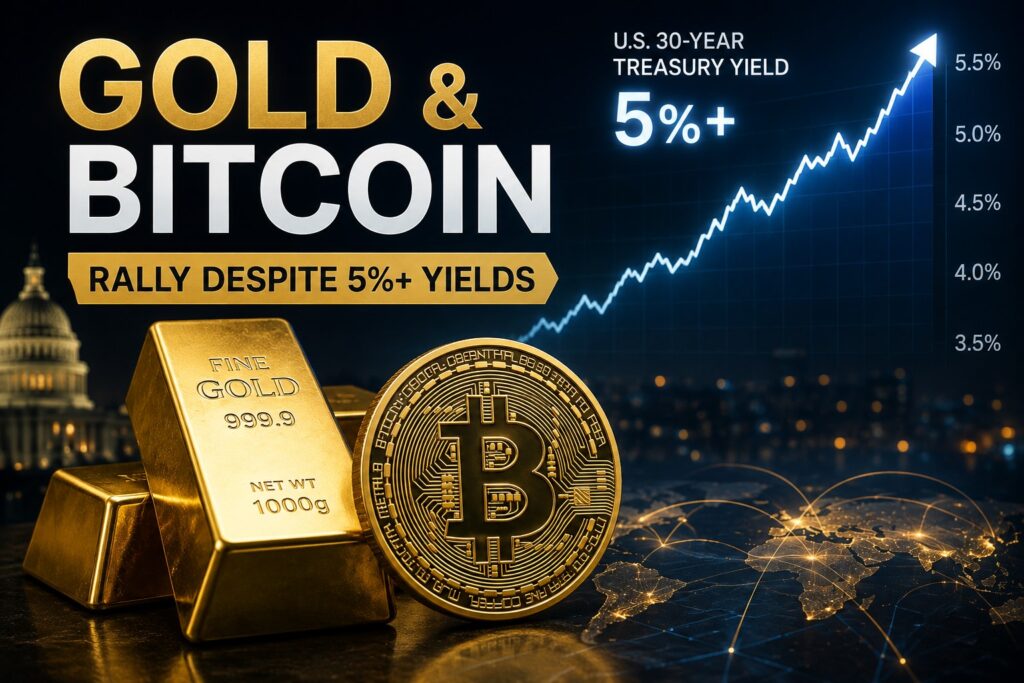
Normally, a sharp rise in U.S. Treasury yields should make life harder for gold and Bitcoin.
Treasuries pay interest. Gold does not, and Bitcoin does not provide a contractual yield. When investors can earn roughly 5% from long-term government bonds, non-yielding assets should theoretically become less attractive.
Yet the Gold and Bitcoin Rally has challenged that simple rule.
In August 2026, long-term U.S. yields moved sharply higher. According to the U.S. Treasury’s official daily yield-curve data, the 10-year Treasury yield was 4.71% on August 18, while the 30-year yield was 5.28%. Reuters reported that the 30-year yield briefly reached 5.327% intraday, its highest level since 2007.
At the same time, gold strengthened and Bitcoin staged a powerful rebound.
I currently own both assets. My gold position is up roughly 15%, while my Bitcoin position remains below my entry price after I bought at around KRW 130 million per Bitcoin.
That difference is what made me look more closely at this market.
If gold and Bitcoin can benefit from some of the same macroeconomic concerns, why have the investment results been so different? And if Treasury yields are this high, why are either of them rising?
The answer starts with a better question:
Why are Treasury yields rising?
1. A 5% Treasury Yield Does Not Always Mean the Same Thing
The first mistake is assuming that “Treasury yields hit 5%” means the benchmark 10-year Treasury is above 5%.
It is not.
The pressure has been concentrated further out on the yield curve. The U.S. Treasury’s official data showed the 10-year at 4.71% and the 30-year at 5.28% on August 18. By August 21, those rates were 4.74% and 5.27%, respectively.
That distinction matters because long-term yields reflect more than expectations for the Federal Reserve’s next few interest-rate decisions.
A 30-year bond must compensate investors for decades of uncertainty involving inflation, government borrowing, fiscal conditions, bond supply, and the term premium.
The term premium is the additional return investors may demand for taking the risk of holding a long-duration bond.
A 5% yield caused by strong economic growth and attractive real returns sends one message.
A 5% yield caused by investors demanding greater compensation for inflation, deficits, and long-term fiscal uncertainty sends another.
The number can be identical. The investment implications are not.
2. Why High Yields Normally Pressure Gold and Bitcoin
The traditional relationship still matters.
Imagine a Treasury bond yielding 3% while gold pays no interest. If that Treasury yield rises to 5% and everything else remains unchanged, holding gold now carries a greater opportunity cost.
Investors are giving up more interest income by owning gold instead of an interest-bearing security.
Bitcoin faces a related problem.
It has no coupon, maturity value, earnings, or contractual cash flow. When safe inflation-adjusted returns become more attractive, investors may become less willing to hold highly volatile assets whose prices depend heavily on future demand.
This is why “higher yields can hurt gold and Bitcoin” remains a useful starting point.
It is not a market law.
The reason yields moved, the direction of the dollar, real interest rates, and liquidity conditions can all change the outcome of the Gold and Bitcoin Rally.
3. Why the Gold and Bitcoin Rally Happened Anyway
Several forces have recently worked against the normal opportunity-cost effect.
Fiscal Anxiety and the Debasement Trade
Long-term Treasury yields rose amid concerns about inflation, heavy government borrowing, fiscal deficits, geopolitical uncertainty, and the supply of long-duration government debt. Reuters reported that the U.S. Treasury responded by doubling certain long-dated bond buybacks from $2 billion to $4 billion per operation.
Those buybacks should not be confused with Federal Reserve quantitative easing.
Treasury buybacks are primarily a debt-management and market-liquidity tool. Quantitative easing is a monetary-policy operation conducted by the Federal Reserve.
The mechanics are different.
But investor interpretation also matters.
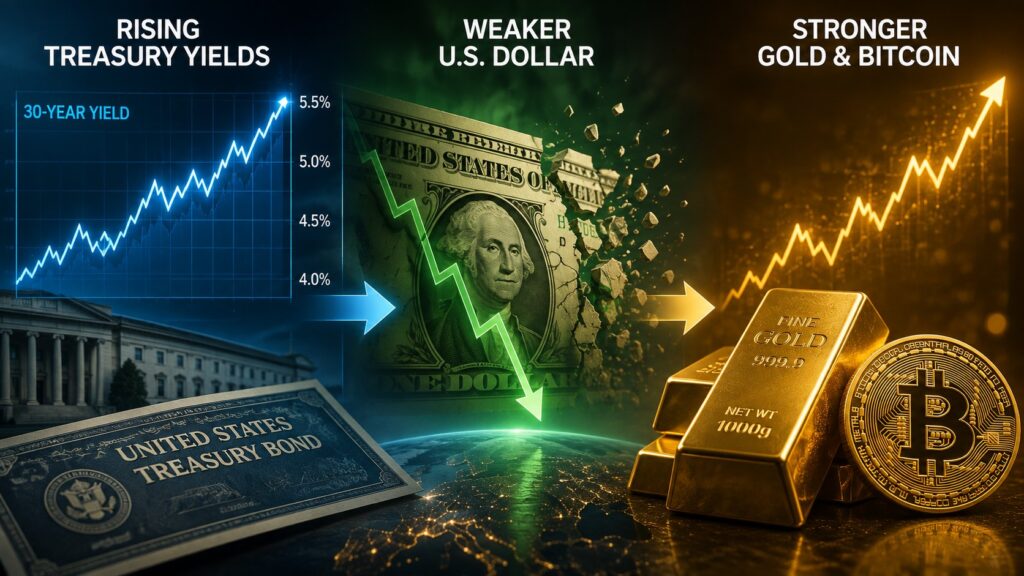
The larger buybacks temporarily pushed long-term yields lower and weakened the dollar. Some market participants interpreted the move as a sign that policymakers were increasingly concerned about long-term borrowing costs, helping revive the so-called debasement trade. Gold and Bitcoin both rose as that narrative gained attention.
The debasement idea is straightforward: if investors become less confident in the long-term purchasing power of fiat currencies, they may seek assets whose supply is more difficult to expand.
Gold is the traditional example.
Bitcoin is increasingly included in that narrative by some investors.
That does not make them equivalent assets.
The Dollar and Real Yields Matter Too
The U.S. dollar is critical because gold is globally priced in dollars.
A weaker dollar can make gold less expensive for investors using other currencies and can increase the appeal of alternative stores of value.
The same 5% Treasury yield can therefore exist in two very different environments:
| Scenario | 30-Year Yield | Dollar | Fiscal Confidence | Gold Environment |
|---|---|---|---|---|
| A | 5.0% | Stronger | Strong | More pressure |
| B | 5.0% | Weaker | Deteriorating | More support |
After the Treasury announced the larger buybacks, the dollar index fell 0.84% on August 19, while gold rose more than 4% and cryptocurrencies also advanced. Over the week ending August 21, the dollar lost nearly 1% and Bitcoin gained almost 20%.
Real yields add another layer.
The U.S. Treasury’s real-yield curve showed the 10-year real yield at 2.44% and the 30-year real yield at 3.06% on August 17. Those are relatively high inflation-adjusted yields, which would normally create a meaningful headwind for gold.
Gold’s resilience despite those real yields suggests that other forces—including dollar weakness, fiscal concerns, geopolitics, and investment demand—have been strong enough to offset part of that pressure.
4. Gold Has a Demand Base Bitcoin Does Not
Gold has an important structural source of demand that Bitcoin does not: central banks.
The World Gold Council’s Gold Demand Trends Q2 2026 report showed that central banks and other official institutions bought a net 289 tonnes of gold during the quarter, up 62% from a year earlier. First-half net purchases totaled 345 tonnes.
World Gold Council — Q2 2026 Central Bank Gold Demand
Central banks may hold gold for reserve diversification, geopolitical protection, liquidity, and reduced dependence on any single currency.
They are not simply deciding whether gold’s zero yield is more attractive than a Treasury bond paying 5%.
That helps explain why gold can remain resilient even when U.S. interest rates are high.
However, the demand picture is not uniformly bullish.
The same World Gold Council report showed 45 tonnes of net outflows from gold-backed ETFs in Q2, while total demand including over-the-counter activity was essentially flat year over year at 1,269 tonnes.
That is an important limitation.
Central-bank buying is strong, but not every group of gold investors is behaving the same way. That distinction is important when judging whether the Gold and Bitcoin Rally has broad support or is being driven by different forces in each market.
5. Why Bitcoin Is Not Simply Digital Gold
This is where my own investment results make the difference especially clear.
My gold investment is currently up roughly 15%, while my Bitcoin position remains below my entry price near KRW 130 million.
Both investments can be connected to similar themes—scarcity, government debt, currency concerns, and long-term monetary risk—but the actual investment experience has been very different.
Gold has a long history as a reserve asset, physical demand, central-bank ownership, and a deep global market.
Bitcoin has a much shorter history and is far more sensitive to liquidity, leverage, regulation, institutional flows, and speculative positioning.
Recent price action illustrates that sensitivity. During the week ending August 21, Bitcoin gained nearly 20%, its strongest weekly advance in roughly two and a half years.
That upside can be powerful.
So can the downside.
The lesson I take from holding both assets is not that gold is automatically better than Bitcoin.
It is that a good macroeconomic thesis does not automatically produce a good entry price.
An investor can be broadly correct about scarcity, government debt, or long-term monetary risk and still experience a large loss because an asset was purchased at an expensive moment.
That is why I would be cautious about treating Bitcoin simply as “digital gold.”
Gold and Bitcoin can share part of the same macro narrative without sharing the same risk profile.

6. Can the Gold and Bitcoin Rally Continue?
Possibly, but the conditions supporting the two assets are not identical.
Gold would generally receive more support if the dollar remains weak, fiscal uncertainty stays elevated, central-bank buying remains strong, geopolitical risks persist, and real yields stop rising.
The World Gold Council expects investment to remain the main source of gold-demand growth through the second half of 2026, with OTC activity and Asian buying playing larger roles. It also expects central banks to remain significant buyers, although its outlook is not a guarantee of higher prices.
World Gold Council — Q2 2026 Gold Outlook
Gold can still experience a substantial correction even if its longer-term macro backdrop remains supportive.
Bitcoin has an even wider range of possible outcomes.
Institutional demand, favorable regulation, improving liquidity, and sustained risk appetite could support further gains. A stronger dollar, tighter liquidity, excessive leverage, or a broad move away from speculative assets could reverse the rally quickly.
For Bitcoin, I would focus on three questions:
- Has the long-term investment thesis changed?
- Is liquidity improving or deteriorating?
- Are institutional flows strengthening or weakening?
Those questions are more useful than focusing only on when a previous purchase price might be recovered.
7. What I Would Watch From Here
Rather than trying to predict the next move in the Gold and Bitcoin Rally from a single Treasury headline, I would monitor five variables together.
Long-term Treasury yields: Are they rising because of stronger growth, or because investors want greater compensation for inflation and fiscal risk?
The U.S. dollar: High yields plus a stronger dollar create a very different environment from high yields plus a weakening dollar.
Real Treasury yields: Higher inflation-adjusted returns increase the opportunity cost of holding gold.
Gold demand: Central-bank buying, ETF flows, and physical investment can show whether demand is broad or concentrated.
Bitcoin liquidity and positioning: Institutional flows, leverage, regulation, and speculative positioning can cause Bitcoin to behave very differently from gold.
The combination matters more than any one indicator.
High long-term yields combined with a stronger dollar and improving fiscal confidence would generally create a tougher environment for gold.
High yields combined with a weaker dollar and worsening fiscal anxiety could continue supporting the hard-asset narrative.
For Bitcoin, that macro picture must also be evaluated alongside liquidity and positioning.
“Rates up = gold down” is a useful shortcut. It is not a law.
8. Final Takeaway
The Gold and Bitcoin Rally does not mean interest rates have stopped mattering.
It shows why the cause of an interest-rate move can matter more than the headline number.
Long-term Treasury yields above 5% can reflect attractive real returns. They can also reflect inflation uncertainty, heavy government borrowing, fiscal concerns, and weaker demand for long-duration debt.
Those environments are not the same.
Gold is especially sensitive to the dollar, real yields, and official-sector demand. Bitcoin adds another layer of sensitivity to liquidity, leverage, regulation, and investor positioning.
The 5% yield itself is not the signal.
The reason behind the 5% yield is what investors need to understand.
FAQ
Q1. Why can gold rise when Treasury yields are high?
High Treasury yields normally increase the opportunity cost of holding gold. But if long-term yields rise alongside inflation concerns, fiscal uncertainty, heavy government borrowing, or dollar weakness, those forces can also increase demand for gold.
Q2. Is Bitcoin really digital gold?
Only partially. Bitcoin and gold both have scarcity-related narratives, but their market structures are very different. Gold has central-bank and physical demand, while Bitcoin is more sensitive to liquidity, leverage, regulation, and speculative positioning.
Q3. Can the Gold and Bitcoin Rally continue?
It can, but there is no certainty. Dollar weakness, fiscal concerns, sustained gold demand, and supportive liquidity could extend the Gold and Bitcoin Rally. A stronger dollar, persistently high real yields, improving fiscal confidence, or tighter liquidity could create pressure in the opposite direction.
📚 Related Articles
How to Read Financial Statements: A Simple and Powerful Beginner’s Guide
Fundamental Analysis for Beginner Investors: A Smart Guide to Better Stock Decisions
Is a Low P/E Ratio Always Better? 5 Costly Mistakes to Avoid

Stock Valuation Checklist: 7 Critical Checks Before Calling a Stock Cheap
A stock can look cheap because its price has fallen 40%, its P/E ratio is…

RSI Divergence vs MACD Crossover: Which Is More Reliable for Trading?
RSI divergence can warn that price momentum is weakening before a reversal becomes obvious. A…

Before You Buy the Dip: 5 Critical Balance Sheet Checks Every Investor Should Make
A stock that falls 20%, 30%, or even 50% can suddenly look cheap. But a…
Disclaimer: This article is for educational and informational purposes only and includes the author’s personal investment experience for context. It is not a recommendation to buy, sell, or hold gold, Bitcoin, bonds, or any other asset. Financial markets are volatile, and individual investment outcomes can differ substantially.