Alphabet reported strong headline numbers.
But the figure that caught my attention was $44.9 billion.
The connection between Google earnings and semiconductor stocks is becoming harder to ignore as Alphabet spends more heavily on AI infrastructure.
According to Alphabet’s Q2 2026 earnings release, the company reported $119.8 billion in second-quarter 2026 revenue, while Google Cloud revenue reached $24.8 billion. Those numbers were impressive, but they were not the part of the report that caught my attention.
The number I kept returning to was capital expenditure.
Alphabet’s capital expenditures reached $44.9 billion during the quarter, roughly twice the year-earlier level and more than the company’s quarterly operating cash flow of $39.1 billion.
This does not automatically make Alphabet’s results good or bad.
It tells us something more interesting: Google is not merely adding AI features to its existing products. It is building the physical capacity required to run them.
For beginner investors, understanding Google earnings and semiconductor stocks starts with following where Alphabet’s infrastructure money is going—not simply whether quarterly EPS beat expectations.
The One Number I Would Read Before EPS
Most earnings headlines begin with revenue and earnings per share.
That makes sense. Revenue shows whether customers are spending, while EPS provides a quick view of reported profitability.
But semiconductor demand is often influenced by a different section of the financial statements: the cash-flow statement.
Capital expenditure, commonly called CAPEX, generally refers to money spent on long-term assets. Alphabet reports that its CAPEX primarily reflects investments in technical infrastructure.
Revenue tells us what Google sold last quarter.
CAPEX hints at what Google expects to need next.
This distinction became especially important in Q2 2026. Alphabet’s purchases of property and equipment climbed from $22.4 billion a year earlier to $44.9 billion.
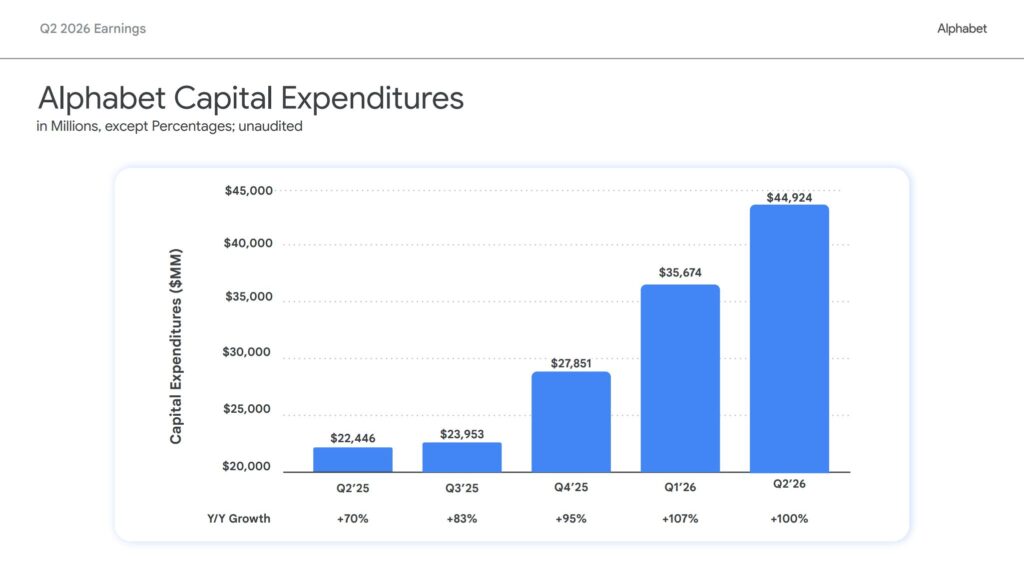
With operating cash flow of $39.1 billion and capital expenditures of $44.9 billion, quarterly free cash flow was negative. Trailing 12-month free cash flow, however, remained positive.
In other words, Google’s core operations continued producing substantial cash. The company simply chose to reinvest an unusually large amount of it.
The key takeaway: Google is not just buying chips. It is building computing capacity.
That capacity may create demand across a much wider part of the semiconductor industry.
The Link Between Google Earnings and Semiconductor Stocks
When investors discuss AI hardware, the conversation usually begins and ends with graphics processing units, or GPUs.
GPUs are critical, but an AI server cannot run on processors alone.
Imagine Google decides to expand an AI data center.
Before a customer can use that new capacity, the site needs electricity, cooling, servers, storage, networking, memory, and processors. Thousands of machines must exchange enormous amounts of data without slowing one another down.
Remove one part of that system, and the expensive processors may sit waiting.
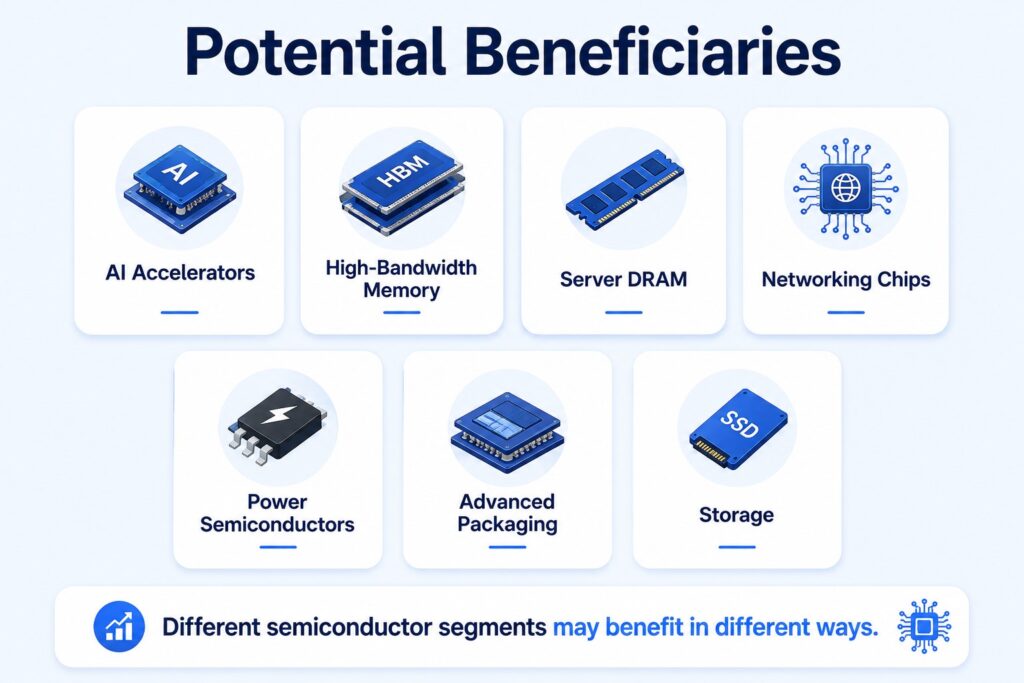
This is why Google’s AI spending can spread across several layers of the semiconductor supply chain.
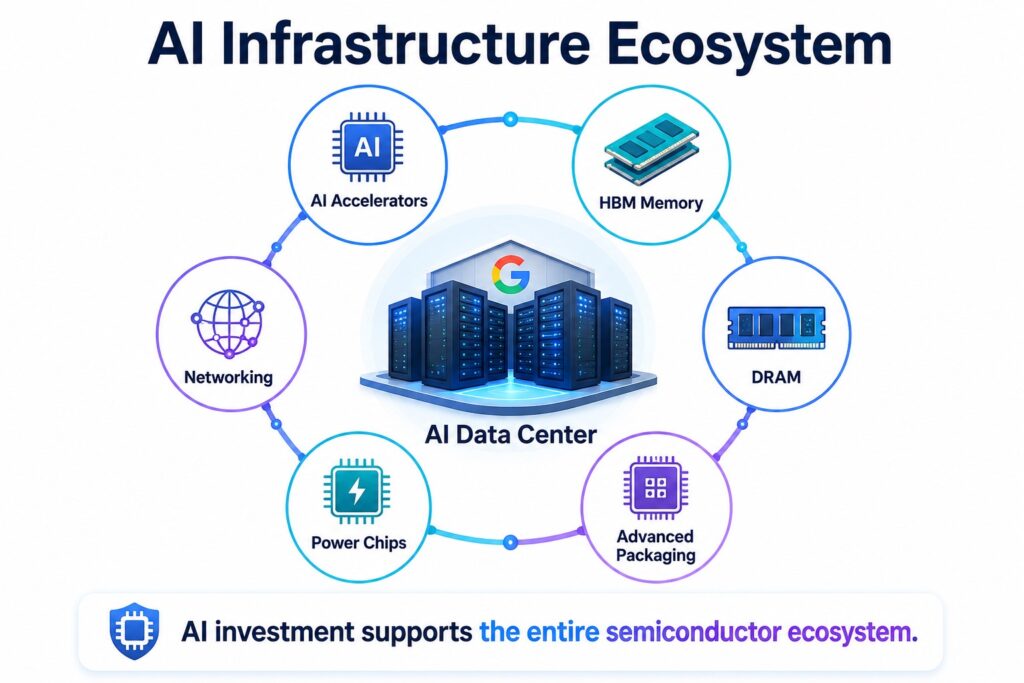
| Semiconductor segment | Role inside AI infrastructure |
|---|---|
| AI accelerators and TPUs | Perform training and inference calculations |
| HBM and server DRAM | Provide high-speed data access and memory capacity |
| Networking chips | Connect servers inside large computing clusters |
| Storage components | Hold datasets, models, and generated content |
| Advanced packaging | Combine processors and memory efficiently |
| Power semiconductors | Manage electricity inside high-density systems |
Alphabet also develops its own Tensor Processing Units, or TPUs. This complicates the investment story because rising Google spending may support custom chips as well as third-party processors.
The beneficiaries may change from one hardware generation to another, so higher Google CAPEX should not be treated as a direct signal to buy the most popular chip stock.
The Surprising Bottleneck May Be Memory
GPUs perform the calculations, but they constantly need new data.
A simple way to think about it is a professional kitchen. Even the fastest chef cannot prepare meals efficiently when ingredients arrive slowly.
AI processors face a similar problem.
High-bandwidth memory, commonly called HBM, is designed to move large amounts of data quickly between memory and an AI accelerator.
As models become larger and more demanding, memory bandwidth can become a major performance constraint.
Traditional server DRAM also remains important. It supports operating systems, databases, data preparation, virtualization, and the many background tasks surrounding AI workloads.
This gives memory companies a meaningful connection to the AI infrastructure cycle.
The memory market is one of the clearest examples of why Google earnings and semiconductor stocks cannot be analyzed through GPU demand alone.
Still, there is an important catch.
Memory is a highly cyclical industry. Strong demand can encourage manufacturers to add capacity. If supply eventually grows faster than customer demand, prices and margins can fall even while AI usage continues increasing.
The beginner mistake is assuming that more AI servers must lead directly to higher memory profits.
The better questions are:
- How much memory is being installed in each system?
- Can suppliers expand production without creating oversupply?
- Are selling prices and margins holding up?
Structural growth and short-term pricing cycles can move in opposite directions.
Google Cloud Shows Whether the Capacity Has Customers
CAPEX becomes more useful when viewed alongside Google Cloud.
Google Cloud revenue rose 82% year over year to $24.8 billion in Q2 2026. Alphabet said growth was led partly by enterprise AI infrastructure and AI solutions.
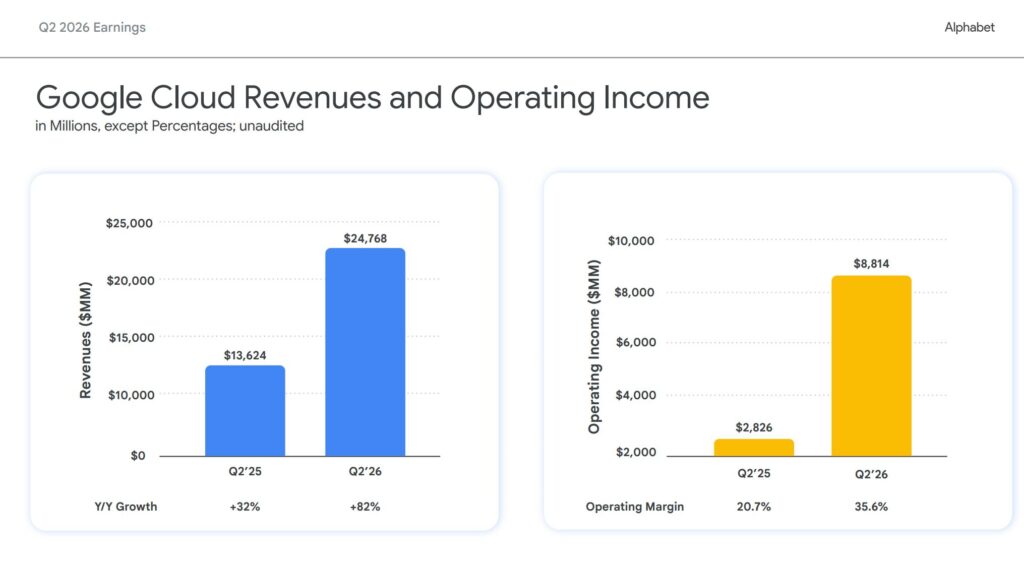
This matters because infrastructure spending is more convincing when customer demand is growing with it.
A simple framework is:
| Cloud Trend | CAPEX Trend | Possible Interpretation |
|---|---|---|
| Growing | Rising | Capacity may be expanding to meet demand |
| Growing | Stable | Existing infrastructure may be used more efficiently |
| Slowing | Rising | Google may be building ahead of demand |
| Slowing | Falling | The infrastructure cycle may be cooling |
No single combination predicts semiconductor stock prices.
But following both numbers over several quarters gives investors a clearer picture than focusing on one EPS surprise.
This comparison helps investors judge whether infrastructure spending is supported by real customer demand. Cloud growth helps investors judge whether infrastructure spending is supported by real customer demand.
It also helps to compare Alphabet with Microsoft and Amazon. When several hyperscale cloud companies expand infrastructure together, the demand trend is more likely to be industry-wide.
When their plans move in different directions, company-specific strategy may be the stronger explanation.
What I Check Before the Market Reacts
Earlier in my investing journey, I often started with the after-hours stock move.
If the share price rose, I assumed the report was strong. If it fell, I looked for the disappointing number.
That approach worked poorly because the first market reaction often focused on a single headline.
Now I use a different order.
I start with operating cash flow and CAPEX. Then I check Google Cloud revenue and operating income. After that, I read management’s comments about AI demand, capacity, power, servers, and data center construction.
Only then do I return to EPS.
A practical way to study Google earnings and semiconductor stocks is to compare CAPEX, Cloud growth, and supplier profitability over several quarters rather than reacting to one report.
For the next Alphabet report, my checklist would be:
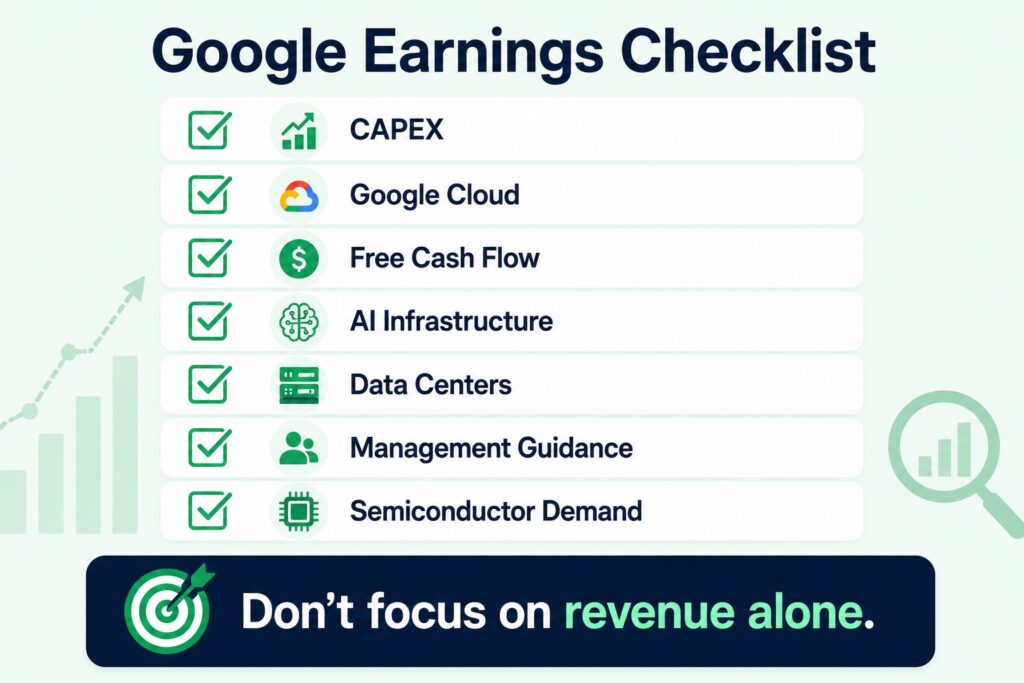
The checklist focuses on CAPEX direction, Cloud demand, infrastructure constraints, and profitability. Comparing these indicators over several quarters is more useful than reacting to a single earnings headline.
This is not a prediction model. It is simply a way to distinguish a durable infrastructure trend from one quarter of market excitement.
Why Higher Google Spending May Not Lift Every Chip Stock
The broad industry story can be positive while individual semiconductor companies struggle.
A supplier may have strong orders but weak pricing. It may face production delays, low manufacturing yields, customer concentration, or rising development costs.
Custom chips create another risk.
Google’s TPUs may increase total AI capacity while reducing the amount of certain third-party hardware required for some workloads. At the same time, a custom design can still benefit foundries, packaging companies, memory manufacturers, and networking suppliers.
The impact is rarely all-or-nothing.
Investors should therefore separate two statements:
Google is spending more on AI infrastructure.
A particular semiconductor company will earn more profit.
The first may be supported by Alphabet’s financial statements. The second requires company-specific evidence.
That distinction matters because industry demand does not translate equally into profits for every supplier.
Three Ways the Story Could Develop
Bull Case
AI demand remains strong, Google Cloud continues growing, and Alphabet keeps expanding infrastructure.
Demand spreads across processors, memory, networking, storage, packaging, and power components.
Base Case
AI investment continues, but Google becomes more selective.
Semiconductor demand remains healthy, although suppliers with stronger technology and pricing power outperform weaker competitors.
Bear Case
AI revenue grows more slowly than expected, data center projects are delayed, or semiconductor supply expands too quickly.
Hardware orders weaken, and cyclical segments such as memory experience pricing pressure.
These scenarios are not forecasts. They are reminders that the same long-term AI trend can produce very different short-term outcomes.
Practical Investor Takeaway
When analyzing Google earnings and semiconductor stocks, I would not begin by asking whether Alphabet beat EPS expectations.
I would start with three questions:
- How much did Google spend on technical infrastructure?
- Is Google Cloud demand growing fast enough to justify that spending?
- Which parts of the semiconductor supply chain are most difficult to expand?
That simple routine keeps the analysis focused on demand, capacity, and profitability rather than headlines.
Google’s earnings should not be treated as a direct buy-or-sell signal for semiconductor stocks. They are better viewed as one of the clearest windows into the scale and direction of global AI infrastructure investment.
Final Thoughts
For investors tracking AI infrastructure, Alphabet’s CAPEX may now be as important as its advertising revenue.
It may be the amount Alphabet is willing to spend before that infrastructure produces its full economic return.
Q2 2026 showed a company investing aggressively, with infrastructure spending temporarily exceeding quarterly operating cash flow while Google Cloud demand continued to grow.
That creates potential opportunities across processors, memory, networking, storage, advanced packaging, and power semiconductors.
It also creates risk.
More spending does not guarantee successful AI monetization, stable memory prices, or higher profits for every chip supplier.
The best way to understand Google earnings and semiconductor stocks is not to treat one earnings report as a trading signal. It is to follow CAPEX, cloud demand, supply-chain bottlenecks, and supplier profitability over several quarters.
The goal is not to predict the next semiconductor winner from one earnings report. It is to recognize whether AI infrastructure demand is strengthening, slowing, or shifting across the supply chain.
FAQ
Q1. Why do Google’s earnings matter for semiconductor stocks?
Alphabet operates some of the world’s largest cloud and AI platforms. The relationship between Google earnings and semiconductor stocks matters because rising infrastructure investment may affect demand for processors, memory, networking, storage, packaging, and power components.
Q2. What is Google CAPEX?
CAPEX is spending on long-term assets such as technical infrastructure, property, and equipment. Alphabet does not publicly disclose every supplier or chip category included in the total.
Q3. Does Google buy only Nvidia GPUs for AI?
No. Google uses multiple types of hardware, including its internally designed TPUs. Its infrastructure also requires memory, networking, storage, packaging, and power components.
Q4. Why is Google Cloud growth important?
Cloud growth shows whether customers are using and paying for Google’s computing capacity. It helps investors judge whether rising infrastructure spending is supported by demand.
Q5. Does higher CAPEX mean semiconductor stocks will rise?
No. Stock performance also depends on valuation, pricing power, competition, production capacity, margins, and company execution.
Related Articles
AI Electricity Demand: The Critical Power Constraint Investors Cannot Ignore
AI Marginal Cost: Why AI Is More Expensive Than Software
AI vs IT: The Critical Economic Difference Investors Must Understand
Why Stocks Fall After Good Earnings: 5 Reasons Most Investors Miss

Stock Valuation Checklist: 7 Critical Checks Before Calling a Stock Cheap
A stock can look cheap because its price has fallen 40%, its P/E ratio is…

RSI Divergence vs MACD Crossover: Which Is More Reliable for Trading?
RSI divergence can warn that price momentum is weakening before a reversal becomes obvious. A…

Before You Buy the Dip: 5 Critical Balance Sheet Checks Every Investor Should Make
A stock that falls 20%, 30%, or even 50% can suddenly look cheap. But a…
Disclaimer: This article is for educational purposes only. It is not financial advice or a recommendation to buy or sell any specific stock, ETF, cryptocurrency, or other asset. All investment decisions are your own responsibility.