
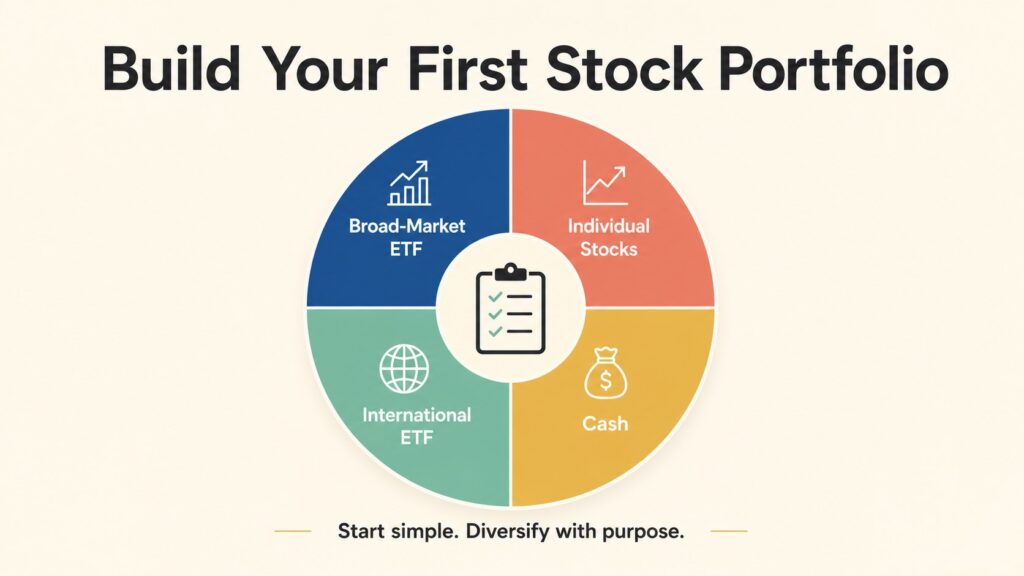
Learning how to build your first stock portfolio can feel more complicated than it needs to be.
Beginners are often told to research companies, diversify, manage risk, follow the economy, and invest for the long term. All of that sounds reasonable, but it does not answer the most practical question:
What should a beginner actually do first?
A first portfolio does not need dozens of stocks, frequent trading, or a complicated strategy. It needs a clear purpose, manageable position sizes, and a structure you can understand when markets are rising and when they are falling.
This guide explains how to build a simple beginner portfolio without depending on market predictions, social media trends, or one “perfect” stock.
How to Build Your First Stock Portfolio With a Clear Purpose
A portfolio is a collection of investments, but that definition does not explain why a portfolio matters.
A better way to think about it is as a system designed to prevent one company, sector, or decision from controlling your entire financial outcome.
Imagine that an investor owns three popular technology stocks. The portfolio contains three companies, but all three may react similarly to higher interest rates, weaker technology spending, or a decline in growth stocks.
The investor owns several stocks but may still be making one concentrated bet.
The purpose of a first portfolio is not to maximize excitement. It is to create a structure that allows you to continue investing without treating every market headline as a reason to change your plan.
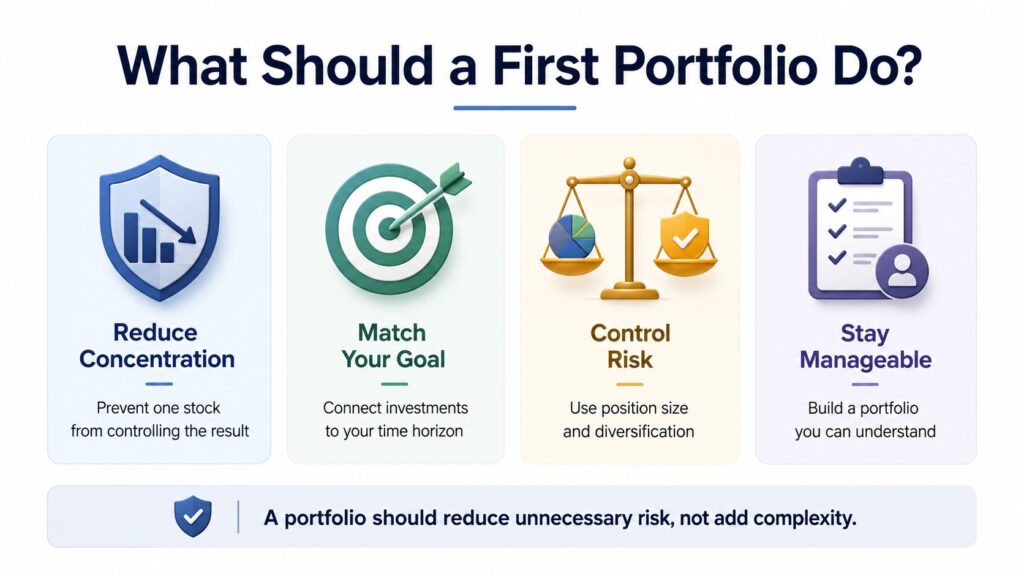
If one stock can determine whether your entire portfolio has a good or bad year, the portfolio may be more concentrated than it appears.
Step 1: Define What the Money Is For
Before you build your first stock portfolio, decide what the money is for and what the portfolio is supposed to achieve.
Common investment goals include:
- Building long-term wealth
- Saving for retirement
- Creating a future income stream
- Learning how financial markets work
- Investing toward a goal that is many years away
Your goal affects both your investment period and the level of risk you may be able to accept.
Money intended for a goal 15 or 20 years away can usually tolerate more short-term volatility than money needed within the next two or three years. Stocks can fall sharply and remain below previous highs longer than beginners expect.
One of the most important beginner rules is therefore simple:
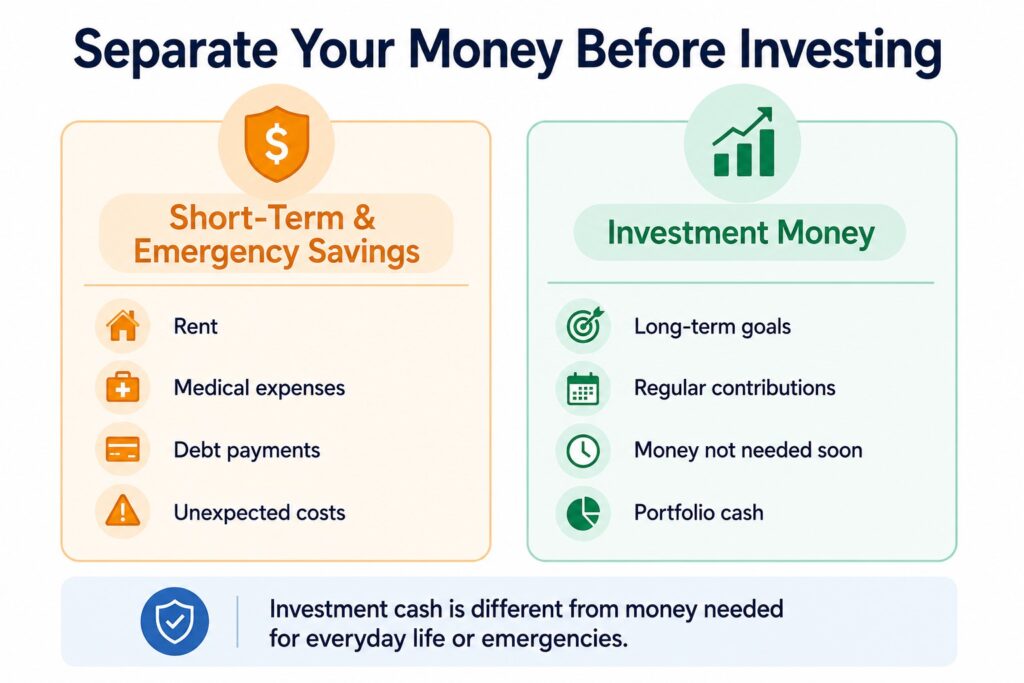
Do not invest money you may need in the near future.
Money for rent, tuition, medical expenses, debt payments, or emergencies should usually remain separate from a stock portfolio.
An emergency fund and portfolio cash are also not the same thing.
- An emergency fund is money reserved for unexpected personal expenses.
- Portfolio cash is money allocated to investing but not yet invested.
Portfolio cash should not replace emergency savings.
Step 2: Choose a Risk Level You Can Actually Live With
Risk tolerance is often described using labels such as conservative, moderate, or aggressive.
These labels can be useful, but they do not always reflect how an investor will behave during a real market decline.
Many people feel comfortable with risk while stock prices are rising. Their true risk tolerance becomes clearer after the portfolio falls for several weeks or months.
A more practical question is:
How would I react if my portfolio declined significantly and remained weak for several months?
Would you continue following your plan?
Would you stop investing?
Would you feel pressured to sell everything?
The answer matters more than the label you choose.
| Risk Approach | Possible Structure | Main Trade-Off |
|---|---|---|
| Lower volatility | Larger diversified ETF allocation, possible bond exposure, limited individual stocks | May produce lower long-term growth and feel less exciting |
| Moderate | Broad ETF core plus a small number of individual stocks | Requires some company research and position monitoring |
| Higher volatility | Larger exposure to individual growth stocks or narrow sectors | Greater concentration risk and larger price swings |
Higher risk does not mean greater investing skill. It simply means accepting a wider range of possible outcomes.
Investor.gov explains how asset allocation and diversification can help investors divide money among different asset categories and reduce concentration risk.
A portfolio that looks impressive but causes you to panic during every decline is not a well-designed portfolio for you.
Step 3: Build a Core Before Adding Individual Stocks
For many beginners, a broad-market ETF can provide a practical starting point.
An ETF such as a total-market or large-cap index fund may hold hundreds of companies within one investment. This reduces the need to correctly identify every future winner.
The SEC provides a beginner-friendly explanation of how exchange-traded funds work, including how they are structured and traded.
Examples commonly discussed by U.S. investors include VTI, VOO, and SPY. These are educational examples, not personal recommendations.
A beginner portfolio can be divided into two parts:
- The core provides broad market exposure.
- The satellite positions provide limited exposure to selected companies, sectors, or investment themes.
This is often called a core-and-satellite portfolio.
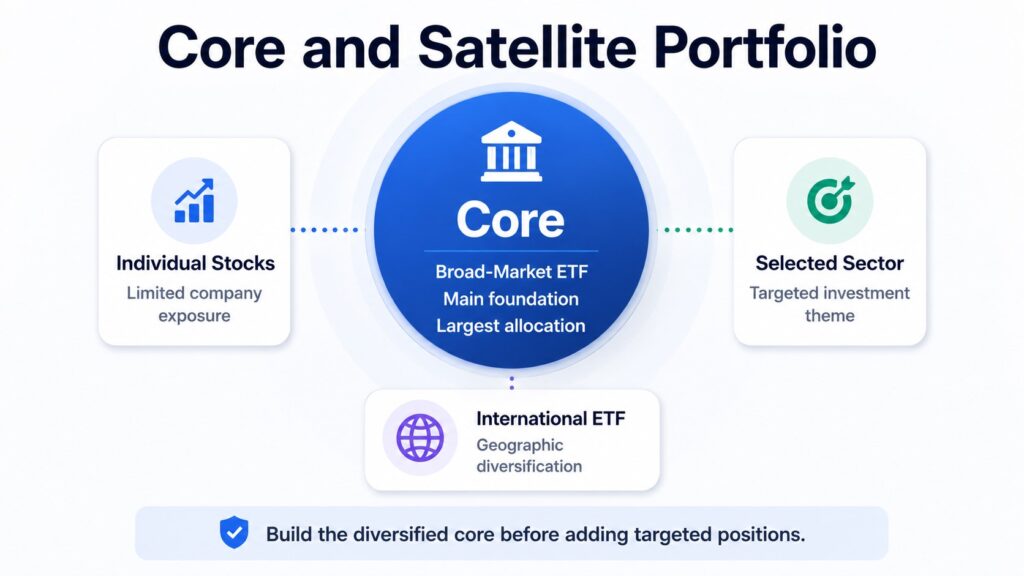
The core is normally the largest part because it is intended to perform most of the diversification work.
Satellite positions should usually remain smaller because individual companies and narrow sectors carry risks that are more difficult to predict.
Many beginners build this structure in reverse. They start with several exciting stocks and add a broad ETF later as an afterthought.
When you build your first stock portfolio, starting with a diversified core makes it easier to control risk before adding individual stocks.
Step 4: Use Allocation to Control Risk
The names of your investments matter, but their size within the portfolio often matters even more.
Owning a volatile company at 5% of a portfolio is very different from owning the same company at 50%.
The following example shows one simple way to build your first stock portfolio around clearly defined roles:
| Portfolio Component | Example Allocation | Main Role |
| Broad-market ETF | 60% | Main diversified foundation |
| Established individual company | 10% | Limited company-specific exposure |
| Second company or sector | 10% | Additional targeted exposure |
| International equity ETF | 10% | Geographic diversification |
| Cash | 10% | Gradual investing and flexibility |
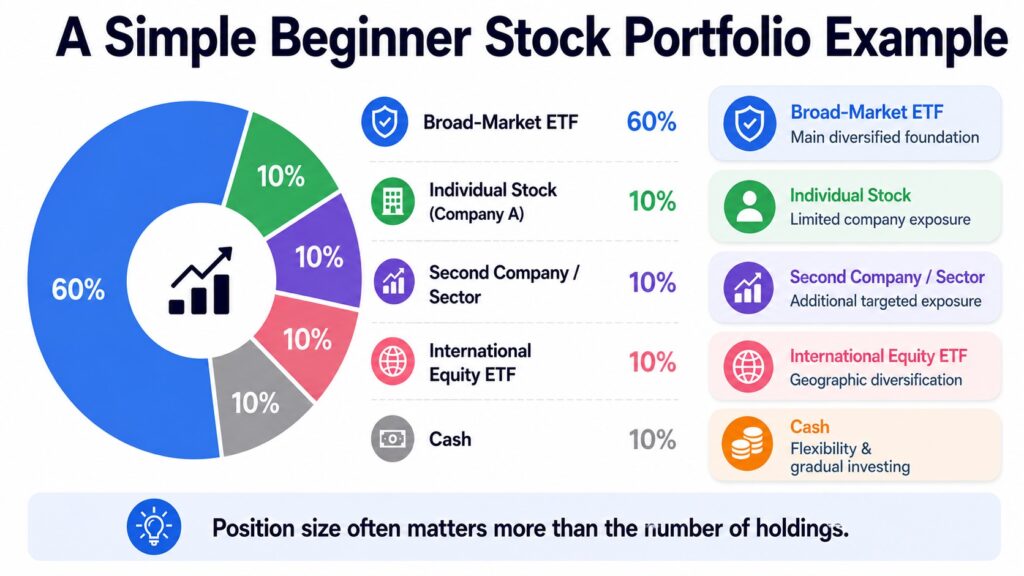
This is not a portfolio every beginner should copy. It is an example of how investments can be organized according to their roles.
The broad-market ETF receives the largest allocation because it is intended to provide the main foundation.
Individual positions remain smaller because company-specific risks are harder to anticipate.
The international ETF provides exposure outside the main domestic market.
Cash allows the investor to invest gradually without feeling pressured to commit every available dollar at once.
Investors seeking lower volatility might replace part of the individual-stock allocation with a diversified bond ETF. However, an international stock ETF and a bond ETF should not be treated as interchangeable.
An international stock ETF mainly provides geographic diversification, while a bond ETF is generally used for asset-class diversification and volatility management.
Step 5: Avoid False Diversification
One of the most common beginner misunderstandings is assuming that more holdings automatically create more diversification.
A portfolio with ten technology stocks may still depend heavily on the performance of one sector.
A portfolio with several ETFs can also contain significant overlap.
For example, a broad-market ETF, an S&P 500 ETF, and a technology-heavy ETF may all hold many of the same large U.S. technology companies.
Owning all three funds may increase your exposure to those companies rather than diversify away from them.
When reviewing a portfolio, check three areas:
- Company concentration: Is one company unusually large?
- Sector concentration: Are most holdings exposed to the same industry?
- ETF overlap: Do several funds own the same top companies?
Overlap is not automatically a problem. The problem is owning overlapping funds without realizing how much exposure they create.
A Simple ETF Overlap Example
Suppose a beginner invests $5,000:
| Investment | Amount | Portfolio Weight |
| Broad-market ETF | $3,000 | 60% |
| Company A | $750 | 15% |
| Company B | $500 | 10% |
| International ETF | $250 | 5% |
| Cash | $500 | 10% |
At first glance, Company A represents 15% of the portfolio.
However, assume Company A also represents 6% of the broad-market ETF.
The ETF creates an additional indirect exposure of:
$3,000 × 6% = $180
The investor’s total exposure to Company A is therefore:
$750 + $180 = $930
That equals approximately:
$930 ÷ $5,000 = 18.6%
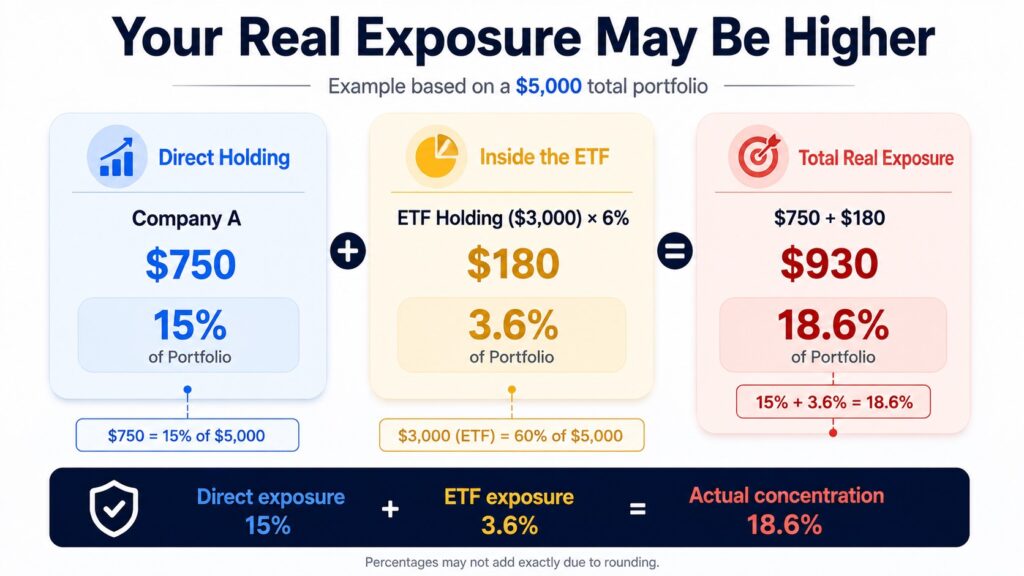
The investor may think Company A represents only 15% of the portfolio, while the effective exposure is closer to 18.6%.
This is why portfolio analysis should begin with actual exposure, not only the number of ticker symbols.
Step 6: Limit the Number of Individual Stocks
Buying many stocks can create the appearance of sophistication, but it often makes a portfolio harder to understand.
Every individual company requires ongoing attention.
You should understand:
- How the company earns money
- What could weaken its business
- Whether its debt level is manageable
- Why you originally bought the stock
- What development would make you reconsider the investment
If you cannot explain why a company belongs in the portfolio, the position may be adding complexity without providing a clear benefit.
There is no perfect number of stocks for every beginner.
However, a diversified ETF core plus a small number of individual companies is often easier to manage than a portfolio containing 15 or 20 unrelated stock ideas.
Before adding another stock, ask:
- Does this investment add exposure I do not already have?
- Is it similar to a company or ETF I already own?
- What role will it play in the portfolio?
- How large should the position become?
- What would make me sell or reduce it?
If there is no clear answer, the new position may not improve the portfolio.
Step 7: Invest Gradually Instead of Waiting for the Perfect Moment
Many beginners delay investing because they are waiting for a major market correction.
Others invest everything at once because they are afraid of missing the next rally.
Both reactions depend on predicting the next market move.
A simpler approach is to invest on a regular schedule. This is commonly known as dollar-cost averaging.
For example, an investor might contribute the same amount every month and divide that contribution according to a target allocation.
Regular investing does not guarantee profits, improve every outcome, or prevent losses.
Its main benefit is behavioral.
It reduces the pressure to choose one perfect entry price and creates a process that can be repeated during both strong and weak markets.
For a beginner, a consistent monthly routine may be more useful than reacting to every inflation report, interest-rate forecast, or market headline.
Step 8: Decide How New Contributions Will Be Used
Portfolio building does not end after the first purchase.
New monthly contributions can help maintain the target allocation without requiring frequent selling.
Suppose your target is:
- Broad-market ETF: 60%
- Individual stocks: 20%
- International ETF: 10%
- Cash: 10%
If individual stocks rise and become 25% of the portfolio, you do not necessarily need to sell immediately.
You could direct more of the next contribution toward the broad-market or international ETF.
This is sometimes called rebalancing through contributions.
It can help correct smaller allocation differences while limiting unnecessary trades.
Common Mistakes When You Build Your First Stock Portfolio
Buying Stocks Because They Are Popular
A company can have an excellent business and still be a poor investment at an unreasonable price.
Popularity is not the same as diversification, safety, or attractive valuation.
Before buying, understand why the company may continue growing and what expectations are already reflected in its share price.
Starting With Too Many Holdings
More holdings create more earnings reports, news stories, price movements, and decisions.
Complexity can make it difficult to identify what is actually driving portfolio performance.
Start with a structure you can understand before adding more positions.
Owning Several Similar ETFs
Different ETF names do not always mean different exposure.
Before adding a new fund, check:
- Its benchmark index
- Its top holdings
- Its sector allocation
- Its expense ratio
- Its overlap with funds you already own
The SEC notes that fund fees and expenses can reduce investment returns over time, even when the individual charges appear small.
A new ETF should have a clear purpose.
Checking the Portfolio Constantly
Daily price movements can make long-term investments feel like short-term trades.
Frequent checking may increase emotional decision-making without improving the underlying portfolio.
A long-term portfolio usually does not require daily changes.
Copying Someone Else’s Allocation
A portfolio created for someone with a different income, age, time horizon, tax situation, and risk tolerance may not fit your circumstances.
Use sample allocations as frameworks, not instructions.
Changing the Plan After Every Market Drop
A decline does not automatically mean the original portfolio structure was wrong.
Before making changes, ask whether any of the following has changed:
- Your financial situation
- Your investment goal
- Your time horizon
- The reason for owning a company
- Your ability to tolerate the portfolio’s volatility
Changing a plan because of fear is different from changing it because the original assumptions are no longer valid.
A Practical Portfolio Review Routine
A beginner portfolio does not need daily management.
For many long-term investors, reviewing the portfolio once or twice a year may be enough.
During the review, ask:
- Does the portfolio still match my goal?
- Has one investment become too large?
- Am I overly exposed to one sector?
- Do several ETFs hold the same companies?
- Do I still understand every individual stock?
- Have fees or fund objectives changed?
- Has my personal financial situation changed?
- Do I need this money sooner than expected?
Rebalancing means adjusting the portfolio toward its intended allocation.
Suppose an individual stock was originally 10% of the portfolio but increased to 25% after a strong price rise.
The company may still be attractive, but the portfolio now carries much more company-specific risk than originally planned.
Rebalancing is not about punishing a successful investment. It is about deciding whether the current level of risk still matches your plan.
A Checklist Before You Build Your First Stock Portfolio
Before making a new investment, use this checklist:
- I understand what the company or ETF owns.
- I know what role it plays in my portfolio.
- The position size matches the level of risk.
- I am not investing money needed in the near future.
- I am not buying only because the price recently increased.
- I have checked the ETF’s main holdings and expense ratio.
- I have checked for company, sector, and ETF concentration.
- I can explain why I would continue holding during a market decline.
- I know what development would make me reconsider the investment.
A portfolio becomes easier to manage when every holding has a clear purpose.
Practical Beginner Framework
A practical process for building your first portfolio is:
- Define the goal.
- Separate emergency savings from investment money.
- Decide how much volatility you can realistically tolerate.
- Build a diversified ETF core.
- Keep individual stock positions limited.
- Check company, sector, and ETF overlap.
- Invest gradually using a repeatable schedule.
- Review the allocation once or twice a year.
- Change the portfolio only when there is a clear reason.
This process will not predict the next market rally or prevent every loss.
Its purpose is to create a portfolio that remains understandable and manageable as market conditions change.
Final Thoughts
You do not need dozens of holdings or a complicated strategy to build your first stock portfolio.
It needs a structure you understand well enough to maintain during both rising and falling markets.
Start with a clear goal, keep short-term savings separate, use diversification intentionally, and control risk through position sizing.
The portfolio can become more sophisticated later, after the basic process feels repeatable.
Stock investing always involves uncertainty. The objective is not to eliminate risk, but to keep each risk at a level you understand and can continue managing over time.
This article is for educational purposes only and does not constitute financial, tax, or investment advice.
FAQ
Q1. How many stocks should a beginner own?
There is no perfect number. A beginner may find a diversified ETF core plus a small number of individual stocks easier to understand and manage than a large collection of companies.
The number of holdings matters less than whether each position has a clear purpose and appropriate size.
Q2. Should a beginner start with stocks or ETFs?
Many beginners use broad-market ETFs as a foundation because one ETF can provide exposure to many companies.
Individual stocks require more research and carry additional company-specific risk. A beginner can use ETFs as the core and add limited individual positions later.
Q3. How much money is needed to build a portfolio?
The amount depends on the brokerage platform, ETF share prices, trading fees, and whether fractional shares are available.
Starting with a large amount is less important than developing a consistent contribution and allocation process.
Q4. Is a 60% ETF allocation right for everyone?
No. The 60% allocation used in this article is a hypothetical example.
An appropriate allocation depends on your financial situation, time horizon, investment objective, and ability to tolerate losses.
Q5. Should cash be included in a stock portfolio?
Some beginners keep a limited amount of portfolio cash so they can invest gradually.
However, portfolio cash should not replace an emergency fund. Money needed for near-term expenses should remain separate from long-term investments.
Q6. How often should a portfolio be rebalanced?
Many long-term investors review their allocations once or twice a year.
A review does not always require trading. Smaller allocation differences may sometimes be corrected by directing new contributions toward underweight investments.
Q7. How can I check ETF overlap?
Compare each ETF’s benchmark, top holdings, and sector weights using the fund issuer’s official website.
Pay particular attention to companies that appear among the largest holdings of several funds.
📚 Related Articles
How to Read Financial Statements: A Simple Beginner’s Guide
Fundamental Analysis for Beginner Investors: A Smart Guide to Better Stock Decisions
Trading Volume for Beginners: How to Read It With Price Action
Interest Rates and the Stock Market: A Beginner’s Practical Guide
What Is a Stock? A Simple and Effective Beginner’s Guide

Market Capitalization Explained: The Costly Mistake Beginner Investors Make
Market capitalization is one of the first numbers investors see when researching a stock. It…
Why Stocks Rise on Bad News: What Beginner Investors Should Know
Many beginner investors wonder why stocks rise on bad news, especially when the headlines seem…
Is a Low P/E Ratio Always Better? 5 Costly Mistakes to Avoid
When I first began studying stock valuation, the P/E ratio seemed like the easiest number…
Disclaimer: This article is for educational purposes only. It is not financial advice or a recommendation to buy or sell any specific stock, ETF, cryptocurrency, or other asset. All investment decisions are your own responsibility.