
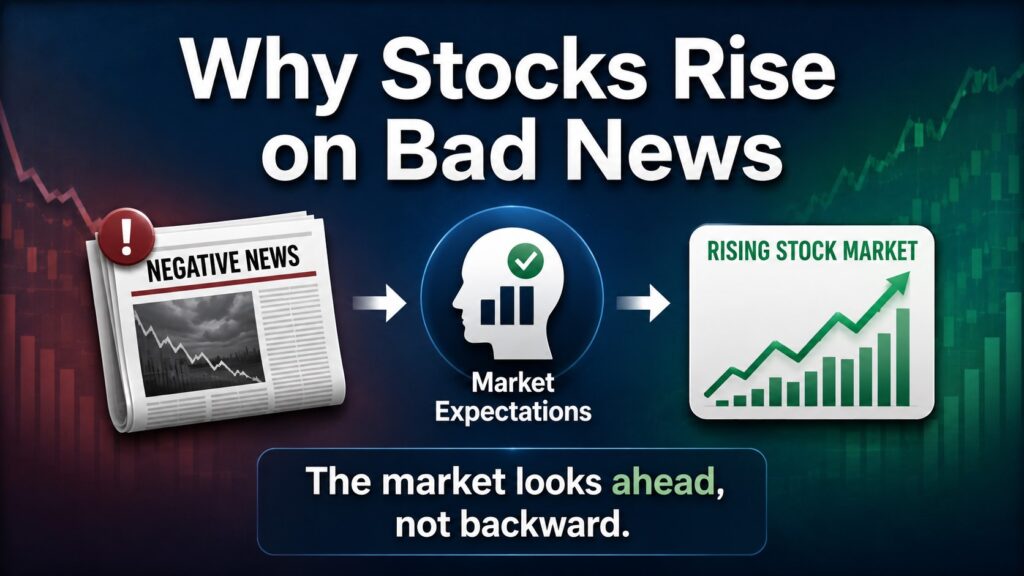
Many beginner investors wonder why stocks rise on bad news, especially when the headlines seem overwhelmingly negative.
You turn on the television, and the warnings seem impossible to ignore.
Inflation remains a concern. Economists debate whether a recession is approaching. Geopolitical tensions create uncertainty, and analysts warn that corporate profits could slow.
Then you open your investing app.
The S&P 500 is rising again.
For a new investor, this can feel completely backwards. If the economy looks weak and the news is negative, shouldn’t stock prices fall?
I used to think so.
When I first started following the U.S. stock market, I assumed prices should move in the same direction as the headlines. Negative economic news seemed like a reason to become cautious immediately, while improving news appeared to be a signal that stocks should rise.
But I repeatedly saw something different.
Sometimes stocks rose after a disappointing economic report. In other cases, a company announced strong profits and its share price still fell.
That contradiction pushed me to stop judging news only by whether it sounded positive or negative.
Instead, I began asking a more useful question:
Was the news better or worse than investors already expected?
That question explains many market moves that initially seem irrational.
The stock market does not simply react to what is happening today. It constantly tries to estimate what corporate profits, interest rates, and economic conditions may look like several months from now.
Once you understand that difference, it becomes much easier to see why stocks can rise even when the news is bad.
Why Stocks Rise on Bad News Before the Economy Improves
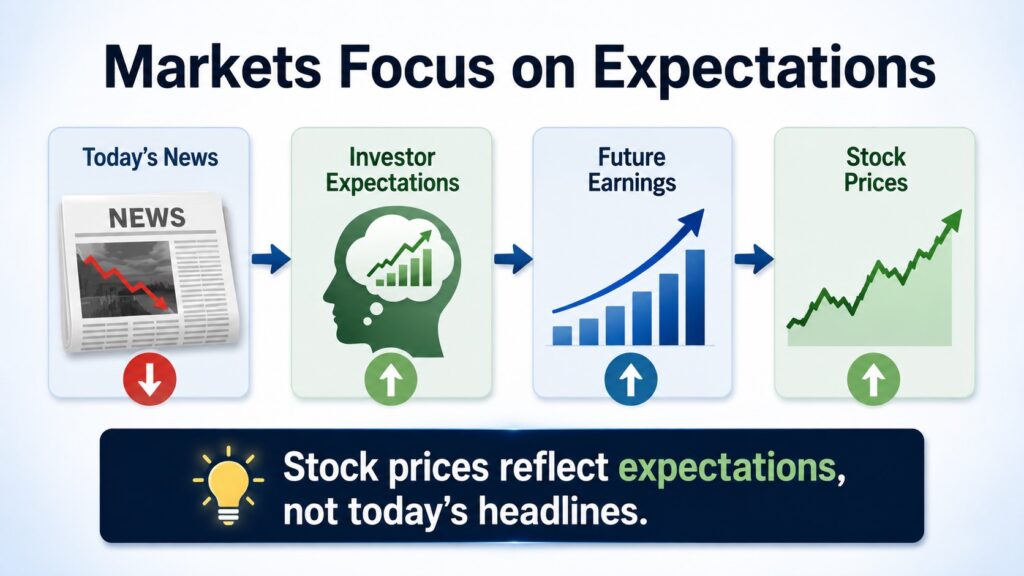
Most economic reports describe conditions that have already occurred.
Inflation data, such as the U.S. Consumer Price Index published by the Bureau of Labor Statistics, measures price changes that have already occurred. Employment reports summarize jobs that were created or lost during an earlier period. Corporate earnings show how a company performed during the previous quarter.
Stock prices work differently.
A stock represents ownership in the future profits of a business. Investors therefore spend much of their time estimating what that business may earn next year and beyond.
They ask questions such as:
- Will inflation continue to slow?
- Will interest rates remain high?
- Could the Federal Reserve eventually ease monetary policy?
- Will consumer spending strengthen or weaken?
- Are company profits likely to recover?
- Is the current problem temporary or permanent?
These expectations can matter more than the condition described in today’s headline.
Suppose the economy is weak, but investors believe the slowdown is nearing its end. They may begin buying stocks before employment, consumer confidence, or corporate profits clearly improve.
By the time the economic news becomes positive, stock prices may have already risen significantly.
This is why the market can appear disconnected from the economy. It is not necessarily ignoring current problems. It may simply be looking beyond them.
Stocks React to Expectations, Not Just Headlines
One of the most important lessons for a beginner investor is that markets compare actual results with expectations.
They do not judge a report only by whether it is objectively good or bad.
Imagine that analysts expect a company to lose $2 billion during the quarter. When the results are released, the company reports a loss of $1 billion.
The company still lost money. The headline is still negative.
Yet the stock could rise because the outcome was not as bad as investors feared.
Now consider the opposite situation.
A company reports record profits, but analysts had expected even stronger growth. The results sound impressive, but they fall short of the expectations already reflected in the stock price.
The stock may decline despite the positive headline.
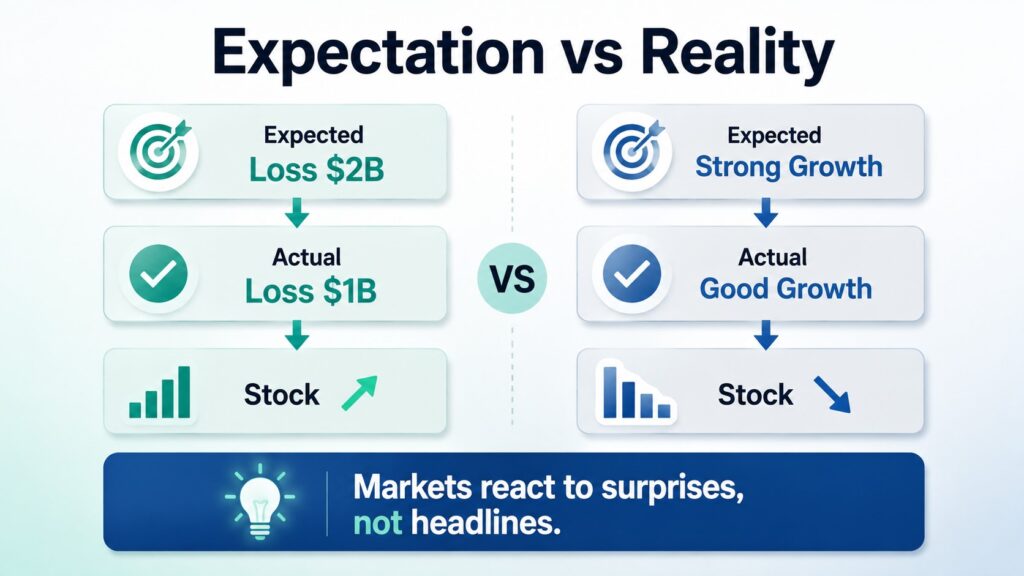
The basic pattern is simple:
- Investors expect a very poor result, but the outcome is only slightly poor: the stock may rise.
- Investors expect an excellent result, but the outcome is merely good: the stock may fall.
The difference between expectations and reality is often more important than the headline itself.
This is why earnings estimates, company guidance, and investor positioning matter. A result can be disappointing in absolute terms and still create a positive market reaction.
Bad News May Already Be Priced In
Financial markets do not usually wait for information to become official.
Analysts study industry trends before earnings are released. Economists publish forecasts ahead of inflation and employment reports. Companies provide guidance about future sales, costs, and demand.
As expectations change, investors gradually adjust their portfolios.
This process is often described as pricing in information.
It helps explain why stocks rise on bad news that investors had already anticipated.
Suppose investors become increasingly worried that a company will report weak sales. Its share price may decline for several weeks before the earnings announcement.
When the company finally reports weaker sales, the news may no longer be a surprise. If management also says that demand is beginning to stabilize, the stock could rise.
To someone reading only the headline, the reaction may look irrational.
To investors who had already prepared for a worse outcome, it may be reasonable.
A useful question to ask is:
Is this information genuinely new, or has the market been expecting it for some time?
That distinction can help explain why negative news sometimes causes little damage—or even supports a rally.
Investors Buy Future Earnings
When you buy a stock, you are not buying last quarter’s income statement.
You are buying a claim on the company’s future cash flows and earnings.
That is why management guidance can matter as much as the latest financial results.
Investors can verify financial results, risk disclosures, and management commentary through company filings available on the SEC’s EDGAR database.
Imagine that a technology company reports lower profits because it is spending heavily on artificial intelligence infrastructure, new products, and research.
Current earnings may look disappointing. However, if investors believe those investments will lead to stronger revenue and profits in the future, the stock may still rise.
The opposite can also happen.
A company may report strong current earnings while warning that demand is weakening, margins are under pressure, or future growth will slow. In that case, the stock may fall even though the latest quarter looked healthy.
While following earnings seasons, I found it more useful to read management’s outlook before reacting to the headline number.
A weak quarter does not always mean the business is deteriorating. A strong quarter does not always mean growth will continue.
The market often rewards improving expectations rather than perfect current conditions.
Interest Rates and Liquidity Can Change the Market’s Mood
Economic headlines are only one part of the market.
Interest rates, bond yields, credit conditions, and financial liquidity also influence how much investors are willing to pay for stocks.
When interest rates rise sharply, borrowing becomes more expensive. Businesses may slow investment, consumers may reduce spending, and safer assets such as government bonds may become more attractive.
Higher rates can also reduce the present value of future corporate earnings, which is especially important for growth stocks.
However, weaker economic data can sometimes increase expectations that the Federal Reserve will eventually lower interest rates.
If inflation begins to cool and economic growth slows, markets may start anticipating fewer rate increases or possible policy easing in the future. Those expectations can support stocks even while current economic reports remain weak.
This is one reason Federal Reserve meetings often produce complicated market reactions.
Investors can review the Federal Reserve’s official monetary policy statements and reports to understand how policymakers are assessing inflation, employment, and interest rates.
A rate increase may sound negative, but stocks could rise if investors believe it will be the final increase.
A rate cut may sound positive, but stocks could fall if investors interpret it as evidence that the economy is weakening faster than expected.
I no longer judge a Federal Reserve announcement only by the decision itself. I also look at the reaction in Treasury yields, the U.S. dollar, and the broader stock market.
Those movements often reveal how investors interpreted the announcement.
Why Markets Can Recover Before the Economy
Stock markets have often begun recovering while economic conditions were still difficult.
During a recession or financial crisis, unemployment may remain high, business confidence may be weak, and corporate earnings may still be falling.
Yet stocks can start rising once investors believe the worst phase is approaching an end.
The market does not need the economy to be healthy.
It only needs future conditions to appear less negative than previously expected.
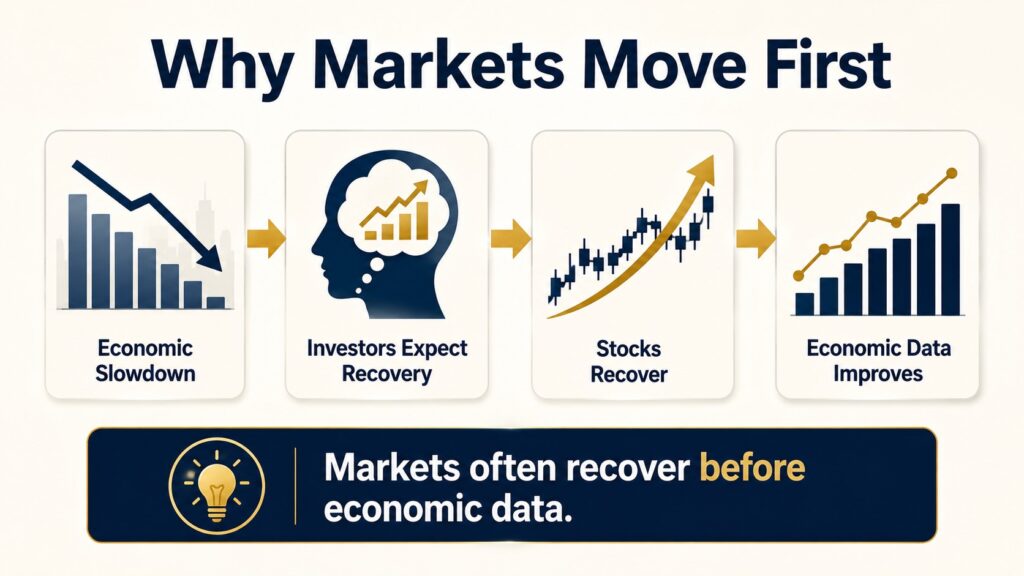
This pattern has appeared during several major market cycles, including the global financial crisis and the 2020 pandemic downturn.
The National Bureau of Economic Research maintains an official chronology of U.S. business cycles, including the February 2020 peak and April 2020 trough.
In both cases, the stock market began looking toward an eventual recovery before many economic indicators had returned to normal.
That does not mean markets always predict the economy correctly. Investors can become overly optimistic, underestimate risks, or change their expectations quickly.
Still, the forward-looking nature of stock prices helps explain why market recoveries often begin when public sentiment remains pessimistic.
By the time financial news becomes broadly optimistic, a large part of the recovery may already be reflected in prices.
Five Reasons Stocks Rise on Bad News
Most rallies during negative news environments can be explained by five recurring conditions.
1. The Outcome Was Better Than Feared
A report can be bad and still exceed expectations.
If investors prepared for a severe recession, a mild slowdown may be received positively. If analysts expected a large earnings decline, a smaller decline can support the stock.
The relevant comparison is not simply good versus bad.
It is expected versus actual.
2. Investors Believe the Problem Is Temporary
Markets may look beyond short-term weakness when investors believe sales, margins, or economic growth will eventually recover.
A difficult quarter matters less when the company’s long-term business model remains intact.
However, this distinction is important.
Temporary weakness can create opportunity, while permanent damage can justify a lower valuation.
3. Interest-Rate Expectations Become More Favorable
Weak economic data can increase expectations that monetary policy will become less restrictive.
Lower expected interest rates may support stock valuations, particularly when inflation is also moving in the right direction.
Bad economic news can therefore produce a positive market reaction when it changes the expected path of interest rates.
4. Long-Term Investors See More Attractive Prices
Pension funds, insurers, mutual funds, and other long-term investors often make allocation decisions over years rather than days.
They may gradually buy when valuations become more attractive, even if current headlines remain negative.
Their buying does not necessarily mean that all risks have disappeared. It may simply mean that expected long-term returns have improved.
5. Extreme Fear Begins to Fade
Periods of intense uncertainty can lead investors to sell broadly, sometimes without carefully separating strong businesses from weak ones.
When fear becomes excessive, prices may fall below what long-term fundamentals appear to justify.
A small improvement in expectations can then create a strong rebound.
This does not mean every decline is a buying opportunity.
The key is determining whether the problem is temporary, already reflected in the price, and unlikely to permanently damage the business.
Why Financial News Can Feel Late
Many investors assume the sequence works like this:
A news event occurs, investors react, and stock prices move.
In reality, institutional investors may begin adjusting their portfolios before a theme becomes widely discussed.
Stock prices can therefore move first, while financial news explains the change afterward.
By the time a story dominates television coverage or social media, part of the market reaction may have already happened.
This does not make financial news useless.
News provides context, explains risks, and helps investors understand important developments.
The problem arises when investors treat every headline as entirely new information that requires immediate action.
When I first became interested in investing, I refreshed financial news sites throughout the day because I assumed every major headline required a decision.
In practice, this often made me more anxious without improving my judgment.
Over time, I found it more useful to review the main developments, compare them with market expectations, and then study the company or economic data in context.
That change made market volatility easier to handle.
Common Mistakes Beginner Investors Make
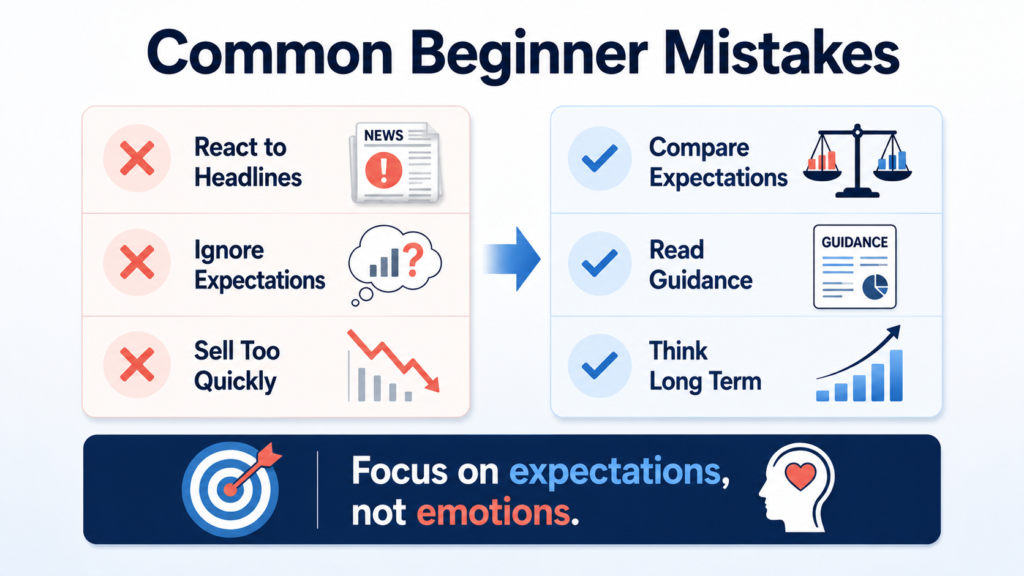
Selling Immediately After a Scary Headline
Dramatic headlines attract attention, but they do not always contain information the market has not already considered.
Before selling, ask whether the news changes the long-term outlook or simply confirms a risk that investors already expected.
Assuming the Economy and Stock Market Must Move Together
The economy and the stock market are related, but they measure different things.
Economic data describes current or past conditions. Stock prices represent expectations about future earnings and growth.
They can move in different directions for extended periods.
Ignoring Company Guidance
Many beginners focus only on revenue, earnings per share, or whether the company beat estimates.
Professional investors also pay close attention to guidance, margins, demand trends, capital spending, and management commentary.
The outlook may explain the stock reaction more clearly than the headline results.
Treating Every Rally as Proof That Risks Are Gone
Stocks can rise even when serious risks remain.
A rally may reflect short covering, improving expectations, lower yields, or relief that conditions were not worse.
It does not necessarily mean the economy is strong or the market cannot decline again.
Trying to Predict Every Short-Term Move
No investor can consistently predict every rally, correction, earnings reaction, or Federal Reserve decision.
A repeatable process is usually more useful than a series of confident forecasts.
A Checklist Before Reacting to Bad News
The next time stocks rise despite negative headlines, pause before assuming the market is behaving irrationally.
Ask:
- Was this outcome already widely expected?
- Was the result better or worse than analysts predicted?
- Did the company change its future guidance?
- Are earnings expectations improving or deteriorating?
- What are Treasury yields doing?
- Has the expected path of Federal Reserve policy changed?
- Is the market reaction consistent across major indexes and sectors?
- Does the news create temporary weakness or permanent damage?
- Am I responding to new information or to fear?
You do not need perfect answers to every question.
The purpose of the checklist is to slow down the decision-making process and separate evidence from emotion.
The Process I Use Before Reacting
When an important market headline appears, I try to follow the same routine.
First, I avoid making an immediate decision based only on the wording of the headline.
Then I read the full report and compare the outcome with what investors expected.
For company news, I review management guidance and the long-term business outlook.
For macroeconomic news, I check Treasury yields, the dollar, and the broader market response.
Finally, I ask whether the development changes the original reason for owning the investment.
This process cannot predict the market, and it does not eliminate risk.
But it helps prevent a temporary emotional reaction from becoming a permanent investment decision.
Final Thoughts
The stock market is not a mirror of today’s economy.
It is a pricing system that continually estimates future corporate profits, interest rates, growth, and risk.
That is why stocks can rise during recessions, recover while unemployment remains high, or rally after a negative earnings report.
In many cases, stocks rise on bad news because the market is comparing the result with earlier expectations rather than judging the headline alone.
The market may have already expected the bad news. The result may be less severe than feared. Investors may be looking toward future earnings, lower interest rates, or improving financial conditions.
None of this means bad news should be ignored.
It means the headline is only the beginning of the analysis.
Instead of asking whether the news sounds good or bad, ask what investors expected, what has changed, and whether the long-term outlook is improving or deteriorating.
That approach is far more useful than reacting to every breaking-news alert.
FAQ
Q1. Why do stocks rise during recessions?
Stocks can rise during a recession because investors expect economic conditions and corporate profits to improve in the future. Markets often react before official economic data confirms a recovery.
Q2. Why do stocks rise on bad news?
Stocks rise on bad news when the outcome is less severe than expected, the risk is already reflected in prices, or investors believe future earnings and financial conditions will improve.
Q3. Can weak economic data be good for stocks?
Sometimes. Weak data may increase expectations for lower interest rates or less restrictive Federal Reserve policy. However, very weak data can still hurt stocks if investors become concerned about a severe recession or falling profits.
Q4. Should beginner investors ignore financial news?
No. Financial news provides useful information and context. It should be considered alongside expectations, company guidance, valuations, Treasury yields, and long-term fundamentals.
Q5. Does the stock market accurately predict the economy?
Not always. The market reflects investor expectations, and those expectations can be wrong. However, stocks often move before economic data because investors are constantly estimating future conditions.
Q6. Why can a company’s stock rise after it reports a loss?
The loss may be smaller than expected, or management may provide an encouraging outlook. Investors focus on how the results compare with expectations and what they imply about future profits.
📚 Related Articles
Why Stocks Fall After Good Earnings: 5 Reasons Most Investors Miss
Fundamental Analysis for Beginner Investors: A Smart Guide to Better Stock Decisions
How to Read Financial Statements: A Simple Beginner’s Guide
How U.S. Treasury Yields Affect Tech Stocks: A Smart and Powerful Beginner’s Guide

Market Capitalization Explained: The Costly Mistake Beginner Investors Make
Market capitalization is one of the first numbers investors see when researching a stock. It…
Is a Low P/E Ratio Always Better? 5 Costly Mistakes to Avoid
When I first began studying stock valuation, the P/E ratio seemed like the easiest number…
How to Build Your First Stock Portfolio: A Smart and Simple Beginner’s Guide
Learning how to build your first stock portfolio can feel more complicated than it needs…
Disclaimer: This article is for educational purposes only. It is not financial advice or a recommendation to buy or sell any specific stock, ETF, cryptocurrency, or other asset. All investment decisions are your own responsibility.