
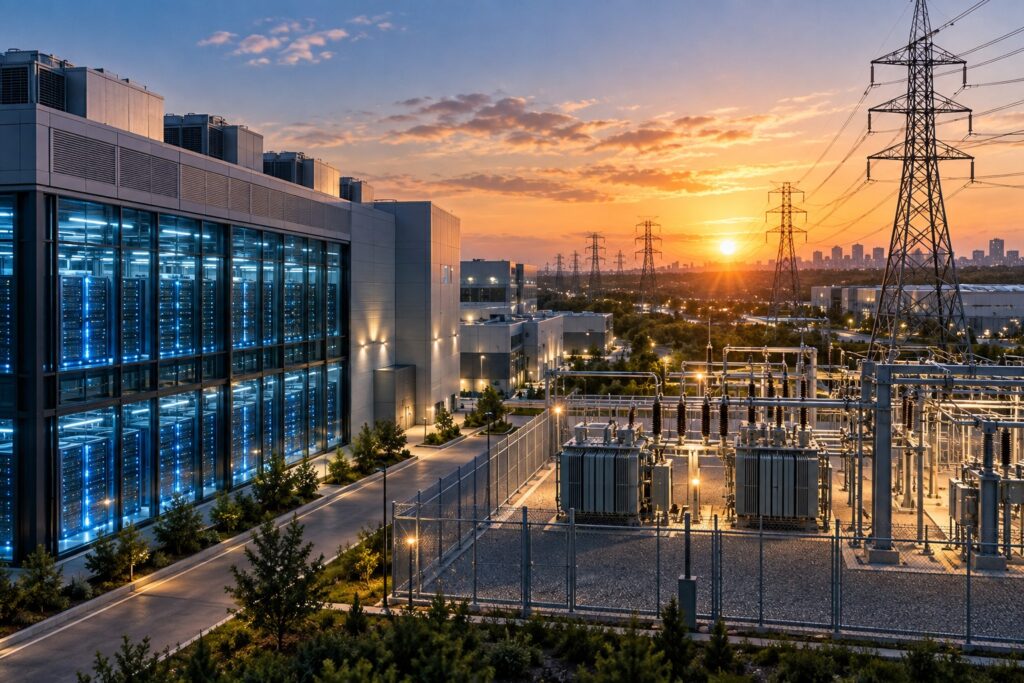
For much of the AI boom, the investment story has centered on GPUs.
That makes sense. Advanced AI models require enormous amounts of computing power, and GPUs have become one of the most visible bottlenecks in the AI infrastructure buildout.
But as more GPUs enter data centers, another constraint is becoming increasingly important:
electricity.
The International Energy Agency expects global data center electricity consumption to roughly double by 2030, with electricity use from AI-focused data centers growing even faster.
That creates an appealing investment thesis:
If AI needs more electricity, perhaps the next major beneficiaries will be power companies rather than chipmakers.
The first half of that argument is increasingly supported by evidence.
The second half requires much more caution.
Electricity demand can rise sharply without every utility, power producer, or grid-equipment company capturing the same economic benefit. Regulation, capital requirements, grid constraints, contract structures, construction timelines, and pricing power all influence where the value actually flows.
For investors, the important question is therefore not simply whether AI needs more electricity.
It is:
Who can turn the AI power bottleneck into durable earnings and cash flow?
That distinction changes how investors should think about the AI power bottleneck as an investment thesis.
The AI Power Bottleneck Is Becoming a Physical Constraint
AI may feel like a digital industry, but its infrastructure is intensely physical.
Models run on servers. Servers sit inside data centers. Those facilities need power, cooling, transformers, substations, transmission capacity, and connections to the electrical grid.
As AI computing expands, those physical requirements become harder to ignore.
The Berkeley Lab 2025 data center energy update estimates that U.S. data centers could account for about 11.8% of total U.S. electricity consumption by 2030, with a scenario range of 9.5% to 15.3%.
The IEA reaches the same broad conclusion from a global perspective. Its 2026 Key Questions on Energy and AI report projects data center electricity consumption rising from about 485 TWh in 2025 to around 950 TWh in 2030. Electricity consumption from AI-focused data centers is projected to grow substantially faster than overall data center consumption.
But the most important issue for investors is not the national electricity total.
It is where that demand appears.
Data centers are geographically concentrated. A large new facility may require hundreds of megawatts—or potentially more—at a specific location.
A country can therefore have sufficient generating capacity in aggregate while an individual data center project still struggles to secure enough power at the location and on the timeline it needs.
This is the first important insight behind the AI power bottleneck:
The problem is not only producing enough electricity. It is delivering enough reliable electricity to the right place at the right time.
That turns the AI power bottleneck into a much broader infrastructure problem.
Why Electricity Could Become More Important as GPUs Improve
A common assumption is that more efficient chips will eventually solve AI’s energy problem.
Efficiency certainly matters.
If a new GPU performs more calculations for each watt of electricity, the energy required for a specific workload can fall.
But that does not necessarily mean total electricity consumption falls.
Suppose an AI system becomes twice as efficient, but lower costs and better performance cause companies to run four times as many AI workloads.
Total electricity use can still increase.
This is why investors should distinguish between efficiency per computation and total system demand.
The IEA’s outlook incorporates uncertainty around hardware efficiency, software improvements, AI adoption, and energy-sector bottlenecks. Even with those uncertainties, its central case still shows substantial growth in data center electricity consumption.
There is another important asymmetry.
GPU supply can expand through additional semiconductor production and improved chip performance. Electricity infrastructure operates on a different timetable.
Power plants, transmission lines, substations, and other grid infrastructure can require years of planning, permitting, financing, construction, and regulatory approval.
The technology cycle may move in months.
The power system often moves in years.
That mismatch is what makes the AI power bottleneck economically interesting.
Why More Electricity Demand Does Not Mean Every Utility Wins
Imagine electricity demand from data centers rises dramatically in a utility’s service territory.
At first glance, that sounds unquestionably positive. More electricity sold should mean more revenue.
But utilities are not ordinary businesses.
Many electric utilities operate under regulated frameworks. They invest capital in generation, transmission, distribution, and other infrastructure, while regulators determine which costs can be recovered from customers and what return the utility can earn on approved investments.
A utility may therefore need to spend billions of dollars upgrading infrastructure before the full demand arrives. Financing requirements can increase. Regulatory approval may take time. New tariffs may require large data center customers to bear more of the infrastructure cost. A planned data center may also be delayed, downsized, or never completed.
So the economic chain is not simply:
AI demand → electricity demand → utility profits
A more realistic chain is:
AI demand → data center load → required infrastructure → capital investment → regulatory treatment → cost recovery → allowed return → cash flow
Every arrow matters.
Demand growth and value creation are not the same thing.
Understanding this distinction is essential when evaluating the AI power bottleneck as an investment theme.
The Real Bottleneck May Be the Grid, Not Electricity Generation
Investors often discuss the AI electricity problem as if the only solution were building more power plants.
Generation is important, but it is only one part of the system.
Electricity must move from generation resources through transmission networks and substations before reaching the data center.
That creates another potential bottleneck:
grid access.
In June 2026, the Federal Energy Regulatory Commission directed all six regional grid operators under its jurisdiction to justify or reform rules governing how data centers and other large electricity users connect to the grid.
The action addressed not only faster connections but also reliability, affordability, and protections for existing customers.
The implication is important.
The scarcity created by AI is not simply a shortage of electricity generation.
It can also involve shortages or delays in:
- transmission capacity,
- interconnection capacity,
- transformers,
- substations,
- grid equipment,
- permitted sites,
- and time.
This is why the AI power bottleneck may create economic value in places that are less obvious than electricity generation itself.
Follow the AI Power Bottleneck, Not Just the Electricity Bill
A useful way to analyze the AI power bottleneck is to break the electricity value chain into several layers:
Generation → Transmission → Substations & Grid Equipment → Distribution/Interconnection → Data Center
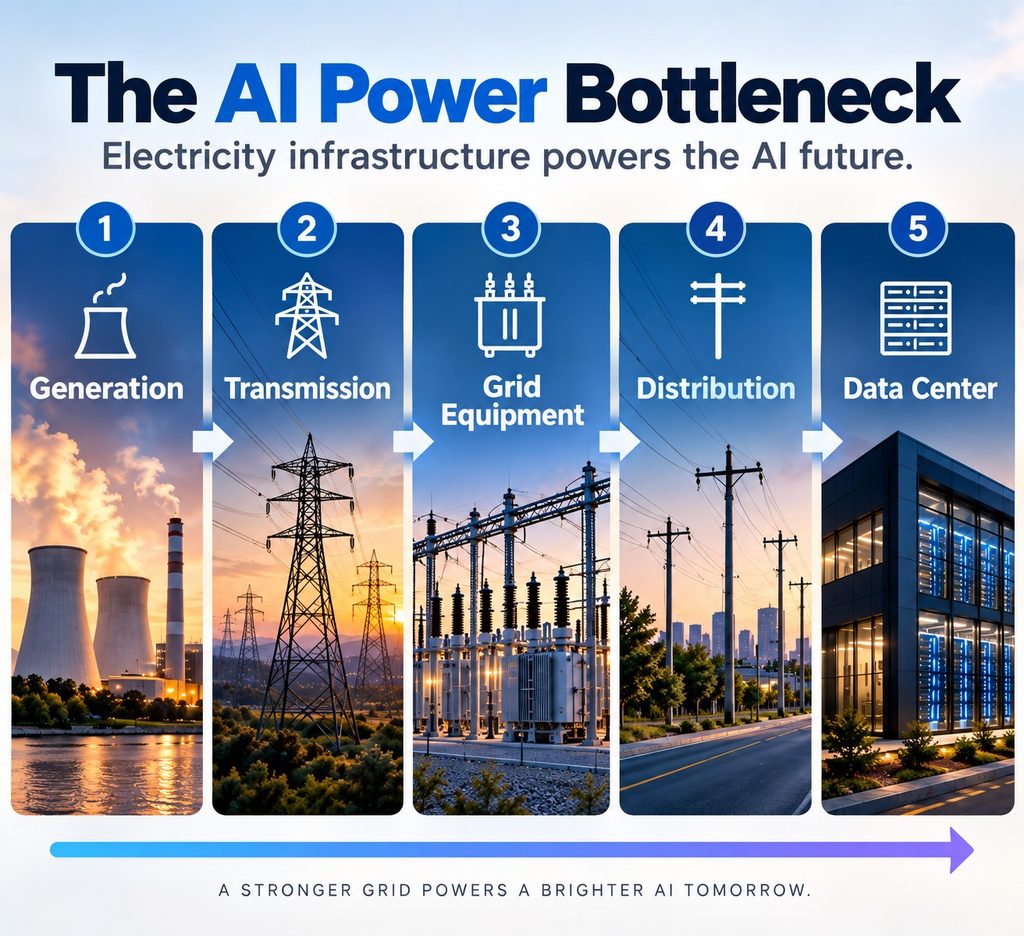
Each layer has different economics.
A power producer may benefit from higher electricity demand and favorable power prices.
A regulated utility may earn returns on approved infrastructure investment but face regulatory limits and substantial financing requirements.
Manufacturers of transformers, switchgear, turbines, and other electrical equipment may benefit when demand exceeds available manufacturing capacity.
Data center developers may gain strategic value from controlling sites that already have access to sufficient power.
The differences become clearer when the value chain is compared directly:
| Layer | Potential Value Driver | Key Investment Risk |
|---|---|---|
| Power Producers | Higher electricity demand, power contracts, favorable pricing | Fuel costs, power-price volatility, new generation supply |
| Regulated Utilities | Rate-base growth from approved grid investment | Heavy CAPEX, regulatory lag, cost-allocation disputes |
| Grid Equipment Manufacturers | Backlogs, constrained manufacturing capacity, pricing power | Capacity expansion, competition, demand normalization |
| Data Center Developers | Scarcity value of sites with sufficient power access | Permitting, interconnection delays, construction costs |
The important question is not which layer has the fastest demand growth.
It is which businesses can convert scarcity into attractive economics.
One company may benefit from higher prices with relatively little incremental capital. Another may need to invest billions before earning an approved return. A third may benefit from equipment shortages only until manufacturing capacity catches up.
A Real-World Signal: Grid Equipment Demand Is Already Responding
One way to test the thesis is to look beyond electricity forecasts and examine whether infrastructure demand is appearing in company orders.
GE Vernova provides a useful example—not because one company proves the entire thesis, but because its results illustrate how data center demand can move through the physical power supply chain.
In the first quarter of 2026, GE Vernova reported that its Electrification segment booked $2.4 billion of equipment orders supporting data centers. According to the company, that was more than it booked from data centers during all of 2025.
The company also said its combined gas turbine equipment backlog and slot reservation agreements had reached 100 GW, and it expected the figure to reach at least 110 GW by the end of 2026.
These figures do not prove that AI-related power equipment will remain highly profitable indefinitely.
But they demonstrate an important mechanism:
AI infrastructure spending can create demand several steps removed from the GPU itself.
A data center requires compute.
Compute requires electricity.
Additional electricity demand may require generation and grid expansion.
Grid expansion requires physical equipment.
The economic effect of AI can therefore propagate through a much larger capital chain than semiconductor demand alone.
The AI Power Mix Will Not Have One Winner
Another common mistake is trying to identify a single energy source that will power the AI boom.
The actual system is likely to be more complicated.
Natural gas, renewables, nuclear power, storage, and other resources can play different roles depending on geography, grid conditions, reliability requirements, cost, and construction timelines.
This means the AI power bottleneck should not be reduced to:
AI = nuclear
or
AI = natural gas
or
AI = utilities
The more useful framework is to ask what a data center actually requires:
reliable power + sufficient capacity + acceptable cost + fast connection + scalable infrastructure
Different technologies and businesses can solve different parts of that equation.
A Better Framework for AI Power Bottleneck Investment Returns
Scarcity can create economic value, but scarcity alone does not tell investors who captures it.
A more useful analytical framework is:
Demand Growth × Pricing Power × Capital Efficiency × Value Capture = Investment Economics
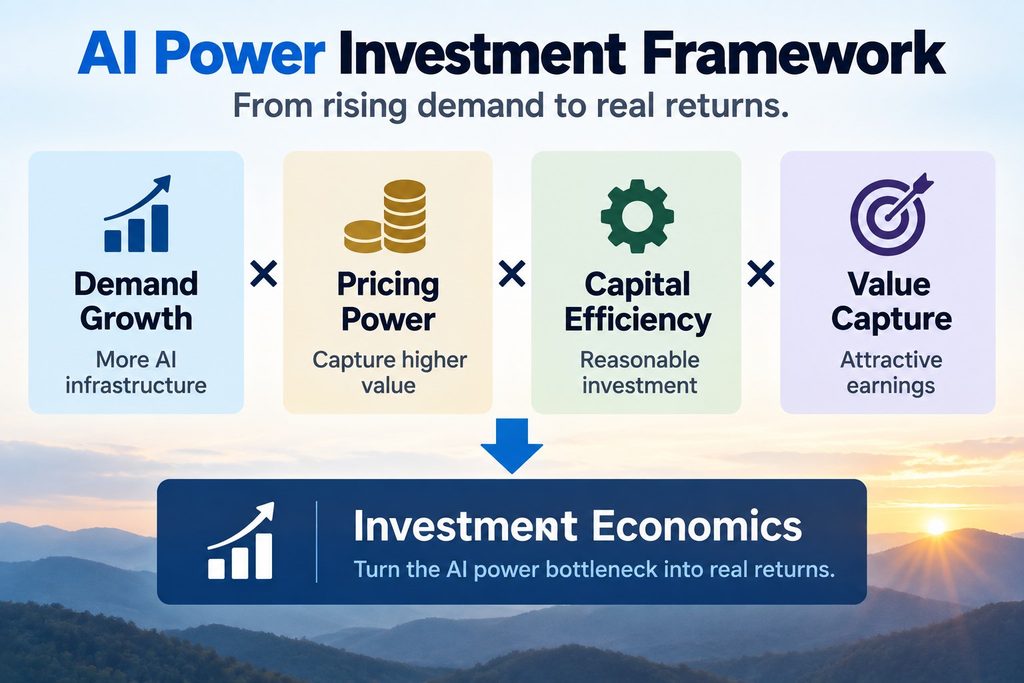
This is not a literal financial formula.
It is a framework for testing whether an attractive industry narrative can translate into attractive business economics.
Demand Growth: Is the company’s addressable market actually expanding because of AI infrastructure?
Pricing Power: Can the company improve pricing or negotiate favorable contracts when supply is constrained?
Capital Efficiency: How much additional capital is required to capture that growth?
Value Capture: After financing costs, regulation, competition, and customer bargaining power, how much of the economic benefit remains with the business and its shareholders?
A company does not need perfect economics on every dimension, but weakness in one factor can limit how much of the AI infrastructure boom ultimately reaches shareholders.
5 Questions to Test an AI Power Investment
Rather than asking whether a company is simply “exposed to AI,” investors can use five questions to test whether that exposure can translate into economic value.
1. Where Is the Actual Bottleneck?
Is the constraint generation capacity, transmission, transformers, substations, interconnection, cooling, or something else?
Scarcity should be demonstrated rather than assumed.
For equipment suppliers, examine backlog growth, book-to-bill ratios, delivery lead times, segment margins, and manufacturing-capacity expansion.
Rising backlog, long lead times, and improving margins can indicate that a supplier is capturing scarcity value. Rapid capacity expansion, however, can eventually weaken that advantage.
2. Who Pays for the New Infrastructure?
If a utility spends heavily to connect a large data center, investors need to know whether those costs are borne by the customer, added to the utility’s rate base, allocated across customers, or handled through another structure.
For regulated utilities, examine rate-base growth, planned CAPEX, allowed return on equity, financing requirements, regulatory filings, and customer-specific tariff structures.
A large CAPEX plan can support future earnings if qualifying investment enters the rate base at an adequate return. But it can also increase debt, equity issuance, and financing costs before those earnings arrive.
3. Does the Company Have Pricing Power?
Rapid demand growth is more valuable when supply cannot adjust quickly.
For independent power producers, examine contracted capacity, power purchase agreements, realized electricity prices, generation availability, and incremental generation costs.
For equipment manufacturers, watch margins, order pricing, and contract terms. Regulated utilities are different because rates are generally determined through regulatory processes.
The key question is whether stronger demand improves margins or returns on capital, not simply revenue.
4. How Much Capital Is Required to Capture the Growth?
Companies can benefit from the same AI infrastructure boom with very different economics depending on how much additional capital they need.
Compare growth with free cash flow, return on invested capital, net debt, interest expense, capital expenditures, and financing needs.
For power producers, compare expected cash flow from new contracts with the incremental capital required to provide additional capacity.
Growth becomes economically valuable only when the returns justify the capital required to produce it.
5. What Could Remove the Bottleneck?
No shortage lasts forever. More generation and transmission can be built, factories can add capacity, and improvements in chips, models, and software can reduce the compute required for some tasks.
For equipment suppliers, watch capacity additions, lead times, backlog conversion, and new competition.
For power producers, watch new generation projects, contracted supply, fuel costs, and power-price normalization.
For utilities, watch interconnection progress, regulatory approvals, load forecasts, and whether planned data centers actually come online.
The key question is how long a company can continue earning attractive economics from today’s scarcity.
Do Not Confuse an Electricity Forecast With an Earnings Forecast
Forecasts from Berkeley Lab and the IEA make a strong case that data centers will become increasingly important to the power system.
But a demand forecast answers:
How much electricity might be needed?
An investment analysis asks:
Who supplies it, who pays for the infrastructure, how much capital is required, and what return can the company earn?
A company can benefit operationally from AI growth and still be an unattractive investment if its economics are weak—or if its valuation already assumes an even better outcome.
So, Will Electricity Matter More Than GPUs?
Electricity is becoming one of the most important physical constraints on AI expansion.
But that does not make electricity the universal “winner” over GPUs.
The two solve different problems:
GPUs provide compute.
Electricity enables compute.
The grid delivers the electricity.
Power equipment expands the grid.
The investment question is therefore not simply GPU versus electricity.
It is:
Where in the AI infrastructure chain is scarcity hardest to solve, and which businesses can capture economic value from that scarcity without destroying returns through excessive capital spending?
The next phase of AI infrastructure investment may increasingly extend beyond chips and into power.
But higher electricity demand alone will not determine the strongest economics.
Investors still need to follow four things:
Demand Growth × Pricing Power × Capital Efficiency × Value Capture
That is a more useful way to evaluate the AI power bottleneck than simply asking which industry sells the most electricity.
Data and regulatory developments in this article were checked against official and primary sources available as of September 21, 2026. Forecasts are inherently uncertain and can change with AI adoption, efficiency improvements, infrastructure development, regulation, and economic conditions. This article is for educational purposes only and is not a recommendation to buy or sell any security.
📚 Related Articles
AI Electricity Demand: The Critical Power Constraint Investors Cannot Ignore
AI Marginal Cost: Why AI Is More Expensive Than Software
AI vs IT: The Critical Economic Difference Investors Must Understand

High Interest Rates and the Economy: Why Can Growth Stay Strong?
If high interest rates are supposed to slow the economy, why can consumers keep spending,…

Can AI Become a Monopoly? Where the Real Economic Moats Are
Artificial intelligence appears to have many ingredients that could produce powerful monopolies. Training frontier models…

Can Big Tech Maintain Its Profit Margins in the AI Era?
Artificial intelligence is creating new revenue opportunities for Big Tech, but it is also changing…