What Is the Dollar Index? This is one of the most useful macroeconomic questions beginner investors can ask when they start learning how global markets are connected.
When I first started building my portfolio, I used to focus almost entirely on company news. If a stock fell, I assumed something must have gone wrong with the business. During a period of market volatility, I watched several large technology stocks decline even though there was no major earnings miss or negative headline. I was confused.
After spending more time looking at macroeconomic data, I noticed something I had completely overlooked. The U.S. Dollar Index, also known as DXY, had been climbing alongside Treasury yields as investors expected tighter Federal Reserve policy. That experience taught me an important lesson: the stock market does not move in isolation. Sometimes the bigger story is happening in the broader economy.
Understanding the Dollar Index will not tell you exactly where the market is heading next. But it can help explain why stocks, gold, oil, and global markets sometimes move the way they do. For beginner investors, learning how the dollar fits into the bigger picture is an excellent first step toward understanding macroeconomics.
What Is the Dollar Index?
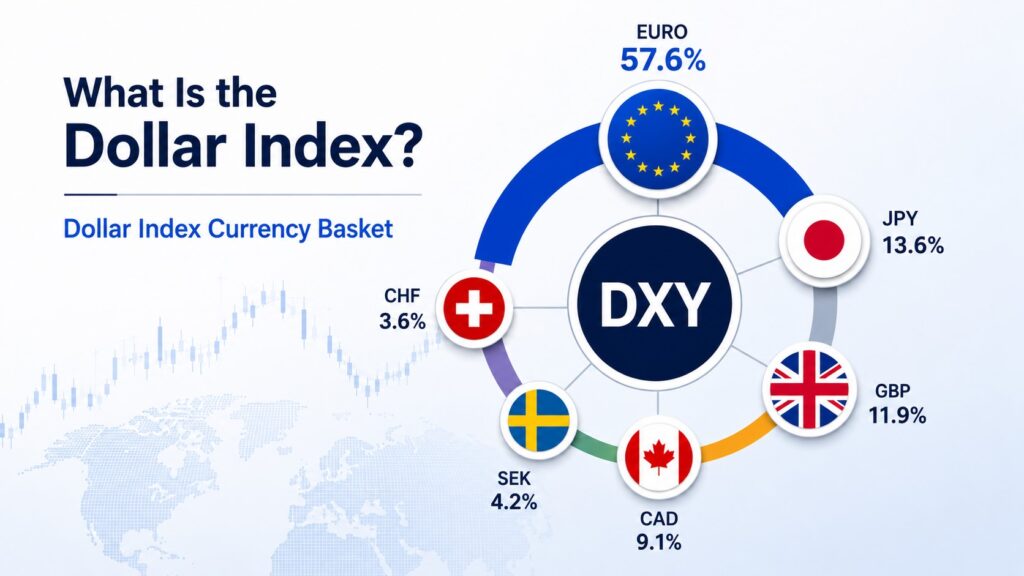
The Dollar Index, commonly known as DXY, measures the value of the U.S. dollar against a basket of major foreign currencies. Rather than comparing the dollar with only one currency, it tracks how the dollar performs against several important developed-market currencies.
The basket includes the euro, Japanese yen, British pound, Canadian dollar, Swedish krona, and Swiss franc.
| Currency | Role in the Dollar Index |
|---|---|
| Euro | Largest weighting |
| Japanese Yen | Major Asian currency |
| British Pound | Major European currency |
| Canadian Dollar | Commodity-linked developed-market currency |
| Swedish Krona | Smaller European currency component |
| Swiss Franc | Safe-haven currency component |
Among these currencies, the euro has by far the largest weighting, meaning movements in the euro often have the greatest influence on the index. Because of this, changes in the EUR/USD exchange rate frequently drive much of the Dollar Index’s movement.
In simple terms, a rising Dollar Index generally means the U.S. dollar is strengthening relative to these currencies, while a falling Dollar Index suggests the dollar is weakening.
This does not automatically mean the U.S. economy is becoming stronger or weaker. The index simply reflects the relative performance of the dollar compared with a specific group of major currencies.
For readers who want to explore the index in more detail, the official ICE U.S. Dollar Index Futures page provides information about its methodology, currency components, and calculation.
How the Dollar Index Is Calculated
After asking “What Is the Dollar Index?”, many beginners assume each currency contributes equally to the index, but that is not the case.
The Dollar Index uses a weighted calculation, meaning some currencies have a much larger impact than others. The euro accounts for more than half of the index, while the remaining currencies make up the rest.
A simple analogy is a school grading system. Imagine your final exam counts for 60% of your grade while several quizzes make up the remaining 40%. Even if you perform well on the quizzes, the final exam still has the greatest influence. The Dollar Index works in a similar way.
Because of this weighting, DXY is not a measure of the dollar against every global currency. Instead, it represents the dollar’s strength against a specific group of developed-market currencies.
Because the index uses a weighted methodology, movements in the euro tend to have a much greater impact than changes in the other currencies.
Understanding that limitation helps prevent beginners from drawing overly broad conclusions about the global economy.
Why the Dollar Index Matters to Investors
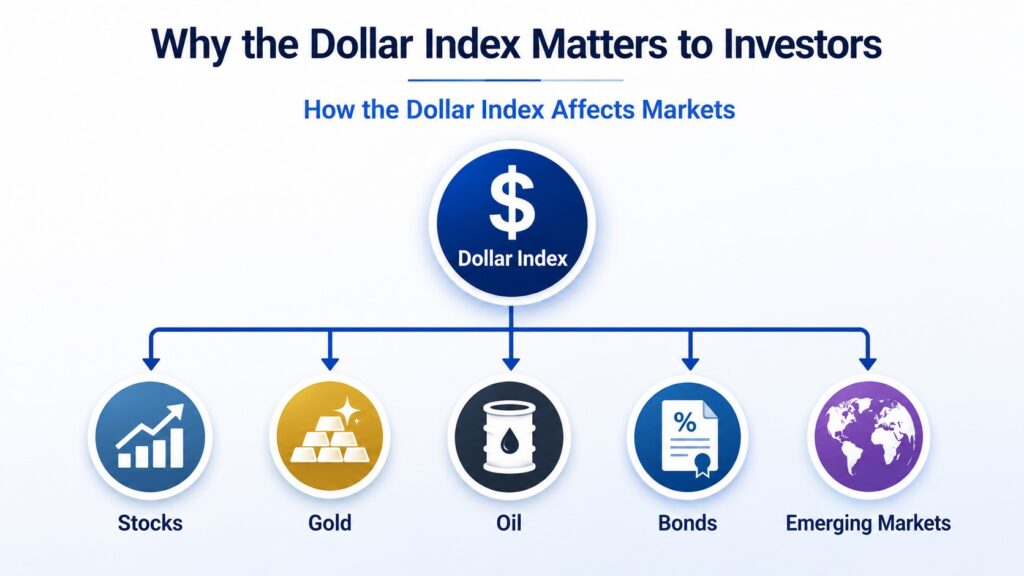
Even if you never trade currencies, the Dollar Index deserves your attention because it influences many parts of the financial markets.
The value of the U.S. dollar affects international trade, multinational corporate earnings, commodity prices, bond markets, and investor confidence. It also reflects changing expectations about interest rates and monetary policy.
A stronger dollar often develops when investors expect higher interest rates or believe the Federal Reserve will maintain tighter financial conditions. Higher yields on U.S. Treasury securities can attract global capital, increasing demand for dollars.
For beginners, the official Federal Reserve website can be a useful source for understanding interest-rate decisions and monetary policy updates.
Conversely, expectations for lower interest rates or easing inflation can reduce demand for the dollar and push the index lower.
This is why experienced investors rarely look at DXY by itself. Instead, they view it alongside several important macro indicators, including inflation, Treasury yields, employment data, and Federal Reserve policy.
If you want to understand this relationship more clearly, you may also read Interest Rates and the Stock Market: A Beginner’s Practical Guide.
The Dollar Index is less about predicting markets and more about providing context.
Dollar Index and Stocks
The relationship between the Dollar Index and stocks is not always straightforward, but there are several common patterns.
Many large U.S. companies generate a significant portion of their revenue overseas. When the dollar strengthens, those foreign earnings convert into fewer U.S. dollars, which can reduce reported revenue and profits.
A stronger dollar may also make American products more expensive abroad, potentially reducing international competitiveness.
Growth stocks can be particularly sensitive when a rising Dollar Index is accompanied by increasing Treasury yields. Higher yields reduce the present value of future earnings, which can pressure companies with high expected growth.
If you’d like to understand this relationship in more detail, read our guide on How U.S. Treasury Yields Affect Tech Stocks: A Beginner’s Guide.
However, it would be a mistake to assume that every increase in DXY leads to falling stock prices.
Corporate earnings, economic growth, inflation, investor sentiment, and Federal Reserve communication all interact at the same time. Sometimes stocks continue rising even while the dollar strengthens because earnings remain healthy and the broader economy is expanding.
This is why market context always matters more than a single indicator.
Dollar Index and Gold
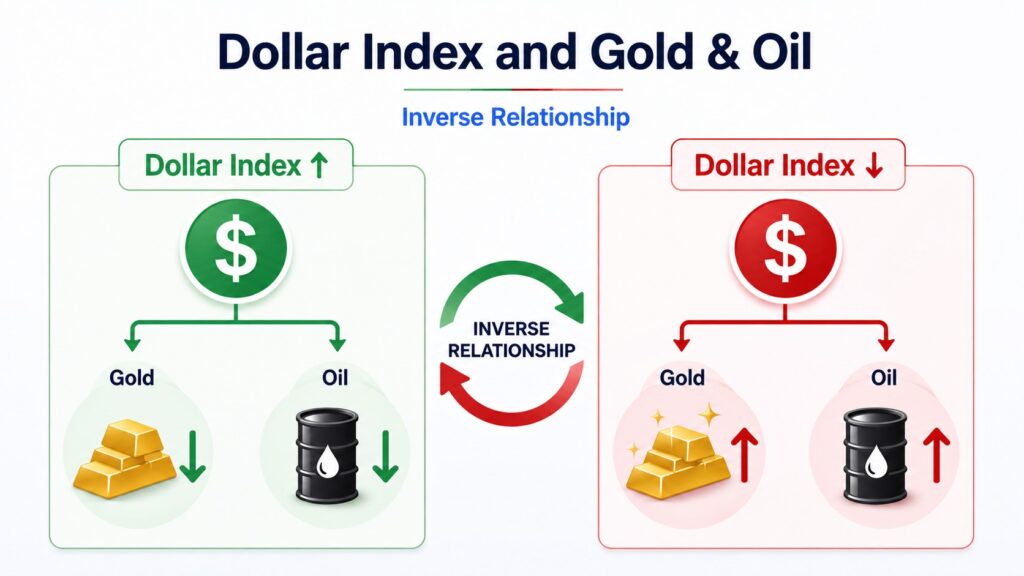
Gold has historically shown an inverse relationship with the Dollar Index, although the relationship is far from perfect.
Since gold is priced globally in U.S. dollars, a stronger dollar makes gold more expensive for buyers using other currencies. That can reduce demand and place downward pressure on gold prices.
A weaker dollar can have the opposite effect by making gold relatively less expensive internationally.
Still, gold responds to much more than currency movements. Real interest rates, inflation expectations, geopolitical uncertainty, central bank purchases, and safe-haven demand all influence gold prices.
This is why experienced investors usually monitor both the Dollar Index and Treasury yields rather than relying on either indicator alone.
One mistake I made early in my investing journey was assuming that every decline in DXY would automatically send gold higher. After watching the market over time, I realized that Treasury yields often mattered just as much. Looking at both indicators together gave me a much better understanding than watching either one alone.
Dollar Index and Oil
Oil prices are also closely connected to the value of the U.S. dollar because crude oil is primarily traded in dollars.
When the dollar strengthens, international buyers may need more of their local currency to purchase the same amount of oil. That can reduce demand at the margin and sometimes pressure prices.
When the dollar weakens, oil may become relatively cheaper for foreign buyers, which can support demand.
However, oil is one of the most complex commodities in the world. Production decisions, geopolitical tensions, global economic growth, seasonal demand, and supply disruptions often have a larger impact than currency movements alone.
The Dollar Index helps explain part of the story, but never all of it.
For long-term investors, watching supply and demand trends together with movements in the U.S. dollar usually provides a more complete picture than focusing on either factor alone.
Dollar Index and Emerging Markets
Emerging markets are often more sensitive to changes in the U.S. dollar than developed economies.
Many governments and companies in emerging economies borrow money in U.S. dollars. When the dollar strengthens, repaying those loans becomes more expensive in local currency terms.
A stronger dollar can also encourage investors to move money toward U.S. assets if higher interest rates make American investments more attractive.
As a result, emerging-market currencies and stock markets sometimes experience additional pressure during periods of sustained dollar strength.
Conversely, a weaker dollar can ease financial conditions and improve investor sentiment toward emerging markets.
Again, these are tendencies rather than guarantees. Economic growth, political stability, and local monetary policy all remain important factors.
What Beginners Should Watch
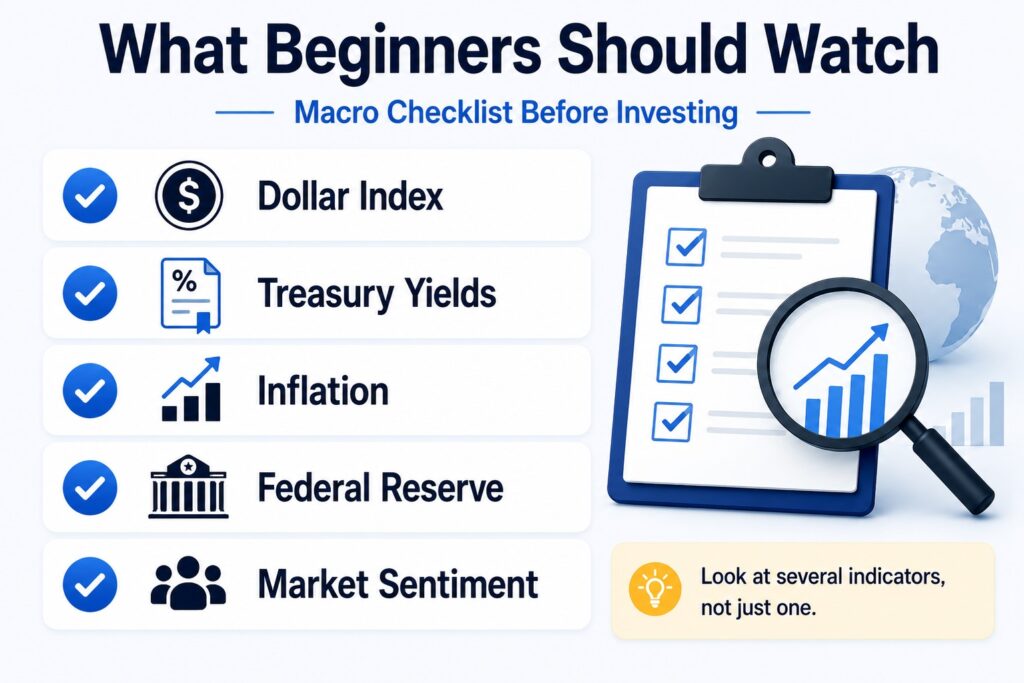
One of the biggest investing mistakes is trying to explain every market move with a single chart.
Instead, I prefer looking at several indicators together before reaching a conclusion.
Macro Insight Lab’s Quick Tip
The next time the market experiences a sharp decline, do not immediately assume it is company-specific news. Open a market chart and compare the Dollar Index, the 10-year U.S. Treasury yield, recent inflation data, and the latest Federal Reserve commentary. When several of these indicators move in the same direction, they often provide a much clearer explanation than the headlines alone.
If you want to follow the Dollar Index over time, the Federal Reserve Economic Data (FRED) database provides historical U.S. Dollar Index data alongside thousands of other macroeconomic indicators that investors commonly monitor.
This simple routine has helped me avoid reacting emotionally to short-term market moves.
Rather than asking, “Is DXY up today?” try asking:
- Why is the Dollar Index moving?
- Are Treasury yields rising as well?
- What is inflation doing?
- What is the Federal Reserve signaling?
- Are investors becoming more risk-averse?
These questions encourage you to think like a macro investor instead of focusing on isolated events.
Common Mistakes Beginners Make
When learning What Is the Dollar Index, the first common mistake is believing that a strong dollar is always good for markets.
While a stronger dollar can reflect confidence in the U.S. economy, it can also pressure multinational companies, commodities, and emerging markets.
Another mistake is assuming that a weak dollar automatically means stocks or gold will rally.
Markets are influenced by many forces simultaneously. A weakening dollar caused by slowing economic growth can create a very different environment from a weakening dollar caused by improving inflation.
Some beginners also watch only the Dollar Index while ignoring Treasury yields or Federal Reserve policy.
In reality, these indicators often reinforce one another. Looking at one without the others provides only part of the picture.
Finally, avoid treating DXY as a buy or sell signal.
Professional investors rarely make decisions using a single indicator. They combine macroeconomic data, corporate earnings, market sentiment, and technical analysis before reaching conclusions.
Final Thoughts
The Dollar Index is one of the simplest macroeconomic indicators that beginner investors can learn, yet it provides valuable insight into how global markets are connected. A rising Dollar Index generally signals a strengthening U.S. dollar, while a falling index suggests the dollar is weakening. Those changes can influence stocks, gold, oil, and emerging markets, but they should always be interpreted within the broader economic environment.
When I review the market today, I no longer look at the Dollar Index in isolation. Instead, I ask how it fits together with Treasury yields, inflation trends, and Federal Reserve policy. That simple habit has helped me understand market movements far better than chasing headlines ever did.
The goal is not to predict every move. It is to build a framework that helps you understand why markets behave the way they do. As your investing knowledge grows, the Dollar Index can become a valuable part of that framework, but it should always be used alongside other macroeconomic indicators, not on its own. The more you practice connecting the Dollar Index with Treasury yields, inflation, and Federal Reserve policy, the easier it becomes to understand why markets move the way they do. Over time, that broader perspective can help you become a more confident and disciplined investor.
For further reading, Investopedia offers beginner-friendly explanations of the Dollar Index, exchange rates, and related macroeconomic concepts.
❓ FAQ
Q1. What Is the Dollar Index and what does it measure?
The Dollar Index measures the value of the U.S. dollar against a basket of major foreign currencies, including the euro, Japanese yen, British pound, Canadian dollar, Swedish krona, and Swiss franc.
Q2. Is a rising Dollar Index good or bad for stocks?
A rising Dollar Index is not automatically good or bad for stocks. It can pressure multinational companies and growth stocks, especially when Treasury yields are also rising. However, stocks can still rise if earnings and economic growth remain strong.
Q3. Why does the Dollar Index affect gold?
Gold is priced globally in U.S. dollars. When the dollar strengthens, gold becomes more expensive for buyers using other currencies, which can reduce demand. However, gold is also affected by real interest rates, inflation expectations, and safe-haven demand.
Q4. Can beginners use the Dollar Index as a trading signal?
Beginners should not use the Dollar Index as a standalone trading signal. It is better used as a macroeconomic context tool alongside Treasury yields, inflation data, Federal Reserve policy, and market sentiment.
Q5. Why is the euro so important in the Dollar Index?
The euro has the largest weighting in the Dollar Index. Because of this, changes in the EUR/USD exchange rate can have a major impact on the direction of DXY.
📚 Related Articles
Interest Rates and the Stock Market: A Beginner’s Practical Guide
Inflation and Stock Investing: A Smart and Essential Beginner’s Guide
How to Read US CPI Data: What Every Investor Should Know
How U.S. Treasury Yields Affect Tech Stocks: A Smart and Powerful Beginner’s Guide

Stock Valuation Checklist: 7 Critical Checks Before Calling a Stock Cheap
A stock can look cheap because its price has fallen 40%, its P/E ratio is…
RSI Divergence vs MACD Crossover: Which Is More Reliable for Trading?
RSI divergence can warn that price momentum is weakening before a reversal becomes obvious. A…
Before You Buy the Dip: 5 Critical Balance Sheet Checks Every Investor Should Make
A stock that falls 20%, 30%, or even 50% can suddenly look cheap. But a…
Disclaimer: This article is for educational purposes only. It is not financial advice or a recommendation to buy or sell any specific stock, ETF, cryptocurrency, or other asset. All investment decisions are your own responsibility.
Pingback: How to Read US CPI Data: What Every Investor Should Know
Pingback: Recession Signals: An Essential Beginner’s Guide to Reading the Economy and Stock Market