
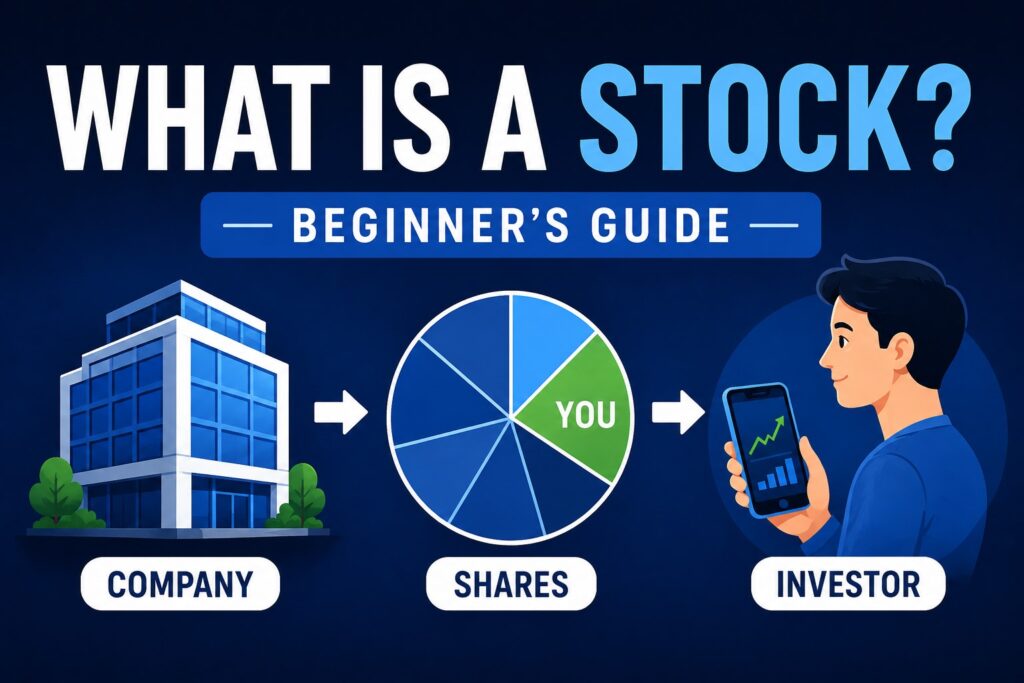
What Is a Stock? A stock represents partial ownership in a company. When you buy shares, you are buying an economic interest in a real business—not simply a ticker symbol whose price moves up and down.
That definition is straightforward. The harder part is understanding what stock ownership means for an investor.
A $20 stock is not necessarily cheaper than a $200 stock. A profitable company does not automatically have an attractive stock. Even strong earnings do not guarantee that the share price will rise, because market prices also reflect what investors expected before the results were announced.
Understanding what a stock is requires more than knowing that it represents ownership. This guide explains how stock ownership works, how shareholders can earn returns, why stock prices change, and how beginners can separate a company’s business quality from the price of its stock.
What Is a Stock?
A stock represents an ownership interest in a company. Public companies can issue shares to raise capital for purposes such as expanding operations, developing products, making investments, or strengthening their financial position.
A simple way to think about it is this:
Buying a stock means buying a small ownership claim on a real business, not simply betting on a price moving up or down.
That distinction matters because evaluating an individual stock starts with understanding the business behind it rather than treating the stock as only a moving price.
What Is a Stock Owner? Understanding Shareholders
Owning a stock means you are a shareholder.
As a shareholder, your ownership is proportional to the number of shares you own. If you own a few shares of a large company, your ownership stake is very small, but you are still a part-owner of that business.
Common shares often carry voting rights, although voting rights can vary by share class. These rights allow shareholders to vote on certain corporate matters, although most individual investors buy stocks primarily because they want to participate in a company’s long-term growth.
Your ownership percentage depends on how many shares you own relative to the company’s total shares outstanding. For example, if a hypothetical company has 1 million shares outstanding and an investor owns 10,000 of them, that investor owns 1% of the company.
However, owning part of a successful business does not guarantee a positive investment return.
A company’s profits may grow while its stock price falls if investors had expected even stronger results or if the stock was already priced at an expensive valuation. This distinction between business performance and stock performance is one of the most important concepts for a new investor to understand.
Common Stock vs Preferred Stock
There are two main types of stock: common stock and preferred stock.
Common stock is the type of stock most often discussed when people refer to buying shares of a public company. It may include voting rights and offers the potential to participate in the company’s growth.
Preferred stock generally has different economic rights from common stock, often including priority for dividend payments. Its price behavior and return characteristics can also differ from common shares.
| Type of Stock | Main Feature | Common Use |
|---|---|---|
| Common Stock | Ownership with voting rights and growth potential | Long-term investing |
| Preferred Stock | Priority dividend payments and income focus | Income-oriented investing |
For an official beginner explanation of stocks, you can also review Investor.gov’s stock basics.
Why Stock Prices Move: Results vs. Expectations
Stock prices change as investors revise their expectations about a company’s future earnings, cash flows, growth, and risk.
This helps explain something that often confuses beginners: good news does not always make a stock rise, and bad news does not always make it fall.
Consider a hypothetical company expected to earn $2.00 per share. If it reports $2.20, that may look like strong news. But suppose investors had become optimistic before the announcement and were informally expecting something closer to $2.40. The official result can be good while still disappointing the expectations already reflected in the stock price.
The reverse can also happen. A company may report declining profits, but its stock could rise if investors had expected an even worse result.
Several forces can change those expectations:
- Earnings and guidance: Investors reassess future profitability.
- Interest rates: Changes in rates can affect borrowing costs and how investors value future cash flows.
- Economic conditions: Employment, inflation, consumer spending, and growth can affect company revenue and margins.
- Company developments: New products, management changes, competition, and regulation can alter the outlook.
- Investor sentiment: Fear or optimism can amplify short-term price movements.
This is why identifying a single cause for every daily price move can be misleading. A more useful question is: What changed relative to what investors previously expected?
Two Ways Investors Make Money From Stocks
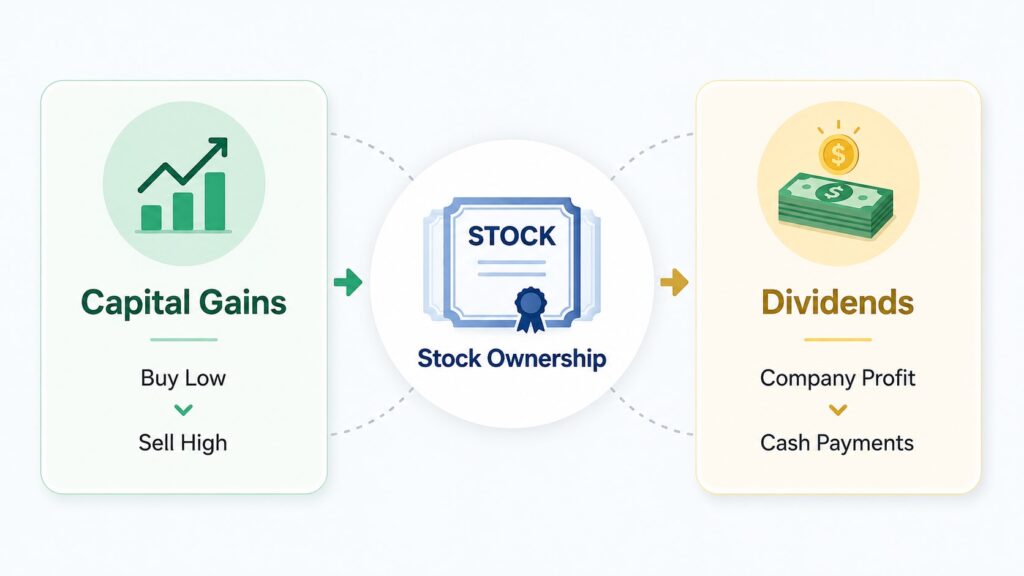
Investors generally earn returns from stocks through capital gains and dividends.
Capital Gains
A stock creates a capital gain when its value rises above the investor’s purchase price. If the investor sells the stock at that higher price, the gain is realized.
For example, if an investor buys a share for $50 and later sells it for $65, the difference is a $15 realized capital gain before considering taxes or transaction costs.
The reverse is also possible. If the stock is sold below the purchase price, the investor realizes a capital loss.
Stock prices can rise substantially when businesses grow and investors become willing to pay more for their future earnings, but capital gains are never guaranteed.
Dividends
A dividend is a payment that some companies distribute to shareholders.
Companies with consistent profits may choose to share a portion of those profits with investors through dividends.
Not all companies pay dividends. Some businesses prefer to reinvest profits into future growth opportunities instead.
The difference is simple:
- Capital gains result when an investment increases in value relative to its purchase price and may be realized when the shares are sold.
- Dividends are distributions that some companies pay to shareholders.
Some investors earn returns from both sources over time.
Taken together, price changes and dividends contribute to an investor’s total return. This is why looking only at a stock’s price change may not capture the full return an investor received over a period.
Potential Benefits and Risks of Owning Stocks
Stocks allow investors to participate in the potential growth of businesses. Returns can come from rising share prices, dividends, or both.
That opportunity comes with risk. A company’s earnings can weaken, competition can increase, debt can become difficult to manage, or investors may simply become less willing to pay a high valuation for the company’s future profits. In severe cases, shareholders can lose most or all of the money invested in an individual stock.
Unlike eligible bank deposits covered by deposit insurance, stock investments are not protected against market losses. The possibility of loss is part of owning an equity investment.
A Common Beginner Mistake: Confusing a Low Share Price With a Cheap Stock
A common beginner mistake is assuming that a stock with a lower share price is cheaper.
Imagine two hypothetical companies:
| Company A | Company B | |
|---|---|---|
| Share price | $20 | $200 |
| Shares outstanding | 1 billion | 50 million |
| Market capitalization | $20 billion | $10 billion |
Company A has the lower share price, but the market values the entire company at twice as much as Company B.
This happens because a share price tells you the price of one unit of ownership, not what the entire business is worth.
Even market capitalization does not tell you whether a stock is attractively valued. Investors may also compare the company’s valuation with its earnings, cash flow, growth prospects, financial position, and risks.
This creates an important distinction:
Share price tells you what one share costs. Valuation asks what investors are paying for the underlying business and its expected financial results.
A $20 stock can therefore be expensive, while a $200 stock can potentially be inexpensive relative to the businesses behind them. The share price alone cannot answer that question.
What Beginners Should Look At Before Buying a Stock
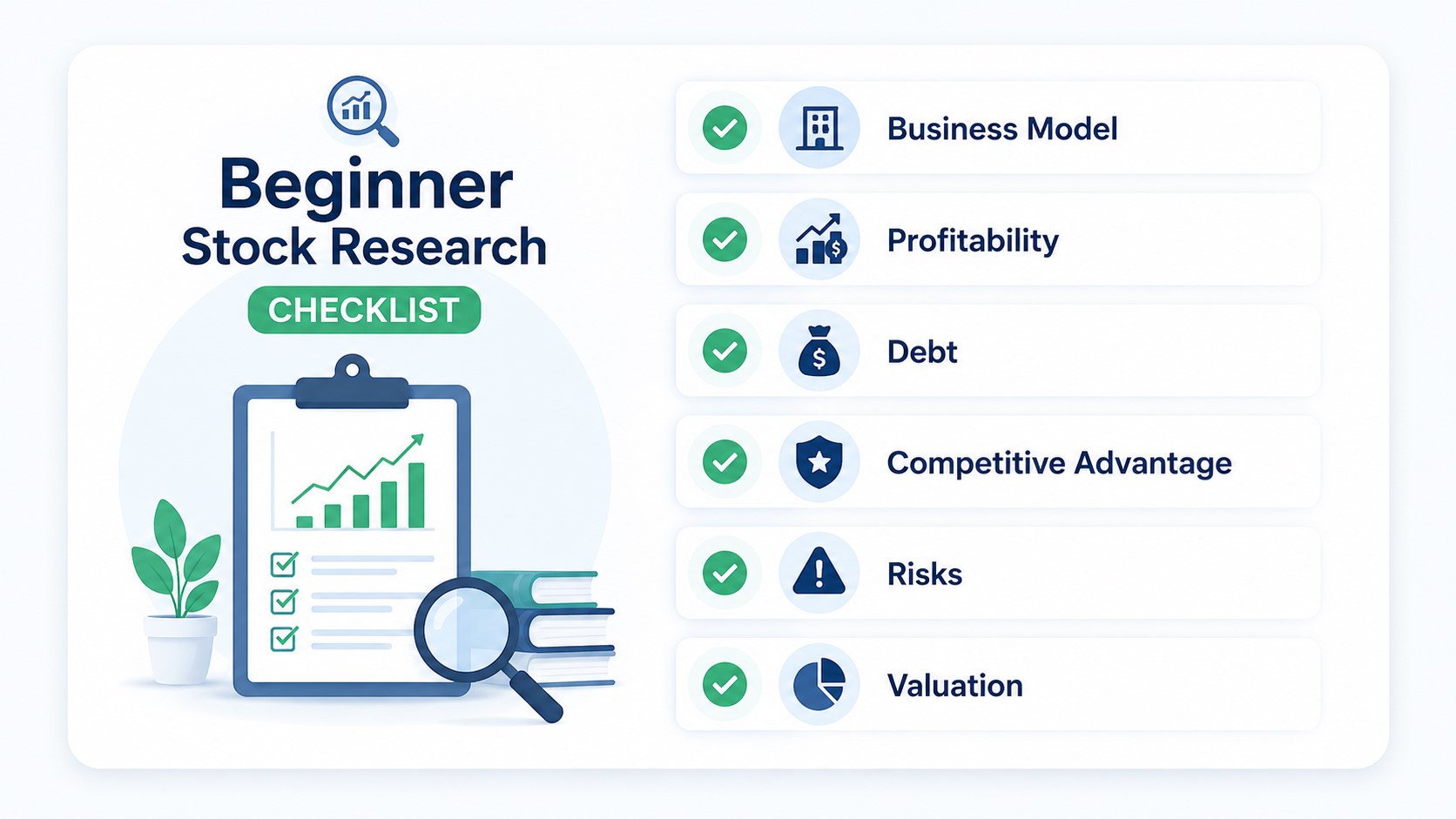
Before buying a stock, beginners should spend less time trying to predict tomorrow’s price and more time understanding what they are actually paying for.
A useful stock review does not require predicting every future revenue or earnings number. Instead, start with five questions about the business, its finances, competitive position, valuation, and the assumptions that could go wrong.
1. Understand How the Business Makes Money
Start with the business model.
Ask what the company sells, who its customers are, and how those customers generate revenue for the company. Some businesses earn money through direct product sales, while others rely on subscriptions, advertising, transaction fees, licensing, or a combination of several revenue sources.
The goal is not to understand every detail of the company immediately. A beginner should first be able to explain, in plain language, where the company’s money comes from.
If the business model is difficult to explain, more research may be necessary before evaluating the stock.
2. Check the Company’s Financial Health
Understanding the business is only the first step. Next, look at whether that business is producing healthy financial results.
Revenue shows how much money the company generates from its operations, while profit indicates what remains after relevant expenses. Cash flow adds another important perspective because accounting profit and actual cash generation are not always the same.
Debt also deserves attention. Borrowing is not automatically a problem, but a company with heavy debt may have less flexibility if profits weaken, interest costs rise, or economic conditions deteriorate.
Beginners do not need to analyze dozens of financial ratios at once. A more practical starting point is to ask:
- Is revenue growing, stable, or declining?
- Is the company profitable?
- Does it generate cash from its business?
- Is its debt manageable relative to its financial resources?
Looking at these numbers together provides more information than relying on a single metric.
If you want to examine these areas in more detail, my guide on How to Read Financial Statements explains how the income statement, balance sheet, and cash flow statement fit together.
3. Examine the Company’s Competitive Position
Good financial results today do not guarantee that they will continue.
The next question is why customers might continue choosing the company instead of its competitors.
A competitive advantage can come from several sources, including a strong brand, proprietary technology, network effects, switching costs, efficient operations, or economies of scale. The relevant advantage depends on the industry.
It is equally important to consider what could weaken that position.
A company may be profitable today but face aggressive competitors, technological change, lower-cost alternatives, or changing customer preferences. Understanding both the strength and the vulnerability of a company’s competitive position gives financial results more context.
Instead of simply asking, “Is this a good company?” ask:
Why does this company earn attractive returns today, and what could prevent it from doing so in the future?
4. Consider Valuation, Not Just Share Price
A strong business is not automatically an attractive investment at every price.
This is where valuation becomes important.
Valuation asks how much investors are paying for a company’s earnings, cash flow, assets, or expected future growth. Metrics such as the price-to-earnings ratio can help with this analysis, but no single valuation ratio provides a complete answer.
For example, two companies may have similar profits but trade at very different valuations. Investors might be willing to pay more for one company because they expect faster growth, more reliable earnings, or lower business risk.
That higher valuation also creates a question: How much future success is already reflected in the stock price?
This is why a falling stock price does not automatically create a bargain. A stock can fall and still remain expensive relative to its financial performance and future prospects. Likewise, a company with a high share price is not necessarily expensive simply because one share costs more.
Share price tells you the cost of one share. Valuation helps you think about the price investors are paying for the underlying business and its expected results.
5. Identify the Risks and Expectations Behind the Stock
Finally, ask what could make your view of the company wrong.
Every stock carries uncertainty. Competition may intensify. Demand may weaken. Costs may rise. Regulation may change. A heavily indebted company may struggle if financing becomes more expensive.
There is also another type of risk that beginners can overlook: expectation risk.
A company can perform well and still disappoint investors if its results fall short of what the market had already expected. When a stock trades at a valuation that assumes rapid growth, even a modest slowdown can cause investors to reconsider how much they are willing to pay for it.
Instead of asking only, “What could go right?” consider three questions:
- What does the current investment case appear to assume?
- What evidence would support those assumptions?
- What development could prove them wrong?
This does not require predicting exactly where the stock will trade next month or next year. The purpose is to identify the conditions on which your interpretation depends.
Putting the Five Questions Together
These five areas work best when considered together.
A company can have an excellent business model but weak finances. It can have strong finances but face growing competition. It can be a high-quality company but trade at a valuation that already reflects very optimistic expectations.
That is why evaluating a stock should not depend on one attractive number or one recent price move.
A simple beginner framework is:
Business → Financials → Competitive Position → Valuation → Risks and Expectations
A beginner does not need to predict every future number correctly. The more useful goal is to understand why the investment case might make sense, what assumptions support it, and what evidence could change that conclusion.
Using Reliable Sources for Stock Research
Educational resources such as Investor.gov can help beginners understand how stocks and markets work. When researching a specific company, however, primary sources become especially important.
A company’s investor relations website can provide earnings releases, presentations, and annual reports. For U.S. public companies, filings available through the SEC’s EDGAR database can provide detailed information about a company’s financial results, business model, debt, and material risks.
Social media and financial commentary can help investors discover questions worth researching, but they should not replace the company’s filings and other primary evidence.
Final Thoughts
The basic answer to “What is a stock?” begins with ownership, but useful stock analysis goes further.
A stock connects four ideas: a business, its financial results, investor expectations, and the price investors are willing to pay for those results. A strong business can still be a disappointing investment if expectations and valuation are too high, while a falling share price does not automatically create a bargain.
For a beginner, the practical starting point is not predicting tomorrow’s price. It is learning to ask better questions: How does the company make money? Are its finances healthy? What assumptions are reflected in the valuation? What could cause those assumptions to change?
That framework turns the question “What is a stock?” from a definition into a foundation for analyzing stocks more carefully.
❓ FAQ
Q1. Can you lose all your money in a stock?
Yes, an individual stock can lose most or all of its value if the underlying company fails. Stock ownership offers potential upside, but shareholders also bear the risk that the business performs poorly.
Q2. Does a lower share price mean a stock is cheaper?
No. Share price tells you the price of one share, not whether the business is cheaply valued. Investors need additional information such as shares outstanding, earnings, cash flow, growth expectations, and risk to evaluate valuation.
📚 Related Articles
How to Read Financial Statements: A Simple and Powerful Beginner’s Guide
Fundamental Analysis for Beginner Investors: A Smart Guide to Better Stock Decisions
Interest Rates and the Stock Market: A Beginner’s Practical Guide
Inflation and Stock Investing: A Smart and Essential Beginner’s Guide

High Interest Rates and the Economy: Why Can Growth Stay Strong?
If high interest rates are supposed to slow the economy, why can consumers keep spending,…

Can AI Become a Monopoly? Where the Real Economic Moats Are
Artificial intelligence appears to have many ingredients that could produce powerful monopolies. Training frontier models…

Can Big Tech Maintain Its Profit Margins in the AI Era?
Artificial intelligence is creating new revenue opportunities for Big Tech, but it is also changing…
Disclaimer: This article is for educational and informational purposes only and does not constitute personalized investment advice or a recommendation to buy or sell any security. Investing involves risk, including the possible loss of principal.
Pingback: How to Read Financial Statements: A Simple and Powerful Beginner's Guide
Pingback: Fundamental Analysis for Beginner Investors: A Smart Guide to Better Stock Decisions