
AI vs IT is often framed as a comparison between two generations of computing technology.
Both eras are built around software, data, semiconductors, and global networks. The internet connected people and information, while artificial intelligence adds a new layer capable of generating text, images, code, analysis, and decisions.
But similar technologies do not always produce the same business economics.
The more useful question is this:
What if AI looks like software to the user but behaves like a capital-intensive industrial system underneath?
That possibility became clearer to me while comparing recent Big Tech earnings presentations with their cash-flow statements.
Discussions about AI no longer focus only on model quality, product launches, or user growth. Management teams increasingly spend time explaining capital expenditure, server capacity, data-center construction, power availability, depreciation, and infrastructure constraints.
The numbers show why this matters.
Alphabet reported $91.4 billion in capital expenditure for 2025, up from the approximately $75 billion it had expected at the beginning of the year. The vast majority was invested in technical infrastructure, including servers, data centers, and networking equipment.
Meta’s 2025 full-year results showed $72.22 billion in capital expenditures, including principal payments on finance leases. According to Microsoft’s fiscal 2026 first-quarter earnings materials, the company also reported $34.9 billion in capital expenditures, driven by growing demand for its cloud and AI offerings.
These companies use different reporting periods and accounting definitions, so their figures should not be added together as though they were directly comparable.
Still, the direction is clear.
AI growth requires a level of physical investment that traditional software investors could once treat as a secondary issue.
This does not mean AI lacks economic value. AI may eventually create enormous productivity gains and highly profitable businesses.
But the winners, margins, and competitive advantages may look very different from those of the traditional software era.
Why AI Is Not Simply the Next Internet
Major technological revolutions rarely repeat the economic structure of the revolution that came before them.
Consider the shift from coal and steam power to oil and electricity. Each system powered factories, transportation, and economic growth. Yet each required different infrastructure, favored different resources, and shifted strategic power toward new industries and regions.
A new general-purpose technology can change more than the products people use. It can also change:
- where companies must invest,
- which resources become scarce,
- who carries the operating costs,
- and which part of the supply chain captures the profits.
AI may create a similar shift.
The internet era rewarded software platforms, search engines, digital advertising networks, e-commerce companies, and smartphone ecosystems.
AI still depends on many of those systems, but it adds a continuously operating layer of computation behind each user interaction.
That is the critical distinction.
The AI revolution may be built around digital products, but its physical foundation includes chips, servers, cooling equipment, electrical substations, fiber connections, and large data centers.
Why Traditional Software Had Such Powerful Economics
To understand the difference between AI and IT, it helps to begin with marginal cost.
Marginal cost is the additional cost of serving one more customer or producing one more unit.
Imagine that Microsoft develops a version of Windows or Adobe builds a professional design application. Creating the software requires engineers, research, testing, marketing, and years of investment.
Once the product is complete, however, distributing one more digital copy is relatively inexpensive.
The same principle applies to many messaging apps, SaaS subscriptions, digital media products, and productivity tools.
These businesses still pay for cloud hosting, cybersecurity, support, and continued development. Their costs are not literally zero.
But compared with a manufacturer that must buy more materials for every additional product, software distribution can have a very low marginal cost.
Users financed much of the IT infrastructure
The traditional IT model had another important advantage: customers purchased much of the equipment needed to use the product.
| Traditional IT requirement | Who usually paid? |
|---|---|
| Personal computer | User or employer |
| Smartphone | User or employer |
| Internet connection | User or employer |
| Local electricity | User or employer |
| Software development | Software provider |
When a customer opened Microsoft Word or edited a photograph, the software company did not need to buy that customer a new computer.
The user supplied the processor, screen, storage, internet connection, and electricity. Software companies could therefore serve additional users without financing the full physical computing burden of every interaction.
This helped create one of the most attractive characteristics of the software business model:
Revenue could grow much faster than the cost of distribution.
This difference in who pays for the underlying computing infrastructure is central to the AI vs IT comparison.
AI vs IT: The Core Economic Difference
Generative AI changes this relationship.
When a user asks an AI model to summarize a report, generate an image, analyze a spreadsheet, or write code, the request usually does not run entirely on the user’s device.
It is processed inside a data center operated by an AI company or cloud provider.
That means each meaningful interaction requires fresh computation.
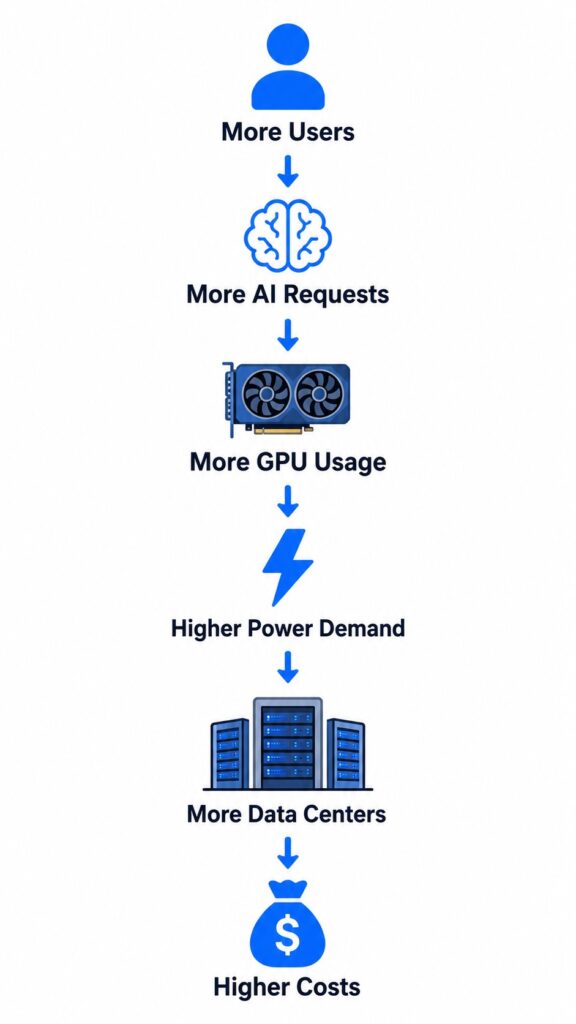
The cost chain looks like this:
More users
→ More inference requests
→ More accelerator usage
→ More electricity and cooling
→ More server and networking capacity
→ Higher operating and capital expenditure
A traditional software product can often be copied and distributed at very low additional cost.
An AI service must repeatedly perform work after the product has already been built.
That does not make AI unscalable. Large providers may gain significant efficiencies from better chips, higher utilization, optimized models, and improved software.
But the cost of serving another customer is no longer as easy to ignore.
Training and Inference Create Different Costs
AI spending is easier to understand when it is divided into training and inference.
Training is the process of creating or improving a model. It can require large upfront or periodic investment in specialized chips, engineering, data, and electricity.
Inference happens when customers use the model. Every answer, translation, image, summary, or analysis requires another computation.
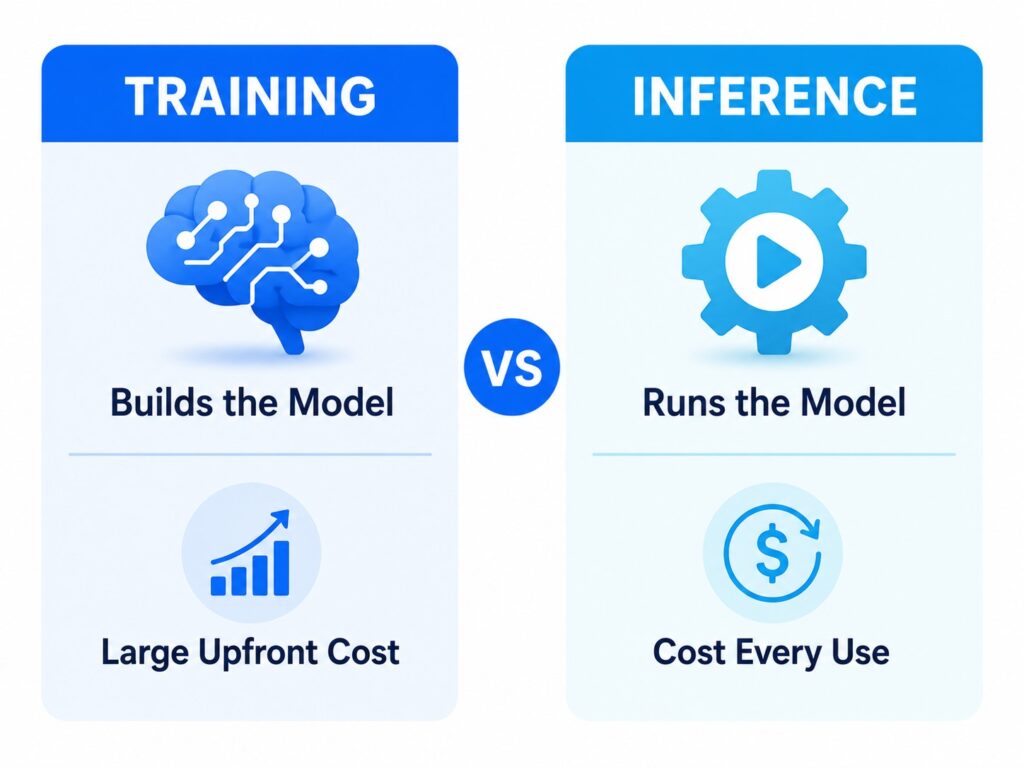
| Training | Inference |
|---|---|
| Builds or improves the model | Runs the model for customers |
| Upfront or periodic investment | Recurring usage-related cost |
| Creates capability | Delivers the service |
| Similar to building a factory | Similar to operating the factory |
The factory comparison is not perfect, but it captures the central point.
A company may complete an expensive training cycle and still face rising costs as usage expands.
A successful AI product does not necessarily end the spending cycle. In many cases, it begins a new one.
This is why user growth alone does not tell investors whether an AI product has an attractive business model.
Who Pays for the Computing?
The biggest difference between traditional software and AI is not intelligence—it’s who pays for the computation.
One of the clearest ways to understand AI vs IT is to ask who owns and finances the computing infrastructure.
| Traditional IT | AI |
|---|---|
| Users bought devices | Providers buy AI accelerators |
| Users paid local power costs | Providers pay data-center power costs |
| Software often ran locally | AI workloads often run remotely |
| Distribution was inexpensive | Each request consumes resources |
| Hardware costs were distributed | Infrastructure costs are concentrated |
AI companies will try to recover these costs through subscriptions, enterprise contracts, usage-based billing, advertising, premium features, and licensing.
An AI coding tool that saves a business many hours of labor may justify a high subscription price. An AI feature added to a free consumer app may be much harder to monetize.
Competition complicates the picture.
During an early market land grab, providers may offer free access or low prices to build adoption. If several models provide similar results, customers may switch easily or choose the cheapest option.
In that environment, a provider may experience rapid usage growth without gaining enough pricing power to cover the full cost of inference.
AI adoption can rise quickly while AI profitability remains uncertain.
Why AI Requires So Much Capital
A competitive AI platform requires more than a strong software team.
It needs access to a large physical system that includes:
- GPUs and other AI accelerators,
- servers and storage,
- high-speed networking,
- data-center buildings,
- electricity supply,
- grid connections,
- backup power,
- cooling systems,
- security and maintenance,
- and frequent hardware upgrades.
Electricity is becoming an especially important constraint.
The International Energy Agency reported that data centers consumed about 415 terawatt-hours of electricity globally in 2024.
In its base-case projection, consumption could rise to around 945 terawatt-hours by 2030. The IEA identified AI as the most important driver of that growth, alongside continued demand for other digital services.
These figures are projections rather than guarantees, but they show why power generation and grid capacity are now part of the AI investment discussion.
Physical Life and Economic Life Are Not the Same
AI hardware introduces another challenge: technological obsolescence.
A chip can remain physically functional while becoming less attractive economically. New accelerators may offer better performance, memory capacity, or energy efficiency, reducing the cost of completing the same workload.
Older equipment may still be useful, but perhaps only for less demanding tasks or at lower returns.
This makes depreciation more than an accounting detail.
Infrastructure investment first appears as cash leaving the business. Its expense then affects later financial periods through depreciation.
At the same time, the company may need to invest again to expand capacity or remain competitive.
For that reason, I would not look at AI capital expenditure as a single headline number.
I would ask three questions:
- How much cash is being invested today?
- How much depreciation will appear in future periods?
- Is the new capacity producing enough revenue and cash flow to justify both?
High capital expenditure may show that management expects strong future demand.
But it is not automatically proof that the investment will produce attractive returns.
Why the Difference Matters for Investors
From an investment perspective, the AI vs IT distinction becomes most visible in capital expenditure, depreciation, margins, and free cash flow.
Traditional SaaS analysis often began with customer growth, recurring revenue, retention, and gross margin.
Those metrics remain useful, but they are not enough for every AI business.
When I review a company with a major AI strategy, I usually start with the cash-flow statement rather than the product presentation.
First, I compare operating cash flow with capital expenditure. This helps show how much cash remains after the company funds its infrastructure.
Next, I look at gross margin and operating margin. If AI usage is expanding rapidly but margins are falling, the company may be absorbing more of the computing cost than customers are paying for.
Finally, I read management’s discussion and financial footnotes for information about:
- depreciation,
- long-term purchase commitments,
- finance leases,
- infrastructure shortages,
- power availability,
- and dependence on external cloud or model providers.
The product demonstration may explain what the technology can do.
The financial statements show what it costs to deliver.
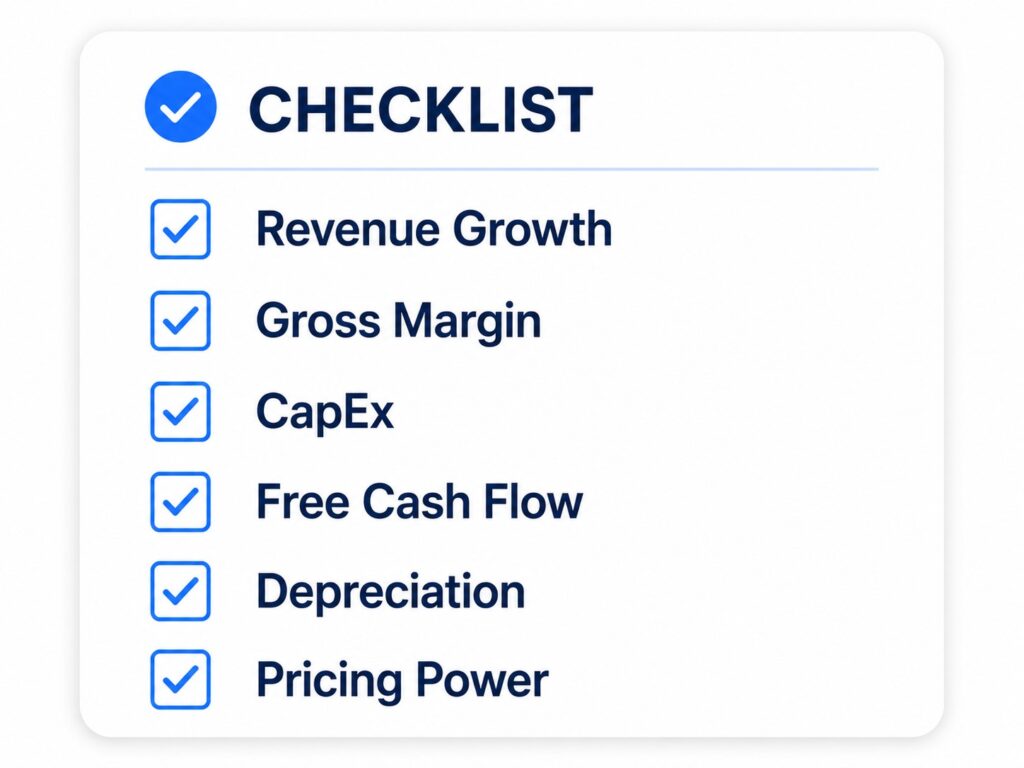
A practical AI business checklist
When evaluating an AI business, investors should look beyond user growth and product announcements. The following six indicators help show whether AI adoption is translating into sustainable financial performance.
Ownership also matters.
A company that operates its own infrastructure carries more capital expenditure but may gain greater control over cost and capacity.
A company that rents infrastructure avoids some upfront investment but may remain dependent on a cloud provider’s pricing.
The same applies to AI models.
Operating a proprietary model may create differentiation but requires significant investment. Using an outside model may reduce development costs but weaken pricing power and control.
A common mistake is to assume that the company with the fastest user growth must have the strongest AI business.
A fast-growing AI product may still struggle if the cost of serving additional users rises almost as quickly as revenue.
Who Could Capture the Value?
It is useful to divide the AI economy into three broad layers.
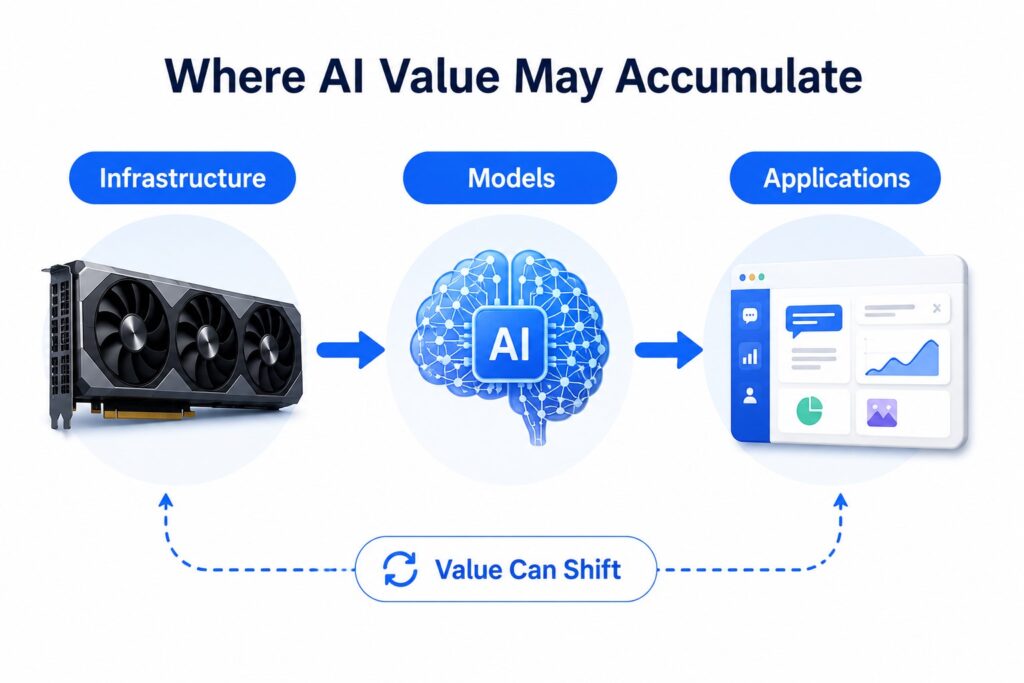
1. Infrastructure
This layer includes semiconductor suppliers, accelerator designers, cloud platforms, data-center operators, networking providers, cooling companies, and electricity-related businesses.
During the infrastructure buildout, suppliers that control scarce equipment or capacity may gain stronger bargaining power.
2. Models
Model providers transform computing capacity into general AI services.
Their main challenge is differentiation. If several models become good enough for the same tasks, competition may pressure prices even when overall demand remains strong.
3. Applications
Application companies use AI to solve specific customer problems in areas such as coding, design, research, healthcare administration, customer service, and financial analysis.
The most attractive applications may not be those with the most impressive demonstrations.
They may be the ones with:
- strong distribution,
- proprietary data,
- deep workflow integration,
- measurable customer value,
- and enough pricing power to cover their AI costs.
The highest revenue growth may appear in one layer while the strongest free cash flow appears in another.
During the infrastructure-building phase, suppliers may capture a larger share of the value. Later, platforms or applications that control customer relationships could gain more pricing power.
The mistake is assuming that the most visible AI brand must capture the largest share of the economic value.
AI Can Still Become Highly Profitable
A higher cost structure does not mean AI cannot become a profitable industry.
Capital-intensive businesses can create substantial value when their assets are productive, demand is durable, and pricing exceeds the cost of capital.
AI economics may also improve through:
- more efficient chips,
- smaller specialized models,
- model compression,
- better software optimization,
- improved data-center utilization,
- lower-cost electricity,
- stronger enterprise pricing,
- and higher customer willingness to pay.
A specialized model designed for one business process may be cheaper to operate than a large general-purpose model.
Cloud providers may also lower costs by scheduling workloads more efficiently, while enterprise applications may gain pricing power when they produce measurable labor savings or additional revenue.
The key question is not simply whether the cost of AI falls.
It is whether the value created per unit of computation rises faster than the full cost of providing it.
Efficiency May Increase Total AI Spending
This leads to the rebound effect, often associated with Jevons Paradox.
When a resource becomes cheaper or more efficient to use, people do not always consume less of it. Lower costs can encourage so much additional demand that total consumption continues to rise.
We can see a simple version of this in everyday AI workflows.
When an AI tool is slow, expensive, or separate from the software people already use, users may reserve it for occasional tasks.
As the tool becomes faster and is integrated into search engines, office software, coding environments, and customer-service systems, people find more uses for it.
A report that once required one AI request may involve several rounds of summarizing, checking, rewriting, and formatting.
The computation required for each individual task may decline while the total number of tasks rises even faster.
The IEA has similarly noted that data-center electricity demand can continue rising even as efficiency improves because AI adoption and the range of computational uses expand.
Efficiency and higher total spending can therefore exist at the same time.
Practical Investor Takeaway
When the AI investment story feels confusing, I use a simple three-step framework.
Start with demand
Is the product attracting paying customers, or mainly free users?
Rapid adoption matters, but the quality of demand matters more. A product used heavily without clear monetization may create costs faster than revenue.
Examine unit economics
Can revenue per customer comfortably exceed inference, cloud, support, and customer acquisition costs?
Strong user growth is less valuable when each additional customer adds little or no profit.
Check the infrastructure burden
How much ongoing capital expenditure and depreciation are required to support future growth?
A company can report strong operating profit while still spending heavily on servers, data centers, leases, and power infrastructure.
This framework is not a prediction about which company will win.
It is a way to avoid confusing technological importance with business profitability.
Final Thoughts
The AI vs IT comparison is not simply about two generations of software. It is about two different cost structures.
Traditional software companies could often add users without financing most of the hardware and electricity required to run their products.
AI providers carry a much larger share of that computing burden through accelerators, data centers, power, cooling, networking, and depreciation.
This does not mean AI cannot become highly profitable.
It means adoption alone is not enough to identify the winners.
The companies that create the most durable value may be those that can turn rising AI usage into pricing power, stable margins, and free cash flow after accounting for the full cost of computation.
That is the difference investors should keep in mind when comparing the AI era with the traditional IT era.
The next article in this series will explore that issue more closely:
The End of Zero Marginal Cost: Why AI Is More Expensive Than Software
Understanding AI starts with understanding its economics.
Once you understand who pays for computation, many of today’s debates about AI, infrastructure, and investment become much easier to interpret.
Sources
- Alphabet Investor Relations, 2025 fourth-quarter and full-year earnings materials
- Meta Platforms Investor Relations, 2025 fourth-quarter and full-year results
- Microsoft Investor Relations, fiscal 2026 first-quarter earnings materials
- International Energy Agency, Energy and AI
Related Reading

Stock Valuation Checklist: 7 Critical Checks Before Calling a Stock Cheap
A stock can look cheap because its price has fallen 40%, its P/E ratio is…
RSI Divergence vs MACD Crossover: Which Is More Reliable for Trading?
RSI divergence can warn that price momentum is weakening before a reversal becomes obvious. A…

Before You Buy the Dip: 5 Critical Balance Sheet Checks Every Investor Should Make
A stock that falls 20%, 30%, or even 50% can suddenly look cheap. But a…
Disclaimer: This article is for educational purposes only and should not be considered financial or investment advice. Always conduct your own research before making investment decisions.
Pingback: AI Marginal Cost Explained: Why AI Is More Expensive Than Software
Pingback: AI Electricity Demand: The Critical Power Constraint Investors Cannot Ignore