
Interest rates and the stock market are closely connected, but the relationship is not as simple as “rates up, stocks down” or “rates down, stocks up.”
That shortcut can help beginner investors understand the basic idea, but it can also lead to poor decisions when the market reacts differently from the textbook explanation.
A better way to think about interest rates is this:
Interest rates are the price of money.
When money becomes more expensive, companies borrow more carefully, consumers spend more cautiously, and investors demand better returns before taking risk. When money becomes cheaper, borrowing and investing can become easier, which may support stocks.
But the stock market does not only care whether interest rates are high or low. It also cares why rates are moving, what investors already expected, and whether corporate earnings can hold up in that environment.
This article explains how interest rates and the stock market are connected in plain English, with a practical routine beginner investors can actually use.
This article is for educational purposes only and is not investment advice.
Why Interest Rates and the Stock Market Are Connected
Interest rates and the stock market are connected because rates affect the basic environment for businesses, consumers, and investors.
When interest rates rise, money becomes more expensive. Companies may pay more to borrow, consumers may spend less, and investors may become more selective.
When interest rates fall, money becomes cheaper. Borrowing can become easier, liquidity may improve, and investors may become more willing to take risk.
However, the relationship is not automatic.
Stocks can rise during higher-rate periods if earnings are strong and the economy remains resilient. Stocks can also fall during lower-rate periods if investors worry about recession or weak earnings.
That is why beginners should not look at interest rates alone. They should ask why rates are moving and how the market is reacting.
How Higher Interest Rates Pressure Stocks
Higher interest rates can pressure the stock market because they make money more expensive.
When borrowing costs rise, companies may become more careful with expansion, consumers may reduce big purchases, and investors may demand better returns before taking stock market risk.
That pressure can show up through company borrowing costs, consumer spending, bond yields, and stock valuations.
Borrowing Costs Rise
Many companies borrow money to grow. They may borrow to build factories, develop new products, hire employees, buy inventory, or expand into new markets.
When interest rates rise, borrowing becomes more expensive. More money may go toward interest payments instead of growth, hiring, or profit.
This can be especially difficult for companies with high debt, weak cash flow, heavy expansion plans, or low current profits.
A strong company with stable cash flow may handle higher rates better. But a speculative growth company that depends heavily on future profits can feel pressure much faster.
Consumers Become More Careful
Higher interest rates also affect households.
Mortgages, car loans, credit cards, and personal loans can become more expensive. When consumers feel more pressure from debt payments, they may delay big purchases such as homes, cars, electronics, furniture, travel, or luxury goods.
That matters because consumer spending is a major part of the U.S. economy.
If investors expect consumers to spend less, they may also expect weaker company revenue. That can weigh on stock prices, especially in consumer discretionary sectors.
Bonds Become More Competitive
Stocks do not compete only with other stocks. They also compete with bonds.
When Treasury yields rise, investors may ask:
“Why should I take stock market risk if safer assets now offer a reasonable yield?”
This does not mean everyone sells stocks. But it changes the comparison.
When bond yields are low, investors may be willing to pay higher prices for stocks. When bond yields rise, the stock market has to work harder to justify high valuations.
This is especially important when stocks are already expensive.
Growth Stocks Become More Sensitive
Higher rates can also pressure stock valuations because investors place less value on profits expected far in the future.
That may sound technical, but the idea is simple.
A dollar expected many years from now looks less attractive when investors can earn more from safer assets today.
This is why growth stocks, technology stocks, and Nasdaq-related ETFs often react strongly when the U.S. 10-year Treasury yield rises.
QQQ, which tracks the Nasdaq-100, can be more rate-sensitive because it has heavy exposure to large growth and technology companies. SPY, which tracks the S&P 500, is more diversified across sectors such as technology, healthcare, financials, industrials, energy, and consumer staples.
This does not mean the S&P 500 is safe from interest rate pressure. It simply means sector composition matters.
What 2022 Taught Me About Interest Rates and the Stock Market
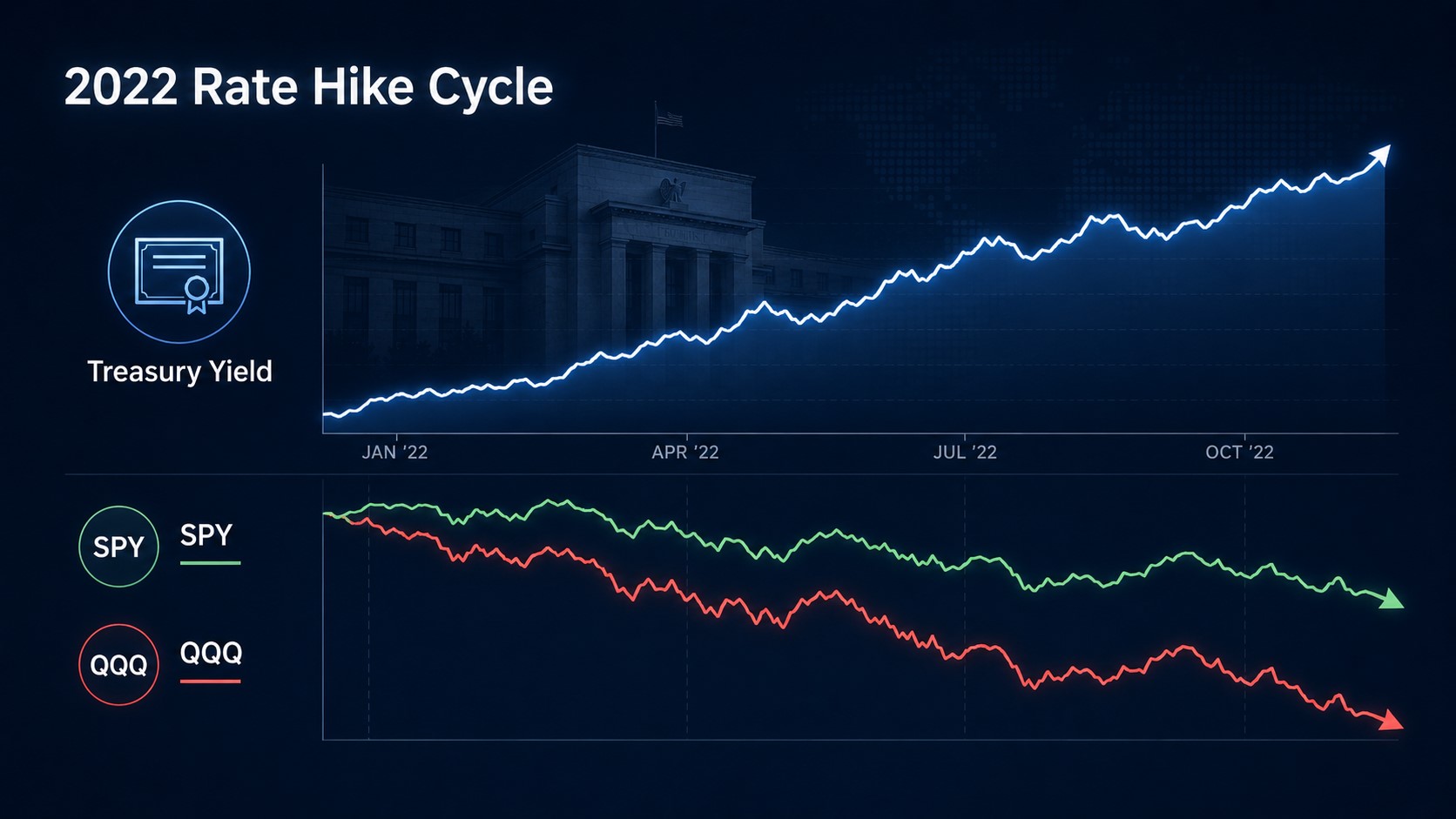
The 2022 rate-hike cycle was the moment when I stopped treating interest rates as a background macro topic.
Before that period, I understood the basic idea that higher rates could pressure stocks. But honestly, I did not fully respect how quickly valuation can change when Treasury yields rise.
At the time, many large technology companies still looked like strong businesses. Revenue was not suddenly disappearing. Products were still useful. The long-term growth story still sounded attractive.
But the market was not only judging business quality. It was repricing future earnings.
As the Federal Reserve moved away from the near-zero rate environment and the 10-year Treasury yield climbed, growth-heavy assets came under much heavier pressure. QQQ, which tracks the Nasdaq-100, fell much more sharply than SPY, which tracks the S&P 500.
That taught me an important lesson:
A good company can still be a bad entry point if the rate environment is working against its valuation.
For me, 2022 was a real reminder that valuation risk is not theoretical. When rates rise quickly, the market becomes less willing to pay high prices for profits that may arrive years later.
Since then, I do not look at growth stocks without checking the 10-year Treasury yield first. When I look at a growth stock, I do not only ask whether the company is good. I also check whether the 10-year Treasury yield is making investors less willing to pay for future growth.
That small habit has helped me avoid chasing growth stocks only because the story sounds exciting.
Why Falling Interest Rates Do Not Always Help Stocks
Falling interest rates can support stocks, but only under the right conditions.
Lower rates can reduce borrowing costs, improve liquidity, and make risk assets more attractive.
However, beginner investors should avoid one common mistake:
Lower rates are not always bullish.
The reason behind the rate cut matters.
If rates are falling because inflation is cooling and the economy is still stable, stocks may respond positively.
But if rates are falling because the economy is weakening sharply, investors may worry more about falling earnings than lower borrowing costs.
In that case, stocks can still struggle even when rates are going down.
This is why the relationship between interest rates and the stock market should never be reduced to one simple rule.
Why Market Expectations Matter
One of the biggest beginner mistakes is assuming stocks will automatically rise after the Federal Reserve cuts rates.
Markets are forward-looking.
That means investors often move before the actual event happens.
If investors already expect rate cuts, stock prices may rise before the official announcement. By the time the Fed cuts rates, some of the good news may already be priced in.
Sometimes stocks can even fall after a rate cut if investors believe the Fed is cutting because the economy is weakening.
The key lesson is simple:
The market does not only react to what happens. It reacts to what happens compared with expectations.
That is why beginners should watch market expectations, not just Fed decisions.
My Practical Screen Setup for Watching Rates
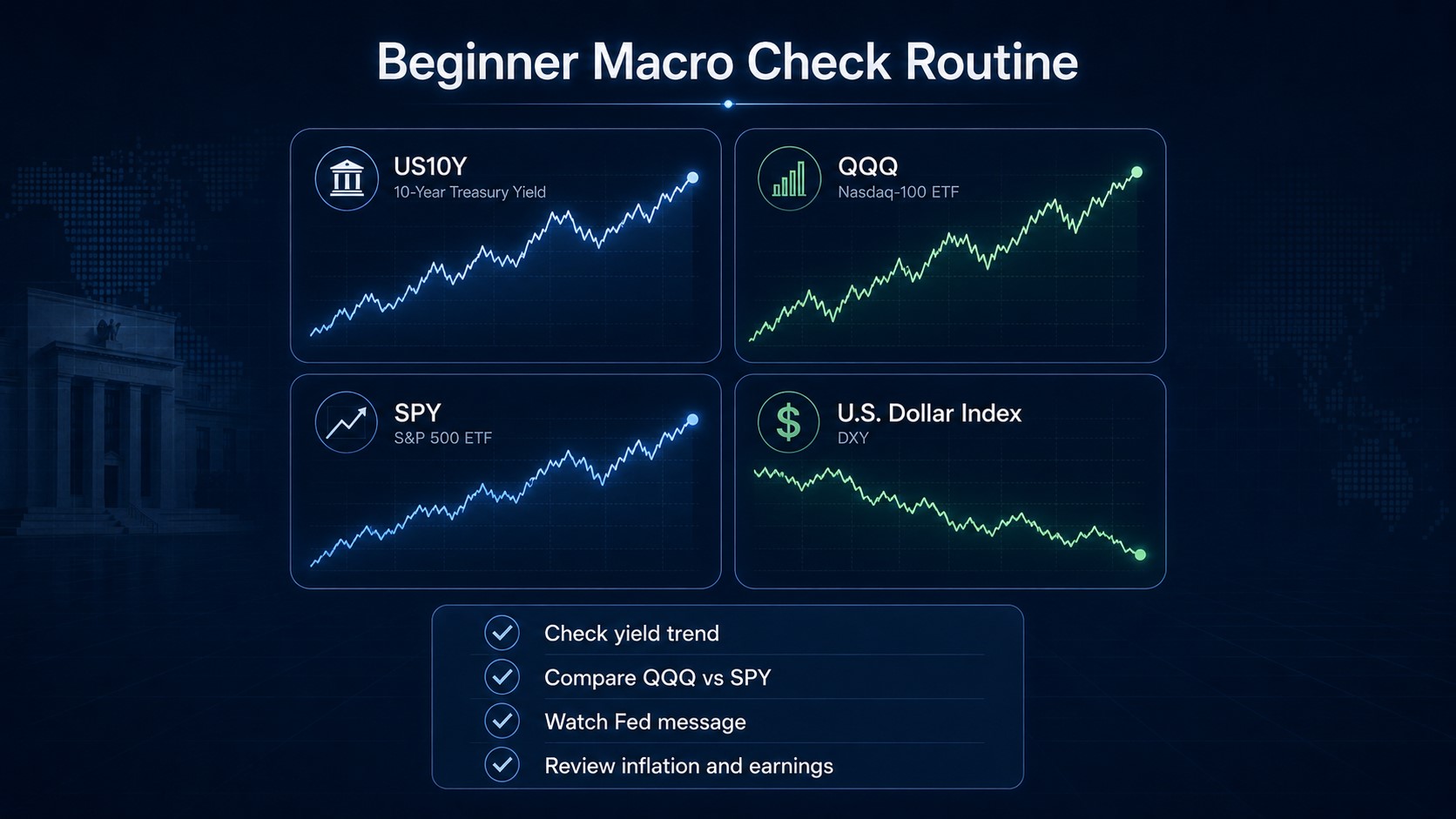
When I check the market, I usually do not start by reading every headline.
I first look at a simple chart setup. This helps me see whether the market is reacting to interest rates, earnings, the dollar, or something else.
My basic setup looks like this:
- Left side: U.S. 10-year Treasury yield, often shown as US10Y on chart platforms
- Right side: Nasdaq 100 or QQQ
- Below that: S&P 500 or SPY
- Separate tab: U.S. Dollar Index
This is not a complicated strategy. It is just a risk check.
For example, if US10Y is breaking higher and QQQ is weaker than SPY, I become more careful with growth stock ideas. I do not treat that as an automatic sell signal, but I do avoid aggressive entries.
On the other hand, if Treasury yields are falling, QQQ is stronger than SPY, and the dollar is not rising sharply, the market may be more comfortable with growth risk.
The key point is not to predict every move.
The point is to avoid buying growth stocks blindly when the bond market is already warning that valuation pressure may be rising.
This routine has become one of my simplest filters. Before I ask, “Is this stock attractive?” I first ask:
Is the interest rate environment helping or hurting this type of stock?
Practical Routine: How to Check Interest Rates Before Investing
Interest rates should not be used as a single buy-or-sell signal.
Instead, they should be part of a broader market checklist.
Here is a simple routine beginner investors can use.
Step 1: Check the 10-Year Treasury Yield
Start with the U.S. 10-year Treasury yield.
For the 10-year yield, I usually check the FRED 10-Year Treasury Yield because it gives a clean long-term view of how Treasury yields are moving.
Ask:
– Is it rising or falling?
– Is the move sudden or gradual?
– Is it near a recent high or low?
– Are growth stocks reacting strongly?
A sudden rise in the 10-year yield can pressure high-valuation growth stocks.
Step 2: Compare QQQ and SPY
Next, compare Nasdaq-related ETFs such as QQQ with S&P 500 ETFs such as SPY.
Ask:
- Is QQQ weaker than SPY while yields are rising?
- Is QQQ stronger than SPY while yields are falling?
- Is the market rewarding growth or becoming more defensive?
This comparison helps beginners see whether the market is reacting mainly to interest rates.
Step 3: Check the Federal Reserve Message
Look at whether the Fed is more focused on inflation or economic weakness.
For the Fed’s policy direction, I usually check the Federal Reserve monetary policy page instead of relying only on headlines.
Ask:
– Is the Fed still worried about inflation?
– Are rate cuts being discussed?
– Does the market expect more cuts than the Fed suggests?
The Fed’s message can change how investors interpret the same interest rate move.
Step 4: Review Inflation and Employment
Rates often move because investors are reacting to inflation and employment data.
For inflation, I usually check the BLS Consumer Price Index. For labor market trends, the BLS Employment Situation is a useful official source.
Ask:
– Is inflation cooling?
– Is the labor market still strong?
– Are wages rising too quickly?
– Is recession risk increasing?
If inflation stays high, the Fed may keep rates higher for longer. If employment weakens quickly, investors may start worrying about earnings.
Step 5: Check the U.S. Dollar
If U.S. yields rise and the dollar strengthens at the same time, risk assets may face additional pressure.
A strong dollar can matter for multinational companies, commodities, emerging markets, and liquidity-sensitive assets.
For beginners, the dollar is useful because it often shows whether global investors are becoming more cautious.
Step 6: Check Corporate Earnings
Even if rates move in a favorable direction, weak earnings can pressure stocks.
Ask:
- Are companies beating or missing expectations?
- Are profit margins improving or shrinking?
- Is earnings strength broad or concentrated in a few large companies?
Interest rates affect valuation, but earnings decide whether companies can justify their stock prices.
Common Beginner Mistakes About Interest Rates and Stocks
Beginner investors often make mistakes because they treat interest rates as a single simple signal.
Here are the most common mistakes to avoid.
Mistake 1: Thinking Lower Rates Always Mean Stocks Go Up
Lower rates can support stocks, but not always.
If rates are falling because the economy is weakening, earnings may decline. In that case, stocks may struggle even with lower rates.
Mistake 2: Ignoring Market Expectations
Markets often move before official Fed decisions.
If rate cuts are already expected, the market may have priced them in. Beginners often react to the headline too late.
Mistake 3: Treating All Stocks the Same
Growth stocks, value stocks, dividend stocks, and defensive stocks can react differently to rate changes.
A rate move that hurts high-growth technology stocks may not affect consumer staples, healthcare, or financials in the same way.
Mistake 4: Watching Only the Fed Rate
The Federal Reserve’s policy rate matters, but the 10-year Treasury yield often has a direct impact on stock valuations.
Beginner investors should watch both short-term Fed policy and long-term Treasury yields.
Mistake 5: Making Decisions From One Data Point
One inflation report, one jobs report, or one Fed speech should not become the entire basis for an investment decision.
Markets move based on trends, expectations, and changing probabilities.
A single data point may create volatility, but a trend changes the market narrative.
Practical Investor Takeaway
Interest rates and the stock market are connected because rates affect stocks through several channels.
They influence:
- Company borrowing costs
- Consumer spending
- Bond yield competition
- Stock valuation
- Investor risk appetite
- Corporate earnings expectations
- Liquidity conditions
Higher rates can pressure stocks, especially growth and technology stocks.
Lower rates can support stocks, especially if inflation is cooling and the economy remains stable.
But the relationship is not automatic.
A better framework is to ask:
- Why are rates moving?
- What did the market already expect?
- Which sectors are most sensitive?
- Are earnings strong enough?
- Is the dollar helping or hurting risk assets?
- Is liquidity improving or tightening?
That approach is much more useful than reacting emotionally to one headline.
Final Thoughts
Interest rates and the stock market have an important relationship, but interest rates should not be used alone.
For beginner investors, the goal is not to predict every Federal Reserve decision.
The goal is to understand how interest rates change the environment for stocks.
When rates rise, investors often become more selective. High valuations face more pressure, and future growth becomes more heavily discounted.
When rates fall, stocks may benefit from easier financial conditions, but only if rate cuts do not signal serious economic weakness.
Lower rates are not automatically bullish.
Higher rates are not automatically bearish.
Interest rates are a lens for understanding risk, valuation, liquidity, and market expectations.
They are not a magic signal.
❓ FAQ
Q1. How are interest rates and the stock market connected?
Interest rates and the stock market are connected because rates affect borrowing costs, Treasury yields, investor expectations, and stock valuations. Higher rates often pressure stocks, while lower rates may support stocks depending on the economic environment.
Q2. How do interest rates affect the stock market?
Interest rates affect the stock market by changing company borrowing costs, consumer spending, bond yields, investor risk appetite, and the valuation of future corporate earnings.
Q3. Why do technology stocks react strongly to interest rates?
Technology stocks often depend heavily on future growth expectations. When interest rates rise, the present value of future earnings may fall, which can pressure tech stock valuations. This is why Nasdaq and QQQ are often sensitive to changes in the 10-year Treasury yield.
Q4. Is the 10-year Treasury yield more important than the Fed rate?
Both matter. The Fed policy rate affects short-term borrowing conditions, while the 10-year Treasury yield influences long-term valuations, mortgage rates, corporate borrowing, and investor sentiment toward stocks.
Q5. Do stocks always rise when the Fed cuts rates?
No. Stocks may rise if rate cuts support growth and liquidity. But if the Fed cuts rates because the economy is weakening sharply, investors may worry about lower earnings, and stocks can still fall.
Q6. What should beginner investors watch besides interest rates?
Beginner investors should also watch inflation, employment data, the U.S. Dollar Index, corporate earnings, liquidity conditions, and market expectations. Interest rates are important, but they are only one part of the bigger picture.
📚 Related Articles
Inflation and Stock Investing: A Smart and Essential Beginner’s Guide
How to Read US CPI Data: What Every Investor Should Know
How U.S. Treasury Yields Affect Tech Stocks: A Smart and Powerful Beginner’s Guide
Why US Treasury Yields and Nasdaq Can Rise Together: A Powerful Beginner’s Guide

High Interest Rates and the Economy: Why Can Growth Stay Strong?
If high interest rates are supposed to slow the economy, why can consumers keep spending,…

Can AI Become a Monopoly? Where the Real Economic Moats Are
Artificial intelligence appears to have many ingredients that could produce powerful monopolies. Training frontier models…

Can Big Tech Maintain Its Profit Margins in the AI Era?
Artificial intelligence is creating new revenue opportunities for Big Tech, but it is also changing…
Disclaimer: This article is for educational purposes only. It is not financial advice or a recommendation to buy or sell any specific stock, ETF, cryptocurrency, or other asset. All investment decisions are your own responsibility.
Pingback: What Is a Stock? A Simple and Effective Beginner’s Guide
Pingback: What Is the Dollar Index? A Smart Beginner’s Guide to DXY and Global Markets
Pingback: Recession Signals: An Essential Beginner’s Guide to Reading the Economy and Stock Market
Pingback: How to Read US CPI Data: What Every Investor Should Know
Pingback: Why US Treasury Yields and Nasdaq Can Rise Together: A Powerful Beginner’s Guide
Pingback: Inflation and Stock Investing: A Smart and Essential Beginner’s Guide
Pingback: How U.S. Treasury Yields Affect Tech Stocks: A Smart and Powerful Beginner's Guide
Pingback: Fundamental Analysis for Beginner Investors: A Smart Guide to Better Stock Decisions
Pingback: How to Read Financial Statements: A Simple and Powerful Beginner's Guide